Plantee Innovations' 21-slide 2024 seed deck raises $1.4M ($0.4M already closed) for an all-in-one smart indoor greenhouse. It is unusually complete for a pre-revenue hardware deck: measured CAC, measured gross margin, a fully sourced bottom-up market model and dated use-of-funds milestones. The fatal gap is that the whole plan depends on cutting CAC from a measured $275 to a targeted $85, and the deck never shows how.
Key takeaways
- Plantee's 2024 seed deck asks for $1.4M with $0.4M already closed, and states both figures on the cover slide rather than the final slide.
- The deck publishes a measured Kickstarter CAC of $275 alongside a Q4/2025 target of $85, a 69% reduction with no stated mechanism.
- At today's numbers, Plantee's $510 net profit CLV against a $275 CAC is a 1.9:1 ratio; the 6:1 claimed in the deck depends entirely on the CAC target landing.
- The market slide derives a $30.7B TAM and $5.1B SAM bottom-up from 1,037M people through stated multipliers, with the full calculation and sources in the appendix.
- AGRO CS, a $168M-revenue CEE gardening supplies company, is the pre-seed investor and provides manufacturing facilities, sales data and distribution — de-risking the hardest part of consumer hardware.
- Planned spend of roughly $2.76M against a $1.4M raise and $1.7M of forecast revenue leaves no buffer for a manufacturing delay.
- The deck commits to seven country launches and three new products by mid-to-late 2025 on a $1M raise with headcount peaking at 15, which reads as focus risk.
- The transferable fix is a single CAC bridge slide: any deck that publishes a measured number next to a target must show the mechanism between them.
What this deck actually is
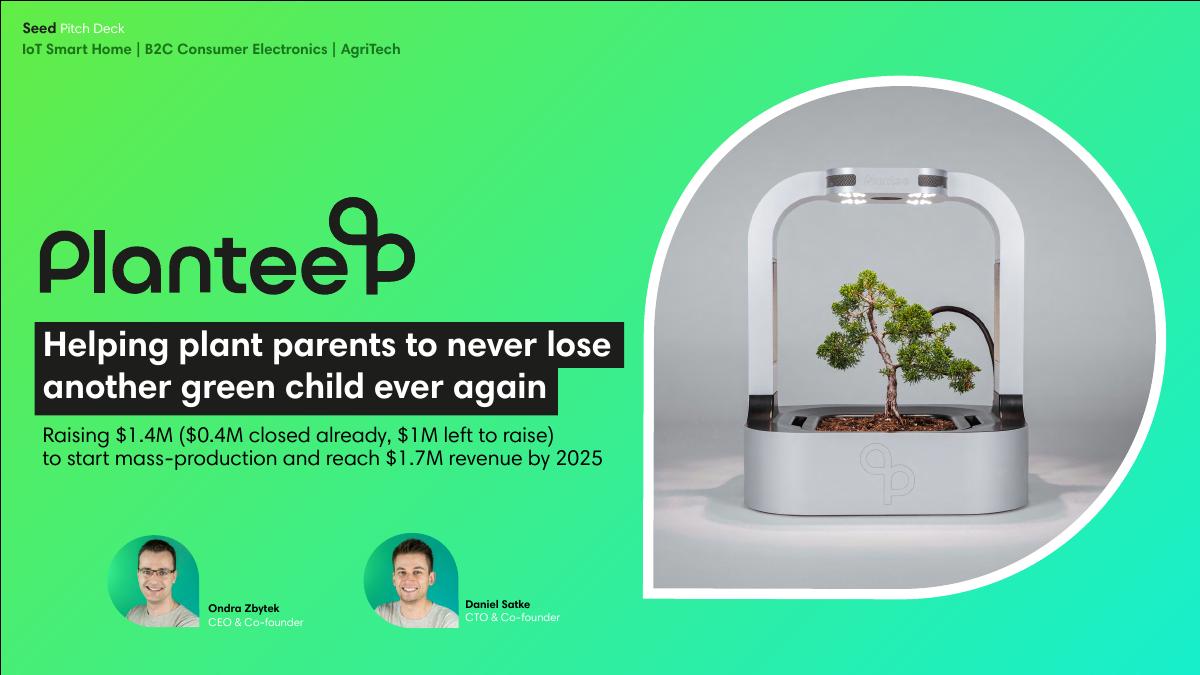
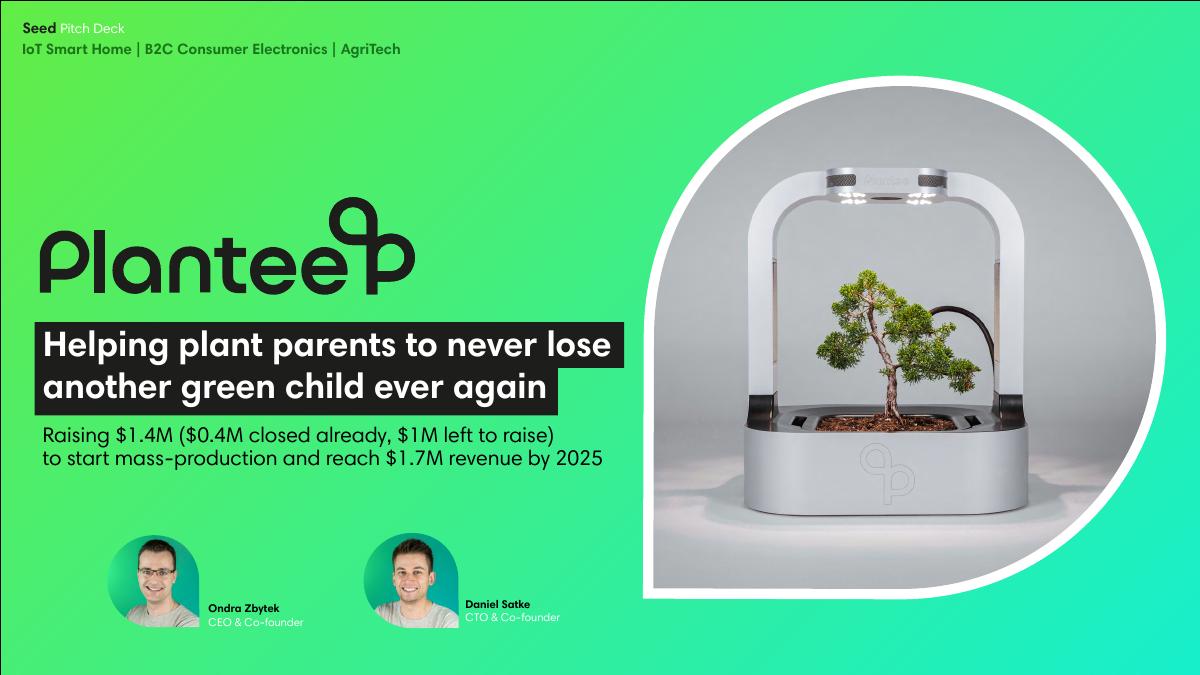
This is a real seed fundraising deck, not a company overview and not a recreation. The cover page says so in plain text: "Seed Pitch Deck", followed by three category labels — IoT Smart Home, B2C Consumer Electronics, AgriTech — and an ask stated before you have scrolled anywhere: "Raising $1.4M ($0.4M closed already, $1M left to raise) to start mass-production and reach $1.7M revenue by 2025."
Plantee Innovations is a Czech hardware startup building an all-in-one smart indoor greenhouse for houseplants. The deck is 21 pages: 19 pages of narrative and two appendix pages (a product roadmap and a full source list). The version analysed here is dated March 2024, which places it after a $102K Kickstarter campaign and before mass production.
What makes it worth a teardown is that it is one of the most complete pre-revenue hardware decks you will read. It has an ask, a use of funds, a three-half operating plan with headcount and cash on hand, measured CAC, measured gross margin, a named pre-seed investor, and a sourced bottom-up market model in the appendix. Most seed decks have two of those. This one has all of them.
It also has a problem that no amount of completeness fixes: the numbers the whole plan depends on are targets, and the deck asks you to fund the gap between the measured number and the target number without ever showing why the gap closes.
Slide-by-slide walkthrough
Slide 1 — Cover and the ask
The cover does four jobs at once: it categorises the company (IoT Smart Home | B2C Consumer Electronics | AgriTech), states the emotional promise ("Helping plant parents to never lose another green child ever again"), states the round ($1.4M, $0.4M closed, $1M left), and states what the money buys (mass production and $1.7M revenue by 2025). Both founders are named with roles.
Putting "$0.4M closed already" on the cover is the single highest-leverage line in the deck. It converts a cold ask into a round with momentum, and it does it before the investor has formed any opinion. Most founders bury this on slide 17. Plantee leads with it.
Slide 2 — Summary
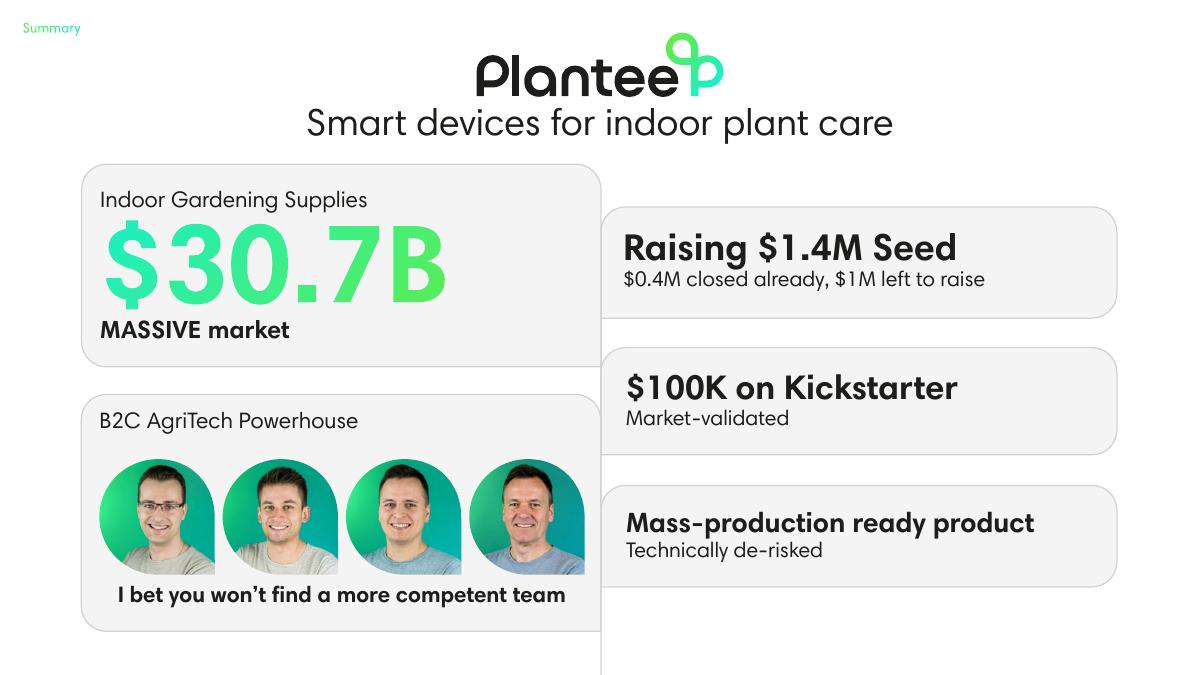
A one-page summary of the whole deck: $30.7B market, $1.4M seed with $0.4M closed, $100K raised on Kickstarter as market validation, a mass-production-ready product described as "technically de-risked", and the tagline "B2C AgriTech Powerhouse". It closes with a line that tells you a lot about the deck's voice: "I bet you won't find a more competent team."
The structure is correct — an investor who reads only this page knows the market, the raise, the validation and the risk position. The tone is the risk. Confidence in a summary slide is fine; a bet framed against the reader is a coin flip that can read as bravado to a partner who has seen 400 hardware decks this year.
Slide 3 — Team
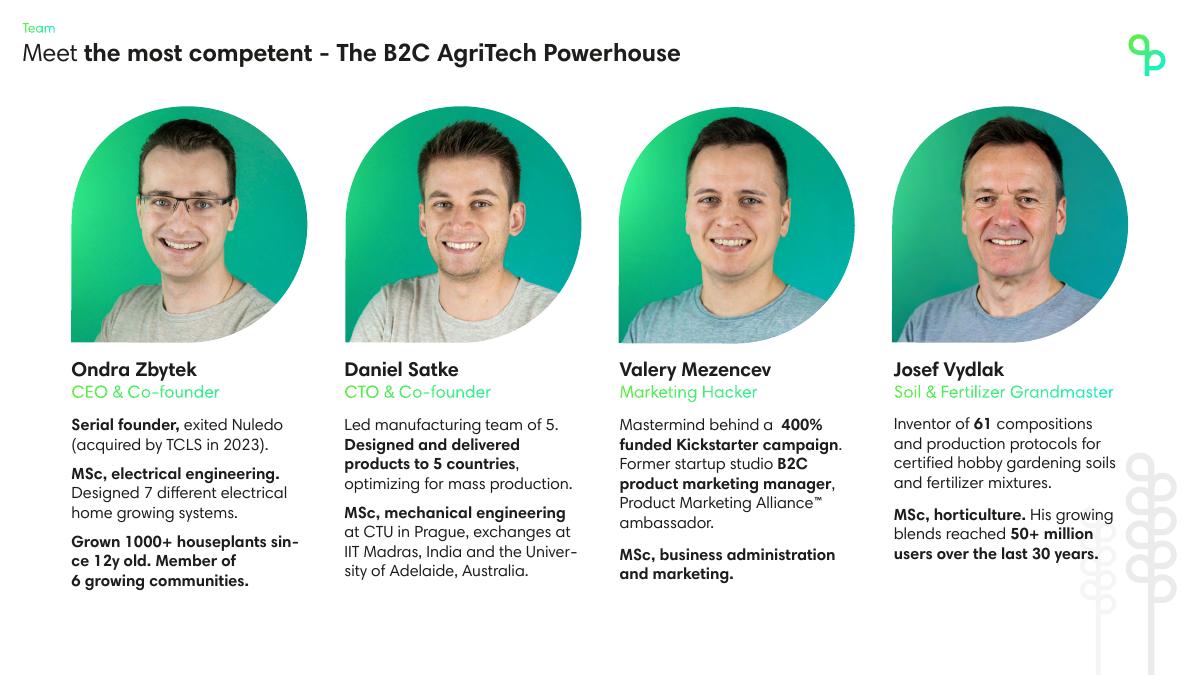
Four people, each with a specific and checkable credential. Ondra Zbytek, CEO: serial founder, exited Nuledo (acquired by TCLS in 2023), MSc electrical engineering, designed seven home growing systems, grown 1,000+ houseplants. Daniel Satke, CTO: led a manufacturing team of five, shipped products to five countries, MSc mechanical engineering at CTU Prague with an exchange at IIT Madras. Valery Mezencev, marketing: ran the 400%-funded Kickstarter, former startup-studio B2C product marketing manager. Josef Vydlak, soil and fertilizer: inventor of 61 soil and fertilizer compositions, MSc horticulture, blends reaching 50+ million users.
This is what a team slide should look like. Every claim is a fact with a number or a named entity attached, and the four skills map exactly onto the four risks of the business: electronics, manufacturing, consumer acquisition, and horticultural credibility. The prior exit is the strongest single line, because it is the only one that proves the CEO has finished something.
Slide 4 — Advisors and investors
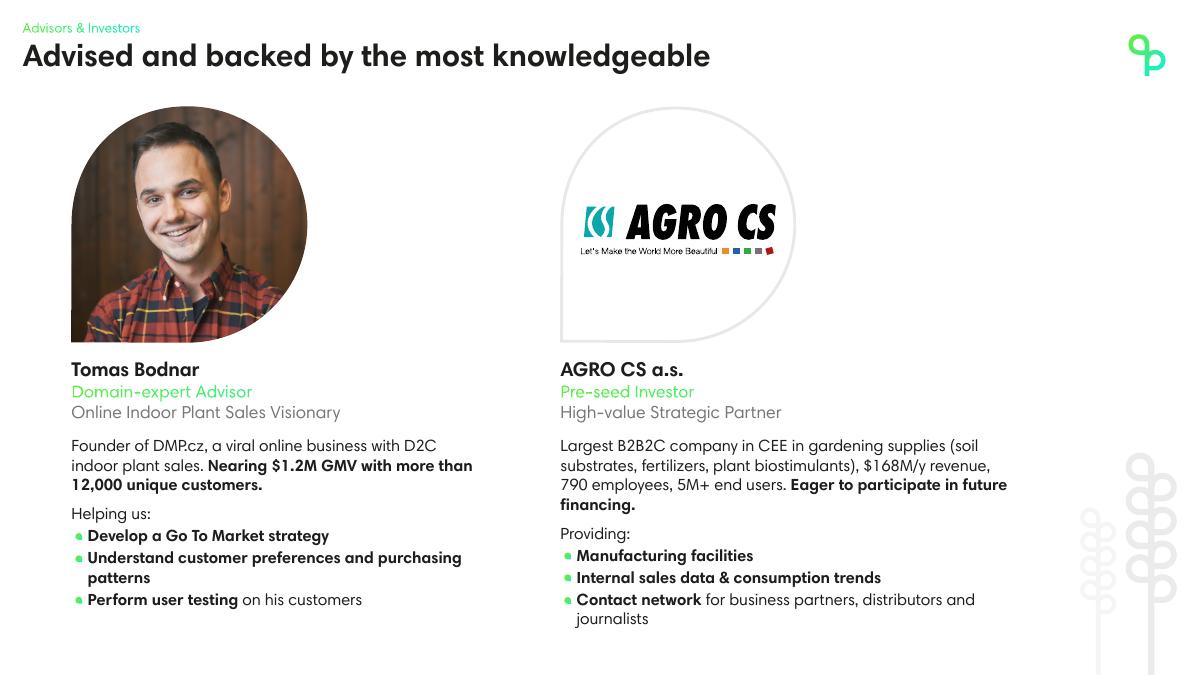
Two entries. Tomas Bodnar, founder of DMP.cz, a D2C indoor plant business nearing $1.2M GMV with 12,000+ customers, advising on go-to-market and running user tests on his own customer base. And AGRO CS a.s., the pre-seed investor: the largest B2B2C gardening supplies company in CEE, $168M annual revenue, 790 employees, 5M+ end users, providing manufacturing facilities, internal sales data and a distributor network, and described as "eager to participate in future financing".
A strategic investor who already wrote a cheque, owns manufacturing capacity in your category and signals follow-on intent is worth more than the cheque. This slide is doing de-risking work that no amount of founder assertion could do. It is placed at position four, which is right — it borrows credibility before the story starts.
Slide 5 — Intro: the origin
A full-bleed quote from the CEO: "It all started when my good friend died." The friend is a plant. It is a deliberate double-take, and it earns the emotional register the rest of the deck uses ("green child", "plant parents", "plant killer").
Founder-origin slides are usually filler. This one works because it is doing category work: it establishes that houseplant owners have a relationship with the object, which is the entire premise of a $999 consumer device. If the reader does not accept that premise, nothing later in the deck holds.
Slide 6 — Intro: not alone
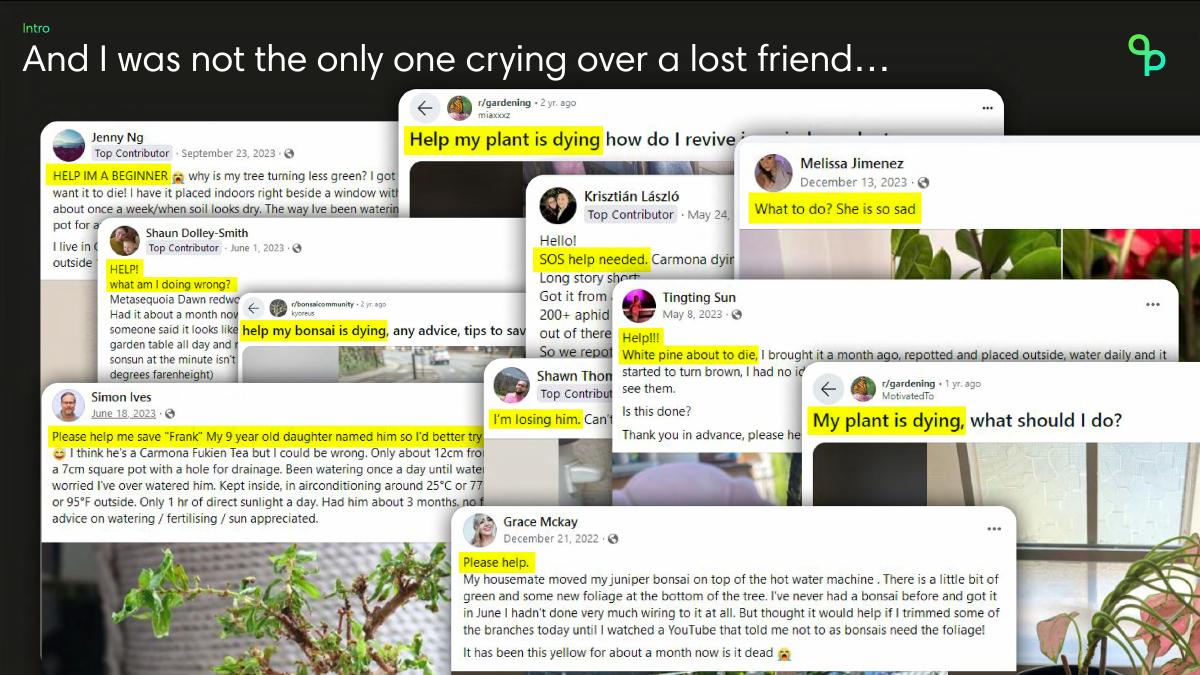
A visual page establishing that the founder's experience is widespread — "And I was not the only one crying over a lost friend…". It is the bridge from anecdote to market, and it is one page of pure setup.
In a 21-page deck this is affordable. In a 12-page deck it would be the first cut, because slide 7 makes the same point with data.
Slide 7 — Problem
The headline stat: 73% of home growers kill multiple houseplants every year due to mistreatment. Four consequences follow: $9.7B in annual economic loss in the US alone, waste from dead plants and soil, stress affecting grower mental health, and worsening indoor air quality. Sources are flagged to the appendix.
The quantified problem is strong and the sourcing discipline is unusual for a seed deck. The vulnerability is that three of the four consequences are societal, not personal — waste, air quality and aggregate economic loss are not what makes Michael reach for a credit card. The one that converts is the emotional cost, and it gets equal weight with the other three rather than dominating.
Slide 8 — Solution
"A smart device delivering consistent and appropriate care for houseplants", connected to an AI-powered database of ideal growing conditions for every plant. Six functions are listed as icons: watering, lighting, fertilization, plant heating, soil heating, air humidification.
The six-function grid is the clearest slide in the deck. It tells a hardware-literate investor exactly what is inside the box, and it justifies the price point better than any adjective could — six actuated systems is a real bill of materials, not a sensor in a pot. The "AI powered database" phrase is the weak element; it is a lookup table of growing conditions until proven otherwise, and calling it AI invites a question the deck does not answer.
Slide 9 — Flagship product
The all-in-one smart indoor greenhouse, presented in three blocks. Customer demand quotes ("your solution seems exactly what I need to grow epiphytic orchids at home", "I've identified myself as a definite plant killer for years"). Product uniqueness: uses any soil substrate, grows all plants, "greenhouse without glass", ideal conditions via planteebase.com. And a business block: rapid prototyping techniques that make the design easily iterable, and proprietary electronics described as "big MOAT and easily transferable to new modular products".
The "business point of view" block is the sophisticated move here — it translates product features into investor language (iteration speed, defensibility, platform reuse) on the same page as the product. Two repeated phrases undercut it: "Ask us how it works!" appears twice in the deck. Curiosity gaps work in a live pitch and fail in a deck that gets forwarded without you in the room.
Slide 10 — Competition
A two-by-two positioning map: hard to grow versus easy to grow on one axis, grows all plants (including bonsais and houseplants) versus narrower on the other. Competitors are plotted with their funding history attached — a pre-seed player at $0.36M raised in 2021, a seed player at $3.3M in 2023, a Series A player at $11.6M in 2021, and one at $55M. Plantee sits in the "grows all plants and easy to grow" quadrant.
Annotating a competitive map with each competitor's raised capital is a genuinely good idea, and I rarely see it. It tells the investor the category is funded (validation) and how much runway the incumbents have (risk), in the same glance. What is missing is price, install base and retention — a competitor with $55M raised is not beaten by axis placement, and the deck does not say what happens when they add the missing quadrant.
Slide 11 — Traction
The densest slide. $102K raised on Kickstarter at 400% funded. A mass-production-ready product built and tested, described as technically de-risked. 8,000 future customers in a private Facebook group and a 10,000-person mailing list waiting for release. iOS and Android apps published. A registered trademark. And two measured unit-economics figures: Kickstarter CAC of $275 against a Q4/2025 target of $85, and small-batch gross margin of 34% against a Q3/2025 target of 51%.
Publishing a measured CAC of $275 next to a target of $85 is honest to a degree that most decks never attempt, and it is also the slide that will generate every hard question in the meeting. A 69% reduction in blended CAC is not a normal efficiency gain; it is a different acquisition model. The deck states the target three times and never states the mechanism.
Slide 12 — Target customer
"Michael, our beloved plant killer": serial plant killer who lost seven houseplants in the last year (against a stat that the average millennial kills seven), home-office high-income worker (44% growth in remote work over five years), started gardening during COVID (18% rise in indoor growing), suffers negative emotions connected to gardening failures, tech-loving IT professional in London whose plants suffer without sufficient sunlight. A side note observes that smart kitchen gardens boomed over three years "but none of them will help Michael".
Every attribute of the persona is backed by a cited statistic rather than invention, and the London detail does real work — low winter light is why the product needs a lighting system, so the persona and the bill of materials agree. The unstated question is whether the emotionally distressed plant killer and the person who spends $999 on a device are the same human being.
Slide 13 — Market size
A proper TAM/SAM/SOM cascade with the arithmetic exposed. TAM: 258M indoor growers, $30.7B market growing at 6.6% CAGR. SAM: 42.6M plant killers, $5.1B. SOM: 10% capture, $0.5B in five years. The logic chain is spelled out — 258M hobby growers in the developed world, 33% with high income, Wi-Fi, a smartphone and a mild-to-cold climate, 50% of those regularly neglecting plants. The appendix shows the full derivation: 1,037M people across the USA, Europe, Japan, South Korea and Singapore, 25% growing houseplants, $119 average annual spend. A competition note argues smart gardens address only kitchen herbs while ornamental houseplants are 13.5x as popular, and 70% of growers grow in the living room versus 47% in the kitchen.
This is the best market slide in any teardown on this site. It is bottom-up, every multiplier is stated, and the sources are listed in the appendix so a diligence analyst can rebuild it. The one number that will not survive scrutiny is the SOM: 10% of the serviceable market in five years, for a hardware startup that has not shipped a mass-production unit, is an assertion rather than a plan.
Slide 14 — Go to market
Spend is allocated across three channels. Inbound at 50%: plant-care blogs and videos positioning the product as the solution, plus planteebase.com as a growing-conditions database capturing search demand, plus SEO. Outbound at 40%: PR (15% of customers came from PR already), influencers who have already requested review units, mall store windows exploiting the fact that the device emits light, and social ads. Guerrilla at 10%: answering gardening questions on Facebook, Reddit and Quora. The slide closes with the blended CAC pair: $275 measured in Q1/2024, $85 targeted for Q4/2025.
The channel mix is thoughtful and cheap-first, and the mall-window insight is the kind of physical-product detail that only comes from having handled the object. But the arithmetic does not connect: a 69% CAC reduction is placed on the same slide as a plan that is 50% content marketing, without a stated payback period, a conversion rate, or a content-to-sale lag. Content compounding is a plausible answer; it is not written down.
Slide 15 — Pricing and unit economics
Hardware and accessories are one-off: Plantee at $999 with 51% gross margin, described as price-validated on Kickstarter; Extenders at $199 with 74% margin; accessories at $220 lifetime with 46% margin. A subscription at $15/month covers an on-call gardener, remote data evaluation and an extended three-year warranty, with an assumption that every fifth customer subscribes and holds for three years. Distribution is 80% own e-shop, 20% marketplaces. Net profit CLV is stated at $510, with manufacturing yield and warranty claims included.
Including yield and warranty in the margin calculation is a hardware-founder detail that signals real operating knowledge — most decks quote a BOM-only margin and get eaten alive in diligence. The problem is the comparison the deck invites: CLV of $510 against a measured CAC of $275 is a 1.9:1 ratio today. The 6:1 the deck claims later depends on CAC falling to $85, so the entire unit-economics argument rests on the one number that is a target rather than a measurement.
Slide 16 — Big vision
Beyond Michael: an ecosystem of smart products (pots, greenhouses, sensors), accessories (plants, seeds, soils, fertilizers, biostimulants, plant protection), and services (AI gardener, sensor data analysis, plant and seed marketplace). Plus the B2B office plant-care market, market leadership in indoor gardening across the US, CA, EU, UK, AU, JP and KR, and profitable $0.5B revenue by 2029.
The ecosystem logic is coherent because it reuses the same electronics and the same customer, which is exactly what slide 9 claimed the proprietary electronics would allow. The $0.5B-by-2029 figure is the weak point: it appears with no bridge from the $1.7M 2025 plan, and an unbridged 300x is easier to dismiss than a smaller number with a path.
Slide 17 — Ask and use of funds
$1.4M with $0.4M closed and $1M remaining. The money buys: $1.7M revenue in 2025 through 1,675 units plus accessories; CAC reduction from $275 to $85 for a 6:1 CLV:CAC by 12/2025; shipping to EU and UK by 06/2024, US and Canada by 01/2025, Japan, Korea and Australia by 06/2025; unit-economics improvement via a 25% BOM cost reduction by 05/2025 and assembly time cut from 3.5h to 2h per unit by 11/2025; and discovery, development and validation of three new products by 11/2025.
Every use of funds is a dated, measurable milestone rather than a spend category — this is how the slide should be written, and it is rare. The concern is load: five workstreams including three new products and seven new country launches, on $1M, with a headcount that peaks at 15. An investor reads that as focus risk.
Slide 18 — Operating plan
A three-period table (H2 2024, H1 2025, H2 2025). Revenue: hardware $52K → $350K → $1.2M ($1.6M, 94% of total); accessories $2.5K → $16K → $56K (4.4%); subscription $240 → $4.3K → $18K (1.4%); total $55K → $370K → $1.3M = $1.7M. Costs: marketing $570K (20%), manufacturing $1.3M (48%), R&D $440K (16%), admin and ops $450K (16%). Operating metrics by end of period: CAC $220 → $140 → $85; BOM $562 → $422 → $422; assembly time 3h → 2.4h → 2h; headcount 11 → 11 → 15; cash on hand $820K → $300K → $300K. Break-even is marked at 08/2025, with a note projecting $23M revenue in 2026.
Showing cash on hand at the end of each period is the mark of a founder who has run a company — it tells the investor when the next round is needed without making them build the model. Two things will get challenged. First, the cost lines total roughly $2.76M against a $1.4M raise and $1.7M of revenue, so the plan is self-funding from gross margin mid-flight with no buffer. Second, $1.3M in 2025 becoming $23M in 2026 is a 13x jump asserted in a footnote.
Slide 19 — Closing
"Growing plants indoors is hard, let's make it easy for everyone!" with the CEO's email, name and the plant.ee domain, alongside a cap-table-style visual showing CEO, CTO, pre-seed investor and an empty slot labelled "You?" for the seed investor.
The empty seat graphic is a good closing device — it makes the reader's role concrete instead of asking for a meeting. Only the CEO's contact details appear, which is fine for a two-founder company.
Slide 20 — Appendix: products under development
Four modular products sharing the same app and electronics: smart light for plants at $249, smart soil measurement module at $129, smart pot at $189, smart watering station at $199. Followed once more by "Ask us how they work and for whom they are intended!"
The price ladder answers the objection that $999 is too high an entry point — there are $129 and $189 doors into the ecosystem. That makes it strategically important enough that it arguably belongs in the main deck rather than the appendix.
Slide 21 — Appendix: sources
A full bibliography grouped by claim area — problem statistics, market size (top-down markets and the complete bottom-up calculation), and target customer research. The bottom-up chain is written out in full: 1,037M people in the relevant developed markets, 25% houseplant hobbyists = 258M, times $119 average annual spend = $30.7B; then 33% high-income with connectivity in cold-mild climates = 85M; then 50% neglecting plants = 42.6M, times $119 = $5.1B.
This page is why the market slide survives diligence. Almost no seed deck ships its working. Publishing the multipliers converts the market slide from a claim into something an analyst can accept, adjust or reject on its merits — and a rejected assumption you can see is far less damaging than a number that came from nowhere.
What this deck does better than most startup pitch decks
The ask is on the cover, with progress attached. "$1.4M, $0.4M closed already, $1M left to raise" on slide 1 sets social proof before any argument. Most decks put the ask on the last slide, after the reader has already decided. · Measured numbers are labelled as measured, and targets as targets. "Kickstarter CAC: $275 (Q4/2025 target: $85)" is the correct way to disclose a gap. It costs credibility in the short term and buys it for the whole deck. · The market model shows its arithmetic. Every multiplier from 1,037M people down to a $5.1B SAM is written out in the appendix with sources. This is the single most copyable thing in the deck. · The team slide maps to the risks. Electronics, manufacturing, consumer marketing and horticulture — four founders, four risks, one credential each with a number or a named company attached. · The strategic investor is a de-risking asset, not a logo. AGRO CS is presented with revenue, headcount, reach and specifically what it provides: manufacturing facilities, sales data, distributor network. · Competitors are annotated with capital raised. A positioning map that also shows who has $55M behind them tells the funding story and the threat story in one glance. · Use of funds is a set of dated milestones. "Reduce BOM by 25% by 05/2025", "assembly 3.5h to 2h by 11/2025" — spend framed as outcomes, not budget lines. · The operating plan includes cash on hand. Ending cash per period tells the investor exactly when the next round happens, which is the question they were going to ask anyway.
Where this deck would fail in an investor meeting
The CAC bridge does not exist. $275 to $85 is a 69% reduction and it underpins the 6:1 CLV:CAC, the break-even date and the 2026 projection. The deck names the target four times and the mechanism zero times. · Today's unit economics are 1.9:1. $510 CLV against $275 CAC is a business that does not work yet. The deck never states the current ratio, so the investor computes it themselves — always worse than being told. · Kickstarter CAC is being used as consumer CAC. Crowdfunding buyers are early adopters reached through a platform with its own demand. Applying that number to a cold e-commerce funnel understates the real starting point. · The gross margin is also a target. 34% measured today, 51% needed. Slide 15 quotes the $999 price at "51% gr. margin" without repeating that the figure is not yet achieved. · $23M in 2026 is a footnote. A 13x jump from $1.3M appears as an annotation on the operating-plan table with no assumptions, which makes the whole table look more optimistic than it is. · Costs exceed the raise plus revenue with no buffer. Roughly $2.76M of planned spend against $1.4M raised and $1.7M of revenue leaves no room for a manufacturing delay — the single most common event in consumer hardware. · Seven country launches and three new products on $1M. EU, UK, US, CA, JP, KR, AU plus three new products by 11/2025, with headcount reaching 15. Investors read scope this wide as unfocused, not ambitious. · No churn or return-rate data. A $999 consumer device has returns; a $15/month subscription has churn. The CLV assumes every fifth customer subscribes for three years, with nothing behind the assumption. · "Ask us how it works" appears twice. Decks travel without the founder. A curiosity gap on the moat is a dead end when a partner is reading the PDF alone on a Sunday. · The moat claim is asserted, not evidenced. "Proprietary electronics — big MOAT" with no patents, no filings and no technical differentiation stated. The trademark is registered; the electronics are not mentioned as protected.
Measured versus targeted: the deck's real risk profile
Metric Measured (Q1 2024) Target in the plan What has to happen
Blended CAC $275 (Kickstarter) $85 by Q4 2025 Content and PR compounding into cheap inbound — mechanism not shown
Gross margin 34% (small batch) 51% by Q3 2025 25% BOM reduction plus assembly time from 3.5h to 2h
CLV:CAC ~1.9:1 6:1 by 12/2025 Entirely dependent on the CAC target landing
Revenue $102K (Kickstarter) $1.7M in 2025, $23M in 2026 1,675 units sold; the 2026 figure is unmodelled
Units shipped 0 mass-production units 1,675 by end 2025 Mass production start, funded by this round
Markets 0 live 7 by 06/2025 EU/UK, then US/CA, then JP/KR/AU on a $1M raise
Read as a table, the deck's shape becomes obvious: the left column is a credible pre-launch hardware company and the right column is a fundable one. The raise is the bridge, and the deck describes the destination in detail while leaving the bridge itself mostly undrawn.
How you would rebuild this deck to close the round faster
Add a CAC bridge slide. One page: $275 today → channel-by-channel contribution → $85. Show the content pipeline volume, the expected organic share, the paid blended cost and the payback period. This is the objection that decides the round, so it deserves a slide, not a footnote. · State the current CLV:CAC before the target. "1.9:1 today, 6:1 at scale, here is the path" is stronger than letting a partner discover the 1.9 themselves at minute 12 of the meeting. · Separate Kickstarter CAC from projected e-commerce CAC. Two labelled numbers, honestly different, with the reason. Reusing a crowdfunding number as a retail number is the kind of thing a diligence analyst finds and never forgets. · Model the $23M or delete it. Either give 2026 its own line in the operating table with unit assumptions, or cut it. An unmodelled 13x in a footnote makes the modelled numbers above it look softer. · Show a downside case. One column: mass production slips three months, CAC lands at $150 instead of $85. What happens to cash on hand and to break-even? Hardware investors trust founders who have already priced the delay. · Cut the geography list to two markets. EU/UK for 2024-25, with the rest as "then". Seven markets on $1M reads as a founder who has not priced localisation, certification and support. · Move the modular product ladder into the main deck. $129, $189, $199 and $249 entry points answer the $999 price objection directly. It is currently on page 20, behind the close. · Replace both "Ask us how it works" lines with the answer. If the electronics are the moat, name what is proprietary. If you cannot say it in a deck, it is not a moat you can raise on. · Add returns and churn assumptions to the CLV. A one-line footnote — assumed return rate, assumed subscription churn — turns the $510 from a claim into a model. · Drop the second intro slide. Slide 6 restates slide 5, and slide 7 proves the same point with data. Going from 21 pages to 19 makes the deck denser without losing an argument.
The transferable lesson
Plantee's deck is more honest than most decks you will read, and that honesty is precisely what exposes it. By publishing "$275 measured, $85 target" the founders did the right thing — and in doing so they wrote the question that will decide their round onto their own slide. The mistake was not the disclosure. The mistake was disclosing the gap without owning the bridge.
Every deck with a pre-revenue plan has this shape somewhere: a number you have and a number you need. Investors are not scared of the gap; they fund gaps for a living. They are scared of a founder who has not visibly thought about how it closes. A single slide showing the mechanism — channel by channel, month by month, with a payback period — converts the deck's biggest liability into its strongest evidence of operating maturity.
Read your own deck the way a partner will: find every number that is a target, and check whether the page next to it explains how you get there. If it does not, that is the page you are actually raising against.
Frequently asked questions
- Is the Plantee deck a real pitch deck for investors?
- Yes. The cover page is labelled "Seed Pitch Deck" and states the raise directly: $1.4M with $0.4M already closed and $1M left. It is a genuine fundraising deck from March 2024, running 19 narrative pages plus two appendix pages covering products under development and a full source bibliography.
- What is Plantee?
- Plantee Innovations is a Czech startup building an all-in-one smart indoor greenhouse for houseplants. The $999 device automates watering, lighting, fertilization, plant heating, soil heating and air humidification, connected to a database of ideal growing conditions. It raised $102K on Kickstarter at 400% funded before this seed round.
- How much was Plantee raising in this deck?
- $1.4M in total, with $0.4M already closed at the time of the deck and $1M remaining. The funds were earmarked for starting mass production, reaching $1.7M revenue in 2025 through 1,675 units, cutting CAC from $275 to $85, launching in seven markets, and developing three new modular products.
- What is the biggest weakness in the Plantee pitch deck?
- The CAC bridge. The deck honestly discloses a measured customer acquisition cost of $275 and a target of $85, but never explains how the 69% reduction happens. Since the claimed 6:1 CLV:CAC, the break-even date and the 2026 projection all depend on that target, the missing mechanism is the deck's single biggest risk.
- Which Plantee slides should founders copy?
- Three. The cover, which states the ask with progress already closed. The market slide, which derives TAM and SAM bottom-up with every multiplier and source published in the appendix. And the operating plan, which shows cash on hand at the end of each period so an investor can see exactly when the next round is needed.
- Are Plantee's unit economics good?
- Not yet, and the deck is honest about it. Net profit CLV is $510 against a measured CAC of $275 — roughly 1.9:1 today. Gross margin is 34% on small batches against a 51% target. Both metrics become healthy only if the BOM reduction, assembly-time cuts and CAC reduction all land as planned.