Planet Clean Recycling (PCRI) presents a pitch deck centered on solving the global plastic crisis through innovative logistics and on-site processing. The company, which claims nearly three decades of experience in markets like the UAE, India, and China, aims to transition from a trading house to a technology-enabled recycler. Their core value proposition lies in 'Mobile Plastic Shredding Units' for remote land access and 'Hybrid Freight and Production Ships' for processing waste at sea. While the deck provides detailed 5-year financial projections for a factory model—forecasting a net income…
Key takeaways
- The company claims a 30-year history serving markets including UAE, Pakistan, India, China, Hong Kong, and east African nations (Slide 4).
- PCRI's primary innovation is mobile trailers designed to shred plastic in remote areas where collection is normally not economically viable (Slide 5).
- A secondary innovation involves 'Hybrid Freight and Production Ships' to process plastics at sea during transit to increase profit margins (Slide 6).
- Financial projections for a factory model estimate revenue growing from $12,652,500 in 2020 to $28,875,219 in 2024 (Slide 9).
- The business model assumes a $1,205 selling price per ton and a $650 purchase price per ton for plastic (Slide 9).
- The deck omits a specific investment 'ask' or breakdown of how new capital will be allocated (Slide 10).
- The team includes a President/CEO with experience in garment factories and oilfield engineering, and an attorney with 35 years of experience (Slides 7-8).
- Operating expenses for the factory model are projected to remain relatively flat, increasing from $4.7M to $6.8M over five years despite revenue doubling (Slide 9).
Planet Clean Recycling: A Logistics-Centric Approach to Waste
Planet Clean Recycling (PCRI) presents a deck that attempts to bridge the gap between traditional industrial recycling and modern environmental technology. The narrative moves from the macro-problem of global plastic pollution to specific logistical solutions designed to capture value in underserved markets. However, the deck functions more as a corporate overview than a high-growth venture pitch, lacking several critical components required for a standard Series A or Seed round.
Slide 1: Title and Branding
The cover slide introduces the company name, 'Planet Clean,' with a logo featuring four interlocking squares in shades of green and blue. The tagline '#RecycleSmarter with Planet Clean Recycling' suggests a focus on efficiency and technology. The background imagery of a tropical beach serves to reinforce the environmental mission but provides no information about the company's actual operations.
Slide 2: The Problem Statement
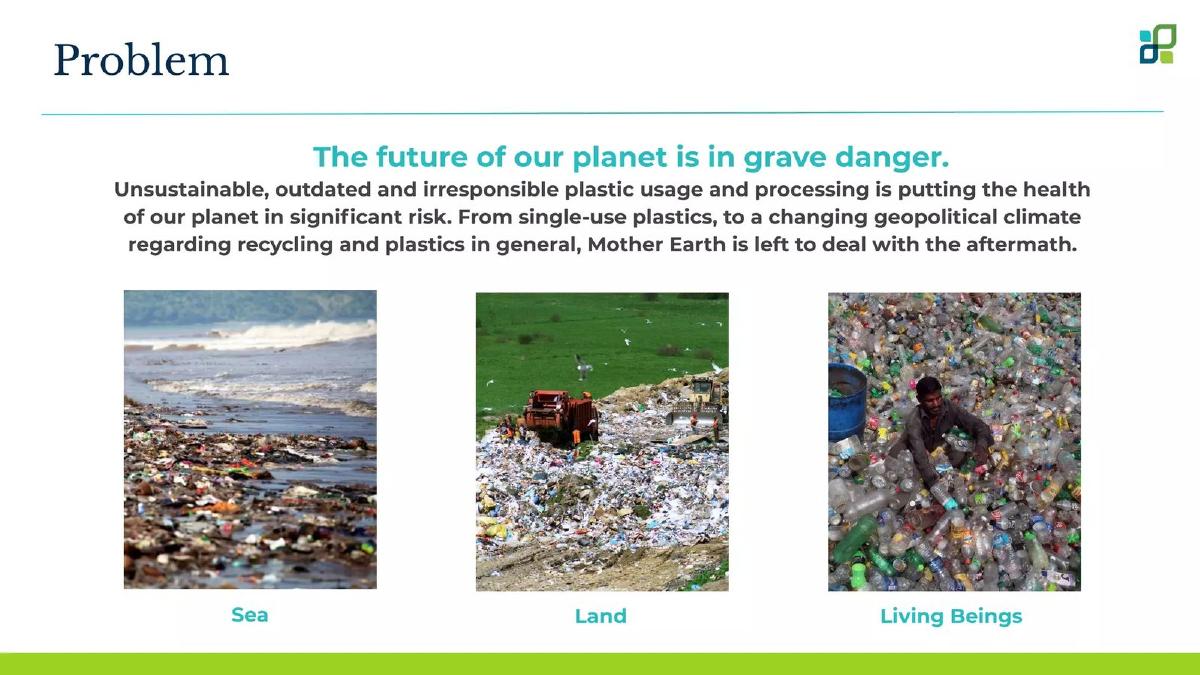
Slide 2 uses high-impact imagery of plastic waste in the sea, on land, and being handled by 'Living Beings.' The text characterizes current plastic usage as 'unsustainable, outdated and irresponsible.' While the emotional appeal is clear, the slide lacks specific data points—such as the total tonnage of uncollected waste or the specific economic loss caused by current recycling inefficiencies—that would help an investor quantify the market opportunity.
Slide 3: Mission and Positioning
This slide serves as a transition, stating that PCRI is 'leading the next global revolution' by 'innovating in the underserved and overlooked.' This is a broad claim that sets the stage for their focus on remote and maritime recycling, though it remains purely aspirational at this point in the deck.
Slide 4: Company History and 'At-a-Glance'
Slide 4 provides important context regarding the company's track record. It claims nearly 30 years of service in international markets, specifically naming the UAE, Pakistan, India, China, Hong Kong, and East Africa. It notes a transition from a 'trading house for recycled polymer' to a 'granule recycling and manufacturing/production business' with a capacity exceeding 1,000 metric tons. This establishes the founders as industry veterans rather than newcomers, which is a significant strength.
Slide 5: Product 1 - Mobile Plastic Shredding Units
This is the first of two 'solution' slides. PCRI proposes mobile trailers that can travel to remote areas to shred plastic on-site. The goal is to create 'highly dense units' that make exporting plastic from remote areas economically viable. The slide uses a simple graphic of a truck and pallets but lacks technical specifications, cost-per-unit for the trailers, or evidence of a working prototype.
Slide 6: Product 3 - Hybrid Freight and Production Ship
Slide 6 introduces a more ambitious concept: processing plastic at sea. By acquiring ships and installing production lines, PCRI aims to 'save time while on voyage' and 'maximize labor.' The graphic indicates a two-phase process occurring within the ship's hull. Like the previous slide, this is a conceptual overview; there is no mention of the maritime regulations, energy requirements, or the capital expenditure (CAPEX) required to refit a freight ship for industrial processing.
Slide 7: The Leadership Team
Nasir Mogul (CEO) and Thomas Brady (Production Manager) are featured here. Mogul's bio is extensive, listing experience in garment factories, ship repair, restaurants, and oilfield engineering. While this shows a breadth of entrepreneurial experience, it does not highlight specific successes in the recycling technology sector. Brady's bio mentions experience in software, gaming, and telecom, which feels somewhat disconnected from a heavy-industry recycling play.
Slide 8: The Leadership Team Continued
The team slide continues with Chris Flannery (Attorney) and Tariq Abdullah (Sales Manager). Flannery brings 35 years of legal experience in securities and corporate matters, which is valuable for a company looking to raise capital or go public. Abdullah’s background includes biology and chemistry degrees, along with retail experience in the UAE and USA. The team appears to have strong administrative and sales foundations but lacks a dedicated CTO or Environmental Engineer to anchor the technical claims made in slides 5 and 6.
Slide 9: Financial Projections - Factory
This slide provides a detailed P&L for a 'Factory' model from 2020 to 2024. Key figures include:
2020 Revenue: $12,652,500 · 2024 Revenue: $28,875,219 · 2020 Net Income: $564,380 · 2024 Net Income: $4,742,797
The 'Key Assumptions' section is the most useful part of the slide, stating a $1,205 selling price per ton and a $650 purchase price per ton. However, the slide does not clarify if these numbers represent an existing factory or a hypothetical one. Furthermore, the operating expenses only grow by 45% while revenue more than doubles, suggesting significant economies of scale that are not explained.
Slide 10: The Conclusion and Call to Action
The final slide is a general summary, stating that the principals believe they can execute the plan within five years. It provides a URL for investors but fails to include a specific 'Ask.' There is no mention of how much money they are raising, what equity is being offered, or what the immediate next steps are for the business.
What Works in This Deck
The strongest element of the PCRI deck is the clear identification of a logistical bottleneck . Most recycling pitches focus on the chemistry of breaking down plastic; PCRI focuses on the cost of moving it. By identifying that remote areas are 'not economically viable to reach' due to density issues, they have found a specific problem to solve. The financial assumptions on Slide 9 are also helpful, as they give investors a baseline for the unit economics (the spread between $650 and $1,205 per ton) that the business relies on.
What Is Missing from This Deck
The deck suffers from several major omissions that would likely stall a due diligence process. First, there is no competitive analysis . The recycling space is crowded with both incumbents and well-funded startups; failing to mention how PCRI differs from existing waste management giants is a mistake. Second, there is no technical validation . The mobile shredding units and production ships are complex engineering projects, yet there are no diagrams, patent mentions, or pilot data to prove they work. Third, the lack of a specific 'Ask' makes it difficult for an investor to understand the scale of the opportunity. Are they raising $1M for a pilot or $50M for a fleet of ships? Finally, the unit economics for the mobile units are missing; while the factory financials are present, the costs of operating a mobile trailer (fuel, maintenance, remote labor) are not broken down.
Founder's Guide: What to Copy and What to Avoid
Founders should copy the 'At-a-Glance' approach on Slide 4. Briefly stating your history, geographic reach, and current capacity builds immediate credibility. It proves you aren't just an 'idea' company. Additionally, the inclusion of key assumptions below the financial table is a best practice that every founder should follow, as it allows investors to stress-test the model.
However, founders should avoid the text-heavy biographies seen on Slides 7 and 8. Investors want to see a 'dot-point' summary of relevant achievements, not a narrative history of every industry a founder has touched. More importantly, never leave out the 'Ask.' A pitch deck is a tool for a transaction; if you don't tell the investor what you need and what they get in return, the deck has failed its primary purpose. Lastly, avoid using generic stock imagery for the problem slide; specific photos of your own pilot sites or the specific regions you intend to serve are far more compelling than generic photos of polluted beaches.
Frequently asked questions
- What is the core technology proposed by Planet Clean Recycling?
- The company proposes two main logistical technologies. First, Mobile Plastic Shredding Units, which are trailers that travel to remote areas to shred and pack plastic into high-density units for export. Second, Hybrid Freight and Production Ships, which are designed to process plastic waste while in transit across the ocean to save time and labor costs.
- What are the financial assumptions for their recycling operations?
- According to Slide 9, the company assumes a purchase price of $650 per ton for raw plastic waste and a selling price of $1,205 per ton for processed material. They also project a 5% annual growth in cargo load and a 1% annual increase in general expenses, leading to a projected net income of $4.74 million by year five.
- Does the deck provide a clear exit strategy or investment ask?
- No. The deck concludes on Slide 10 with a general invitation to 'join us' and a link to an investor URL, but it does not state the amount of capital being raised, the valuation, or the specific milestones the funding will achieve. There is also no mention of an exit strategy for investors.
- Where does Planet Clean Recycling currently operate?
- Slide 4 states the team has been serving markets in the UAE, Pakistan, India, China, Hong Kong, and east African nations for nearly three decades. It describes the company's evolution from a trading house for recycled polymers to a manufacturing business with a capacity of over 1,000 metric tons.
- Who are the key members of the leadership team?
- The team is led by Nasir Mogul (President and CEO), who has a background in financial services and various industrial sectors. He is supported by Thomas Brady (Production Manager), Chris Flannery (Attorney), and Tariq Abdullah (Sales Manager). The biographies emphasize general professional experience rather than specific technical patents or environmental science credentials.