Plastic Finance presents a complex hybrid model that combines physical waste management with decentralized finance (DeFi). Operating primarily in Indonesia, the company seeks to empower scavenger communities through financial inclusivity while providing a transparent, blockchain-tracked recycling process. The deck outlines a circular economy where plastic waste is converted into stablecoins and recycled goods, with a significant portion of profits (60% yearly) designated for investors. While the vision is ambitious, spanning from carbon absorption to IoT-tracked recycling facilities, the deck…
Key takeaways
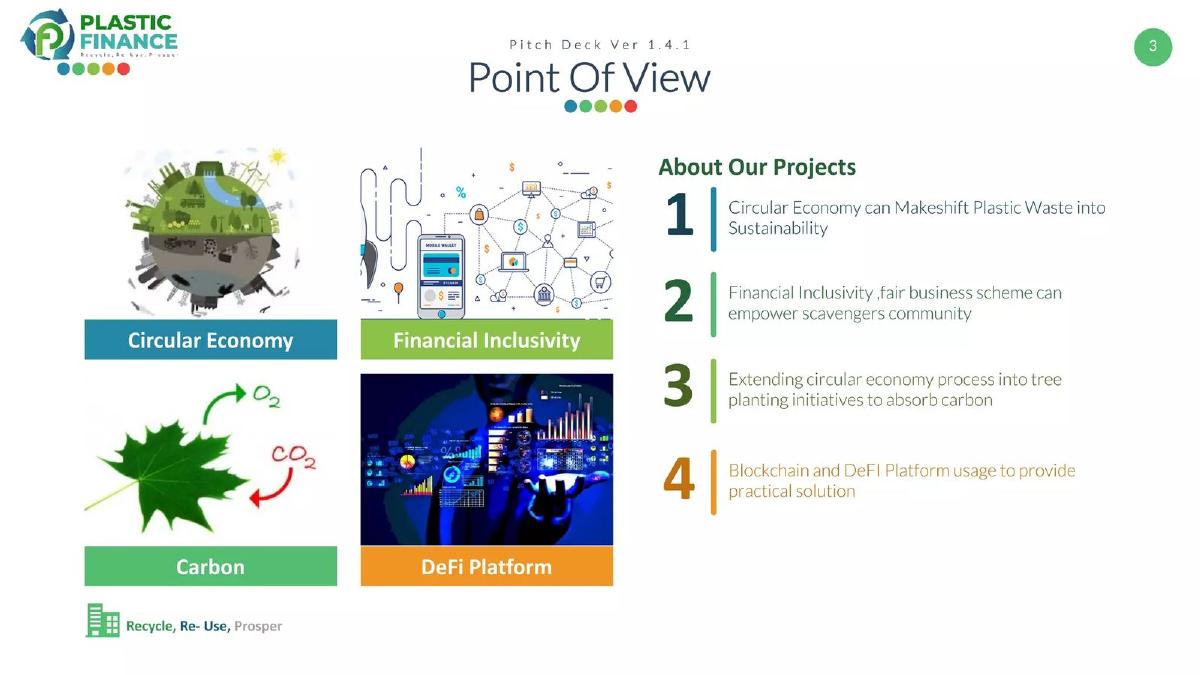
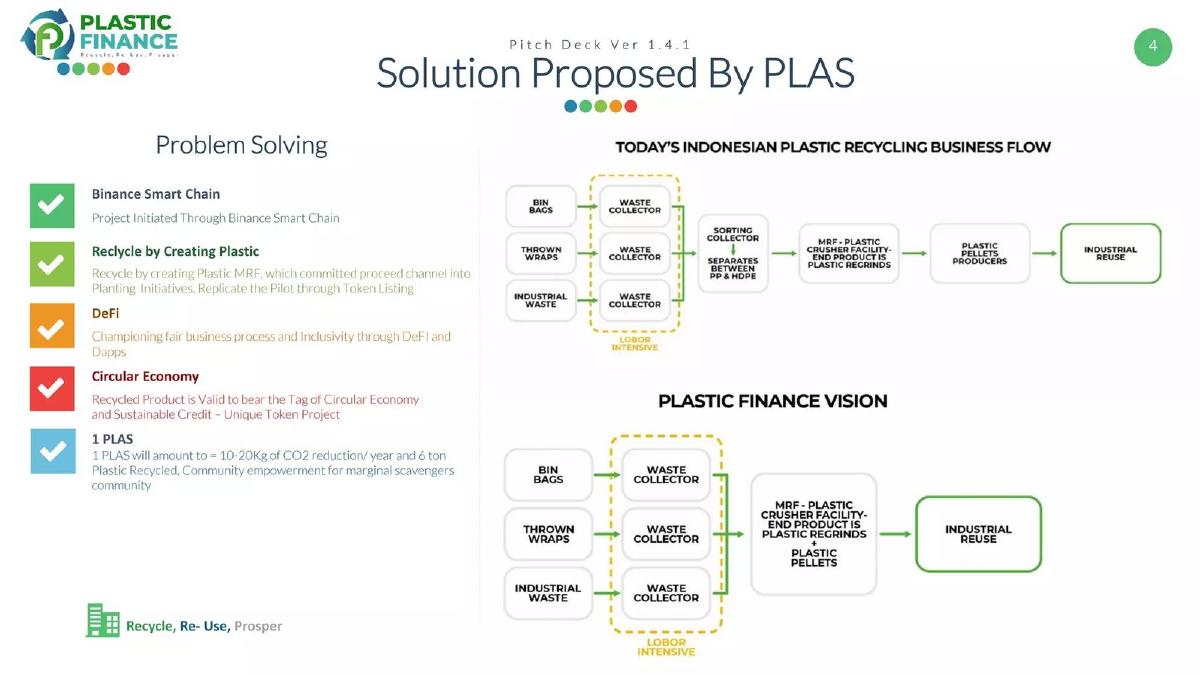
- The project focuses on four pillars: Circular Economy, Financial Inclusivity, Carbon absorption, and a DeFi Platform (Slide 3).
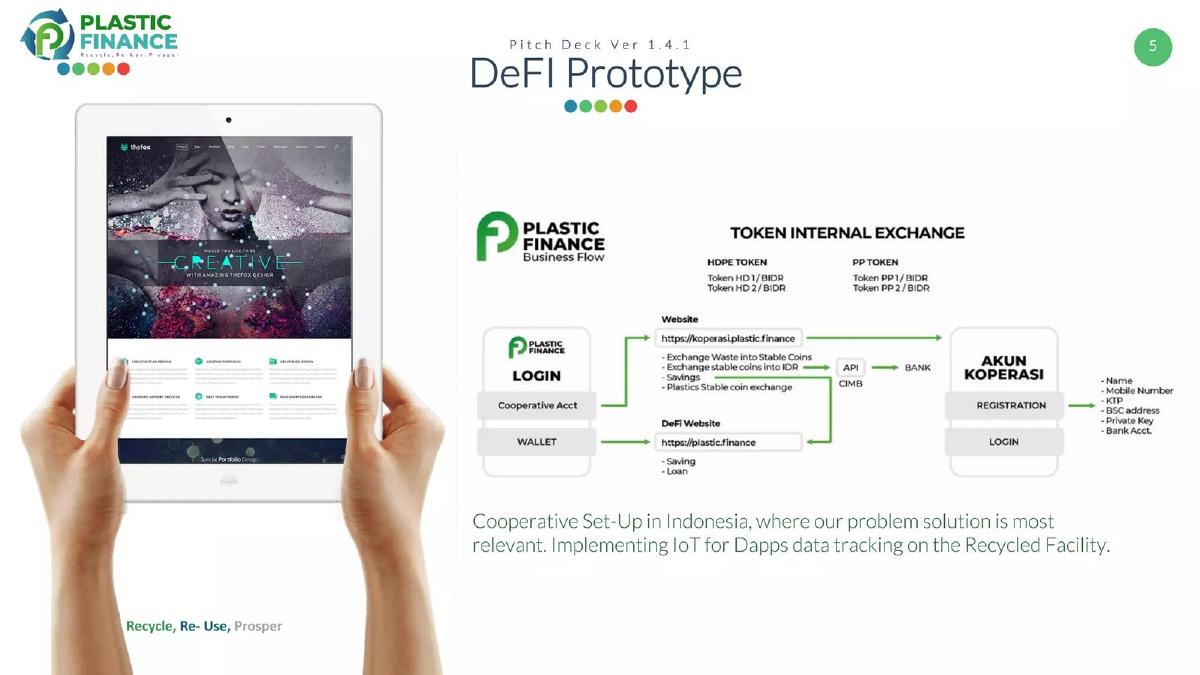
- The business model is centered on a cooperative set-up in Indonesia, utilizing IoT for data tracking at recycling facilities (Slide 5).
- An internal exchange converts plastic waste into stablecoins, which can then be exchanged for IDR via API links to banks like CIMB (Slide 5).
- The economic model promises a 60% yearly dividend to investors from net profit dividends of recycling sales (Slide 7).
- Transaction fees on the DeFi website are set at a precise 0.175% (Slide 7).
- The target investor profile includes 'Millennial and Gen-Z' and 'Crypto Enthusiasts' interested in ESG aspects of blockchain (Slide 9).
- The team includes specialized roles such as a 'Listing Manager' and 'Head of Cooperative,' reflecting the project's dual crypto-physical nature (Slide 15).
- The Dapps interface includes features for tracking 'Recycled Virgin Plastic' in tons and 'Future CO2 Avoided' (Slide 17).
Slide-by-Slide Analysis
Slide 1: Title Slide
The cover slide introduces the company as 'Plastic Finance' with the tagline 'Recycle, Re-Use, Prosper.' It identifies the venture as the 'First Sustainable Circular Economy Token.' The version number '1.4.1' is prominently displayed, suggesting an iterative development process for the deck. The background imagery features professionals in a collaborative setting, which is standard but does not immediately communicate the waste management aspect of the business.
Slide 3: Point Of View
This slide functions as the mission statement. It breaks the project into four distinct categories: Circular Economy , Financial Inclusivity , Carbon , and DeFi Platform . The text explicitly states that the project aims to empower the 'scavengers community' through fair business schemes and extend the circular economy into tree-planting initiatives to absorb carbon. This is a broad scope, attempting to link social impact, environmental sustainability, and financial technology in a single narrative.
Slide 5: DeFi Prototype & Business Flow
This is a technical architecture slide. It details the 'Plastic Finance Business Flow,' specifically highlighting a 'Cooperative Set-Up in Indonesia.' The flow shows how participants log in to a cooperative account, exchange waste for stablecoins, and then exchange those stablecoins for IDR (Indonesian Rupiah) via an API link to CIMB Bank . It also mentions the use of IoT for Dapps data tracking at the recycling facility. This slide is crucial as it explains the bridge between physical waste and digital currency, though the diagram is dense and requires significant study to understand the 'HDPE Token' and 'PP Token' internal exchange mechanisms.
Slide 7: An Economically Unique Viable Project
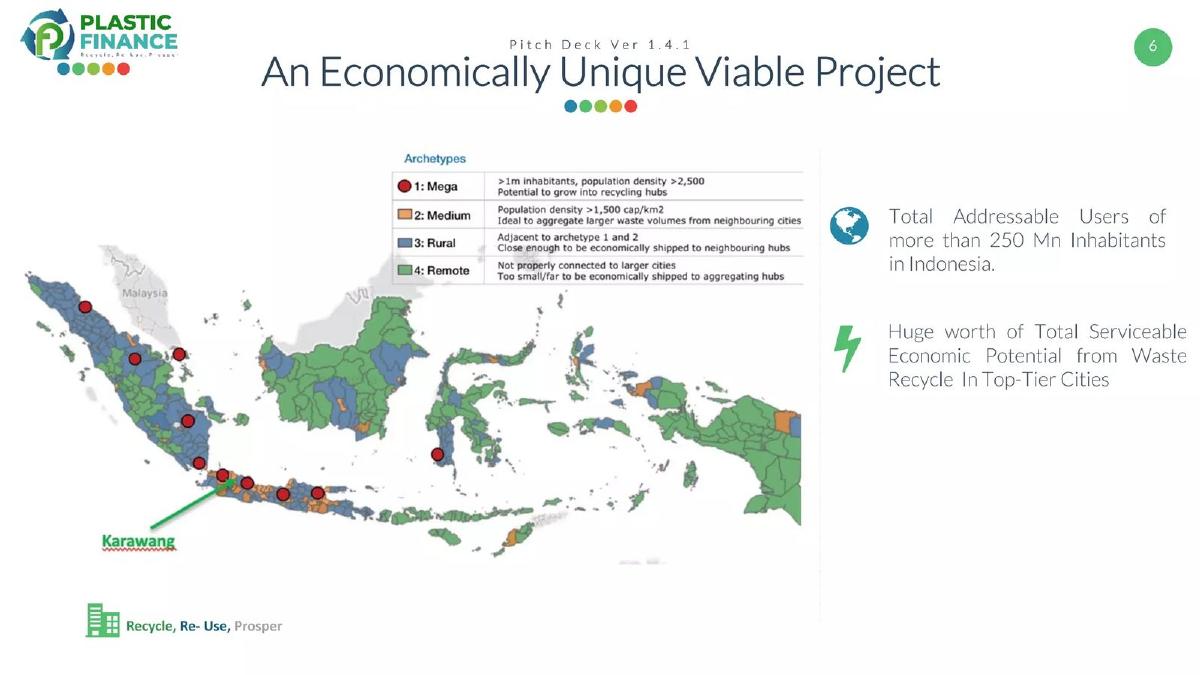
This slide serves as the business model summary. It claims the project will become 'self-sustaining' through its own cash generation. Key figures include a 5% Spread Profit from the exchange and a 0.175% Transaction Fee from the DeFi website. Most notably, it promises a 60% Yearly dividend to investors from the net profit of recycling sales. A further 10% is earmarked for 'Greenity.' The visual uses a hand holding a growing plant made of coins, a literal representation of 'green finance.'
Slide 9: Who Are PLAS Investors Profile?
Instead of listing current investors, this slide describes the target investor. It identifies two groups: Millennial and Gen-Z (who are willing to contribute to the environment) and Crypto Enthusiasts/Visionaries (who care about ESG aspects of blockchain). The text suggests that the project can 'Neutralize Criticism' regarding the environmental impact of cryptocurrencies, positioning the PLAS token as a 'green' alternative.
Slide 11: Beyond Plastic Vision
This slide is a quote-heavy vision statement. It features a quote from Alex de Vries , founder of Digiconomist, from a May 21, 2021, Quartz article. The quote discusses the potential for people to shift away from Bitcoin if it attracts negative headlines due to its environmental impact. Plastic Finance uses this to justify their 'Decarbonization' mission, though the slide itself contains no data or proprietary information.
Slide 13: Meet Who Are Behind The Scenes
This slide introduces the founder, Agung Dumadio . It includes a quote from him stating that plastic recycling has not changed in 20-30 years and that blockchain can 'revolutionize our plastic waste from useless goods to renewable goods.' While it establishes the founder's philosophy, it lacks a professional biography or a track record of previous successes in waste management or fintech.
Slide 15: Meet Our Great Team
The team slide lists eight additional members and advisors. The roles are highly specific to the project's unique needs: Dr. Iqbal Alan Abdullah (Cooperative Advisor), Mamat Haerudin (Head of Cooperative), and Ario Bima Sakti (Listing Manager). The inclusion of a 'Graphic Designer' and 'Corporate Secretary' suggests the team is focused on both the operational and promotional aspects of the token launch. However, like the founder slide, there are no details regarding the team's past employment or credentials.
Slide 17: Exhibit: Dapps for plastic waste
The final slide shown provides UI/UX mockups of the mobile application. The screens show a 'Presale is Live Now' banner, a wallet balance in PLAS and IDR , and a 'Detail barang' (item detail) screen for waste deposits (listing PP12 and PP20 plastics). The 'Global Overview' screen shows metrics like 0.1020 Tons of Recycled Virgin Plastic and 504,412 PLAS of 'Future CO2 Avoided.' This slide is effective at showing that the software development is at least in the prototyping stage.
What Plastic Finance Does Well
Plastic Finance excels at creating a cohesive narrative that links disparate concepts: waste management, social equity for scavengers, and decentralized finance. By focusing on the Indonesian cooperative model, they provide a concrete geographic and regulatory anchor for a project type that is often too abstract. The inclusion of specific recycling types (HDPE, PP) and the integration with a known bank (CIMB) adds a layer of practical credibility to the technical flow. They also clearly define their revenue streams (spreads and transaction fees), which is often missing in early-stage crypto decks.
What is Missing from the Deck
The deck suffers from several significant omissions that would be required for a traditional VC or a sophisticated crypto fund. First, there is no Market Size slide; it is unclear how large the Indonesian plastic recycling market is or what percentage they aim to capture. Second, there is no Traction data; the deck shows prototypes but does not state if any recycling facilities are currently operational or how many scavengers have signed up. Third, the Competitive Landscape is ignored; there are other 'Recycle-to-Earn' projects globally, and the deck fails to differentiate itself from them. Finally, the Ask is missing; an investor cannot tell how much capital is being raised or what the valuation of the PLAS token or the parent company is.
What a Founder Should Copy
Founders should look at Slide 5 as a good example of how to map out a complex ecosystem. If your business involves multiple stakeholders (users, banks, internal exchanges, physical facilities), a clear flow diagram is essential. The 'Investor Profile' on Slide 9 is also a clever way to signal who the project is for, which can help in self-selecting the right leads during a fundraise. Lastly, the 'Exhibit' slide (Slide 17) is a strong way to end a deck, as it proves the product isn't just a concept but has a tangible interface with defined metrics.
Frequently asked questions
- What is the core value proposition of Plastic Finance?
- Plastic Finance attempts to solve the inefficiency of plastic recycling by tokenizing the process. By using blockchain and IoT, they provide transparency in waste tracking and offer financial tools to scavengers who are typically excluded from the formal banking system. Their 'Point of View' slide (Slide 3) emphasizes that a circular economy can turn makeshift waste into sustainability through a fair business scheme.
- How does the company generate revenue and reward investors?
- Revenue is generated through recycling sales and transaction fees. According to Slide 7, the project takes a 5% spread profit from the exchange and a 0.175% transaction fee from the DeFi website. Investors are promised 60% of the net profit dividends from recycling sales annually, while 10% of net profit is allocated to 'Greenity' initiatives.
- What is the significance of the Indonesian cooperative mentioned in the deck?
- The cooperative (Akun Koperasi) is the bridge between the digital token economy and the physical world. Slide 5 shows that scavengers or participants register with their KTP (Indonesian ID) and bank accounts. This structure allows the project to operate within local regulatory frameworks while providing 'Financial Inclusivity' to a community that often lacks traditional credit access.
- Who are the key people behind the project?
- The project is led by Founder Agung Dumadio. The team is supported by a range of advisors, including Dr. Iqbal Alan Abdullah (Cooperative Advisor) and Mochamad Indrawan (Sustainability Advisor). The presence of a 'Listing Manager' (Ario Bima Sakti) suggests a strong focus on getting their PLAS token onto cryptocurrency exchanges (Slide 15).
- What critical information is missing from this pitch deck?
- The deck is missing several standard venture capital components. There is no slide detailing the total addressable market (TAM), no competitor matrix, and no historical traction metrics (e.g., tons of plastic recycled to date). Most importantly, the deck does not state how much money they are raising or how those funds will be allocated.