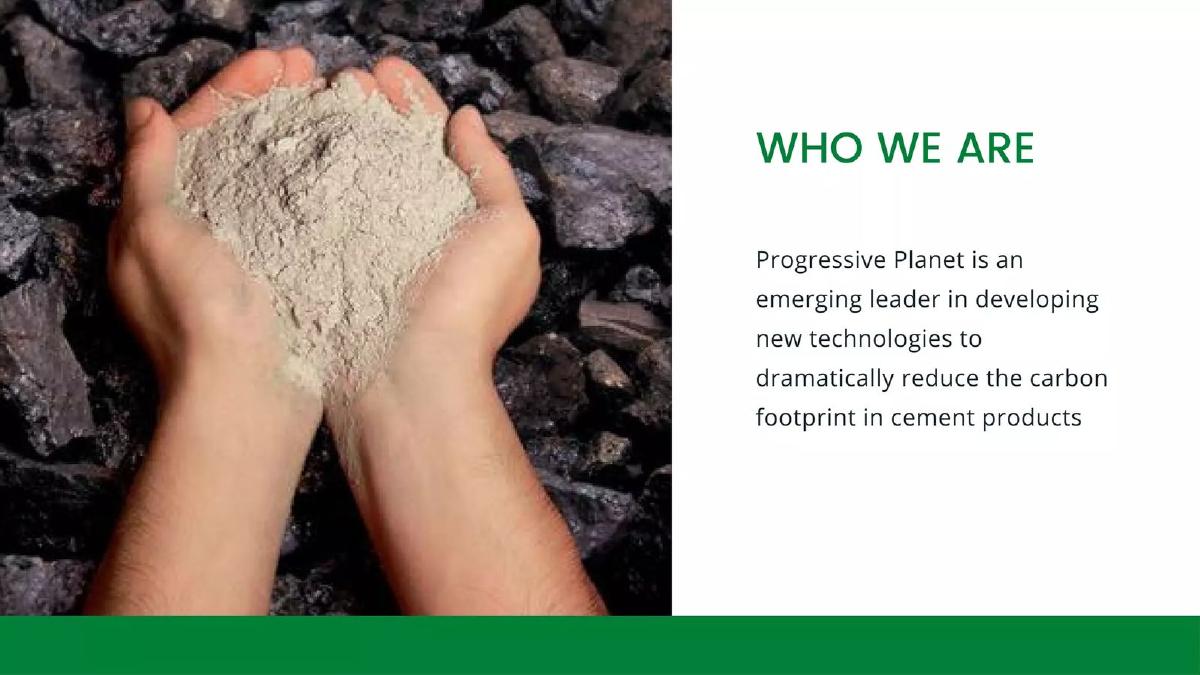
Progressive Planet Solutions (Plan) addresses the high carbon footprint of the cement industry, specifically targeting the 44% of limestone weight off-gassed as CO2 during calcination. The deck outlines a strategy to commercialize PozGlass SCM, a proprietary blend of natural pozzolan and recycled glass, which diverts waste from landfills while reducing concrete emissions. With a flagship plant planned for British Columbia and a roadmap for North American expansion, the company highlights its $2 million raised for commercialization and a heavy emphasis on scientific advisors. However, the deck…
Key takeaways
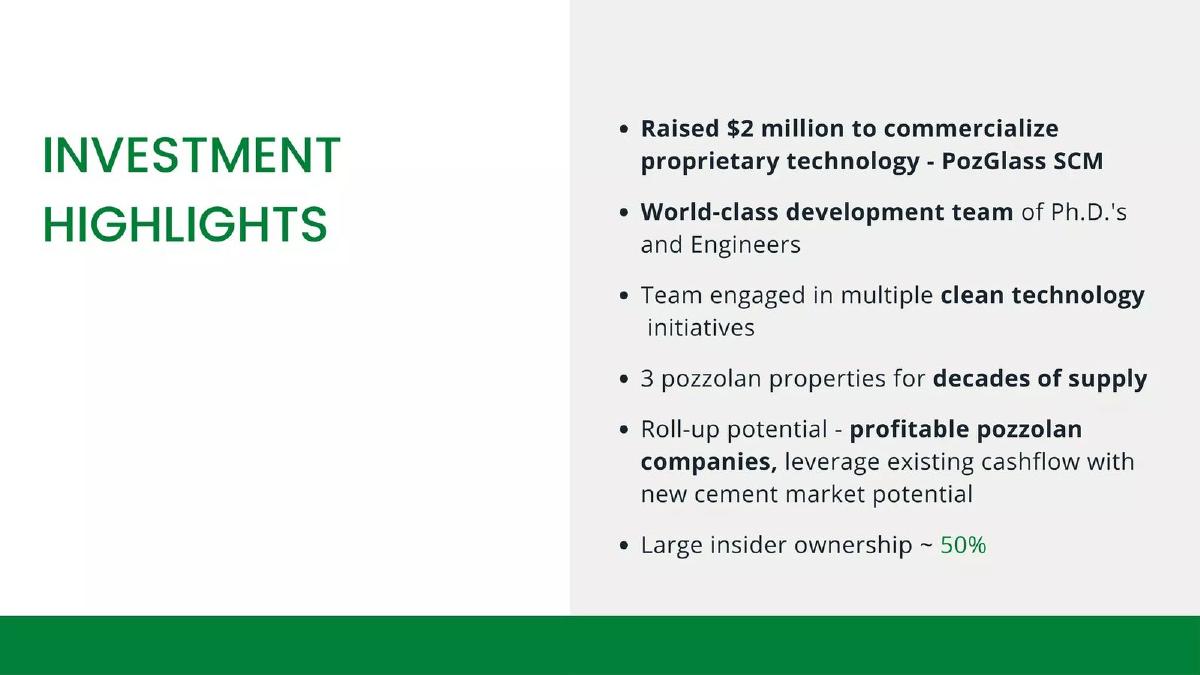
- The company has raised $2 million to commercialize its proprietary PozGlass SCM technology (Slide 2).
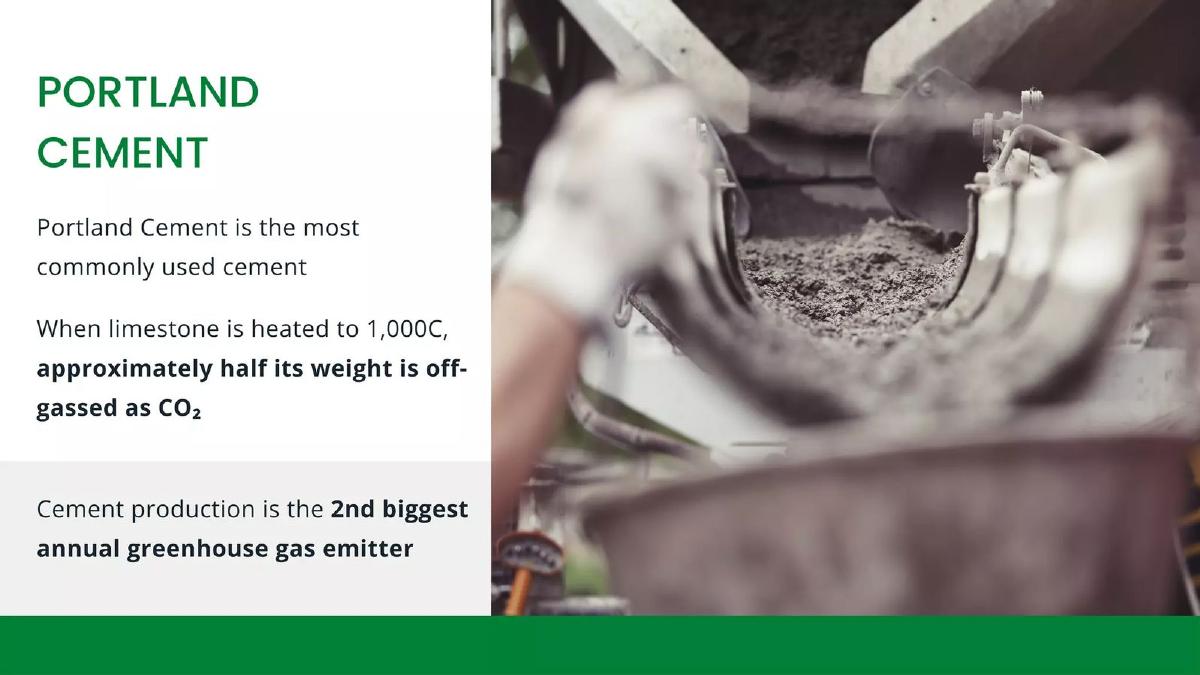
- Portland cement production is identified as a high-carbon process, with 44% of limestone weight off-gassed as CO2 during calcination (Slide 3).
- PozGlass SCM combines natural pozzolan with recycled post-consumer glass, aiming to divert the 60% of glass that currently goes to landfills (Slide 4).
- Natural pozzolans are positioned as superior to fly ash due to better cementing behavior and a smaller CO2 footprint (Slide 5).
- The company is developing C-Quester Cellular Concrete with the goal of permanent CO2 sequestration as limestone (Slide 6).
- Expansion plans target regions with SCM supply shortages, including Washington, Oregon, California, and Ontario (Slide 7).
- The 2021-2023 roadmap includes finalizing the flagship plant, commercializing PozGlass, and seeking licensees for C-Quester (Slide 8).
- Management and insiders hold approximately 50% ownership of the company (Slide 2).
Executive Summary and Title
Slide 1: Title Slide
The presentation opens with a clear value proposition: "Concrete Solutions for a Better Planet." The subtitle specifies the focus on "Decarbonizing the Production of Cement Products." The branding identifies the company as Progressive Planet Solutions, dated July 2021. The imagery of mountains suggests an environmental focus, though it does not directly represent the industrial nature of the business.
Slide 2: Investment Highlights
This slide serves as the executive summary. Key data points include: $2 million raised to commercialize PozGlass SCM, a team comprised of Ph.D.s and engineers, and the possession of three pozzolan properties intended to provide "decades of supply." A notable governance detail is the ~50% insider ownership , which suggests strong alignment between management and shareholders. The slide also mentions "roll-up potential," indicating a strategy to acquire profitable pozzolan companies to leverage existing cash flow.
The Problem and The Solution
Slide 3: High Carbon Footprint of Portland Cement
The deck identifies the specific pain points in cement production: quarrying, grinding, and calcination. It notes that 44% of limestone weight is off-gassed as CO2 during calcination, which requires temperatures of 1450C. The slide introduces Supplementary Cementitious Materials (SCMs) as the solution to replace portions of cement (typically 20%) to reduce emissions. It identifies fly ash as the current standard SCM in North America, setting the stage for a replacement product.
Slide 4: PozGlass SCM
This slide introduces the flagship product, PozGlass SCM. The formula is presented visually: natural pozzolan plus recycled post-consumer glass. The business case for glass is strong: over 60% of post-consumer glass currently goes to landfill . By diverting this glass, the company claims it can receive "tip fees," effectively getting paid for its raw materials. The slide notes a flagship plant planned for British Columbia (BC) with subsequent expansion into the Pacific Northwest.
Slide 5: Natural Pozzolans
The company argues that natural pozzolans are superior to the industry-standard fly ash. Claims include better cementing behavior and a smaller CO2 footprint. Crucially, the slide states that minimal energy is required to mine and mill natural pozzolan compared to the roasting required for fly ash and traditional cement. This points toward a potential cost advantage in production, though specific figures are not provided.
Slide 6: Product Development Pipeline
Beyond PozGlass, the company introduces C-Quester Cellular Concrete . This product is described as being under development with the objective of permanent CO2 sequestration in cellular concrete as limestone. This positions the company not just as a carbon-reducer, but as a potential carbon-capture player in the building materials space.
Market Strategy and Roadmap
Slide 7: PozGlass Expansion
The geographic strategy is centered on North America. The flagship plant in BC is designed to be replicated in "target growth regions." The deck identifies Washington, Oregon, California, Nevada, Kansas, Nebraska, and Ontario as expansion opportunities. The primary driver for these locations is a documented shortage of SCM supply according to industry data, suggesting a supply-constrained market rather than a demand-constrained one.
Slide 8: Timeline
The timeline spans from 2018 to 2023. Key milestones include:
2018: Steve Harpur becomes CEO; acquisition of Z1 Natural Pozzolan Quarry. · 2019: First comminution product sold; first SCM development agreement with U of Alberta. · 2020: First organic agricultural powders shipped; second SCM agreement signed. · 2021: Testing PozGlass SCM with C&CS Atlantic Inc.; finalizing flagship plant location. · 2022 (Projected): Commercialize PozGlass SCM and C-Quester; launch Innovation Centre. · 2023 (Projected): Expansion into Pacific Northwest; seeking licensees for C-Quester.
Team and Contact
Slide 9: Advisors and Scientific Advisors
The company leans heavily on external expertise. The slide lists five general advisors and three scientific advisors. The scientific advisors— Dr. Chad Vecitis, Dr. Doug Brown, and Dr. Greg Silverberg —all hold Ph.D.s, reinforcing the technical credibility claimed on Slide 2. The general advisors include founders of other industrial or recycling firms (e.g., Nicole Stefenelli of Urban Impact), suggesting a network capable of supporting the "roll-up" strategy mentioned earlier.
Slide 10: Contact Information
The final slide provides direct contact details for Steve Harpur (CEO and Chair) and Jeff Walker (VP, The Howard Group) , who handles Investor Relations. The company's head office is listed in Vancouver, BC. The repetition of the mountain imagery maintains the "green" branding established at the start of the deck.
What Works Well
The deck excels at identifying a specific, high-impact niche within the massive cement industry. By focusing on the 44% CO2 off-gassing in calcination, the founders show a deep understanding of the chemical problem they are solving. The inclusion of "tip fees" as a revenue stream for recycled glass is a compelling business model detail that suggests the potential for high margins on raw materials. Furthermore, the geographic expansion strategy is logically tied to regions with known SCM shortages, which justifies the choice of target markets.
What Is Missing
The most significant omission is a detailed financial section. While the deck mentions $2 million raised and the existence of profitable pozzolan companies for potential roll-ups, it provides no revenue figures, no margin analysis, and no specific unit economics for PozGlass SCM. An investor cannot determine from these slides how much it costs to produce a ton of PozGlass versus a ton of traditional Portland cement. Additionally, there is no explicit "Ask" slide in this 10-slide selection; it is unclear how much capital the company is currently seeking or how those funds would be allocated between the flagship plant and R&D for C-Quester.
Founder Takeaways
Focus on the Chemistry of the Problem: If you are in a deep-tech or industrial sector, follow this deck's lead by identifying the exact point of inefficiency (e.g., Slide 3's breakdown of calcination). It builds immediate technical authority. Leverage Waste Streams: The "tip fee" model (Slide 4) is a classic example of a circular economy advantage. If your business can get paid to take its raw materials, that should be a central pillar of your pitch. Balance Advisors with Operators: While the scientific advisors are impressive, a founder should ensure the deck also highlights the operational team capable of building and running a factory. This deck is advisor-heavy, which is good for R&D but can raise questions about industrial execution at scale.
Frequently asked questions
- What is the primary product being pitched?
- The primary product is PozGlass SCM, a supplementary cementitious material. It is a proprietary blend of natural pozzolan and recycled post-consumer glass designed to replace portions of Portland cement or fly ash in concrete production, thereby reducing the overall carbon footprint of the final building material.
- How does the company generate revenue beyond selling the material?
- Slide 4 indicates that the company can receive 'tip fees' for diverting post-consumer glass from landfills. Additionally, Slide 8 mentions a strategy to 'seek additional licensees' for their C-Quester Cellular Concrete technology, suggesting a dual-track revenue model of material production and intellectual property licensing.
- What is the current stage of the company's infrastructure?
- According to Slide 8, as of 2021, the company was 'finalizing flagship PozGlass plant location' and had previously upgraded its first comminution plant in 2020. The timeline suggests that full-scale commercialization of PozGlass SCM was slated for 2022, moving from testing to active production.
- Who are the key people involved in the company?
- The deck highlights Steve Harpur as CEO and Chair. It places significant weight on its scientific advisory board, which includes Dr. Chad Vecitis, Dr. Doug Brown, and Dr. Greg Silverberg. The team is described as a 'world-class development team of Ph.D.'s and Engineers' on the highlights slide.
- What major market problem is the company solving?
- The company is addressing two problems: the high CO2 emissions of the cement industry (specifically the energy-intensive calcination process) and the scarcity of fly ash, which is the most common SCM in North America but is a byproduct of the declining coal industry.