PlanetClean Recycle Industries (PCRI) presents a pitch deck centered on solving global plastic waste through innovative logistics and on-site processing. The company, which claims nearly three decades of experience in markets like the UAE, India, and China, proposes a two-pronged hardware strategy: mobile plastic shredding trailers for remote land areas and hybrid freight ships that process plastic while in transit. While the deck highlights a management team with deep maritime and financial experience, it relies heavily on aggressive financial projections, forecasting net income to grow from…
Key takeaways
- The company claims a 30-year history serving markets in the UAE, Pakistan, India, China, Hong Kong, and East Africa (Slide 4).
- The core product innovation involves mobile trailers that shred plastic on-site in remote areas to increase packing density for export (Slide 5).
- A secondary 'Hybrid Freight and Production Ship' concept aims to process plastics at sea to save time and labor costs during transit (Slide 6).
- Financial projections for the Mobile Units assume a $1,205 selling price per ton against a $350 purchase price per ton (Slide 9).
- The Mobile Units segment projects a net income increase from $78,731,005 in 2020 to $262,368,977 by 2024 (Slide 9).
- The Ship segment projections assume a 0% tax rate because 'tax is paid by the buyer' and an $850 purchase price per ton (Slide 10).
- The management team features a Captain with 29 years of shipping experience and a CFO with 25 years in securities and CPA services (Slide 8).
- The deck identifies a niche focus on the farming and construction industries in North America as a key value proposition (Slide 7).
Executive Summary and Brand Identity
Slide 1: Title Slide
The deck opens with a clean, professional aesthetic featuring the PlanetClean logo and the tagline '#RecycleSmarter with PlanetClean Recycling.' The background image of a tropical beach reinforces the environmental mission of the company. The title clearly identifies this as an 'Investor Deck,' signaling its purpose for capital raising.
Defining the Environmental Crisis
Slide 2: Problem
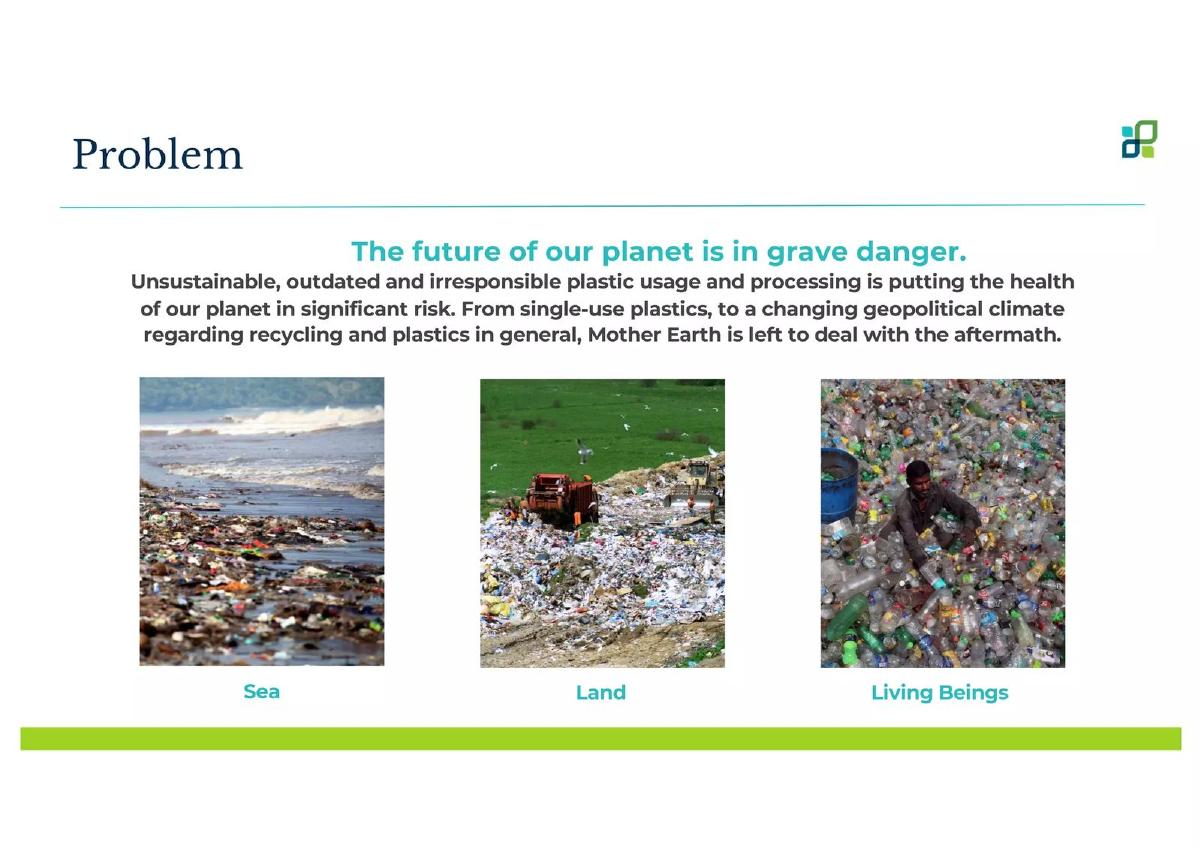
This slide uses high-impact imagery to categorize the plastic crisis into three areas: Sea, Land, and Living Beings. The text states that 'The future of our planet is in grave danger' due to 'unsustainable, outdated and irresponsible plastic usage.' It frames the problem not just as an environmental one, but as a geopolitical issue where 'Mother Earth is left to deal with the aftermath.' This sets a high-stakes tone for the subsequent solution.
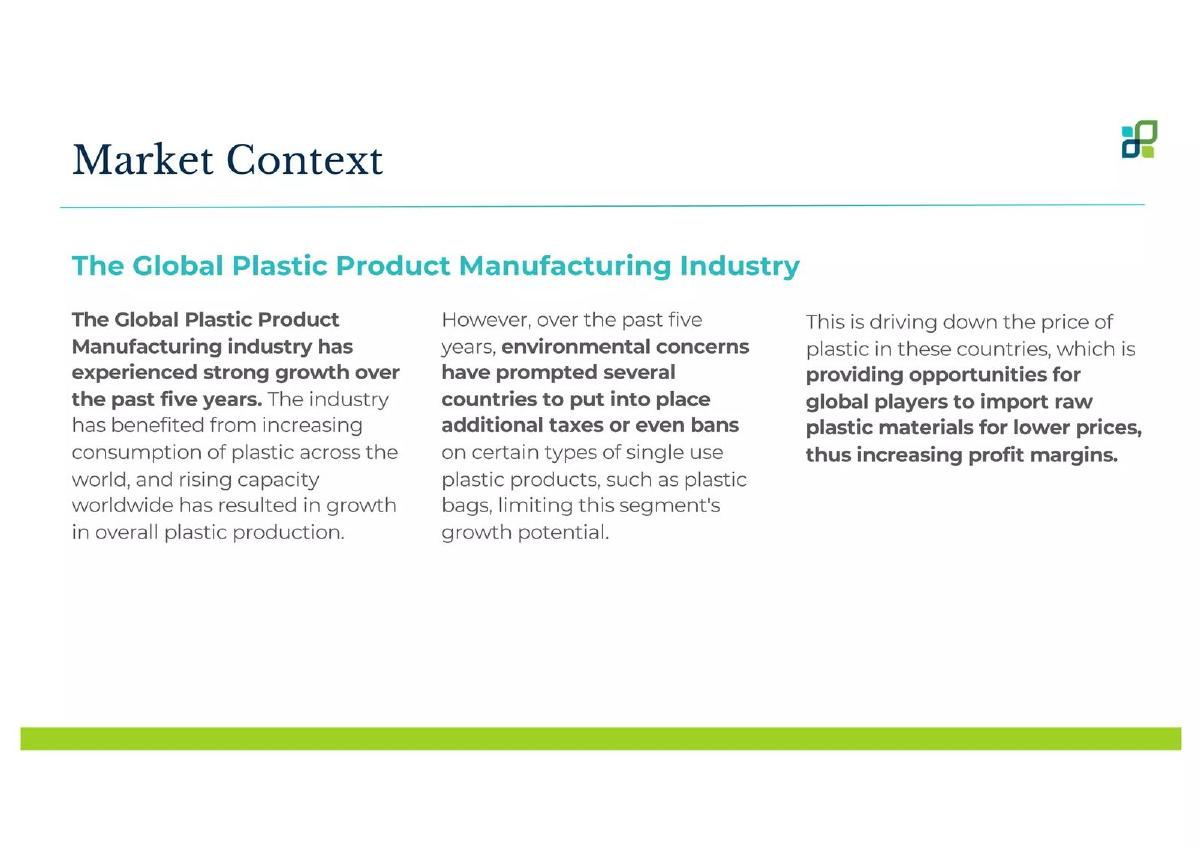
Slide 3: Market Context
The deck transitions from environmental concern to economic opportunity. It notes that the Global Plastic Product Manufacturing industry has seen strong growth over the last five years. Crucially, it points out that while environmental concerns have led to taxes and bans on single-use plastics, these same regulations are 'driving down the price of plastic in these countries.' The company views this as an opportunity for 'global players to import raw plastic materials for lower prices, thus increasing profit margins.'
Company History and Logistics Strategy
Slide 4: Planet Clean Recycling: At-a-Glance
This slide establishes the company's credibility. It claims the team has been serving markets for 'nearly three decades,' specifically naming the UAE, Pakistan, India, China, Hong Kong, and East African nations. It describes a transition from a 'trading house for recycled polymer processing' to a 'granule recycling and manufacturing/production business' with a stated capacity of over 1,000 metric tons. This slide is vital for showing that the company is an established operator, not a pre-revenue startup.
Slide 5: P.1: Mobile Plastic Shredding Units
The first core product offering is the Mobile Plastic Shredding Unit. The slide explains that the company will produce mobile trailers to travel to remote areas, shred plastic on-site, and pack it into 'highly dense units.' The goal is to make sourcing plastic from remote areas 'economically viable' by increasing the efficiency of container packing for export. An illustration shows the workflow from loose plastic to a fully loaded freight truck.
Slide 6: P.3: Hybrid Freight and Production Ship
The second product offering involves 'Hybrid Freight and Production Ships.' The plan is to acquire ships and process plastics while at sea. The slide claims this will 'save time while on voyage' and 'save costs by maximizing labor.' The illustration depicts a ship with 'Phase 1' and 'Phase 2' processing areas located below the deck, suggesting a floating factory model that delivers finished products directly to destinations in the Middle East, Africa, or Asia.
Value Proposition and Leadership
Slide 7: PCR and Management Team Value Propositions
This slide lists 14 bullet points detailing the company's competitive advantages. Key points include 'Established purchase agreements with customers,' a 'Niche focus on targeting the farming and construction industries in North America,' and 'Favorable input supply agreements with local recycling facilities.' It also mentions that current demand is exceeding their production capacity, which serves as a primary justification for expansion capital.
Slide 8: PCRI Team Cont’d
The team slide focuses on two key executives. Captain Michalis Fountoglou (Marine Operations) is credited with 29 years of shipping experience and 450 successful S&P transactions. Brian Zucker (CPA) is introduced as the CFO, with 25 years of experience in the securities industry, including roles at Deloitte Haskins and Sells and various publicly traded companies. The presence of a CPA and a maritime veteran suggests a focus on regulatory compliance and operational logistics.
Financial Projections and Assumptions
Slide 9: P.1 Financial Projections - Mobile Units
This slide provides a detailed 5-year P&L for the Mobile Units segment. Revenue is projected to grow from $162,675,000 in 2020 to $546,588,000 in 2024. Net income is projected to reach $262,368,977 by year five. Key assumptions include a 21% tax rate, a $1,205 selling price per ton, and a $350 purchase price per ton. The model assumes 10 additional mobile units are purchased each year.
Slide 10: P.3 Financial Projections - Ship
The ship-based processing segment shows even more aggressive growth. Revenue is projected to rise from $107,220,000 in 2020 to $732,434,706 in 2024. Net income is forecasted at $336,018,487 by 2024. The assumptions here differ slightly: a $650 purchase price per ton and a 0% tax rate (buyer-paid). The chart shows a steep upward trajectory in net income over the five-year period.
What Works in This Deck
Operational Specificity: Unlike many environmental decks that remain at a high level, PlanetClean provides specific logistics solutions (mobile shredders and hybrid ships) to solve the 'density' problem in recycling logistics. Established Track Record: Citing 30 years of experience in specific international markets provides a level of 'social proof' that the founders understand the complexities of cross-border waste trade. Granular Assumptions: Including the specific purchase and sale price per ton ($350/$650 vs $1,205) allows investors to stress-test the business model against market fluctuations.
What Is Missing from This Deck
The Ask: The most significant omission is a clear funding request. The deck does not state how much capital is being raised, the valuation of the company, or how the funds will be allocated between ships and mobile units. Current Asset Status: While the deck mentions a 1,000 metric ton capacity, it is unclear how many mobile units or ships are currently operational versus how many are 'planned' for the 2020-2024 projection period. Competitive Landscape: There is no mention of other global recycling firms or logistics companies that might be pursuing similar 'on-site' processing strategies. Regulatory Risk: Given the 'geopolitical climate' mentioned on Slide 2, a more detailed analysis of import/export bans (like China's National Sword policy) would be appropriate for a company operating in these regions.
Founders: What You Should Copy
Visualizing the Workflow: The illustrations on Slides 5 and 6 are excellent examples of how to explain a complex logistics process simply. Founders should use similar diagrams to show how their product fits into a larger supply chain. Segmented Financials: Breaking the projections into 'Mobile Units' and 'Ships' is a smart move. It allows investors to see the different margin profiles and risk factors associated with land-based versus maritime operations. Experience-Led Bios: The team slide focuses on 'years of experience' and 'number of transactions' rather than just titles. This is particularly effective for heavy industry or logistics startups where operational history is the primary currency of trust.
Frequently asked questions
- What is PlanetClean's primary business model?
- PlanetClean Recycle Industries is transitioning from a trading house for recycled polymers into a manufacturing and production business. Their model relies on sourcing plastic from remote or maritime locations using mobile shredding units and specialized ships, processing the material into granules, and selling them at a projected price of $1,205 per ton to global markets.
- How does the company plan to handle logistics in remote areas?
- According to Slide 5, the company intends to produce mobile trailers that travel to remote areas to shred plastic on-site. This process creates 'highly dense units' that make it economically viable to transport plastic from regions that do not have a large enough supply to justify traditional shipping methods.
- What are the key financial assumptions for the ship-based processing?
- Slide 10 outlines assumptions for the 'Hybrid Freight and Production Ship,' including 8 round-trip voyages per year and a 0% tax rate (attributed to the buyer). It assumes a purchase price of $650 per ton and a selling price of $1,205 per ton, leading to a projected net income of $336 million by 2024.
- Who is leading the company's maritime operations?
- Marine operations are led by Captain Michalis Fountoglou. As stated on Slide 8, he has over 29 years of experience in the shipping industry, served as a Master for the Latsis Group and Stelmar Tankers, and has completed over 450 successful S&P transactions.
- What market segments is PlanetClean targeting?
- While the company has a history in Asia and Africa, Slide 7 explicitly mentions a 'niche focus on targeting the farming and construction industries in North America.' They claim that current demand in these sectors is exceeding their in-house production capacity.