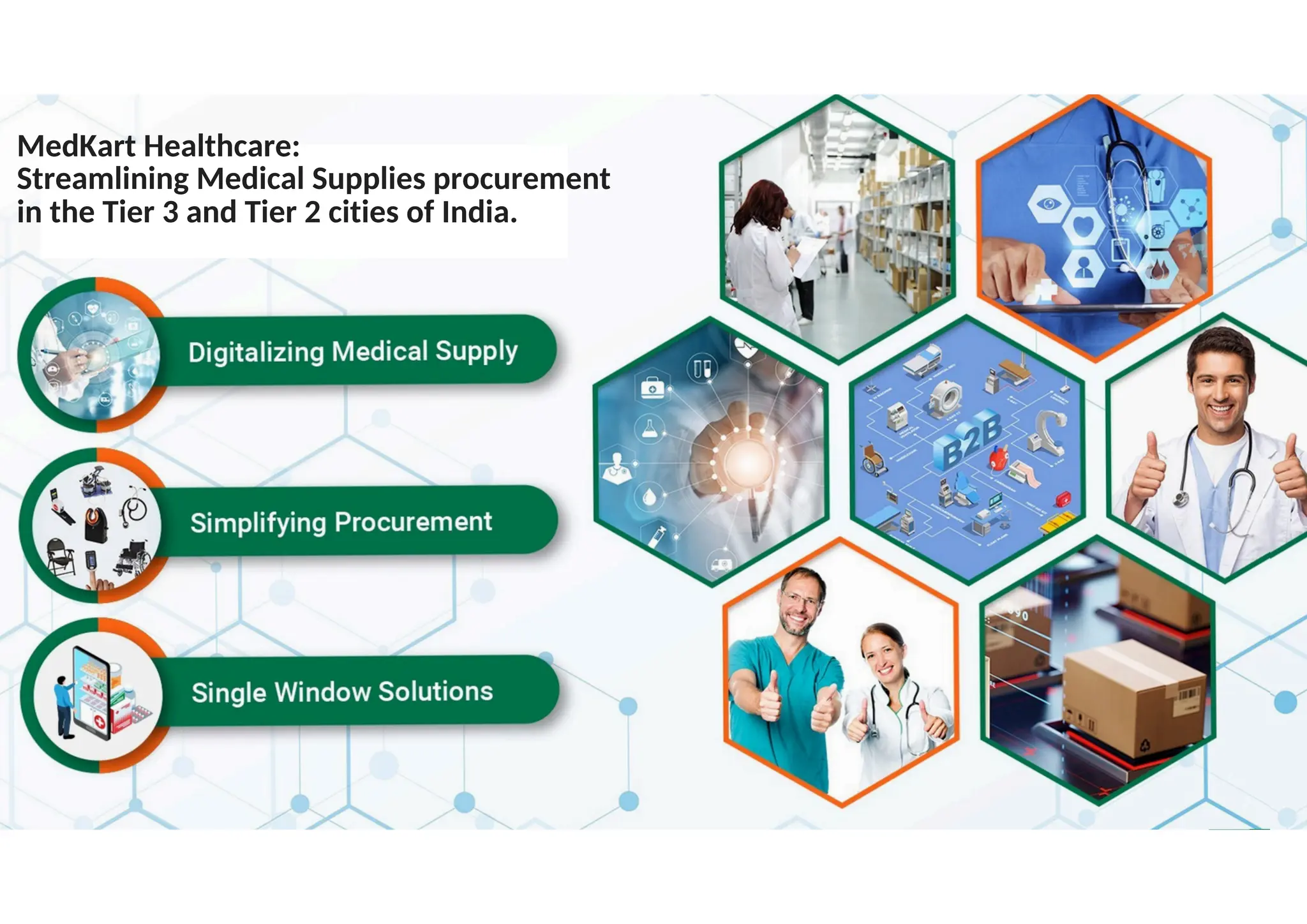
MedKart addresses the fragmented medical procurement landscape in India, specifically targeting Tier 2 and Tier 3 cities where supply chains are often manual and inefficient. The deck outlines a B2B marketplace model designed to provide a 'single window' for hospitals to manage inventory and procure equipment. With a $600k pre-seed ask, the company projects rapid scaling to a $24 million turnover and EBITDA positivity by year three. While the deck successfully identifies a massive $50B market opportunity in India and showcases a strong list of associated brands like 3M and Abbott, it lacks a…
Key takeaways
- The company is seeking $600k (Rs. 5 Cr) in a pre-seed round to fund 12 months of operations (Slide 10).
- MedKart targets the Indian medical device market, estimated to reach $50B by 2030 with a 16.4% CAGR (Slide 4).
- The business model is multi-faceted, including transaction margins, financing/leasing, and subscription-based tech tools (Slide 7).
- MedKart claims to have ties with over 100 brands, including major names like Johnson & Johnson, Abbott, and Roche (Slide 6).
- The go-to-market strategy focuses on 25-400 bed multi-speciality hospitals that currently rely on manual inventory management (Slide 5).
- Financial projections estimate revenue growing from INR 44.9 million in Year 1 to INR 6,590.8 million in Year 5 (Slide 8).
- The fund allocation plan designates 30% for operations, 28% for business development, 22% for manpower, and 20% for technology (Slide 8).
- The deck omits a team slide, which is a critical missing component for a pre-seed investment evaluation.
Executive Summary: The Digital Transformation of Indian Medical Procurement
MedKart presents a classic B2B marketplace play aimed at one of the most inefficient sectors in the Indian economy: medical supply chains in non-metropolitan areas. The deck outlines a transition from manual, fragmented procurement to a centralized digital platform. With a modest $600k ask, the company is positioning itself for a high-growth trajectory in a market poised to quintuple in size by 2030.
Slide 1: Title and Value Proposition
The opening slide clearly defines the company's niche: 'Streamlining Medical Supplies procurement in the Tier 3 and Tier 2 cities of India.' It highlights three core pillars: Digitalizing Medical Supply, Simplifying Procurement, and Single Window Solutions. The imagery uses a hexagonal grid featuring medical professionals and logistics, immediately signaling a B2B healthcare-meets-logistics focus.
Slide 2: Vision Statement
The vision is 'To be one of the most reliable and largest medical supplies platform in the world focusing on the quality and affordability to its core.' While the vision is global, the rest of the deck remains strictly focused on the Indian domestic market, which is a more realistic starting point for a pre-seed venture.
Slide 3: New Dimension to Business
This slide uses a pyramid graphic to explain the operational benefits. At the base is 'Access to wide range of products,' leading up to 'Data-driven decision making' and 'Inventory optimization.' Key metrics mentioned here include a 'Minimum 12% to 14% of cost saving' for customers and 'Higher cash flows' resulting from minimized inventory days. This slide effectively communicates the 'why' for the customer.
Slide 4: Market Size and Opportunity
MedKart provides a detailed breakdown of the market. They cite the Indian medical device market at $11 Billion in 2020, growing to $50 Billion by 2030 at a CAGR of 16.4%. Crucially, they identify their Serviceable Addressable Market (SAM) as $3.3B. The slide also mentions a goal to touch a GMV of 5,000 crore INR by 2030 with a Net Revenue of 15%. The inclusion of both global and local data helps frame the scale of the opportunity.
Slide 5: Go-To-Market Strategy
The GTM strategy is segmented by geography and customer type. They are targeting 25-400 bed multi-speciality hospitals that currently rely on manual inventory management. The geographic rollout is split into Phase 1 (Delhi NCR, Haryana, Punjab, UP, Uttarakhand) and Phase 2 (East, North-East, and South India). This phased approach suggests a logical, regional expansion plan rather than trying to boil the ocean at once.
Slide 6: Associated Brands & Customers
This is a credibility slide. It lists over 100 brands, including major logos like 3M, Abbott, Johnson & Johnson, and Roche. On the customer side, it lists hospital groups like Cloudnine, Saroj, and Ujala Cygnus. The slide notes that MedKart is onboarding 21 hospitals in Tier II & III in North India. This provides the first hint of actual traction, though it doesn't specify if these are active paying customers or just 'onboarded' to the platform.
Slide 7: Business Model
Product Supply: Margin/Transaction-based revenue. · Finance Wing: Financing/leasing medical equipment. · Tech Tool: Subscription-based revenue for optimization and MIS tools. · Ad Window: Advertisement revenue from principal companies.
This diversified model shows the founders are thinking about multiple ways to monetize the data and relationships they build, moving beyond simple brokerage.
Slide 8: Financials (Post Fund Raise)
The financial table provides a five-year projection. Year 1 shows revenue of INR 44.9 million with a 30.1% EBITDA loss. By Year 3, they project revenue of INR 1,387.4 million and a flip to a 1.1% EBITDA profit. By Year 5, revenue is projected at INR 6,590.8 million with an 11.2% EBITDA margin. The slide also includes a 'Fund Allocation %' pie chart: 30% Operation, 28% Business Development, 22% Manpower, and 20% Technology.
Slide 9: Product Development and Use of Funds
This slide elaborates on the $600k ask. The funds are earmarked for:
Building a B2B online marketplace with a digital catalogue of over 300k products. · Point of Sale/Distribution in the Top 20 Cities of India. · Investing in the full technology stack and supply chain infrastructure. · Building a core team of executive people.
The mention of a 300k product catalogue is an ambitious target for a pre-seed stage company.
Slide 10: Why To Invest
The final slide summarizes the pitch. It states MedKart started its journey on Dec 23, 2024 (which appears to be a future date relative to typical deck creation, or a typo for 2023). It reiterates the $24 million turnover goal and the $600k (Rs. 5 Cr) pre-seed ask for the next 12 months of operation. It frames the investment as a way to 'propel us to the next level.'
What Works in This Deck
The deck is very clear about the problem it is solving and the specific geographic market it is targeting. The focus on Tier 2 and Tier 3 cities is a smart differentiation from larger competitors who often focus on Tier 1 metros. The business model slide is comprehensive, showing a path to high-margin software and finance revenue alongside lower-margin product sales. The inclusion of recognizable brand logos (3M, Abbott) adds immediate institutional credibility to a pre-seed startup.
What Is Missing
The most glaring omission is a Team Slide . In a pre-seed round, investors are primarily betting on the founders' ability to execute. Without knowing who is behind the company, their backgrounds in healthcare or logistics, or their previous successes, it is difficult to validate the aggressive growth projections. Additionally, there is a lack of Unit Economics . While they mention a 15% net revenue target, they don't break down the cost of customer acquisition (CAC) versus the lifetime value (LTV), which is critical for a marketplace model. Finally, the Competition Slide is missing; the deck assumes a vacuum, ignoring existing players like PharmEasy, Retailio, or Moglix that might be encroaching on this space.
Founder's Guide: What to Copy and What to Avoid
Copy the Market Sizing: Slide 4 is a great example of how to break down TAM, SAM, and SOM. It uses credible growth rates and links the macro-opportunity (the sunrise sector) to the company's specific revenue goals. Copy the Credibility Slide: If you have relationships with major brands, show them. Slide 6 does this well by separating suppliers from customers, showing a healthy ecosystem.
Avoid the 'Future Date' Typo: Slide 10 mentions a start date of Dec 23, 2024. If this is a typo, it suggests a lack of attention to detail. If it is a projected start date, it makes the 'traction' mentioned in Slide 6 confusing. Avoid Omission of the Team: Never send a deck without a team slide. At the pre-seed stage, the team is 80% of the investment decision. Avoid Overly Aggressive Financials: Projecting a jump from 44 million to 6.5 billion in revenue over five years requires a massive amount of capital and flawless execution; without a detailed 'how' (like a hiring plan or specific marketing spend), these numbers can look like 'spreadsheet math' to experienced investors.
Frequently asked questions
- What is MedKart's primary value proposition?
- MedKart positions itself as a 'single window' digital solution for medical supply procurement in India's Tier 2 and Tier 3 cities. According to Slide 3, they aim to provide inventory optimization, data-driven decision-making, and a minimum of 12% to 14% cost savings for healthcare facilities that currently manage procurement manually.
- How does the company plan to generate revenue?
- As shown on Slide 7, the revenue model is diversified. It includes transaction-based margins on product supply, a 'Finance Wing' for financing or leasing medical equipment, subscription-based technology tools for asset management and MIS, and an 'Ad Window' for principal companies to advertise on the platform.
- What is the specific market opportunity MedKart is chasing?
- Slide 4 identifies the Indian medical device market as a 'Sunrise Sector.' While the global market is $800B, MedKart focuses on the $11B Indian market (2020), which is expected to grow to $50B by 2030. They specifically identify a Serviceable Addressable Market (SAM) of $3.3B within India.
- What are the projected financial milestones?
- According to Slide 10, MedKart expects to reach a turnover of INR 200 Cr ($24 million) by the end of its third year. The financial table on Slide 8 shows they expect to turn EBITDA positive in Year 3 (1.1%) and reach an 11.2% EBITDA margin by Year 5.
- How will the $600k investment be utilized?
- Slide 9 and 8 detail the use of funds. The $600k is intended for building digital supply infrastructure, product development, and hiring an initial employee base. Specifically, 30% goes to operations, 28% to business development, 22% to manpower, and 20% to technology development.