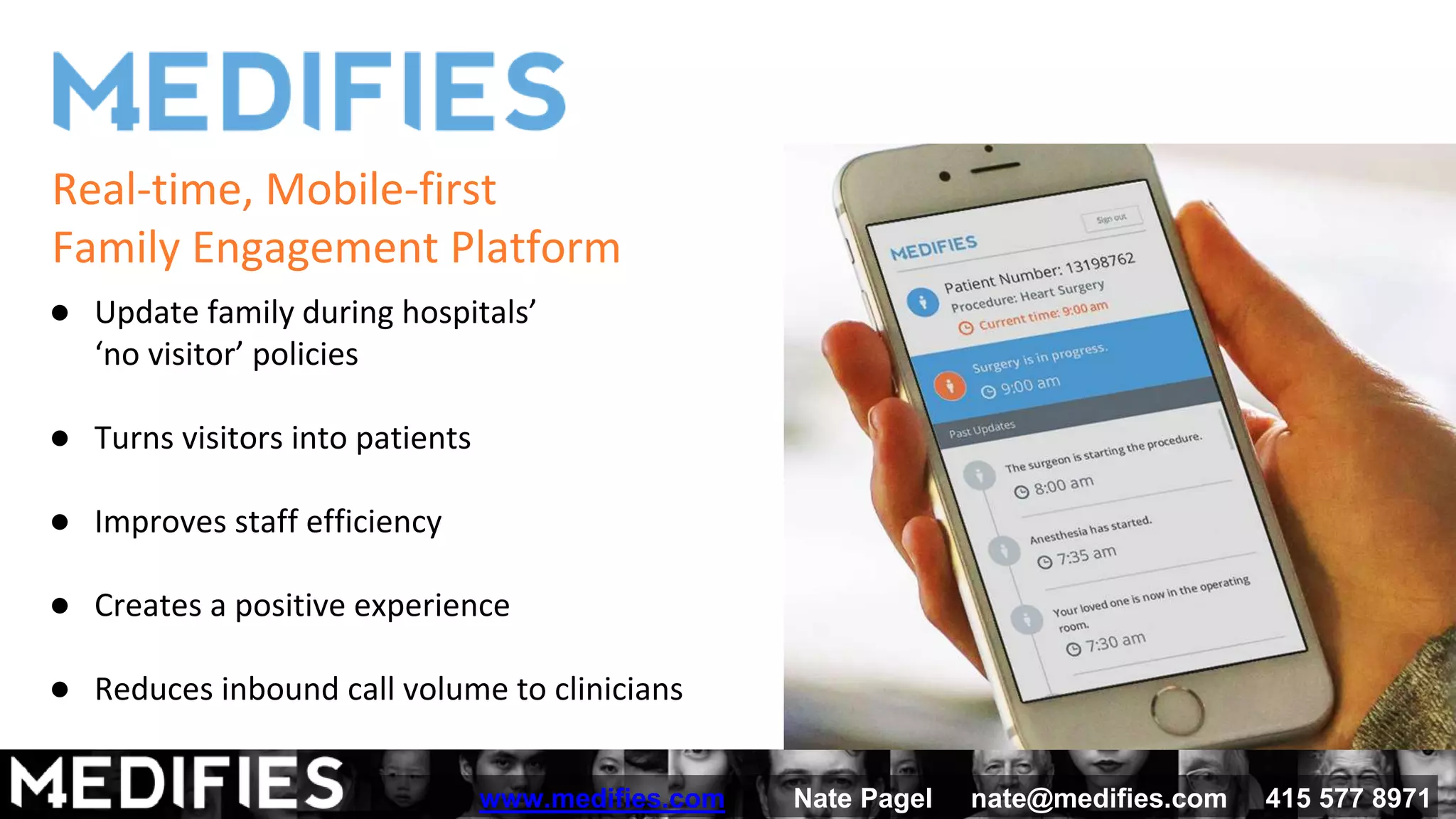
Medifies is a real-time, mobile-first family engagement platform that addresses the communication gap in hospitals, particularly during 'no visitor' policies enforced by the COVID-19 pandemic. The deck highlights a clear pain point: the inefficiency of manual family updates which leads to high inbound call volumes and poor satisfaction scores. With $550k in SAFE investment already raised, the company seeks further funding to scale its presence in major health systems like Ascension and HCA. The deck is notable for its specific focus on the pandemic as a catalyst for adoption, projecting a jum…
Key takeaways
- The platform aims to reduce inbound call volume to clinicians, which reportedly increases fivefold during visitor restrictions (Slide 5).
- Medifies claims a single double mastectomy procedure resulted in 21 people being added to the platform by one patient (Slide 8).
- The company identifies a specific lead generation opportunity, noting that 4 out of 21 contacts in a sample case were direct relatives who should be genetically tested (Slide 8).
- Traction is demonstrated through a pilot with Ascension Indiana, which represents a total of 23 hospitals (Slide 12).
- The financial model projects a massive revenue scale from $78,000 in 2019 to $56,073,600 by 2023 (Slide 14).
- Medifies has already raised $550k via SAFE, with participation from Jumpstart Capital and the founders (Slide 14).
- The exit strategy focuses on acquisition, citing Cerner's $21B market cap and various digital health acquisitions ranging from $18M to $200M (Slide 18).
- A Board of Advisors slide features six individuals with deep ties to HCA, Stanford Health Care, and UCSF, but a dedicated core management slide is missing (Slide 20).
Medifies Pitch Deck Teardown
The Medifies deck is a product of its time, specifically tailored to the immediate needs of the healthcare industry during the early stages of the COVID-19 pandemic. It positions a communication tool not just as a convenience, but as a clinical necessity for hospitals operating under strict 'no visitor' mandates. The deck is lean, data-driven in its projections, and heavily reliant on external validation through its advisory board.
Slide 1: Title and Value Proposition
The opening slide establishes Medifies as a 'Real-time, Mobile-first Family Engagement Platform.' It immediately lists five key benefits: updating families during 'no visitor' policies, turning visitors into patients, improving staff efficiency, creating a positive experience, and reducing inbound calls. The visual of a smartphone showing a surgery progress timeline (e.g., 'Anesthesia has started,' 'Surgery is in progress') clearly communicates the product's core function.
Slide 5: The Problem - Waiting Room Inefficiency
This slide highlights the 'Hospital Waiting Room Experience' as the primary pain point. It uses a photo of a 'No Visitors' sign due to Coronavirus to create urgency. The slide argues that current solutions—expensive waiting room monitors—are 'useless.' The most compelling metric here is the claim that staff time is wasted on a '5x inbound call volume' when families cannot be physically present to receive updates.
Slide 8: Case Study - Real Procedure Data
Medifies uses a specific example of a double mastectomy to demonstrate the platform's viral potential and data value. According to the slide, 21 people were added to the platform for this one procedure. The slide identifies a secondary business model: 17 of the registered users were female and 4 were direct relatives who 'should be genetically tested.' This suggests the platform serves as a high-intent lead generation engine for hospitals.
Slide 10: COVID-19 Specific Features
Titled 'Medifies COVID19,' this slide lists features 'Available soon,' including case-specific messaging, multiple languages, HIPAA compliance, and automatic contact tracing. The inclusion of contact tracing indicates the company's attempt to pivot or expand its utility to meet the specific public health requirements of the pandemic era.
Slide 12: Go to Market & Traction
The deck shows a screenshot of an 'Ascension Information Services' form. It highlights a pilot at 'St. Vincent Evansville' with a note that success there leads to 'All Indiana,' which the slide clarifies represents 23 hospitals. This is a strong way to show a clear path to scale within a major health system rather than just listing names of interested parties.
Slide 14: Fundraising and Milestones
The company discloses it has 'Raised $550k SAFE to date' from founders and Jumpstart Capital, noting that no salaries are currently being paid. The goals for 2020 include taking Ascension, HCA, and Miami Surgical live, hiring a regional sales team, and reaching $1.9M ARR to hit breakeven. The logos of Tenet Health, Ascension, Miami Surgical Center, and HCA Healthcare are displayed to imply deep institutional relationships.
Slide 16: Reiteration of Value
This slide repeats the core value propositions from the title slide: turning visitors into patients, improving staff efficiency, and creating a positive experience. It serves as a transition into the final financial and exit sections of the deck.
Slide 14 (Repeated Numbering): Financial Projections
The P&L table provides a five-year outlook. It shows a significant inflection point in 2020, where revenue is projected to grow from $78,000 to $1,870,000. By 2023, the company projects $56,073,600 in total revenue from 390 customers. Interestingly, the 'Cost of Goods Sold' line is left blank, and the 'Investments by year' row shows a need for $2,000,000 in 2020 to fuel this growth.
Slide 18: Exit Scenario - Acquisition
This slide focuses on the 'CEO has been a part of 5 exits to date,' though it does not name the CEO on this specific slide (Nate Pagel is in the footer). It lists several acquisitions by Cerner, Stericycle, McKesson, and others to prove the liquidity of the digital health market. It concludes with a bold claim: 'If we exit in 2023 with $20M revenue... return on Seed round would be approximately 20x.'
Slide 20: Board of Advisors
The final slide in the provided set lists six advisors. The profiles are impressive, including a former SVP from HCA, the Director of Sourcing at Stanford Health Care, and several MDs from UCSF and Sutter Memorial. This slide is clearly intended to compensate for the lack of a detailed management team slide by showing that the company is guided by industry veterans.
What Medifies Does Well
Urgency and Relevance: The deck masterfully ties its product to the immediate crisis of COVID-19. By showing how 'no visitor' policies create a specific, measurable burden on hospital staff (5x call volume), they turn a 'nice-to-have' communication tool into a 'must-have' operational efficiency tool.
Secondary Value Proposition: The mention of genetic testing leads on Slide 8 is a sophisticated touch. It shows investors that the company understands the broader hospital business model (patient acquisition) rather than just focusing on the software's user interface.
Clear Traction Path: Instead of vague 'conversations,' Slide 12 shows the actual administrative paperwork for a pilot, providing a tangible sense of progress.
What is Missing from the Medifies Deck
Core Team Slide: While the Board of Advisors is strong, the deck lacks a slide dedicated to the founders and the people building the product day-to-day. Investors fund teams, not just ideas or advisors.
Unit Economics: The financial slide lists 'Cost of Goods Sold' as a line item but provides no data for it. For a SaaS company, understanding the margin and the cost to acquire a customer (CAC) versus the lifetime value (LTV) is critical, especially when projecting a jump to $56M in revenue.
Product Depth: We see the family-facing side of the app, but there is no visual representation of the clinician-facing side. How does a nurse or surgeon actually input these updates? If it requires manual entry, it might actually decrease efficiency, contradicting their main value prop.
What You Should Copy for Your Own Deck
The 'Why Now' Slide: Use external market shifts (like the pandemic in this case) to explain why your solution is suddenly mandatory. Medifies does this perfectly on Slide 5.
Evidence of Internal Buy-in: If you are in a pilot, show the actual forms or internal documents (redacted if necessary) that prove you are moving through the organization's procurement process. It is much more convincing than a logo list.
Advisor Credibility: If your core team is small or lacks industry-specific exits, leverage a 'Board of Advisors' slide to show that you have the right mentors to navigate complex regulatory environments like healthcare.
Specific Exit Comparables: Don't just say 'we will be acquired.' List specific companies that have been acquired in your space, the price they sold for, and the multiples they achieved. This shows you have a realistic understanding of the endgame.
Frequently asked questions
- What is the primary problem Medifies solves?
- Medifies addresses the 'Hospital Waiting Room Experience,' specifically during 'no visitor' policies. It aims to replace 'useless, expensive waiting room monitors' with a mobile-first update system. By automating updates, it reduces the burden on nurses and surgeons who otherwise face a 5x increase in inbound calls from worried family members, which negatively impacts Medicare reimbursement scores.
- How does Medifies plan to generate revenue beyond software fees?
- Slide 8 suggests a 'patient recruitment' angle. By capturing the contact information of a patient's family and friends, the platform identifies potential new patients. For example, in a mastectomy case, the deck notes that four registered contacts were direct relatives who 'should be genetically tested,' implying the platform acts as a lead generation tool for hospital services.
- What is the current funding status of the company?
- According to Slide 14, Medifies has raised $550,000 to date through a SAFE (Simple Agreement for Future Equity). The investors include the founders and Jumpstart Capital. The slide also notes that, at the time of the deck's creation, no salaries were being taken, and they were seeking additional SAFE investment for 2020.
- What are the projected financials for the company?
- The projections on Slide 14 are extremely aggressive. They show revenue holding steady at $78,000 for 2018 and 2019, then jumping to $1.87M in 2020, $7.15M in 2021, and reaching $56.07M by 2023. This growth is predicated on increasing the customer count from 1 to 390 over that five-year period.
- Who is leading the company?
- The deck is unusual because it does not have a standard 'Team' slide showcasing the founders' backgrounds. Instead, it mentions that the 'CEO has been a part of 5 exits to date' on Slide 18 and provides a 'Board of Advisors' on Slide 20. Nate Pagel is listed as the contact person on the footer of every slide.