Medirom Healthcare Technologies (NASDAQ: MRM) operates a dual-track business model in Japan, combining a large-scale wellness salon network with digital health technology. As of late 2022, their Re.Ra.Ku brand managed 312 stores, while their digital arm launched the MOTHER Bracelet, a self-charging fitness tracker utilizing thermoelectric and solar power. The deck highlights a transition from a net loss of 990,731 thousand Yen in 2021 to a net income of 148,965 thousand Yen in 2022. While the physical salon business remains the primary revenue driver (86% of total revenue), the deck emphasize…
Key takeaways
- The company operates 312 wellness salons under the Re.Ra.Ku brand as of December 31, 2022 (Slide 4).
- Medirom acquired 100% of high-end hair salon ZACC by January 2022 to expand its luxury beauty segment (Slide 4).
- The MOTHER Bracelet is a self-charging wearable that uses a thermoelectric generator and solar power to eliminate the need for manual charging (Slide 13).
- The digital health segment includes 'Lav', a smartphone app for remote weight loss programs tied to government insurance (Slide 4).
- Total revenue grew from 5,409,825 thousand Yen in 2021 to 6,954,057 thousand Yen in 2022 (Slide 22).
- The company achieved an Adjusted EBITDA margin of 4.2% in 2022, up from a negative 1.4% in 2021 (Slide 22).
- Medirom partners with blue-chip corporations like Fujitsu General Japan and Daikin for health guidance programs (Slide 19).
- The management team is led by founder Kouji Eguchi, who established the Re.Ra.Ku brand in 2000 (Slide 25).
Medirom Healthcare Technologies: A Hybrid Play on Physical and Digital Wellness
Medirom Healthcare Technologies (NASDAQ: MRM) presents a unique case study in the wellness sector. Unlike pure-play software startups, Medirom is a mature, publicly traded entity that has successfully bridged the gap between traditional brick-and-mortar services and high-tech health monitoring. This teardown analyzes their September 2023 investor presentation, which details their transition from a salon operator to a diversified healthcare technology company.
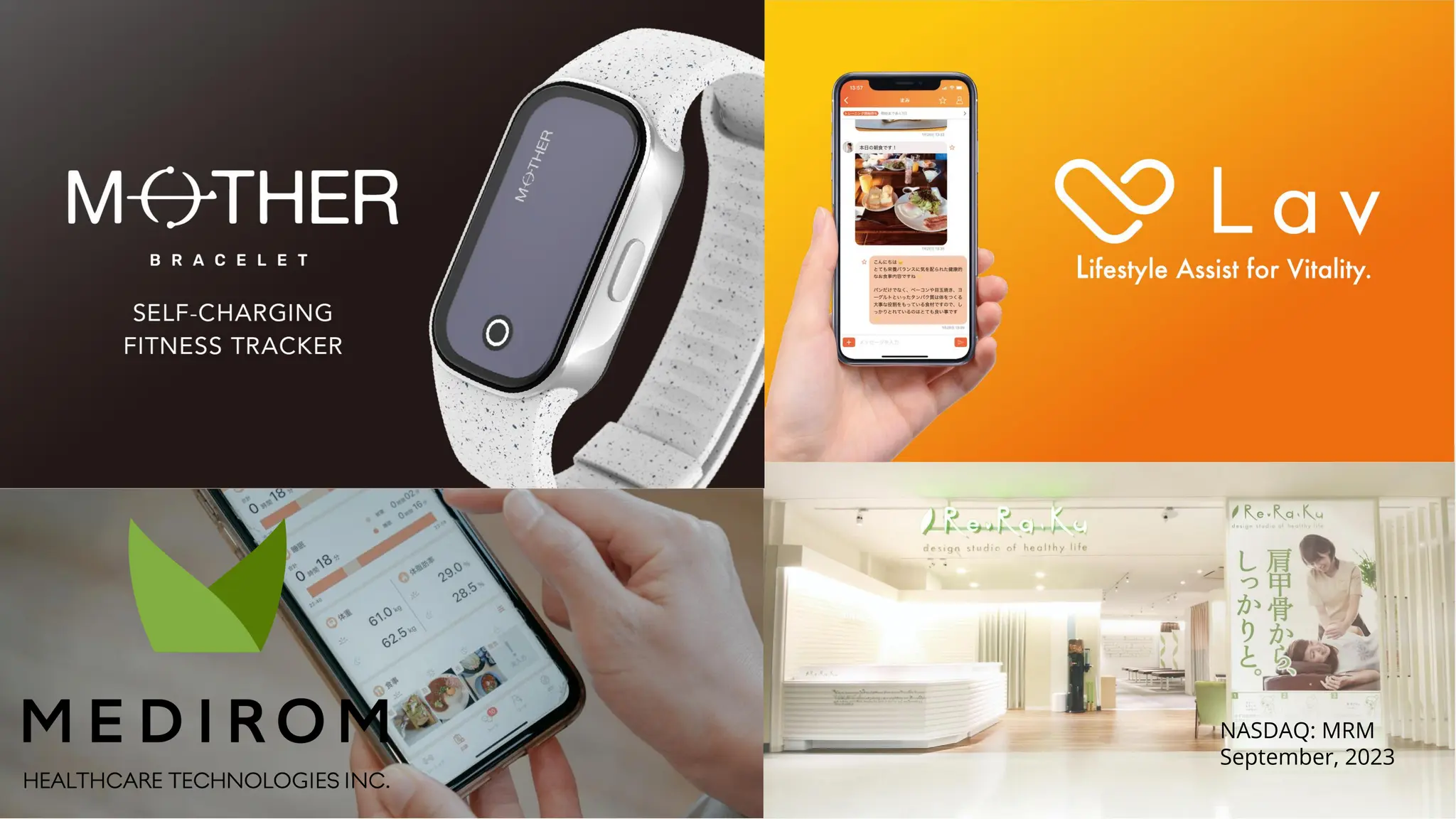
Slide 1: Title and Brand Overview
The cover slide establishes the four pillars of the Medirom ecosystem: the MOTHER Bracelet (hardware), the Lav app (software), the Medirom corporate brand, and the Re.Ra.Ku salon brand. It explicitly notes the company's NASDAQ ticker (MRM) and dates the presentation to September 2023. This slide effectively communicates that the company is not just a service provider but a multi-faceted technology group.
Slide 4: Company Highlights
This slide provides the hard data on the company's scale. The Wellness Salon Business is anchored by Re.Ra.Ku, which boasts 312 stores across Japan as of December 31, 2022. The mix of 199 directly-owned and 113 franchise salons suggests a strategy that balances control with scalable growth. The slide also mentions the acquisition of ZACC, a high-end hair salon brand, indicating a push into the luxury beauty market. On the digital side, it introduces the MOTHER Bracelet (launched in 2022) and the Lav app, which is positioned as a remote weight loss program tied to government insurance—a critical detail for understanding their B2B2C revenue model.
Slide 7 & 10: Segment Introductions
Slide 7 serves as a transition to the Wellness Salon Business, emphasizing 'high quality, innovative preventive solutions.' Slide 10 transitions to the Digital Preventative Healthcare Technology segment. It showcases the hardware (MOTHER Bracelet and its gateway hub) alongside the software interface for both mobile and desktop. The inclusion of a centralized monitoring system on Slide 10 hints at institutional applications beyond individual consumer use.
Slide 13: The MOTHER Bracelet Technology
This is the core product slide for their hardware division. It identifies 'Three Reasons for being Recharge-Free.' First, a thermoelectric generator developed by Matrix Industries in Silicon Valley, which uses body heat. Second, a TDK solar panel for indoor and outdoor light harvesting. Third, a low-power algorithm. By focusing on the 'recharge-free' aspect, Medirom addresses the primary friction point of wearable devices: battery life and charging fatigue. The exploded view of the device adds technical credibility to these claims.
Slide 16: Multi-Sector Application
Slide 16 illustrates the versatility of their monitoring technology. It lists four specific use cases: Physician Rounds, Nursing Rounds/Temperature Checks, Drivers' Health Status Real-Time Monitoring, and Clinical Trials. The inclusion of taxi drivers and clinical trials suggests that Medirom is targeting enterprise contracts where continuous health data is a safety or regulatory requirement, moving beyond the crowded consumer fitness tracker market.
Slide 19: Specific Health Guidance Business
This slide outlines a complex ecosystem involving the Japanese government (Ministry of Health, Labor and Welfare), health insurance providers, and service provider companies (Medirom). It names 'blue chip' partners including Fujitsu General Japan, Daikin, and Kokuyo. The flow chart explains how Medirom's Lav app facilitates coaching for insured persons, with results reported back to the government. This demonstrates a sophisticated understanding of the Japanese regulatory environment and a clear path to non-consumer revenue.
Slide 22: Income Statement
The financial slide provides a two-year comparison (2021 vs. 2022) in both Japanese Yen and U.S. Dollars. Key figures include:
Total Revenue: Grew from 5,409,825k Yen to 6,954,057k Yen. · Operating Income: Swung from a loss of 470,587k Yen to a profit of 96,967k Yen. · Net Income: Improved from a loss of 990,731k Yen to a profit of 148,965k Yen. · Adjusted EBITDA: Rose to 293,931k Yen (4.2% margin).
The breakdown shows that while the salon business is the giant, the Digital Preventative Healthcare segment saw massive relative growth, jumping from 43,965k Yen to 386,383k Yen in a single year.
Slide 25: Key Management Team and Board
The team slide features four key figures. Kouji Eguchi (Founder and CEO) is highlighted for his long tenure, having established Re.Ra.Ku in 2000. Fumitoshi Fujiwara (CFO) brings experience from AC Capital and Eaglestone Capital. The presence of outside directors Tomoya Ogawa (formerly of DeNA) and Akira Nojima (formerly of Recruit Co.) suggests a board with significant experience in Japanese tech and beauty industries. The bios focus on long-term industry stability rather than 'serial entrepreneur' hype.
Slide 28: Appendix
The final slide is a simple placeholder for additional information, marking the end of the core narrative. The deck is structured to move from established physical dominance to future-facing technological innovation, backed by audited financial recovery.
What Medirom Healthcare Technologies Does Well
The deck excels at demonstrating a proven business model . Unlike many healthcare startups that rely on projected user growth, Medirom leads with its 312 physical locations and actual revenue figures. This 'real-world' foundation gives investors confidence that the company can fund its R&D through existing operations.
The technical explanation of the MOTHER Bracelet on Slide 13 is also a highlight. Instead of using vague marketing terms, it cites specific technologies (thermoelectric generators) and partners (Matrix Industries, TDK). This level of detail is necessary to convince investors that their hardware can actually compete with giants like Apple or Fitbit by offering a unique utility: no charging.
Finally, the regulatory integration shown on Slide 19 is a masterclass in explaining a B2B2G (Business to Business to Government) model. By showing how they fit into the Japanese Ministry of Health's framework, they demonstrate a high barrier to entry for foreign competitors.
What is Missing from the Deck
Despite the strong financial reporting, the deck lacks unit economics for the digital segment . While we see total revenue for digital healthcare, we don't see the Customer Acquisition Cost (CAC) or Lifetime Value (LTV) for the Lav app or the MOTHER Bracelet. For a segment that grew nearly 9x in one year, these metrics are vital for understanding future profitability.
There is also a lack of competitive analysis . The deck assumes a vacuum. In the wearable space, they are competing with global tech titans; in the salon space, they face local fragmentation. A slide addressing how they maintain their moat against both types of competitors would have strengthened the case.
Lastly, the 'The Ask' is missing . As a public company presentation, this is common, but for a fundraising teardown, it's worth noting that there is no specific request for capital or a stated use of proceeds. This is a 'status update' deck rather than a 'pitch' deck.
What Other Founders Should Copy
Founders should emulate the segmentation of revenue found on Slide 22. By clearly separating 'Relaxation Salon,' 'Luxury Beauty,' and 'Digital Preventative Healthcare,' Medirom allows investors to value different parts of the business appropriately. This is especially useful for companies in transition.
The use of partner logos and government frameworks (Slide 19) is another takeaway. If your startup operates in a regulated industry, showing the flow of 'Permission' and 'Report Results' between you and the authorities is the fastest way to prove your business is legitimate and defensible.
Finally, the visual consistency of the deck—using a clean, green-accented theme that matches their logo—creates a professional, institutional feel. It avoids the cluttered 'tech-bro' aesthetic in favor of something that looks like a healthcare company.
Frequently asked questions
- What is the primary source of revenue for Medirom?
- According to the Income Statement on Slide 22, the Relaxation Salon business is the primary driver, generating 5,972,913 thousand Yen in 2022. This represents approximately 86% of the company's total consolidated revenue of 6,954,057 thousand Yen. While Digital Preventative Healthcare is growing, it contributed 386,383 thousand Yen in the same period.
- How does the MOTHER Bracelet stay charged without a plug?
- Slide 13 explains that the device uses a combination of two technologies: a thermoelectric generator that converts the temperature difference between skin and air into power, and a TDK solar panel that generates electricity from both sunlight and indoor lighting. This dual-source system allows for constant power generation without external charging.
- What is the 'Lav' application mentioned in the deck?
- As described on Slide 4 and Slide 19, Lav is an internally developed smartphone app for health monitoring. It functions as a digital platform connecting individuals with healthcare professionals for remote weight loss programs. It is specifically integrated into government-supported health guidance programs in Japan.
- Is Medirom currently profitable?
- Yes, based on the 2022 year-end data on Slide 22. The company reported a net income of 148,965 thousand Yen (approximately $1,130 thousand USD) for 2022. This was a significant turnaround from the 990,731 thousand Yen net loss reported for the fiscal year 2021.
- What is the scale of Medirom's physical salon network?
- Slide 4 states that as of December 31, 2022, Medirom has over 312 stores throughout Japan. This network consists of 199 directly-owned salons and 113 franchise salons. The flagship brand for these locations is Re.Ra.Ku, which focuses on wellness and innovative preventive solutions.