Media Glass, based in Rio de Janeiro, presented a pitch deck in 2015 for a R$ 200.000,00 convertible debt offering. The company positioned itself as a pioneer in the Brazilian 'Smart Glass' and wearables market, specifically targeting enterprise solutions. Their business model relied on two primary revenue streams: custom application development at a fixed price of R$ 6 mil per fortnight and Google Glass hardware rentals for R$ 1 mil. While the deck highlights early projects for clients like Gefco and Queiroz Galvão, it functions more as a formal investment prospectus than a narrative-driven…
Key takeaways
- The company sought a total investment of R$ 200.000,00 in exchange for a 15% social participation stake (Slide 2).
- The offering was structured as convertible debt with a 5-year term and a 3% annual interest rate (Slide 2).
- Media Glass operated a service-based model charging R$ 6.000,00 per fortnight for custom development (Slide 5).
- Revenue was supplemented by renting Google Glass units for R$ 1.000,00 for specific corporate events or launches (Slide 5).
- Early traction included a car picking app prototype for Gefco and an integrity alert system for Queiroz Galvão Óleo e Gás (Slide 6).
- The deck explicitly lists 17 different performance indicators across finance, sales, marketing, and HR to be reported to investors (Slide 8).
- A significant portion of the deck is dedicated to legal risks, including the potential loss of conversion rights and lack of liquidity (Slide 9).
- The vision was to be recognized as the Brazilian leader in Smart Glass and Wearables by the year 2020 (Slide 3).
Media Glass: A 2015 Snapshot of the Brazilian Wearable Market
The Media Glass pitch deck is a fascinating artifact from the mid-2010s, a period when Google Glass was perceived as the next major frontier for enterprise productivity. Based in Rio de Janeiro, Media Glass Soluções Tecnológicas positioned itself not just as a software house, but as a specialized bridge between emerging wearable hardware and the Brazilian corporate sector. The deck is notably formal, functioning as a legal offering document for a direct public distribution of convertible debt, exempt from CVM registration under specific Brazilian instructions.
Slide 1: Title and Regulatory Disclosure
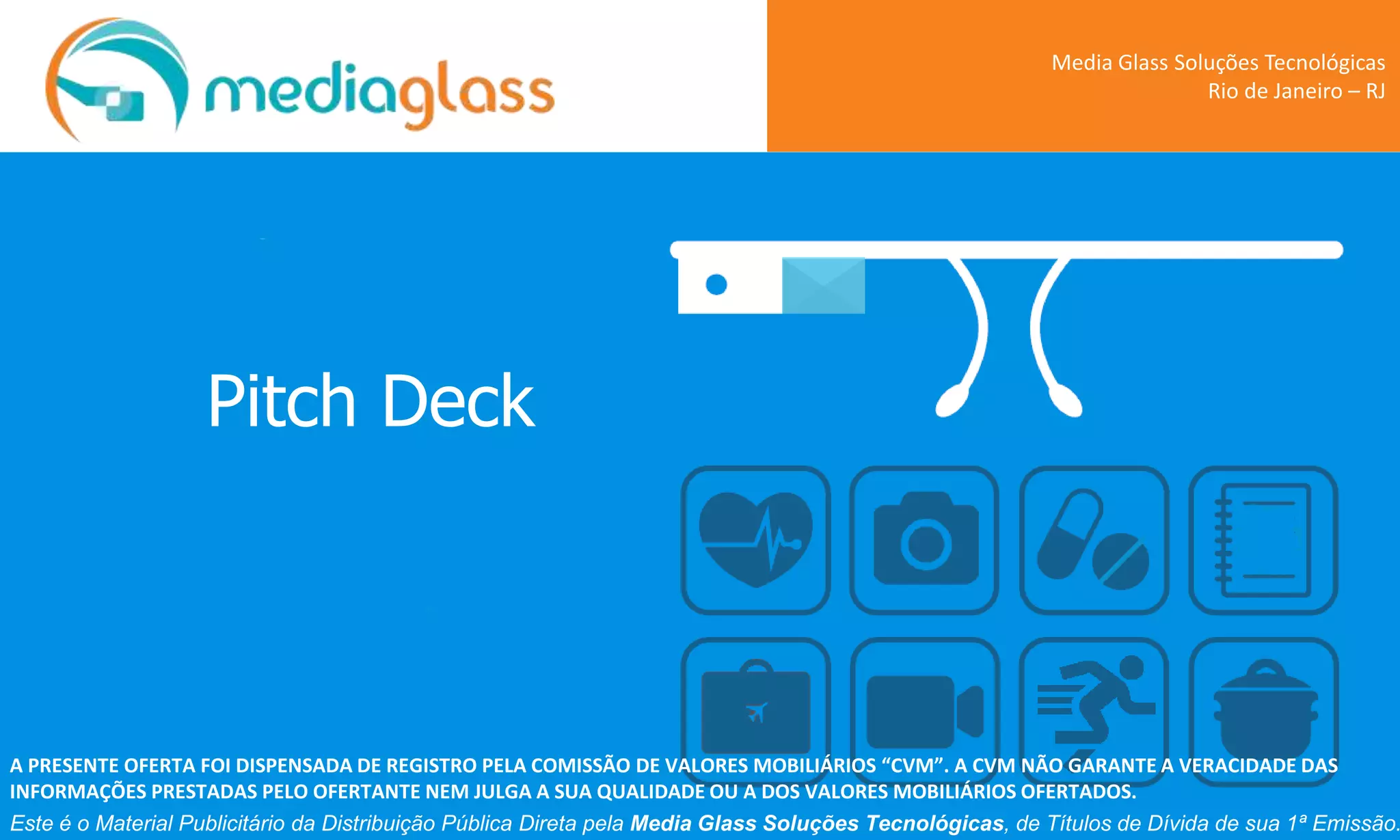
The cover slide establishes the brand identity with a logo featuring a stylized eye/lens icon. It clearly states the location as Rio de Janeiro – RJ. Crucially, the bottom of the slide contains a heavy legal disclaimer in Portuguese, noting that the offer is exempt from CVM (Comissão de Valores Mobiliários) registration and that the CVM does not guarantee the veracity of the information. This immediately signals that this is a formal fundraising document for a regulated 'Direct Public Distribution' of debt securities.
Slide 2: Terms of the Offering
This slide provides a granular breakdown of the financial ask. The 'Ofertante' is Media Glass Soluções Tecnológicas LTDA - ME. The 'Ativo Ofertado' (Offered Asset) is Convertible Debt Securities. Key figures include:
Total Emission Value: R$ 200.000,00. · Equity Stake: 15% social participation. · Series: Three series with unit values of R$ 1.000, R$ 5.000, and R$ 25.000. · Total Units: 56 titles. · Interest Rate: 3% per year. · Maturity: 5 years (July 2020).
This level of detail is rare in early-stage decks and reflects the requirements of the Broota crowdfunding platform mentioned later in the deck.
Slide 3: Mission and Vision
The company defines its mission as using new technologies to optimize business processes and generate efficiency. The vision is time-bound and specific: to be recognized as the leader in Brazil for Smart Glass and Wearables applications by 2020. It includes footnotes defining 'Smart Glass' as intelligent glasses and 'Wearables' as wearable devices, suggesting the founders felt the need to educate their audience on the category itself.
Slide 4: Market Timing (Why Now)
This slide uses a timeline to justify the 'Why Now' argument. It traces wearable history from Steve Mann's 1980 'Wearable Computer' through the launch of Google Glass in 2012 and its public opening in 2014. It also notes the announcement of the Apple Watch and Android Wear in late 2014. The timeline ends with a prediction of a 'clash of giants' in the wearable market from 2016 onwards, positioning Media Glass at the precipice of a major market shift.
Slide 5: Business Model
Media Glass presents two distinct revenue streams: 1. Project-based development: They budget application development at a fixed price of R$ 6.000,00 per fortnight ('quinzena'). 2. Hardware Rental: They rent Google Glass units for R$ 1.000,00 for specific corporate actions such as store openings, sporting events, or real estate launches. A footnote clarifies that if a client wants to buy the equipment, Media Glass handles the purchase and passes the cost through for reimbursement. This model suggests a service-heavy approach rather than a scalable SaaS product.
Slide 6: Traction and Case Studies
Titled 'O que já fizemos' (What we have already done), this slide showcases three projects:
Connect Cargas: An Android and iOS app for logistics. · Queiroz Galvão Óleo e Gás: A probe integrity alert system. · Gefco: A prototype app for 'Car Picking.'
The inclusion of Gefco and Queiroz Galvão, both significant industrial players, provides the company with enterprise credibility.
Slide 7: Market Expectations
This is a transition slide for Section III of the deck. While the following slides are not fully visible in this set, this slide indicates a structured approach to discussing market size and growth potential.
Slide 8: Performance Indicators (KPIs)
This slide is highly structured, listing the metrics the company commits to reporting to investors every four months via the Broota platform or email. The KPIs are categorized into:
Financial: Gross revenue, costs, revenue growth, expense division, and accumulated net profit. · Commercial: Leads generated, sales volume, conversion rate, and sales by type. · Marketing: Site visits, unique visitors, page views, and press mentions. · Projects/HR: Ongoing/started/concluded projects and head count.
This level of transparency is designed to build trust with retail investors in a crowdfunding context.
Slide 9: Risk Factors
A dense slide covering legal and financial risks. It warns of the 'Perda do direito de conversibilidade' (Loss of conversion rights) if the company fails to change its legal structure to a corporation. It also explicitly mentions 'Riscos de Crédito,' stating the company might not be able to pay the 3% interest if it lacks funds, and 'Perda do capital investido,' warning that this is a high-risk investment where the investor should be prepared to lose everything.
Slide 10: Contact Information
The final slide provides direct access to CEO Flávio França. It includes a professional email address, a Skype ID ('mediaglass'), and a mobile phone number. The persistent footer regarding the CVM disclosure remains present, maintaining the deck's status as a formal offering document.
What Media Glass Does Well
The deck is exceptionally transparent regarding the terms of the investment. By explicitly stating the valuation (implied by R$ 200k for 15%), the interest rate, and the reporting schedule, Media Glass removes the ambiguity that often plagues early-stage pitches. The business model is also refreshingly simple: they are a specialized dev shop that uses hardware rentals as a 'foot in the door' for larger software contracts. The inclusion of recognizable enterprise logos like Gefco provides necessary social proof for a technology that was, at the time, still considered experimental.
What is Missing from the Deck
The most glaring omission in these ten slides is a dedicated 'Team' slide. While the CEO is mentioned at the end, the technical pedigree of the developers building these complex wearable apps is not highlighted. There is also no detailed breakdown of the 'Market Size' (TAM/SAM/SOM) within the provided slides, nor is there a clear 'Competitor' analysis. Furthermore, the deck does not explain how the R$ 200.000,00 will be spent—there is no 'Use of Funds' breakdown to show if the capital is for hiring, hardware acquisition, or marketing.
Founder Takeaways
Founders should look at Slide 8 as a masterclass in 'Investor Relations Readiness.' Even if you aren't raising via a crowdfunding platform, having a pre-defined list of KPIs that you promise to report shows a level of maturity and accountability that professional investors value. Additionally, the 'Why Now' timeline on Slide 4 is a strong way to visualize market tailwinds. However, founders should avoid the 'service-only' trap shown in Slide 5 unless they intend to remain a boutique agency; for venture scale, investors typically want to see how a service model evolves into a scalable product.
Frequently asked questions
- What is the specific investment ask and structure?
- Media Glass sought R$ 200.000,00 through a convertible debt offering (Títulos de Dívida Conversíveis). The investment was split into three series with unit values of R$ 1.000, R$ 5.000, and R$ 25.000. The debt carried a 3% annual interest rate with a maturity date of July 2020, representing a 15% equity stake upon conversion.
- How does Media Glass generate revenue?
- The business model is two-fold. First, they charge a fixed price of R$ 6.000,00 per fortnight for custom software development projects. Second, they offer a rental service for Google Glass hardware at R$ 1.000,00 per unit for specific activations like store openings or real estate launches.
- What kind of traction did the company show in the deck?
- Slide 6 showcases three specific projects: a mobile app for 'Connect Cargas' (Android/iOS), a probe integrity alert system for the energy company Queiroz Galvão Óleo e Gás, and a specialized 'Car Picking' app prototype for the logistics firm Gefco.
- What are the primary risks disclosed to investors?
- The deck highlights risks related to the conversion of debt into equity, specifically noting that if the company does not transition to a 'sociedade por ações' (corporation), investors might be unable to convert. It also warns of a total loss of invested capital and a lack of liquidity for any shares received.
- Who is the lead contact for the company?
- The deck identifies Flávio França as the CEO of Media Glass. His contact information, including a corporate email, Skype handle, and a Rio de Janeiro-based mobile phone number, is provided on the final slide for investor inquiries.