Meniga’s 2023 deck is a masterclass in communicating a corporate turnaround and strategic simplification. Raising $16M in a Series D round, the company addresses its 'stagnant' past by proposing a 'Meniga Reinvented' framework. The deck focuses on consolidating a scattered product portfolio—which previously included disparate tools like Carbon Insights and Rewards—into three core pillars: Data, Insights, and Payments. By targeting a global market expected to grow from $517.1M in 2023 to over $1B by 2028, Meniga positions itself as a lean, insight-driven partner for tier-one banks like UniCred…
Key takeaways
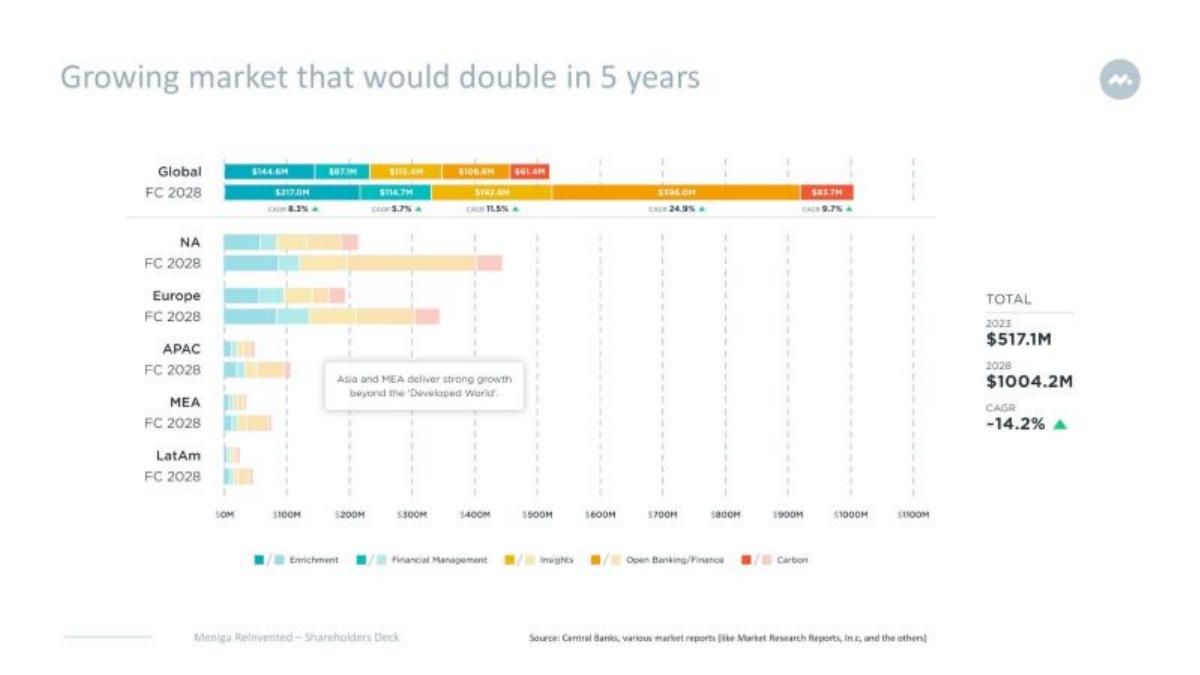
- The total addressable market is projected to grow from $517.1M in 2023 to $1004.2M by 2028, representing a 14.2% CAGR (Slide 2).
- Meniga is moving from a fragmented 'Today' portfolio of 7+ products to a 'Tomorrow' structure focused on Data, Insights, and Payments (Slide 4).
- The company identifies a €7.7M upsell opportunity within its existing customer base if all current clients licensed the full portfolio (Slide 5).
- Europe is designated as 'Priority Zero,' where the company already holds significant market share and seeks to build with new verticals (Slide 6).
- Revenue projections aim to move the company from 'stagnant' to doubling revenue over a 5-year period with a 15.7% CAGR (Slide 7).
- The internal organizational structure is being realigned into specific 'Farmers' (upselling) and 'Hunters' (new clients) teams under the Commercial branch (Slide 12).
- The deck lists high-profile clients including UniCredit, Groupe BPCE, Swedbank, and Adyen to establish enterprise-grade credibility (Slide 11).
- Strategic partners include industry heavyweights like Tink, TrueLayer, BCG, and Accenture (Slide 11).
Executive Summary: The Pivot to Precision
The Meniga 2023 Series D deck, titled Meniga Reinvented , serves as a strategic roadmap for a company transitioning from a broad, feature-heavy fintech provider to a focused data insights platform. With a $16M raise, the company addresses the common 'Series D' challenge: how to reignite growth after reaching maturity. The deck is structured as a townhall-style presentation, emphasizing internal alignment and a clear shift in mission. It moves away from a 'stagnant' revenue model toward a projected doubling of revenue over five years, underpinned by a 14.2% market CAGR in the open banking and financial management sectors.
Slide 1: Title Slide
The opening slide sets a sober, professional tone with the subtitle Townhall Meetings - September 2023 . The visual language uses a dark theme with a stylized smartphone graphic showing a 'Saving challenge' and 'Apply for Mortgage' notification. This immediately grounds the company in the consumer banking experience, despite its B2B business model.
Slide 2: Market Dynamics and Growth Projections
Slide 2 provides a data-heavy justification for the company's existence. It forecasts a Global market that would double in 5 years , growing from $517.1M in 2023 to $1004.2M in 2028 . The slide breaks down the market into five categories: Enrichment, Financial Management, Insights, Open Banking/Finance, and Carbon. Notably, 'Open Banking/Finance' is projected to have the highest CAGR at 24.9% . This slide is crucial for investors as it validates the tailwinds behind Meniga’s core product shift.
Slide 3: The Four Pillars of Growth
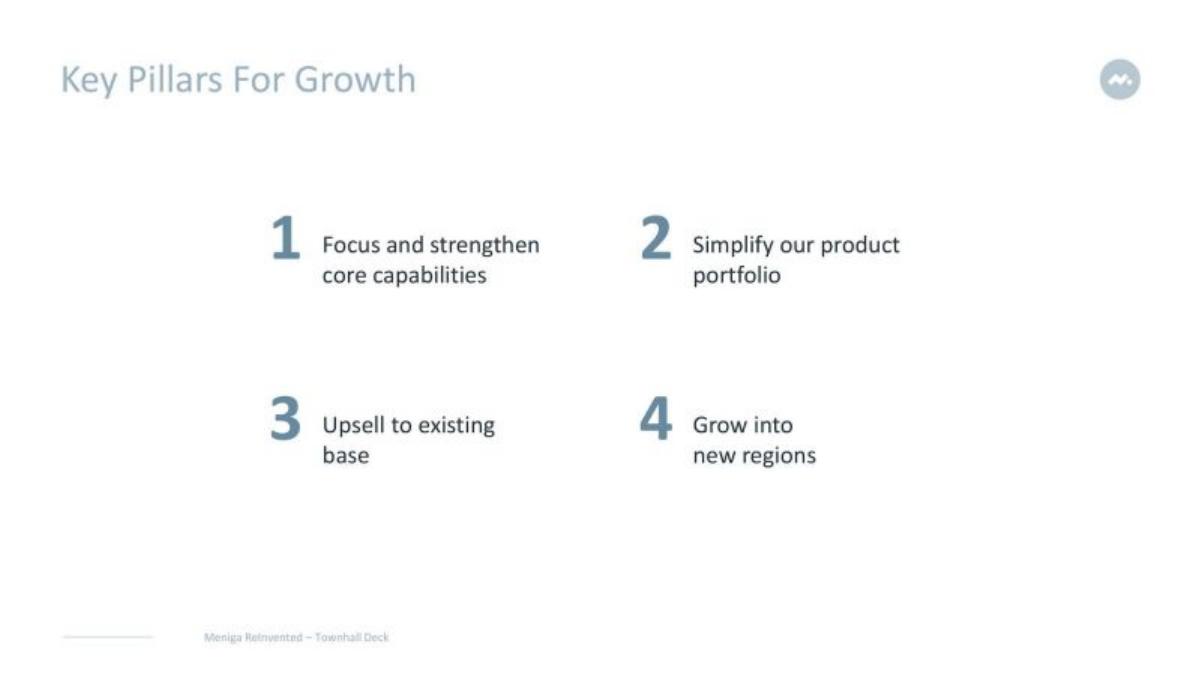
This slide outlines the strategic framework for the 'Reinvented' Meniga. The four pillars are: 1. Focus and strengthen core capabilities , 2. Simplify our product portfolio , 3. Upsell to existing base , and 4. Grow into new regions . This is a classic 'back to basics' strategy often seen in late-stage companies looking to optimize their unit economics before an exit or further scaling.
Slide 4: Product Portfolio Simplification
One of the most important slides in the deck, Slide 4 contrasts Today with Tomorrow . The 'Today' view shows a fragmented list of products: Financial Management, Cashflow Assistant, Savings, Insight Factory, Meniga Hub, Carbon Insight, and Rewards. The 'Tomorrow' view consolidates these into three clean buckets: DATA (Consolidation, Standardization, Enrichment, Aggregation), INSIGHTS (Core PFM, Savings, Cashflow, Sustainability), and PAYMENTS (beta) . This visualizes a move from selling 'features' to selling a 'platform'.
Slide 5: The Upsell Opportunity
Slide 5 quantifies the revenue potential of the existing customer base. It notes that the total potential revenue... can reach up to €7.7M if every current customer licensed all products. It shows a transition in the portfolio mix, where 'Insights' is expected to grow from a fragmented share to 68% of the portfolio's focus. This slide directly addresses how the company will achieve its revenue targets without necessarily acquiring new logos, which is a lower-cost growth path.
Slide 6: Geographic Market Focus
This slide provides a refreshingly honest assessment of global markets. EU is 'Priority Zero' , where Meniga already has a strong foothold. North America (NA) is described as attractive but requiring 'significant investments'. The commentary on MEA and APAC is particularly detailed, noting political hurdles in the former and price sensitivity in the latter. For an investor, this level of regional nuance demonstrates a sophisticated understanding of the global fintech landscape.
Slide 7: Revenue Trajectory
Slide 7 visualizes the shift From stagnant to doubling the Revenue . It shows a base revenue level (represented by a dashed line) and layers on growth from the four pillars. The forecast predicts a 15.7% CAGR over five years. The right-hand chart breaks down this growth by source, showing that 'Upsell' and 'Strengthen core' are the primary drivers in the early years, with 'New regions' contributing more significantly in years 4 and 5.
Slide 8 & 9: Mission and Communication
Slide 8 defines the new core purpose: Enrichment powered Insights and Payments . Slide 9 expands this into 'Taglines' such as 'Customer engagement simplified' and 'Your data orchestration platform'. These slides are designed to align the company's marketing and sales teams around a unified message, moving away from the disparate product-specific messaging of the past.
Slide 10: The Transition
A simple transition slide asking How do we get there? with a pointer to Key needs and asks! . While the specific 'asks' are not detailed on this slide, it serves as the bridge to the organizational execution plan.
Slide 11: Internal Alignment and Ecosystem
This slide maps the organization's strategy to execution. It lists major Clients (UniCredit, BPCE, Swedbank, CA, Adyen, AXA) on the left and Partners (Minna, Tarabut Gateway, Tink, TrueLayer, BCG, Accenture) on the right. In the center, it details how the internal teams (Commerce, Product, Engineering, Delivery, Support) interact to 'Design', 'Build', 'Sell', and 'Run' the product. This is a high-level view of the company’s operating model.
Slide 12: Organizational Structure
Slide 12 provides a detailed org chart. The Commercial branch is notably split into Farmers (Upselling to existing) and Hunters (New Clients), with a dedicated Pre-sales team. This structure supports the 'Upsell' pillar mentioned earlier in the deck. The Engineering branch includes Development, QA, and Infrastructure, while Delivery & Support includes Technical Consulting and Customer Support (both in-house and outsourced).
Slide 13: Conclusion
The final slide is a simple Thank you with the Meniga logo. It lacks a specific call to action or contact information, which is common in townhall decks but would be an omission in a pure external investor pitch.
What Works in This Deck
Transparency: The deck is remarkably honest about the company's 'stagnant' past and the specific hurdles in markets like APAC and MEA. This builds significant trust with sophisticated investors. · Strategic Clarity: The transition from a cluttered product list to a three-pillar platform (Data, Insights, Payments) is logically sound and visually clear. · Client Credibility: Listing tier-one banks and global fintechs like Adyen and AXA provides immediate proof of enterprise-grade reliability. · Quantified Upsell: By putting a specific Euro figure (€7.7M) on the internal upsell opportunity, Meniga shows a clear, low-risk path to immediate revenue growth.
What Is Missing
Unit Economics: While the deck discusses total revenue growth, it omits specific unit economics such as Customer Acquisition Cost (CAC), Lifetime Value (LTV), or gross margins. · Competitive Landscape: There is no dedicated slide comparing Meniga to direct competitors in the PFM (Personal Finance Management) or Open Banking space, although some are mentioned in the regional analysis. · The 'Ask' Details: As this is a townhall/shareholder version of the deck, the specific terms of the $16M Series D raise (valuation, use of proceeds breakdown) are not explicitly detailed on the slides provided. · Team Bios: There are no individual bios or track records for the leadership team, which is standard for a Series D deck to demonstrate the 'bench strength' required for a turnaround.
What a Founder Should Copy
The 'Today vs. Tomorrow' Framework: Use Slide 4's approach to show how you are simplifying your product. Investors love to see a move from complexity to a scalable platform. · Regional Nuance: Don't just say you are 'going global'. Follow the example on Slide 6 and explain why certain markets are priorities and why others are being approached with caution. · Revenue Layering: Slide 7 is an excellent way to show how different strategic initiatives (upselling vs. new regions) contribute to the overall revenue goal over time. · Internal Alignment: Showing how your org chart (Slide 12) specifically maps to your growth pillars (Slide 3) proves that your strategy isn't just talk—it's reflected in how you hire and organize your people.
Frequently asked questions
- What is the primary goal of the 'Meniga Reinvented' strategy?
- The primary goal is to simplify a complex product portfolio and transition from a stagnant revenue state to a growth phase. According to Slide 4, this involves consolidating various features like 'Carbon Insight' and 'Cashflow Assistant' into three streamlined categories: Data, Insights, and Payments. This simplification is intended to make the product easier to sell and more effective for bank partners to integrate.
- How does Meniga plan to achieve its revenue growth targets?
- Growth is driven by four key pillars: strengthening core capabilities, simplifying the product portfolio, upselling to the existing base, and expanding into new regions (Slide 3). Slide 7 specifically forecasts that upselling to existing clients and strengthening the core in the EU will be the primary contributors to the projected 15.7% CAGR over five years.
- Which geographic markets are prioritized in this deck?
- Europe is the top priority, labeled 'Priority Zero' on Slide 6. North America is viewed as attractive but requiring significant investment. Interestingly, the deck is very candid about other regions: it notes MEA has political and cultural hurdles, while APAC is described as highly price-sensitive with a cost structure that currently acts as a hurdle for Meniga.
- What does the 'Tomorrow' product portfolio look like?
- The future portfolio (Slide 4) is divided into three segments. 'Data' covers consolidation and enrichment; 'Insights' includes core finance management, savings, and sustainability; and 'Payments' is currently in beta, focusing on payment initiation on aggregation. This replaces a more cluttered 'Today' view that featured standalone modules like 'Meniga Hub' and 'Rewards'.
- Who are Meniga's key clients and partners?
- Slide 11 identifies a robust roster of enterprise clients including UniCredit, Swedbank, Groupe BPCE, Crédito Agrícola, Adyen, and AXA. Their partner ecosystem is equally high-tier, featuring technical partners like Tink and TrueLayer alongside strategic consulting firms like BCG and Accenture, which suggests a B2B2C distribution model through major financial institutions.