The Melodics pitch deck is a study in extreme minimalism, utilizing only 9 slides to communicate a compelling investment thesis. Rather than relying on dense text, the deck uses high-impact imagery and bold statistics to define the problem—a massive market of 1 billion people where 90% quit learning music. The presentation leans heavily on industry validation, showcasing logos of major hardware partners like Ableton and Akai, and a high-profile endorsement from DJ Jazzy Jeff. Crucially, it provides clear unit economics on slide 5, demonstrating a $116 return for every $31 spent on acquisition…
Key takeaways
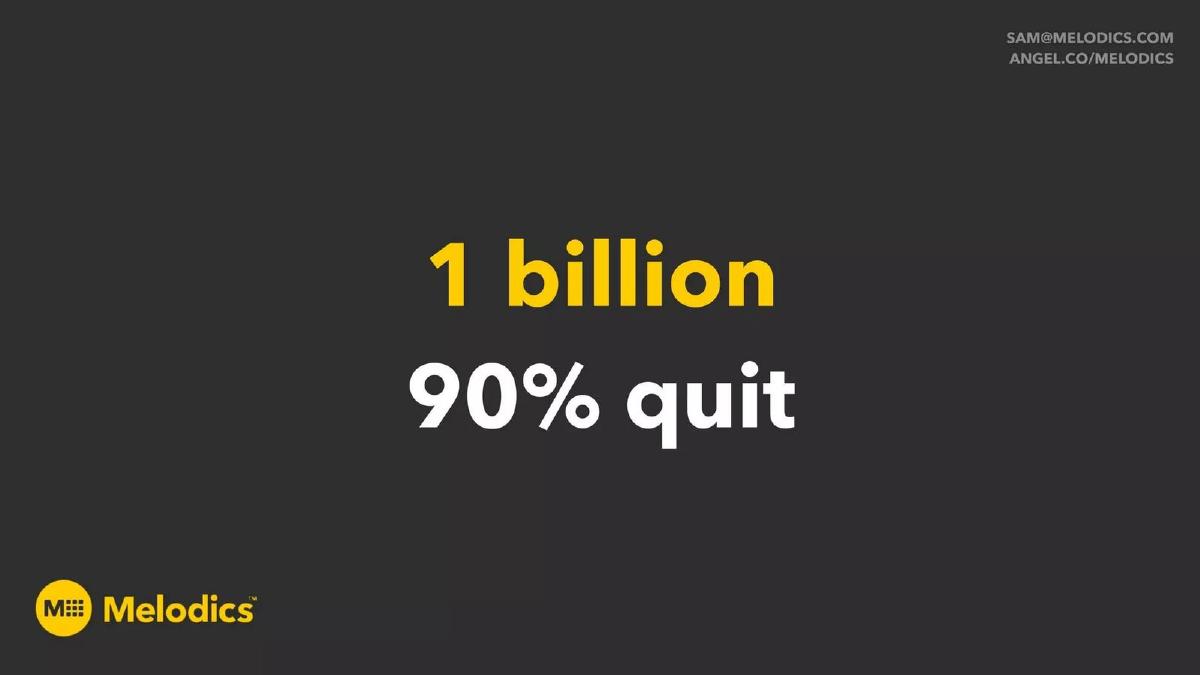
- The deck identifies a massive addressable market of 1 billion people with a 90% churn rate in traditional music education (Slide 3).
- Unit economics are presented with extreme clarity: a $31 CAC yields a $116 LTV (Slide 5).
- At the time of the deck, the company had reached 60,000 users and $20,000 in Monthly Recurring Revenue (Slide 5).
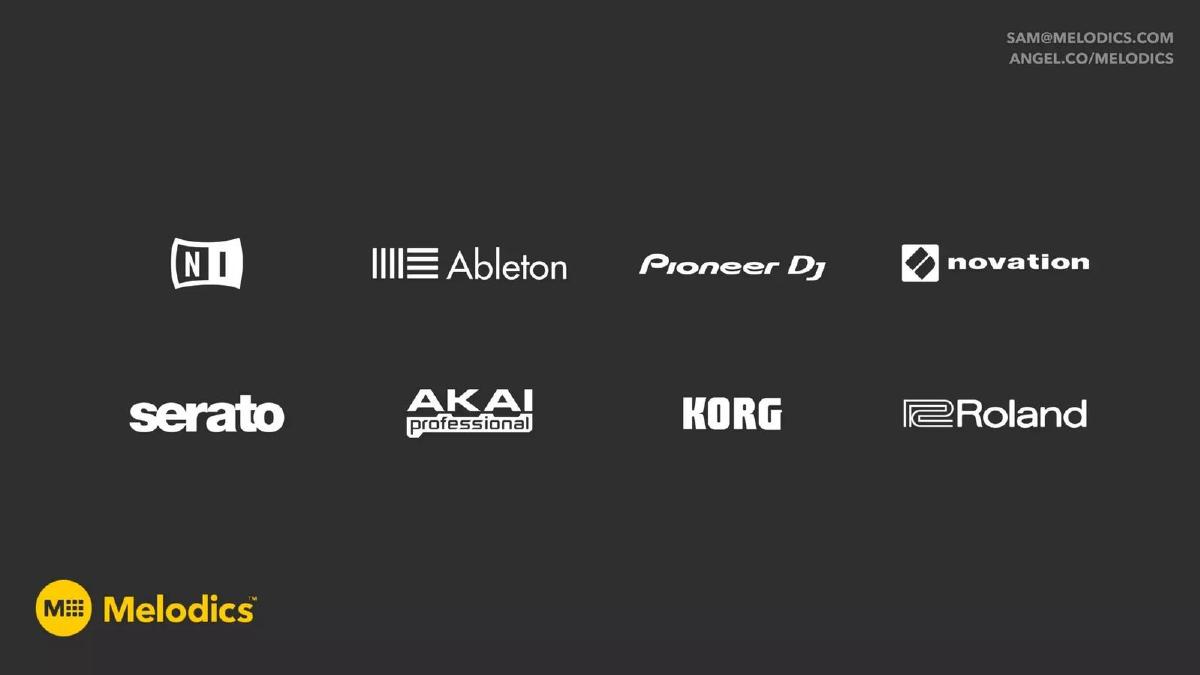
- Industry integration is a core strategy, evidenced by eight major music technology partner logos including Roland, Korg, and Pioneer DJ (Slide 6).
- The product uses gamification elements like 'Practice complete' and star ratings to address the high quit rate of music students (Slide 4).
- Social proof is localized to the target demographic through a direct quote from DJ Jazzy Jeff (Slide 8).
- The deck completely omits a team slide, a detailed roadmap, and a specific funding ask, relying instead on existing traction and partnerships.
- The visual identity is consistent throughout, using a high-contrast yellow and charcoal palette that mirrors the product's UI (Slide 1, 4, 9).
The Power of Minimalist Fundraising
The Melodics pitch deck is an anomaly in the world of venture capital. At only 9 slides, it ignores almost every traditional 'rule' of deck construction—there is no team slide, no competitive matrix, and no detailed financial forecast. Instead, it relies on a high-velocity narrative that moves from a massive problem to a proven solution with attractive unit economics. This deck was used to raise a $2,500,000 Seed round in 2014, proving that when the metrics and partnerships are strong, less is often more.
Slides 1-3: The Hook and the Massive Problem
Slide 1: Title The deck opens with a high-contrast yellow title slide featuring the Melodics logo. Notably, every slide in the deck contains the founder's email and an AngelList URL in the top right corner, ensuring that contact info is never more than a glance away for an investor.
Slide 2: Cultural Context Slide 2 features a photo of Kanye West with the quote: "You ain't got no fkin Yeezy in your Serato??" This is a strategic choice. It establishes the company's place within the modern music ecosystem and subtly references the founder's background at Serato, a dominant software in the DJ world. It is a 'vibe' slide designed to build immediate rapport with investors who understand the music tech space.
Slide 3: The Billion-Person Problem Melodics defines its market and problem with just four words: "1 billion / 90% quit." This slide identifies a massive Total Addressable Market (TAM) and a specific pain point: the high friction and failure rate of traditional music education. By framing the problem this way, the solution (Melodics) is positioned as a retention and engagement tool for a billion-person market.
Slides 4-5: The Product and the Math
Slide 4: Product UI and Gamification Instead of a list of features, Slide 4 shows a screenshot of the Melodics interface. It highlights 'Practice complete!', 'Lesson complete!', and 'Challenge complete!' alongside a 3-star rating system and a trophy icon. This visually communicates that Melodics is an 'edutainment' platform that uses gamification to solve the 90% quit rate mentioned on the previous slide.
Slide 5: Unit Economics and Traction This is the most critical slide in the deck. It presents the core business case in bold text: "Spend $31 / $116 return." This 3.7x return on acquisition spend is the 'holy grail' for seed investors. Below this, the company lists its current traction: "60K users" and "$20K MRR." These figures prove that the product has found early market fit and that the business model is already generating revenue.
Slides 6-8: Validation and Partnerships
Slide 6: Hardware Partnerships Melodics showcases its deep integration into the music hardware industry by displaying eight logos: Native Instruments (NI), Ableton, Pioneer DJ, Novation, Serato, Akai Professional, Korg, and Roland. For a music tech startup, these partnerships are a massive moat, suggesting that Melodics is bundled with or recommended by the world's leading hardware manufacturers.
Slide 7: Strategic Focus Slide 7 narrows the focus to three primary partners: Ableton, Novation, and Serato. This likely represents the company's most active or lucrative distribution channels, reinforcing the idea that they aren't just a standalone app, but a core part of the digital musician's workflow.
Slide 8: The Influencer Endorsement To round out the social proof, Melodics includes a quote from DJ Jazzy Jeff: "If you make music, Melodics is like going to the gym for a workout." This endorsement from a respected industry veteran validates the product's utility for serious musicians, moving it beyond the category of a 'toy' or 'game.'
Slide 9: Conclusion
Slide 9: Final Title The deck ends as it began, with the Melodics logo and contact information. There is no 'Ask' slide detailing how much they are raising or what the valuation is, which suggests this deck was used as a teaser or as part of a conversation where those details were handled verbally or in a follow-up document.
What Works in This Deck
Extreme Clarity: The deck never uses two words when one will do. The unit economics on Slide 5 are impossible to misunderstand. · Industry Authority: By leveraging the logos of giants like Roland and Korg, Melodics borrows the credibility of established market leaders. · Traction-First Approach: Leading with $20,000 MRR at the seed stage immediately separates the company from 'idea-stage' startups. · Visual Consistency: The use of the product's UI colors (yellow and charcoal) throughout the deck creates a professional, branded experience.
What is Missing
The Team Slide: This is the most glaring omission. While the founder's history with Serato is hinted at, a formal slide detailing the expertise of the engineering and content teams is standard and missing here. · The Ask: Investors want to know how much capital is needed and what milestones that capital will unlock. This deck provides the 'why' but not the 'how much.' · Market Size Data: While '1 billion' is a bold claim, the deck doesn't break down the serviceable obtainable market (SOM) or explain where that billion-person figure originates. · Competition: There is no mention of other music learning platforms (like Yousician or Synthesia), leaving the investor to wonder how Melodics defends its position.
What a Founder Should Copy
The 'Unit Economics' Slide: If you have a clear CAC and LTV, put them on a slide with almost no other text. It is the most persuasive argument you can make. · Logo Clouds for Partnerships: If you have formal partnerships, use them. They act as a proxy for due diligence. · The 'Big Number' Problem: Distilling your market problem into a single, shocking statistic (like a 90% quit rate) makes your solution feel necessary rather than just 'nice to have.'
Frequently asked questions
- How did Melodics raise $2.5M with only 9 slides?
- The deck focused on the 'Big Truths' of the business: a massive market, a clear problem (90% quit rate), and proven unit economics ($31 spend for $116 return). By the time this deck was used, Melodics already had 60,000 users and $20,000 MRR, which provided the necessary de-risking for investors. The presence of major industry partners like Ableton also signaled that the company had already secured its distribution channels.
- Why is there no team slide in the Melodics deck?
- While unusual, the omission of a team slide suggests the founder (Sam Gribben, former CEO of Serato) likely relied on his personal reputation and the 'Angel.co/melodics' link provided on every slide to handle founder due diligence. In a seed round where the founder is a known industry veteran, the product's traction and partnerships often speak louder than a standard bio slide.
- What is the significance of the Kanye West slide?
- Slide 2 uses a cultural touchstone to establish the 'vibe' and relevance of the product. By quoting a lyric regarding Serato, it subtly nods to the founder's pedigree while positioning Melodics within the modern, digital-first music production ecosystem. It serves as an emotional hook rather than a data point.
- How does Melodics demonstrate its business model?
- The deck implies a subscription or high-margin digital goods model by highlighting MRR (Monthly Recurring Revenue) and a high LTV-to-CAC ratio. Slide 5 specifically shows that for every $31 spent on customer acquisition, they see a $116 return, indicating a sustainable and scalable growth engine.
- What are the biggest risks missing from this deck?
- The deck ignores competition, technical hurdles of 'adaptive learning,' and the cost of content production. It also doesn't explain how the $2.5M will be spent. However, for a seed stage narrative, these omissions are often overlooked if the growth metrics and industry partnerships are sufficiently impressive.