Meliora Therapeutics secured $11M in Seed funding in 2023 by pitching a computational platform, Anchoromics, designed to deconvolve drug mechanisms of action in oncology. The deck is a masterclass in efficiency-based value propositions, contrasting traditional biopharma's multi-year, multi-million dollar lead identification timelines against Meliora’s six-month, $150k process. By showcasing a 99% accuracy rate in predicting targets for well-characterized compounds and providing a proof-of-concept for a CDK11 inhibitor, the company successfully bridged the gap between high-level AI theory and…
Key takeaways
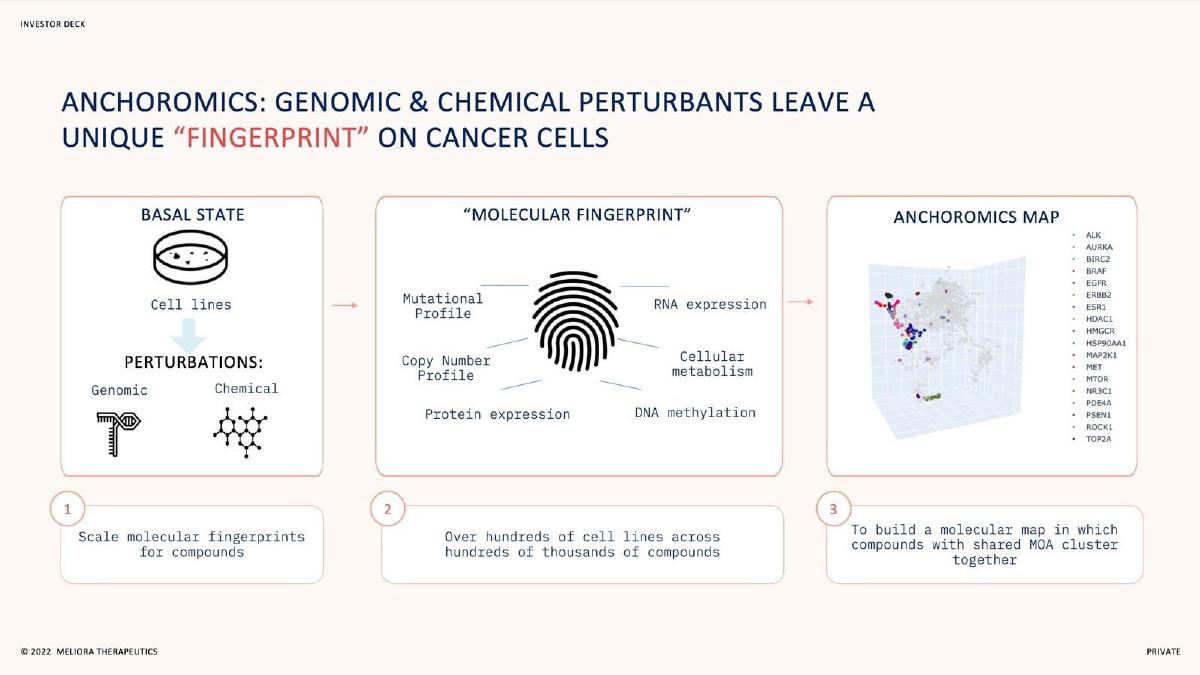
- Meliora uses a proprietary platform called Anchoromics to map genomic and chemical perturbants to unique molecular fingerprints (Slide 3).
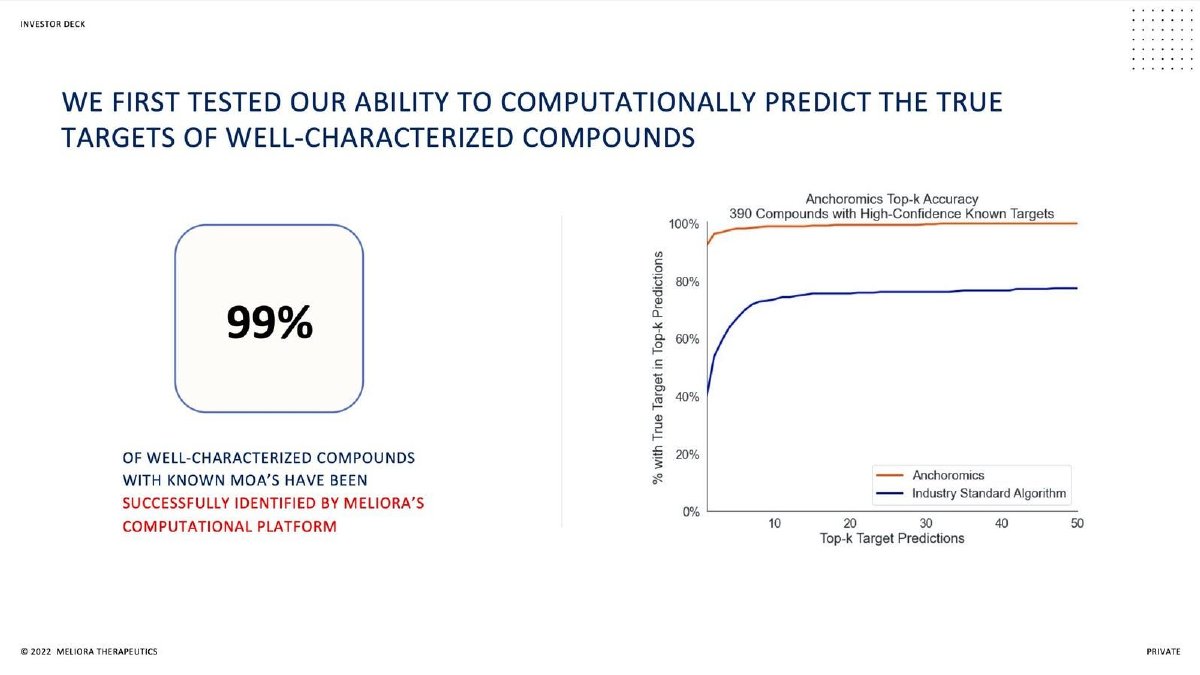
- The company claims a 99% success rate in identifying the true targets of well-characterized compounds using their computational platform (Slide 5).
- Meliora positions itself as significantly more efficient than traditional biopharma, citing a 6-month, $150k lead identification process vs. years and millions of dollars (Slide 4).
- The deck highlights a specific proof-of-concept asset: a CDK11 inhibitor developed in 9 months for $125k (Slide 6).
- The Anchoromics map clusters compounds with shared Mechanisms of Action (MOA) across hundreds of cell lines and thousands of compounds (Slide 3).
- Seed round proceeds are explicitly allocated to expanding the data science team and nominating additional precision medicine oncology programs (Slide 7).
- The technical validation slide compares Meliora's 'Anchoromics Top-k Accuracy' against an 'Industry Standard Algorithm,' showing a significant performance gap (Slide 5).
- The platform aims to turn existing chemistry into a 'flywheel of high probability-of-success clinical assets' (Slide 4).
The Strategic Narrative: Efficiency as a Competitive Moat
Meliora Therapeutics entered the 2023 fundraising market with a clear, data-driven proposition: the current model of oncology drug discovery is broken, and computational biology is the fix. The deck, consisting of 14 slides, focuses heavily on the 'how' and the 'proof.' In an industry where Seed rounds are often sold on the pedigree of the founders alone, Meliora leans into technical validation and cost-benefit analysis.
The overarching theme is 'deconvolution.' By using AI to understand exactly how a drug interacts with a cell (its mechanism of action), Meliora argues they can skip the expensive, high-failure-rate guesswork of traditional assay development and high-throughput screening. This teardown examines how they structured this argument to secure $11M in Seed funding.
Slide 1: Title and Branding
The deck opens with a minimalist title slide. It features the Meliora Therapeutics logo—a stylized, isometric 'M'—and the date, September 2022. The design is clean and professional, signaling a 'tech-forward' biotech company rather than a traditional academic spin-out. The footer marks the document as 'Private,' a standard practice for sensitive biotech IP.
Slide 2: The Mission Statement
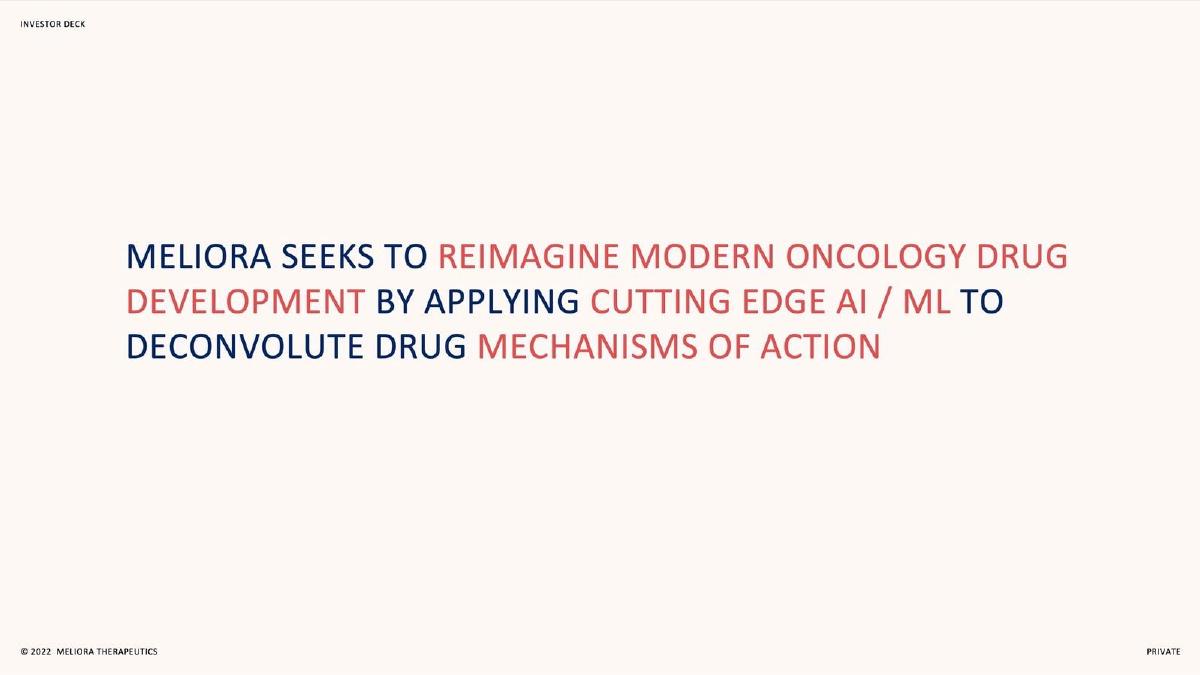
Slide 2 serves as the executive summary in a single sentence: 'MELIORA SEEKS TO REIMAGINE MODERN ONCOLOGY DRUG DEVELOPMENT BY APPLYING CUTTING EDGE AI / ML TO DECONVOLUTE DRUG MECHANISMS OF ACTION.' This slide establishes the industry (Oncology), the tool (AI/ML), and the specific problem being solved (Mechanism of Action deconvolution). It is a high-level 'Why we exist' statement that sets the stage for the technical deep dive that follows.
Slide 3: Anchoromics and Molecular Fingerprinting
This is the core technical slide. It introduces 'Anchoromics,' Meliora's proprietary approach. The slide uses a three-step flow to explain a complex biological process:
1. Basal State & Perturbations: They start with cell lines and apply genomic and chemical perturbations. · 2. Molecular Fingerprint: They collect a multi-omic data set, including RNA expression, cellular metabolism, DNA methylation, protein expression, copy number profiles, and mutational profiles. · 3. Anchoromics Map: This data is fed into a 3D molecular map where compounds with shared mechanisms of action (MOA) cluster together.
The visual representation of the map on the right side of the slide lists specific targets like ALK, BRAF, EGFR, and MET, showing that the platform is already being applied to well-known oncogenic drivers.
Slide 4: The Efficiency Comparison
Slide 4 is the 'business case' slide. It maps out the drug development pipeline: Assay Development, High Throughput Screening, Hit-to-Lead Development, Property Optimization, and Pre-IND Studies. Meliora claims their platform allows them to 'Immediately enter Lead Optimization,' effectively bypassing the first two stages. The most striking part of this slide is the direct comparison: Traditional Biopharma (Years+ & $ millions) vs. Meliora (6 months & ~$150k). This 10x to 20x improvement in efficiency is a powerful hook for Seed investors looking for platform scalability.
Slide 5: Computational Validation
To counter skepticism regarding AI accuracy, Slide 5 presents a validation study. The headline states they tested their ability to predict the true targets of 'well-characterized compounds.' The result is a bold 99% figure. The chart on the right compares 'Anchoromics Top-k Accuracy' against an 'Industry Standard Algorithm.' The Meliora line (orange) hits near-100% accuracy almost immediately, while the industry standard (blue) plateaus below 80%. This slide is designed to prove that their 'fingerprinting' isn't just theoretical—it works on known data sets.
Slide 6: Proof-of-Concept Asset (CDK11)
Platform companies often struggle to prove they can actually make a drug. Slide 6 addresses this by showcasing their first asset: a CDK11 inhibitor. They highlight two key pillars:
Efficacy: Using the compound OTS964, they blocked tumor growth in xenograft models for triple-negative breast cancer, pancreatic cancer, and melanoma. · Safety: They report 'no measurable tox' at efficacious doses in mouse models, including inspections of brain, heart, liver, and lung tissue.
Crucially, they reiterate the efficiency metric: this was achieved in 9 months with $125k , reinforcing the claims made on Slide 4.
Slide 7: Seed Round Use of Proceeds
The final slide in the provided sequence outlines the roadmap. The 'Seed Round Financing' is split into two buckets: Platform and Pipeline . For the platform, they aim to expand the data science team and generate more proprietary data. For the pipeline, they intend to nominate additional programs with 'clear path to IP feasibility.' The stated goal is to demonstrate that their computational approach is repeatable across multiple targets.
What Meliora Therapeutics Does Well
The deck is exceptionally disciplined. It avoids the 'fluff' often found in early-stage decks, such as oversized market slides (everyone knows oncology is a massive market) or generic 'cancer is bad' emotional appeals. Instead, it treats the investor as a sophisticated partner who cares about technical differentiation and capital efficiency.
The use of the 'CDK11' proof-of-concept is a masterstroke. It transforms Meliora from a 'software company trying to do biology' into a 'biotech company powered by superior software.' By providing mouse model data (xenograft growth) and safety signals, they provide the 'wet lab' validation that biotech VCs require before committing significant capital.
What is Missing from the Deck
The most notable omission in this 14-slide sequence is a Team Slide . In Seed-stage investing, the pedigree of the founders (e.g., former roles at Genentech, Broad Institute, or successful exits) is often the primary driver of the valuation. While the publisher summary mentions AI and ML, the deck doesn't show who is building these models.
Additionally, there is no Competitive Landscape slide. While they compare their algorithm to an 'Industry Standard,' they don't name other AI-drug discovery players like Recursion or Exscientia. Investors would likely want to know how Meliora’s 'fingerprinting' differs from the computer vision or generative chemistry approaches used by peers.
Finally, there is no Financial Ask or Valuation mentioned on the slides. While we know from publisher reports that they raised $11M, the deck itself keeps the 'Ask' vague, focusing on 'Seed Round Financing' without a specific dollar target or equity structure.
Founder Takeaways: How to Copy Meliora’s Success
1. Quantify Your Efficiency: If your startup claims to be faster or cheaper, don't just say it—map it. Meliora’s Slide 4 is a perfect template for any founder disrupting a legacy process. Contrast the 'Old Way' (Time/Cost) with 'Your Way' (Time/Cost) using a clear visual pipeline.
2. Lead with a 'Golden Metric': The 99% accuracy claim on Slide 5 is the 'Golden Metric' of this deck. It’s a simple, memorable number that summarizes technical superiority. Find the one metric that proves your tech works better than the status quo and give it its own slide.
3. Bridge the Gap Between Digital and Physical: If you are a 'Platform' company, you must show a 'Product.' Meliora didn't just pitch an algorithm; they pitched a CDK11 inhibitor. Showing that your software can produce a physical result (in this case, a drug lead with animal data) significantly de-risks the investment.
4. Use 'Use of Proceeds' to Set Milestones: Slide 7 doesn't just say 'we will hire people.' It says they will 'nominate additional programs' and 'generate proprietary data.' This tells investors exactly what the 'Value Inflection Points' will be for the next round of funding.
Frequently asked questions
- What is Meliora's core technical advantage?
- Meliora utilizes a platform called Anchoromics. As shown on Slide 3, this involves scaling 'molecular fingerprints'—which include RNA expression, cellular metabolism, DNA methylation, and protein expression—across hundreds of cell lines. By mapping these fingerprints, they can cluster compounds with shared mechanisms of action (MOA), allowing them to identify drug targets with much higher precision than traditional methods.
- How does Meliora compare its costs to traditional pharma?
- Slide 4 provides a direct comparison. Traditional biopharma lead identification is cited as taking 'Years+ & $ millions.' In contrast, Meliora claims their process takes approximately 6 months and costs roughly $150k. This represents a massive reduction in both time-to-market and capital expenditure for the early stages of drug discovery.
- What evidence of efficacy does the deck provide?
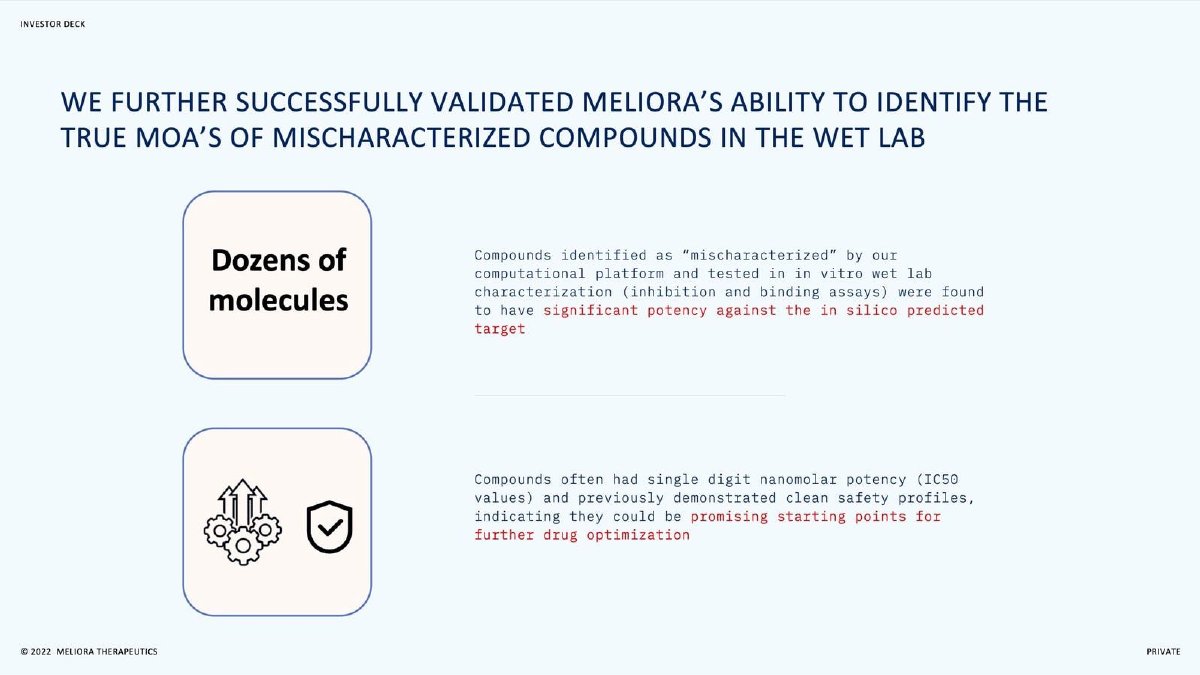
- Slide 6 details their first proof-of-concept asset, a CDK11 inhibitor. The company reports that treatment with OTS964 blocked xenograft tumor growth in triple-negative breast cancer, pancreatic cancer, and melanoma cell lines. Furthermore, they claim the compound achieved single-digit nanomolar potency in just 9 months with a $125k investment.
- What is the primary goal of the Seed round?
- As stated on Slide 7, the goal is to build a 'robust pipeline of targeted therapy starting scaffolds' to demonstrate the feasibility of their computational approach. Specifically, they intend to expand their data science team, generate more proprietary data for their molecular map, and nominate new oncology programs with clear paths to IP feasibility.
- Does the deck include a team or financial slide?
- The 14-slide deck provided does not include a dedicated team slide or a detailed multi-year financial forecast. While Slide 7 mentions 'Key hires' in computational platform development and drug development, the specific pedigree of the founders is omitted from this version of the presentation.