Menlo Micro’s 22-slide deck is a masterclass in deep-tech storytelling, framing a hardware component—the switch—as a relic of the 1800s ripe for disruption. The company, spun out of GE Ventures, leverages its pedigree to validate a 'best of both worlds' solution: the Ideal Switch. The deck meticulously contrasts their technology against legacy electromechanical and solid-state switches, claiming a 'Rule of 99' (99% reduction in size, weight, and power). While the deck is light on specific unit economics, it excels at demonstrating technical maturity, showing a transition from R&D in 2017 to h…
Key takeaways
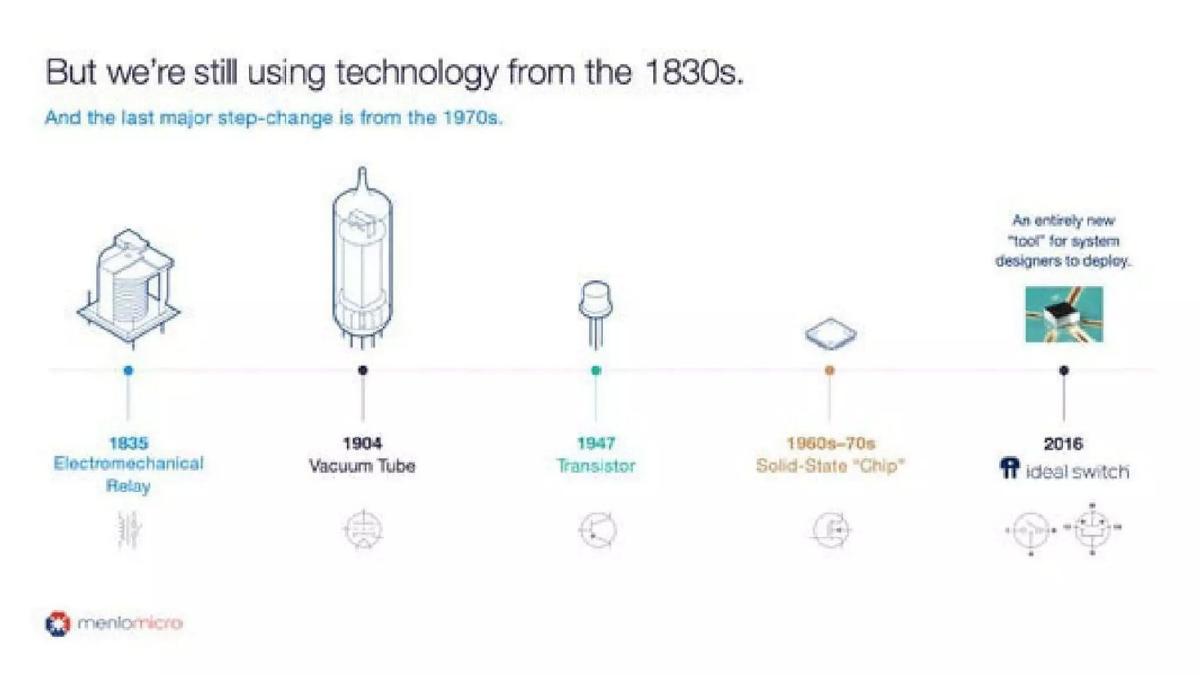
- The deck frames the problem as a historical stagnation, noting that the last major step-change in switch technology was in the 1970s (Slide 5).
- Menlo Micro claims a 'Rule of 99,' achieving a >99% reduction in size, weight, and power consumption compared to traditional switches (Slide 7).
- The company highlights a strong corporate lineage, originating from GE's 12-year effort to reinvent the circuit breaker starting in 2004 (Slide 8).
- Technical validation is provided through a 'Theory vs. Reality' comparison, showing their switch handles DC to 50GHz+ with resistance as low as 0.005 Ohms (Slide 6).
- Manufacturing scalability is a core focus, showing a transition from 180 wafers/year in 2017 to a capacity of 6,000 wafers/year in 2020 (Slide 16).
- The deck identifies a massive Serviceable Addressable Market (SAM) of $20B+ by 2023, driven largely by Power IoT and Telecom (Slide 20).
- The leadership team is exceptionally senior, featuring former executives from GE, Microsemi, and Broadcom (Slide 21).
- Competitive analysis is granular, providing direct performance and size comparisons against both electromechanical relays (Slide 17) and solid-state switches (Slide 18).
The Deep Tech Narrative: Reclaiming the Switch
Menlo Micro’s pitch deck is a sophisticated example of how to pitch a fundamental hardware innovation. Instead of focusing on a niche application, the deck positions the company as the successor to Thomas Edison, aiming to replace a 180-year-old technology. This teardown examines how they use historical context, technical benchmarking, and manufacturing milestones to build a case for a $227.5 million investment.
Introduction and Historical Context (Slides 1-5)
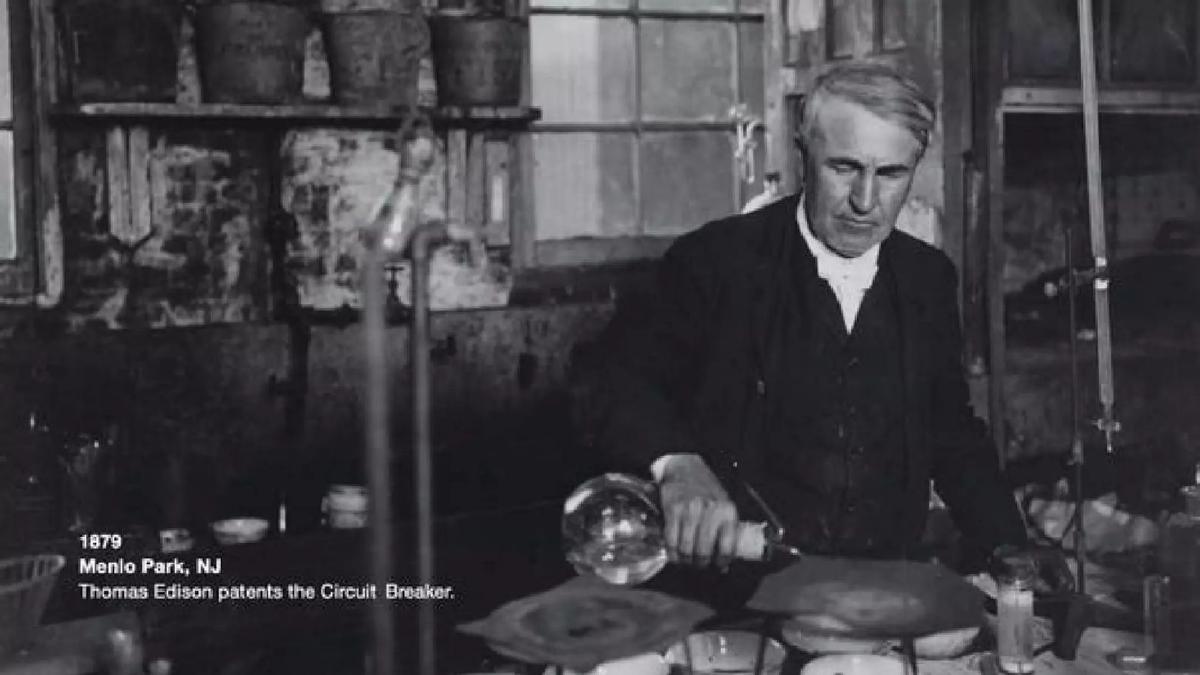
The deck opens with a bold claim on Slide 1 : "Enabling the electrification of everything: Milliwatts-to-kilowatts, DC-to-light." This sets a massive scope immediately. Slide 2 uses a historical image of Thomas Edison, noting he patented the circuit breaker in 1879. This isn't just fluff; it establishes the 'Why Now' by showing how little the core technology has changed.
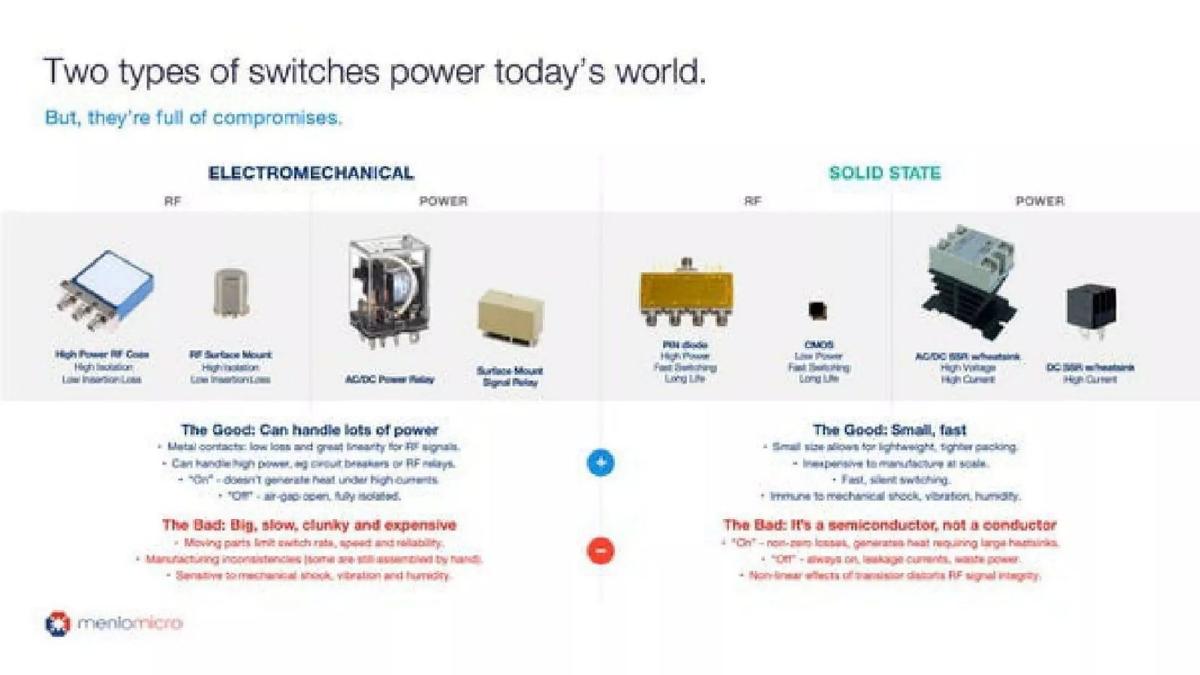
Slide 3 illustrates the ubiquity of switches in homes, work, cars, and the world at large, calling it the "most ubiquitous electronic component." Slide 4 introduces the central conflict: the two existing types of switches (Electromechanical and Solid State) are full of compromises. Electromechanical switches are "Big, slow, clunky and expensive," while Solid State switches generate heat and waste power because they are semiconductors, not true conductors. Slide 5 provides a timeline of innovation, showing that while transistors and chips arrived in the mid-20th century, the last major step-change was in the 1970s, leaving a gap that Menlo Micro filled in 2016.
The Solution: The Ideal Switch (Slides 6-7)
Slide 6 is a critical technical slide. It compares the "Perfect switch in theory" to the "Ideal Switch in reality." It lists impressive specs: resistance as low as 0.005 Ohms, isolation greater than 10 Giga-Ohms, and a lifetime of over 3 billion actuations. By showing that their product nearly matches theoretical perfection, they address the skepticism inherent in deep-tech investing.
Slide 7 introduces "Menlo's Rule of 99." This is a powerful marketing tool that simplifies complex engineering into three digestible metrics: a >99% reduction in Size & Weight, a >99% reduction in Power Consumption, and a >99% improvement in Switching Speed, Lifetime, and Linearity. This slide serves as the 'hook' for the entire deck, providing a clear value proposition for system designers.
Origin Story and Strategic Moats (Slides 8-9)
Slide 8 details the company's lineage. It shows that the technology didn't start in a garage but inside GE. GE began the effort to reinvent the circuit breaker in 2004, developing core IP in high-temperature metal alloys for 12 years before Menlo Micro was formed in 2016. This provides immense credibility regarding the R&D depth.
Slide 9 answers "Why Menlo?" by listing their capital and strategic advantages. They mention raising over $77M (at the time of the deck) and name-drop partners like GE, Corning, and Microsemi. Crucially, they mention shipping over 100,000 units to a Fortune 100 customer (GE Healthcare), proving that this is not just a lab experiment but a commercialized product.
Technical Deep Dive and Manufacturing (Slides 10-16)
Slides 10 through 13 provide an architectural look at the switch. They highlight the use of a glass cap, a unique alloy beam, and through-glass-vias. Slide 13 shows actual microscopic imagery of the beam, which is "smaller than a human hair but can handle >400V." This visual evidence is vital for hardware decks to prove the technology is real.
Slide 14 emphasizes their "secret sauce"—advanced materials leveraged from GE and Corning. This reinforces their IP moat. Slide 15 explains the manufacturing process, highlighting that they use scalable semiconductor techniques (wafer-level manufacturing) rather than manual assembly. Slide 16 is a 'traction' slide for manufacturing, showing a 4x increase in wafer size and a jump in capacity from 100K units/year in 2017 to over 10M units/year "Today" (2020). This demonstrates they have solved the 'Valley of Death' in hardware production.
Competitive Benchmarking (Slides 17-18)
These slides are dense with data, providing head-to-head comparisons. Slide 17 shows the Ideal Switch vs. Electromechanical Relays, highlighting that the Ideal Switch is 100x smaller (0.06 cm³ vs 71 cm³) and 1000x faster. Slide 18 compares it to Solid State switches, noting that unless nano-second speed is required, the Ideal Switch is better due to lower loss, less resistance, and the lack of a need for heavy heatsinks. These slides are designed to arm a VC with the technical justification needed for a high-valuation round.
Market Opportunity and Team (Slides 19-21)
Slide 19 maps out applications across RF/Microwave, General Purpose, and Smart AC/DC Power switching. Slide 20 quantifies this into a $20B+ SAM by 2023. The chart shows that while they started in Medical and Aero/Defense, the massive growth is expected in the "Power IoT" sector. This transition from high-margin/low-volume to high-volume markets is a classic scaling narrative.
Slide 21 presents the team. It is an exceptionally high-pedigree group. CEO Russ Garcia (ex-Microsemi), CTO Chris Keimel (ex-GE Research), and a board featuring Managing Directors from Paladin and 40 North. The presence of advisors from Corning, Microchip Technology, and Broadcom suggests a deep network within the semiconductor industry.
What Works in This Deck
The 'Rule of 99' Framework: It distills a highly technical product into a simple, memorable value proposition that any investor can understand. · Pedigree and Lineage: By tracing the tech back to GE and Edison, they eliminate the 'science risk' that plagues many Series A/B hardware startups. · Direct Comparisons: Slides 17 and 18 don't just say they are better; they provide specific volume (cm³) and power (mW) metrics against existing industry standards. · Manufacturing Maturity: Slide 16 is perhaps the most important for a Series B/C deck, as it proves they can actually build the product at scale, which is where most hardware companies fail.
What is Missing from This Deck
Unit Economics: While they mention "reduced COGS" on Slide 16, the deck never specifies the cost to produce a single switch or the expected margins. · Financial Projections: The deck shows a $20B SAM, but it does not provide a revenue roadmap or a path to profitability. · The Ask: There is no slide detailing how much capital is being raised in this specific round or how those funds will be allocated (e.g., R&D vs. Sales vs. CapEx). · Customer Pipeline: Beyond the 100k units to GE Healthcare, there is little mention of other specific pilot programs or the current sales pipeline.
What a Founder Should Copy
Historical Framing: If you are disrupting a legacy industry, start by showing how long it has been since the last innovation. It creates a sense of inevitability for your solution. · Visual Proof: The use of SEM (Scanning Electron Microscope) images on Slide 13 and 15 is excellent. For deep tech, seeing the physical reality of the innovation is highly persuasive. · Application Mapping: Slide 19 does a great job of showing how one core technology can be packaged differently to serve vastly different markets (5G, Medical, Industrial IoT). · Strategic Partner Validation: Highlighting the specific contributions of partners (GE for alloys, Corning for glass) shows a sophisticated understanding of the supply chain and IP landscape.
Frequently asked questions
- What is the 'Ideal Switch' technology?
- As described on Slide 11 and 12, the Ideal Switch is a micro-electromechanical system (MEMS) fabricated on a glass substrate. It uses a unique alloy beam and through-glass-vias (TGV) to combine the high power handling and isolation of traditional mechanical switches with the small size and speed of solid-state semiconductors. It is designed to handle everything from milliwatts to kilowatts.
- How does Menlo Micro justify its market size?
- On Slide 20, the company projects a SAM of over $20 billion by 2023. This is broken down into six verticals: Medical, Aerospace & Defense, Test & Measurement, Consumer, Telecom, and Power IoT. The largest growth driver identified is 'Power IoT,' which represents the majority of the projected $20B+ figure.
- What are the key technical advantages cited?
- The deck focuses on the 'Rule of 99' (Slide 7), which includes a 99% reduction in size and weight, and a 99% reduction in power consumption. Additionally, Slide 17 claims the switch is 1000x faster and has a 1000x longer life than conventional electromechanical relays, supporting over 3 billion switching cycles.
- Who are the strategic partners mentioned?
- Slide 9 and Slide 14 highlight deep partnerships with GE and Corning. Menlo Micro leverages GE's 100+ years of industrial power experience and Corning's glass science. Other mentioned partners and investors include Paladin Capital Group, Microsemi, and 40 North Ventures.
- Is there evidence of commercial traction?
- Slide 9 states that over 100,000 Ideal Switches have been shipped to a Fortune 100 customer (GE Healthcare) and that the company is a qualified GE supplier. Slide 16 further notes that they have moved from a research environment to a scalable commercial fab with a capacity of over 10 million units per year.