Memo’s Series A deck is a masterclass in narrative-driven fundraising, focusing heavily on the structural 'data gap' in the $100 billion PR and communications industry. Rather than relying on vanity metrics, Memo highlights its unique moat: direct data access from publishers like Wired, Time, and The Verge. The 11-slide presentation successfully argues that while social platforms have 'walled gardens' for data, the open web remains siloed and unmeasured. By positioning itself as the centralized data layer for earned media, Memo attracted $10M in funding from high-profile investors including F…
Key takeaways
- Memo identifies a massive market opportunity in the $100 billion PR/Comms industry on slide 6.
- The core value proposition is providing the 'actual number of readers' on articles, a metric previously unavailable to PR teams (slide 7).
- The company leverages a unique data acquisition strategy by partnering directly with publishers for direct data access (slide 5).
- Twitter is used as a strategic benchmark, noting it generates $400 million in data licensing revenue to illustrate the value of centralized data (slide 3).
- The deck features high-tier social proof with case studies from Google, Johnson & Johnson, and Allbirds on slide 8.
- A testimonial from Google’s Head of Measurement & Insights provides strong enterprise validation on slide 9.
- The investor slide lists prominent firms like Susa, Founder Collective, and Abstract Ventures, signaling strong institutional backing (slide 10).
- The deck is visually minimalist, using a consistent dark blue theme and isometric illustrations to explain complex data flows (slides 4-5).
The Narrative of the Unmeasured Web
Memo’s Series A pitch deck is a focused, 11-slide presentation that prioritizes the 'Why Now' and the 'How' of their data acquisition strategy. In an era where PR teams are under increasing pressure to prove ROI, Memo identifies a fundamental flaw in the ecosystem: the lack of primary-source data. The deck moves quickly from a broad observation about global reading habits to a specific technical solution, using high-profile logos to bridge the gap between a startup and an industry standard.
Slides 1-2: The Problem of Siloed Data
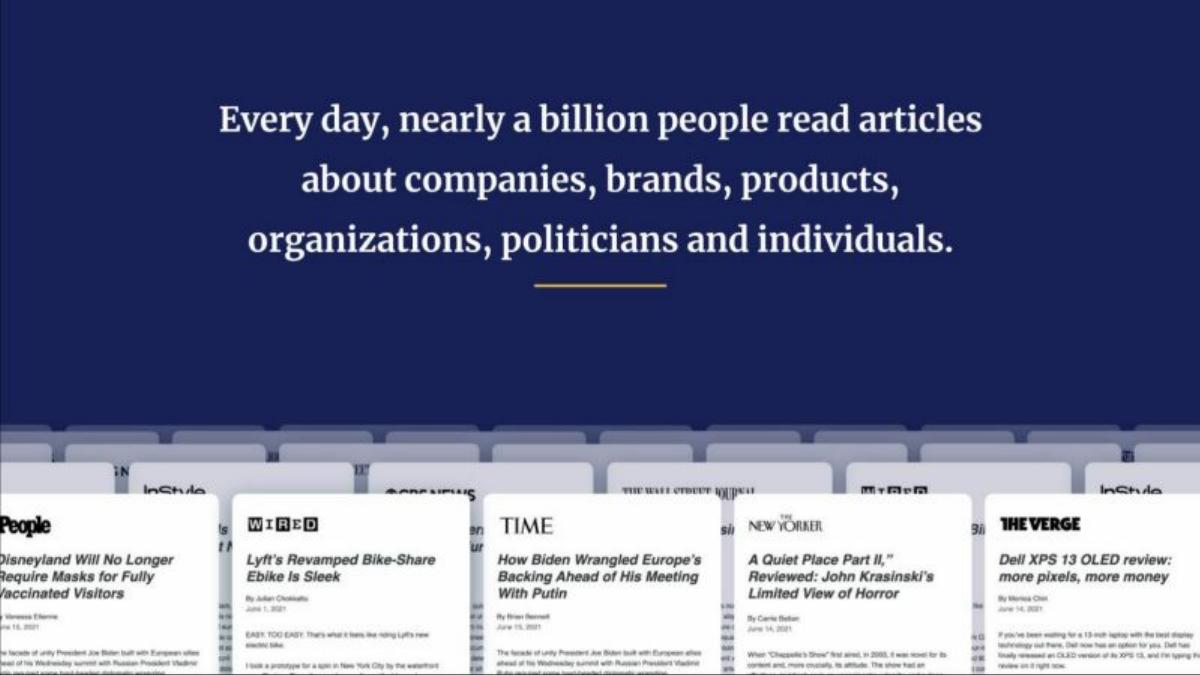
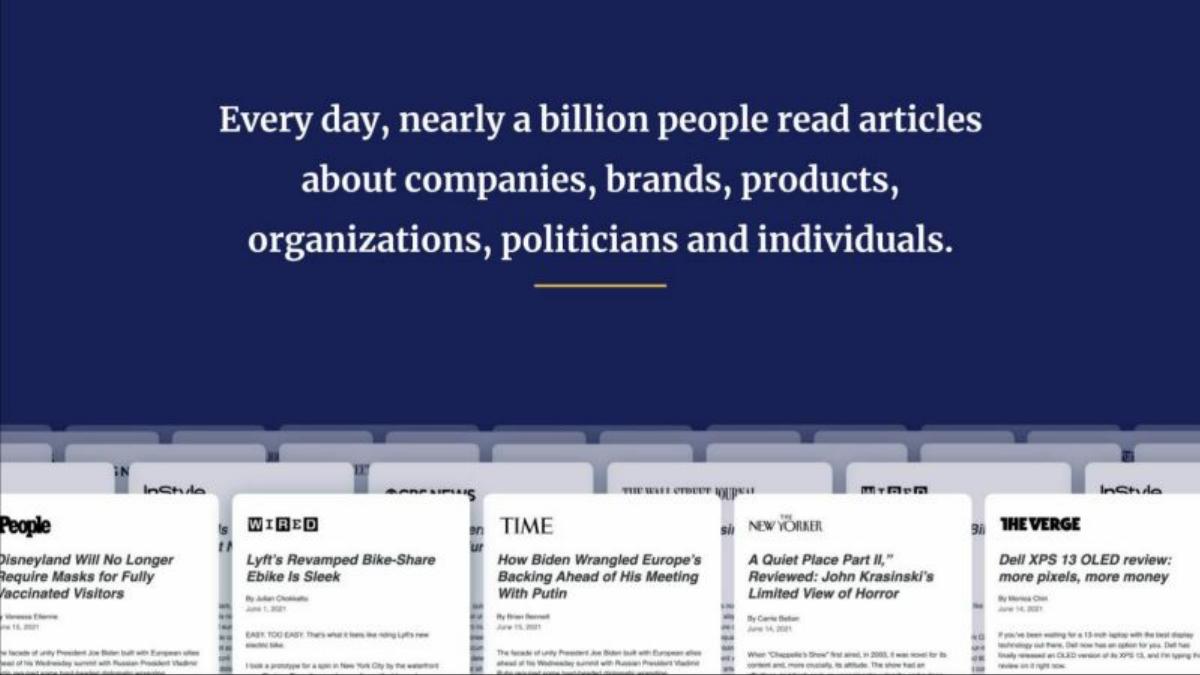
The deck opens with a massive scale statement on Slide 1 : 'Every day, nearly a billion people read articles about companies, brands, products, organizations, politicians and individuals.' This sets the Total Addressable Market (TAM) not in dollars, but in human behavior. The background features a collage of headlines from major publications like Wired, Time, and The New Yorker, grounding the pitch in the real world of media.
Slide 2 immediately introduces the friction. It states that impact has never been properly measured because engagement data is 'siloed across thousands of publications’ sites.' The visual uses a hexagonal grid featuring logos like Bloomberg, WSJ, CNN, and Forbes, illustrating the fragmented nature of the web. This slide establishes that the current state of PR measurement is based on guesswork because the data is trapped behind individual publisher walls.
Slides 3-4: The Walled Garden Comparison
Slide 3 is a strategic anchor for the deck. It compares the 'open web' to 'walled gardens' like Twitter and Facebook. The slide notes that 'Twitter generates $400 million in pure data licensing revenue' and mentions that billion-dollar analytics companies have been built on the Twitter firehose. By doing this, Memo isn't just selling a PR tool; they are selling the potential of a new 'firehose' for the rest of the internet. They pose the question: 'What if a company could centralize a comparable data source through a verticalized SaaS solution?'
Slide 4 introduces Memo as that solution. It defines the company as a 'global data layer for the open web' serving industries including PR, Marketing, Research, and Finance. The isometric graphic shows the Memo 'M' sitting atop a layer of publisher data, visually representing the 'centralized data layer' concept mentioned in the text.
Slide 5: The Proprietary Moat
This is arguably the most important slide in the deck for a Series A investor. Slide 5 explains the 'How.' Memo doesn't just scrape the web; they 'partner with publications who provide direct data access.' The diagram shows data flowing from publishers like Wired, Time, and The Verge through the Memo engine and out to enterprise customers like Samsung, Walmart, and Google. This direct partnership model is Memo’s primary competitive advantage, as it bypasses the inaccuracies of third-party estimation tools.
Slide 6: The Competitive Landscape
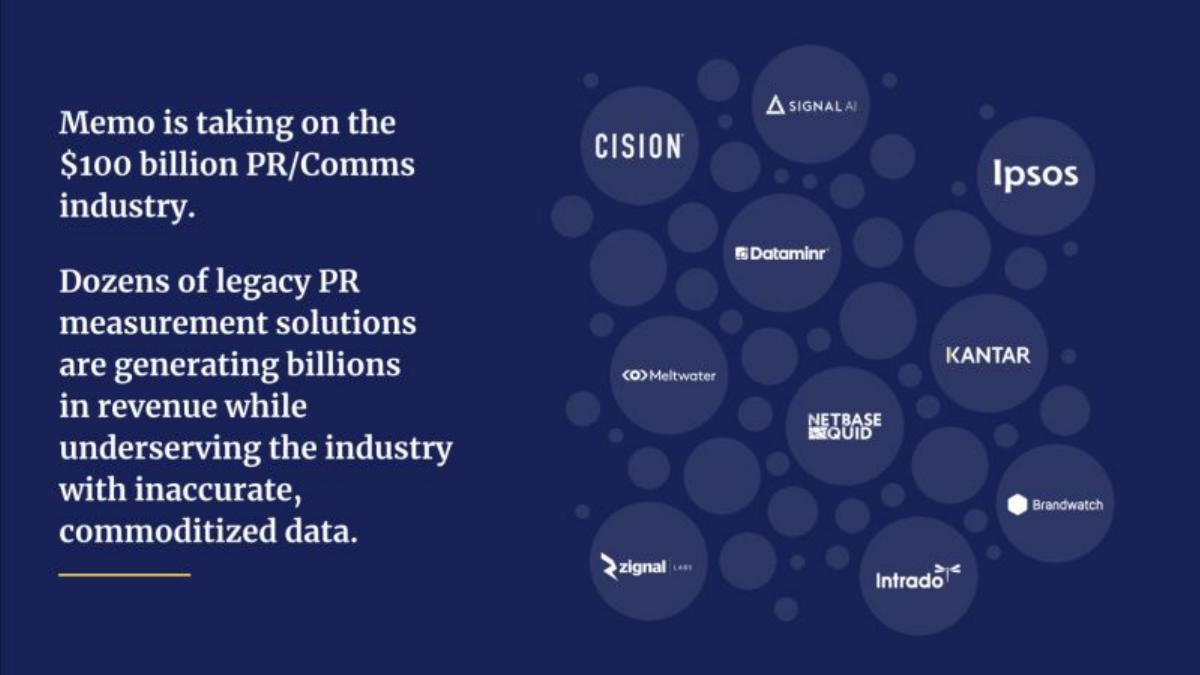
Slide 6 takes a direct shot at the $100 billion PR/Comms industry. It lists a 'who's who' of legacy players, including Cision, Meltwater, and Kantar. The text is aggressive, stating these companies generate billions in revenue while 'underserving the industry with inaccurate, commoditized data.' By framing the competition as 'legacy' and 'inaccurate,' Memo positions itself as the modern, data-first alternative.
Slides 7-9: Product and Social Proof
Slide 7 provides a look at the product dashboard. The key takeaway here is the metric: 'Readership 1,392,521.' The slide emphasizes that Memo is the 'first and only platform that can tell a company the actual number of readers on their articles.' This is the 'aha' moment for the target customer.
Slide 8 provides three specific use cases from massive brands:
Google: Used Memo to identify which columnists actually drive engagement to prioritize media outreach. · Johnson & Johnson: Used Memo to benchmark readership against competitors like Moderna and Pfizer during the vaccine rollout. · Allbirds: Integrated Memo data into their marketing mix model to put earned media on par with paid media measurement.
Slide 9 reinforces this with a direct quote from Jenna Clark, Head of Measurement & Insights at Google Communications: 'We need platforms like Memo that have real metrics, straight from publications.'
Slide 10: The Backers
The final content slide, Slide 10 , displays the logos of Memo’s investors. The list includes Susa Ventures, Founder Collective, MHS Capital, Abstract Ventures, MathCapital, and Lightshed Ventures. It also highlights individual backing from Jonah Goodhart, the founder of Moat. This slide serves to validate the company's trajectory and the quality of its institutional support.
What Memo Does Exceptionally Well
Memo excels at category positioning . Instead of fighting for a small slice of the PR software market, they position themselves as a data infrastructure company. By comparing their potential to the Twitter firehose, they shift the investor's mindset from 'another SaaS tool' to 'a foundational data utility.' This is a classic Series A tactic to justify a higher valuation based on platform potential rather than just current revenue.
The use of primary-source validation is also a major strength. Most PR decks rely on social shares or 'potential reach' (a widely criticized metric). Memo’s insistence on 'actual readership' through direct publisher partnerships is a compelling 'unfair advantage' that is difficult for competitors to replicate without similar legal and technical agreements.
What is Missing from the Memo Deck
As is common with publicly shared decks, several critical components are missing:
Team Slide: There is no information regarding the founders’ backgrounds or their specific expertise in media or data. · Financials and Traction: While the deck mentions Google and Walmart as customers, it provides no data on Annual Recurring Revenue (ARR), growth rates, or churn. · Unit Economics: There is no mention of Customer Acquisition Cost (CAC) or Lifetime Value (LTV), which are standard requirements for a Series A. · The Ask: The deck does not state how much capital is being raised or how the funds will be allocated (though the catalogue listing confirms a $10M raise).
Founder Takeaways: The Power of the 'Data Gap'
Founders should study how Memo identifies a structural gap in an industry. They didn't just say 'we have better software'; they said 'the industry is built on a lie (inaccurate data) and we have the only source of truth.' If your startup relies on a unique way of acquiring data that others cannot easily access, that should be the centerpiece of your deck, just as it is on Slide 5 for Memo.
Additionally, the social proof on Slide 8 is a model for how to present case studies. Instead of vague testimonials, they provide specific business outcomes (e.g., 'identifying columnists,' 'benchmarking against Pfizer,' 'feeding into marketing mix models'). This demonstrates that the product isn't just a 'nice to have' but is integrated into the core workflows of the world's largest companies.
Frequently asked questions
- What is Memo's primary business model according to the deck?
- Memo operates as a centralized data layer for the open web. It partners directly with publishers to gain access to their internal engagement data, which it then aggregates and sells as a verticalized SaaS solution to PR, marketing, and finance professionals. This allows customers to see real readership numbers rather than estimates.
- Who are Memo's main competitors mentioned in the teardown?
- Slide 6 identifies several legacy PR measurement and intelligence competitors, including Cision, Meltwater, Signal AI, Dataminr, Ipsos, Kantar, Brandwatch, NetBase Quid, Zignal Labs, and Intrado. Memo differentiates itself by claiming these legacy players provide 'inaccurate, commoditized data' compared to Memo's direct publisher feeds.
- What specific metrics does Memo provide to its users?
- According to the product dashboard shown on slide 7, Memo provides total readership counts, average readership per article, and comparisons between brands and competitors. It also tracks 'Most-Read Articles,' 'Most-Read Publishers,' and 'Most-Read Topics' based on actual reader counts rather than social shares or impressions.
- Does the deck include a team slide or financial projections?
- No. The 11-slide deck provided does not include a team slide, detailed financial projections, unit economics, or a specific 'ask' for the round. It focuses almost entirely on the problem, the unique data solution, and enterprise customer validation.
- How does Memo justify the value of its data?
- Memo uses the 'Twitter Firehose' as a comparison on slide 3. It notes that Twitter generates $400 million in data licensing revenue and has enabled billion-dollar valuations for analytics companies. Memo argues that by centralizing publisher data, they are creating a comparable and valuable data source for the rest of the web.