PlaySav presents a platform that converts mobile advertisements into interactive gaming elements, rewarding users with discounts for engagement. The deck highlights a significant market opportunity, noting a 3900% increase in mobile ad spending between 2012 and 2016. PlaySav targets both Small to Medium Businesses (SMBs) and national retailers, projecting a rise in revenue from $0 in 2017 to $49M by 2021. The company is seeking $1M via a convertible note to fund infrastructure development, app launches, and a regional rollout to 1.6 million people. While the deck provides detailed financial p…
Key takeaways
- The company is seeking $1M in the form of a convertible note for development and marketing (Slide 22).
- Mobile ad spending grew from $2.6B in 2012 to $101B in 2016, representing a 3900% increase (Slide 7).
- PlaySav projects revenue to scale from $0 in 2017 to $49M by 2021 (Slide 21).
- The revenue model is predicated on a billing rate of $0.0001 per exposure multiplied by duration and number of users (Slide 18).
- Customer Acquisition Cost (CAC) is projected to drop significantly from $28 in 2017 to $2 in 2021 (Slide 20).
- The team includes founders with 25+ and 15+ years of experience in management and computer science, respectively (Slide 14).
- Traction includes participating in the Ignite Northwest Accelerator Spring 2016 and filing a PCT in March 2014 (Slide 16).
- The startup identifies a target market of 7.3M SMBs that currently offer discounts (Slide 8).
Executive Summary and Value Proposition
Slides 1-2: The Hook
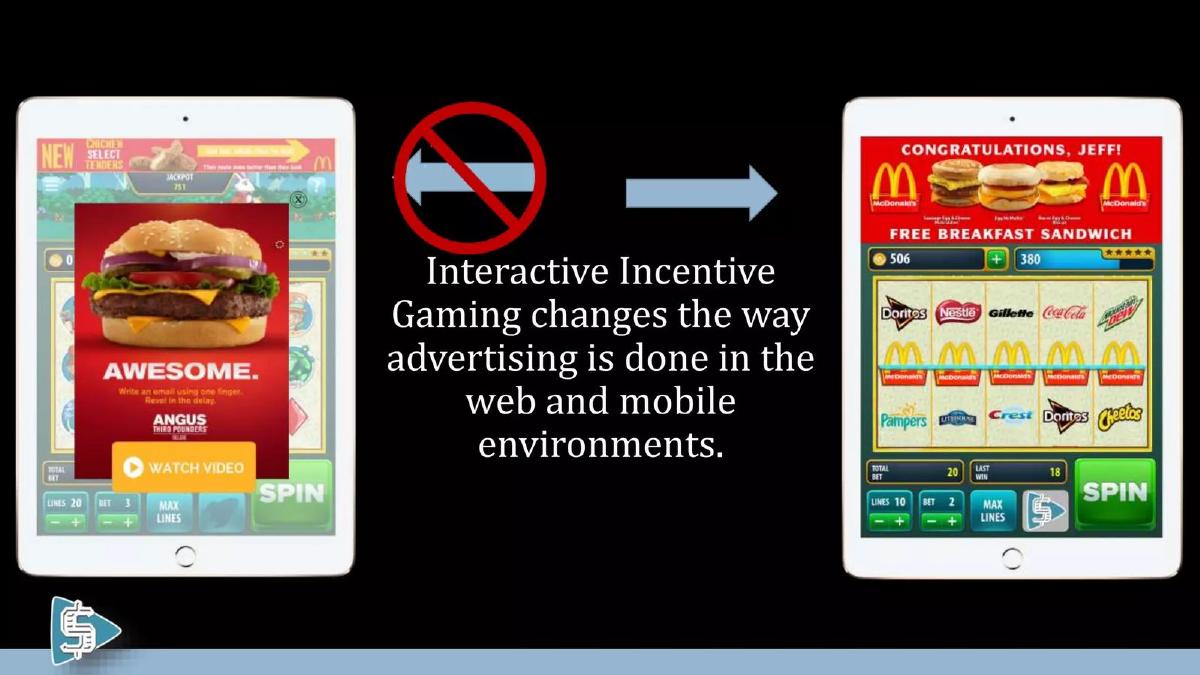
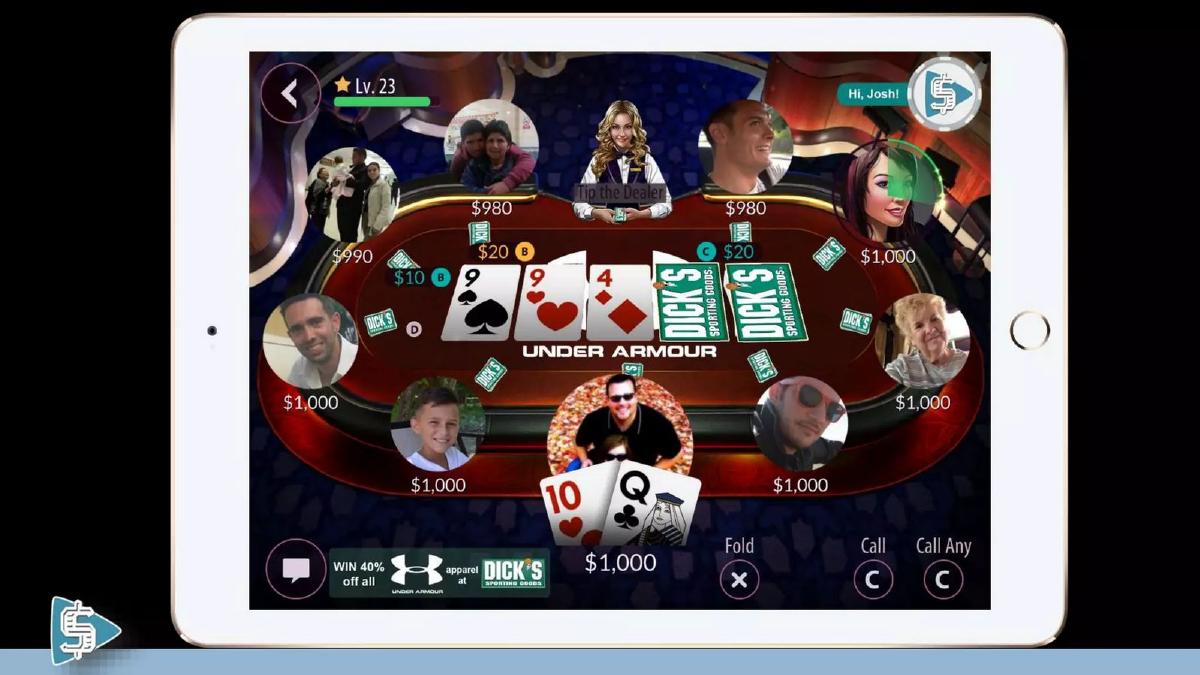
PlaySav opens with a clear, albeit generic, tagline: "Saving money has never been so much fun!" Slide 1 establishes the leadership (Jeff Cates and Josh Comstock) and their affiliation with the Ignite Northwest accelerator. Slide 2 introduces the concept of "Interactive Incentive Gaming," contrasting traditional static ads with a gamified slot-machine interface where brand logos (McDonald's, Nestlé, Coca-Cola) serve as the game symbols. The visual transition from a standard banner ad to a branded game screen immediately communicates the product's core function.
Slides 3-6: The Problem and Solution
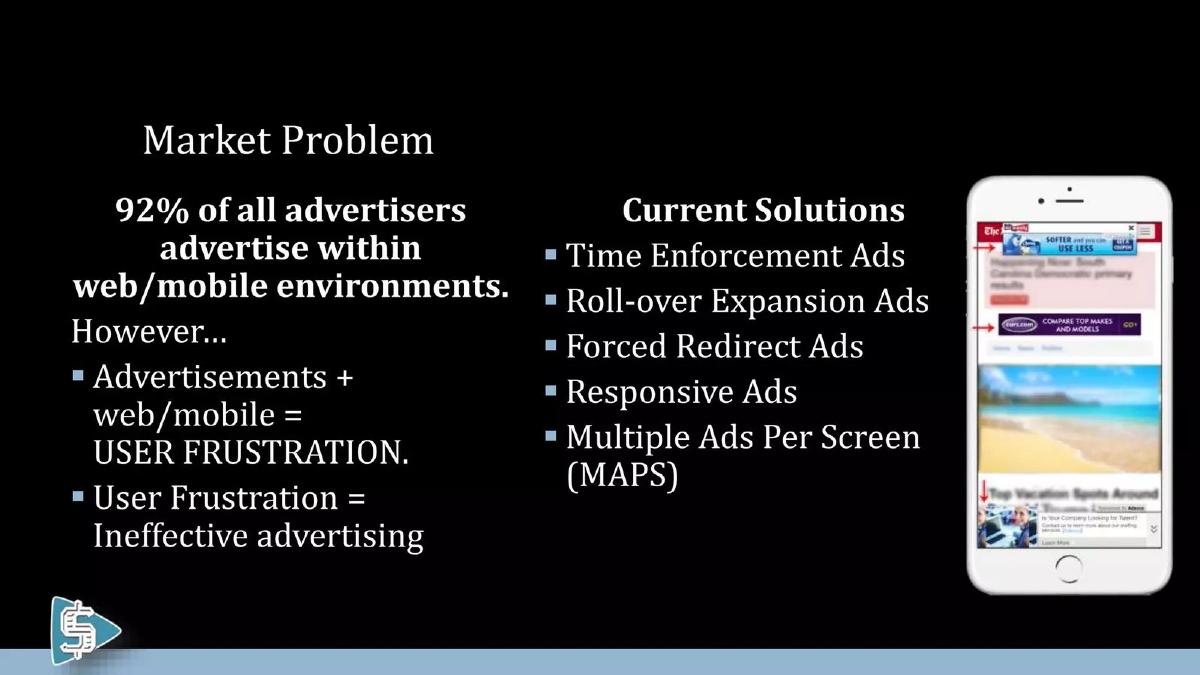
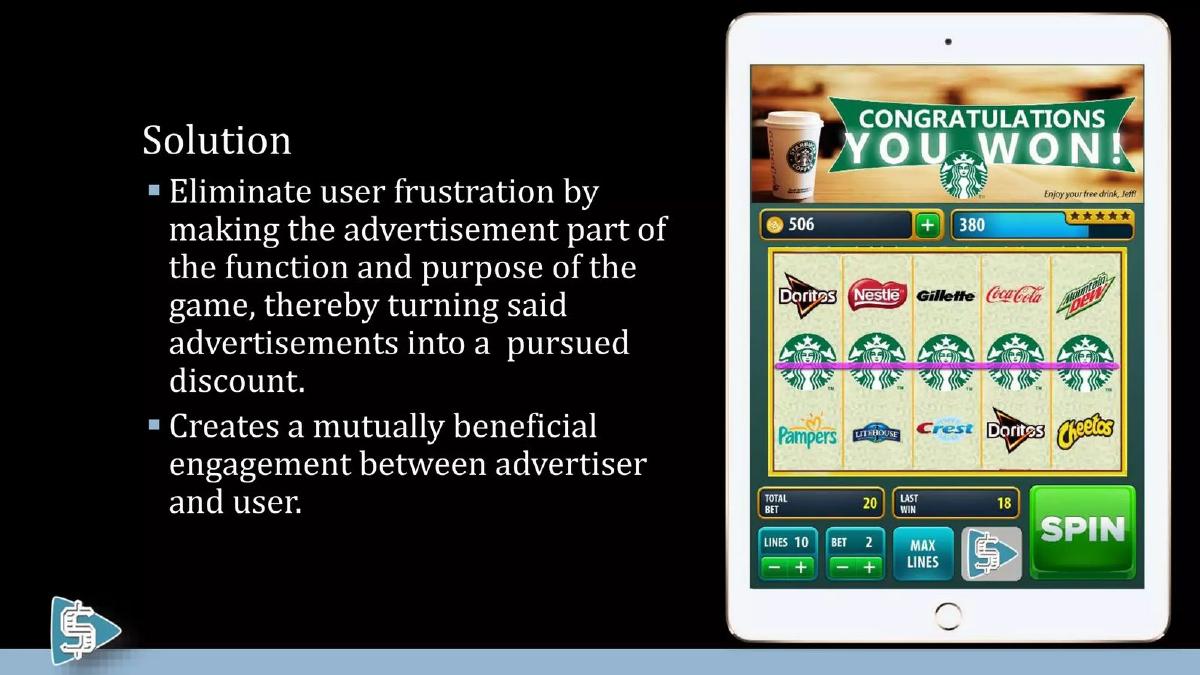
Slide 3 defines the market problem as "User Frustration," listing current intrusive ad formats like forced redirects and expansion ads as ineffective. Slide 4 and 5 use mockups to show how ads currently interrupt gameplay, whereas PlaySav integrates them. Slide 6 explicitly states the solution: turning advertisements into a "pursued discount" to create mutually beneficial engagement. The deck argues that by making the ad the "purpose of the game," users will actively seek out brand interactions rather than avoiding them.
Market Analysis and Opportunity
Slides 7-10: Market Size and Growth
The deck leans heavily on the explosive growth of mobile advertising. Slide 7 notes a 3900% increase in mobile ad spending from 2012 ($2.6B) to 2016 ($101B). Slide 8 segments the SMB market, identifying 7.3M businesses that offer discounts and setting a target of capturing 1% (73k SMBs) at a rate of $60/month. Slide 9 addresses the National Advertiser Market, targeting 12% of the 913 billion-dollar businesses in the US. Slide 10 focuses on the "Gamer Market," claiming 104.8M gamers prefer discount ads and highlighting an average daily mobile gaming time of 33 minutes.
Slides 11-12: Launch Strategy
PlaySav defines its initial launch area as a population of 1.6 million. Slide 11 breaks down the local SMB target market, aiming for 346 local businesses (1% of the local total). Slide 12 applies a similar logic to national advertisers within that same 1.6M population launch zone, projecting a local digital advertising budget of $1.6M for these entities, of which PlaySav hopes to capture a small sliver ($24,804).
Team and Traction
Slides 13-15: Leadership and Governance
The team slide (Slide 14) presents a senior leadership group with significant tenure. CEO Jeff Cates claims 25+ years of management experience, while COO Josh Comstock and CTO Matt Brass bring 15+ and 20+ years of technical experience, respectively. Slide 15 introduces a Board of Advisors with impressive credentials, including a Vice President from JPMorgan-Chase and a partner from Venture-Net Partners. This slide is intended to build institutional credibility for a pre-revenue startup.
Slide 16: Intellectual Property and Traction
Traction is primarily defined by development milestones and IP filings rather than user growth. The slide lists wireframes, demo games, and the filing of a PCT in 2014. Notably, it mentions they are "Pursuing MOU's from 3 National Retailers," which indicates that at the time of the deck, no firm commercial contracts were in place. Participation in the Ignite Northwest Accelerator (Spring 2016) is the most recent milestone listed.
Competitive Landscape and Business Model
Slide 17: Competitive Matrix
The Competitor Ranking Matrix is a standard "check-box" slide where PlaySav awards itself five stars across all categories (Price, Exposure, Engagement, etc.), while competitors like Facebook, RetailMeNot, and Groupon receive lower marks. While it highlights PlaySav's unique focus on "Vicinity Notifications" and "Mutual Engagement," the five-star sweep across the board often comes across as biased to sophisticated investors.
Slides 18-19: Revenue Mechanics
Slide 18 provides the specific billing formula: $0.0001 Rate x Exposure x Duration x No. Users. This is a highly granular micro-transaction model. The company anticipates the bulk of its revenue (97%) coming from advertisers (SMBs and National Retailers), with only 3% coming from users via in-app purchases or CPC. Slide 19 visualizes the "Annual Hits" required to reach their goals, showing a massive jump in SMB engagement between 2017 and 2018.
Financial Projections and Funding Ask
Slides 20-21: Expense and Revenue Models
Slide 20 contains a critical projection: the Customer Acquisition Cost (CAC). PlaySav expects CAC to drop from $28 in 2017 to just $2 in 2021. This 92% reduction in CAC is a bold claim that usually requires significant justification regarding viral loops or organic growth strategies, which are not detailed here. Slide 21 provides the P&L summary, projecting a move from a $1M EBITDA loss to a $19.5M EBITDA profit in five years.
Slide 22: The Ask
The company is seeking $1M in the form of a Convertible Note. The funds are earmarked for infrastructure development, the launch of the PlaySav Hub App, the development of 1-3 games, and a regional launch to 1.6 million people. The use of a convertible note suggests a seed-stage round where a firm valuation had not yet been established.
Social Impact and Closing
Slides 23-24: Philanthropy and Contact
Slide 23 introduces the "Sharing the Goodness Foundation," a philanthropic arm dedicated to fighting global starvation. While noble, the inclusion of graphic imagery of a starving child is a jarring shift in tone from the previous slides about slot-machine advertising and EBITDA margins. Slide 24 concludes with contact information and a link to a Crowdfunder page, indicating the founders were open to equity crowdfunding.
What PlaySav Does Well
The deck is exceptionally clear about its revenue mechanics. Unlike many startups that hand-wave away their pricing, PlaySav provides a specific formula ($0.0001 per exposure/duration/user) on Slide 18. This allows investors to stress-test the assumptions behind the $49M revenue goal. The market sizing is also well-segmented, distinguishing between the needs and budgets of local SMBs versus national brands. The inclusion of specific patent and trademark serial numbers on Slide 16 provides a level of due diligence readiness that is often missing in early-stage decks.
What is Missing from the PlaySav Deck
The most glaring omission is actual user data or pilot results. While the deck mentions "Market tested demo games" on Slide 16, it provides no metrics on user retention, session length, or coupon redemption rates from those tests. For a gaming-based platform, engagement metrics are the lifeblood of the business. Additionally, the deck lacks a detailed explanation of the "viral loop" or marketing strategy required to bring the CAC down from $28 to $2. Without a clear path to organic growth, the projected $8.5M marketing budget in 2021 (Slide 20) might not be enough to sustain the projected revenue growth if the CAC doesn't drop as predicted.
Founder Takeaways: What to Copy
Founders should emulate the way PlaySav breaks down its target market into actionable segments (Slides 8-12). By looking at a specific "Launch Area" population of 1.6 million and calculating the exact number of SMBs they need to convert (346), the goal feels attainable rather than theoretical. The "Revenue Model" visualization on Slide 19, which separates "Annual Hits" by customer type, is also a strong way to show how different segments contribute to the bottom line. Finally, providing a clear list of how the investment funds will be spent (Slide 22) is a best practice that every pitch deck should follow.
Frequently asked questions
- What is the core problem PlaySav is trying to solve?
- PlaySav identifies 'User Frustration' as the primary barrier to effective mobile advertising. According to Slide 3, current solutions like forced redirects and multiple ads per screen lead to ineffective engagement. PlaySav intends to solve this by making the advertisement a functional part of a game, turning ads into 'pursued discounts' that users actually want to interact with.
- How does PlaySav plan to generate revenue?
- The revenue model is multi-faceted but primarily driven by advertisers. Slide 18 states that billing is based on a $0.0001 rate per exposure, duration, and user count. They expect 55% of revenue from regional SMBs and 42% from national retailers. A small fraction (3%) is projected to come from in-app purchases and click-throughs (CPC).
- What is the status of their intellectual property?
- PlaySav claims significant progress in protecting their concept. Slide 16 notes a provisional patent filed on September 5, 2012, followed by a PCT filing on March 13, 2014 (WO 2014/039576 A2). They also mention three trademarks filed in July 2012, suggesting a long-term focus on protecting their 'Interactive Incentive Gaming' model.
- What are the projected financials for the first five years?
- The company anticipates a steep growth curve. Slide 21 shows revenue starting at $0 in 2017, growing to $2.9M in 2018, and reaching $49M by 2021. During this same period, EBITDA is projected to move from a $1M loss in 2017 to a $19.5M profit by 2021, representing a 40% EBITDA margin.
- Who are the key members of the leadership team?
- The leadership consists of Jeff Cates (Founder & CEO), who has 25+ years in management and sales; Josh Comstock (Founder & COO), with 15+ years in computer science and mobile tech; and Matt Brass (CTO), who brings 20+ years of software development experience. The board also includes advisors from JPMorgan-Chase and Venture-Net Partners (Slides 14-15).