Giggling Platypus Co. attempts to address urban congestion through a real-time parking reservation app. The deck highlights a vision of streamlining city parking by allowing users to book and pay for spots in advance. While Slide 8 claims impressive early adoption with over 10,000 active users and a 50% reduction in parking search time, the presentation suffers from critical omissions. There is no mention of a founding team, no specific financial 'ask' or use of funds, and no detailed competitive analysis beyond a vague claim of having a 'seamless user interface.' The revenue model relies on…
Key takeaways
- The company claims to have reached a milestone of over ten thousand active drivers as stated on Slide 8.
- The platform reportedly reduces parking search time by fifty percent for its user base according to Slide 8.
- Revenue is generated through a combination of convenience fees per booking and premium monthly subscriptions as shown on Slide 6.
- The technology stack relies on direct integration with existing parking garage systems and smart city sensors per Slide 7.
- There is a complete absence of a team slide, leaving the qualifications of Avery Davis and the founders unknown.
- The deck provides no specific financial 'ask,' valuation, or roadmap for how capital would be deployed.
- Market potential is described qualitatively as 'expanding rapidly' on Slide 5, but lacks any quantitative dollar figures or CAGR data.
- Competitive differentiation is limited to 'exclusive partnerships' and 'transparent pricing' on Slide 9 without naming specific partners or competitors.
Slide-by-Slide Teardown
Slide 1: Title Slide
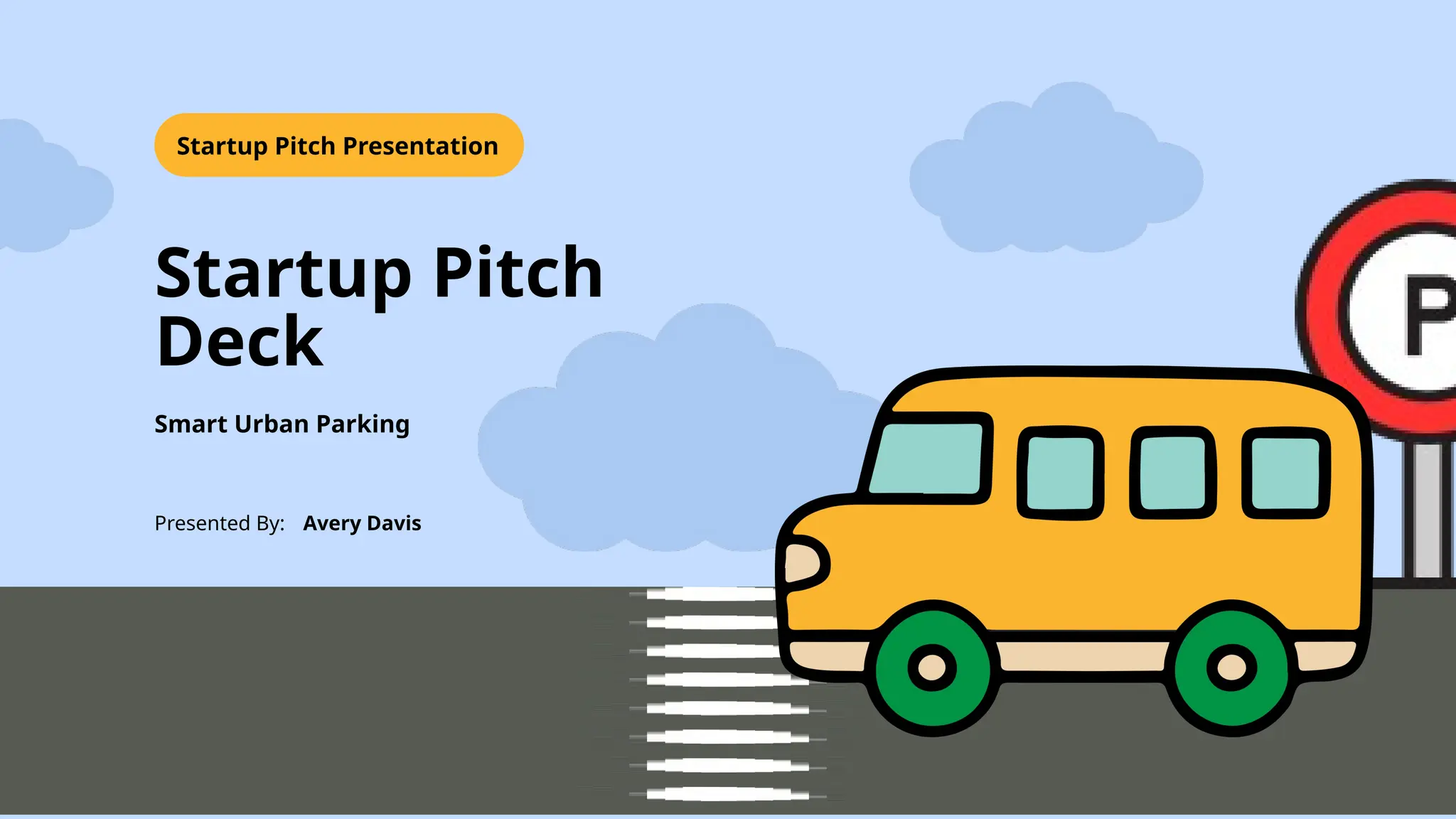
The cover slide introduces the company as 'Smart Urban Parking' and identifies the presenter as Avery Davis. The subtitle mentions 'Startup Pitch Presentation.' The visual style uses a cartoonish illustration of a bus and a parking sign, which contrasts with the more professional photography used in later slides. It establishes the sector—urban mobility—but fails to include a clear company logo or a compelling one-sentence value proposition.
Slide 2: Our Vision
This slide introduces the company name: Giggling Platypus Co. The stated goal is to 'reduce urban congestion by providing drivers with a smart, intuitive platform to efficiently find and reserve parking spaces.' While the vision is clear, the company name is highly idiosyncratic for a logistics and infrastructure startup, which may require a branding justification that is not provided here.
Slide 3: Current Challenges
The problem slide focuses on 'Wasted Time in Traffic.' It notes that drivers waste 'countless hours' searching for parking, which leads to stress, wasted fuel, and inefficient mobility. The slide uses a high-angle photo of city traffic to illustrate the point. However, it lacks specific data points—such as the average number of minutes a driver spends searching for parking or the economic cost of this inefficiency—to ground the problem in reality.
Slide 4: Our Solution
The solution is defined as 'Real-Time Parking Reservations.' The slide describes an 'easy-to-use mobile app' that shows availability and allows for booking and payment. The text is brief and functional. It does not show a mockup of the app interface, which is a missed opportunity to demonstrate the 'intuitive' nature of the platform mentioned in the vision slide.
Slide 5: Market Potential
Slide 5 discusses 'Growing Urban Mobility Needs.' It claims the smart parking market is 'expanding rapidly' as cities grow. This slide is purely qualitative. It contains no market sizing figures (TAM, SAM, SOM) and no citations for the growth claims. For an investor, this slide fails to quantify the scale of the opportunity.
Slide 6: Revenue Approach
The business model is described as 'Transaction Fees and Subscriptions.' Giggling Platypus Co. generates revenue through a 'small convenience fee' per booking and 'premium monthly subscriptions.' While the model is clear, the slide omits the actual price points. There is no information on what constitutes a 'small' fee or the cost of a premium subscription, making it impossible to evaluate the revenue potential per user.
Slide 7: Innovative Technology
This slide highlights 'Seamless Sensor Integration.' The platform reportedly connects to 'existing parking garage systems and smart city sensors.' This is a critical technical claim, as it suggests the company relies on third-party hardware rather than deploying its own. The slide does not explain how these integrations are secured or if there are any proprietary APIs involved.
Slide 8: Early Adoption
This is the strongest slide in the deck regarding traction. It claims 'Over ten thousand drivers actively use Giggling Platypus Co.' and reports a 'fifty percent reduction in parking search time.' These are significant metrics for an early-stage startup. However, the slide does not specify the geographic location of these users or the timeframe in which this growth occurred.
Slide 9: Market Position
The company describes itself as a 'User-Focused Parking App.' It claims to stand out through a 'seamless user interface, transparent pricing, and exclusive partnerships with prime downtown parking facilities.' The mention of 'exclusive partnerships' is a key competitive moat, but the slide does not name any of these partners, which weakens the credibility of the claim.
Slide 10: Conclusion and Contact
The final slide provides a 'Thank You' and lists contact information. It uses placeholder text for the website and social media handles ('@reallygreatsite' and 'reallygreatsite.com'). This indicates the deck may be a template or was not fully finalized before being shared, which is a significant red flag for professional investors.
What Works
Clear Problem/Solution Fit: The deck identifies a universally understood pain point—urban parking—and offers a direct digital solution. The narrative flow from problem to solution to technology is logical and easy to follow.
Traction Metrics: Claiming 10,000 active users and a 50% efficiency gain (Slide 8) provides a concrete reason for an investor to keep reading. These figures suggest that the product has moved beyond the conceptual stage and has achieved some level of product-market fit.
Simple Revenue Model: The combination of transactional and recurring revenue (Slide 6) is a standard and effective way to monetize a marketplace app. It shows the founders are thinking about both high-volume users and occasional customers.
What is Missing
The Team Slide: Perhaps the most glaring omission is the lack of a team slide. Investors back people, especially at the early stage. Without knowing the background of Avery Davis or the technical and operational leadership, the deck lacks human credibility.
The Ask: There is no mention of how much money the company is looking to raise, the valuation they are seeking, or what milestones the funding will help them achieve. A pitch deck without an 'ask' is merely an informational brochure.
Financial Projections and Unit Economics: The deck provides no insight into the company's burn rate, customer acquisition cost (CAC), or lifetime value (LTV). Without these, the sustainability of the business model cannot be assessed.
Competitive Landscape: The parking app space is crowded with incumbents like SpotHero and ParkWhiz. This deck fails to mention any competitors or explain why Giggling Platypus Co. is better than existing, well-funded alternatives.
What a Founder Should Copy
Concise Slide Content: The deck avoids 'walls of text.' Each slide focuses on a single core message with minimal supporting copy. This is an excellent practice for keeping an audience engaged during a live presentation.
Focus on Benefits: Rather than getting bogged down in the minutiae of how the sensors work, the deck focuses on the benefit to the user: saving time and reducing stress. Founders should always lead with the 'why' before the 'how.'
Visual Consistency: Despite the placeholder text on the final slide, the deck maintains a consistent color palette and layout throughout. A clean, professional-looking deck suggests a level of attention to detail that investors appreciate.
Frequently asked questions
- What is the primary product offered by Giggling Platypus Co.?
- The primary product is a mobile application designed for real-time parking reservations. According to Slide 4, the app allows drivers to view availability, book spots, and pay in advance to reduce the time spent searching for parking in crowded urban environments.
- How does the company plan to make money?
- As detailed on Slide 6, the revenue approach is two-fold. The company charges a 'small convenience fee' on every individual parking booking and offers a 'premium monthly subscription' tier targeted at frequent daily commuters who require regular parking access.
- What technical integrations does the platform use?
- Slide 7 explains that the platform utilizes 'Seamless Sensor Integration.' It connects directly to existing infrastructure, specifically parking garage systems and smart city sensors, to provide users with up-to-the-minute data on spot availability.
- What traction has the startup achieved so far?
- The deck claims significant early adoption on Slide 8, stating that over ten thousand drivers are actively using the platform. Furthermore, the company reports that these users experience a 50% reduction in the time typically spent searching for parking.
- What critical information is missing from this pitch deck?
- The deck is missing several standard components: a team slide (only one name, Avery Davis, is mentioned on the cover), a specific funding request, a breakdown of the total addressable market (TAM), a roadmap, and a detailed competitive landscape analysis.