The July 2014 'Snapchat for Business' deck is less of a traditional investor pitch and more of a strategic sales enablement tool designed to onboard brands into a radically new content ecosystem. At a time when the industry was obsessed with permanent 'likes' and 'wall posts,' Snapchat leaned into its core philosophy: 'Delete is our default.' The deck meticulously defines its terminology—Snaps, Stories, and Our Story—to ensure corporate partners understand the mechanics of ephemeral engagement. With 50% of its user base in North America and 48% aged 13-17, the deck presents a compelling demog…
Key takeaways
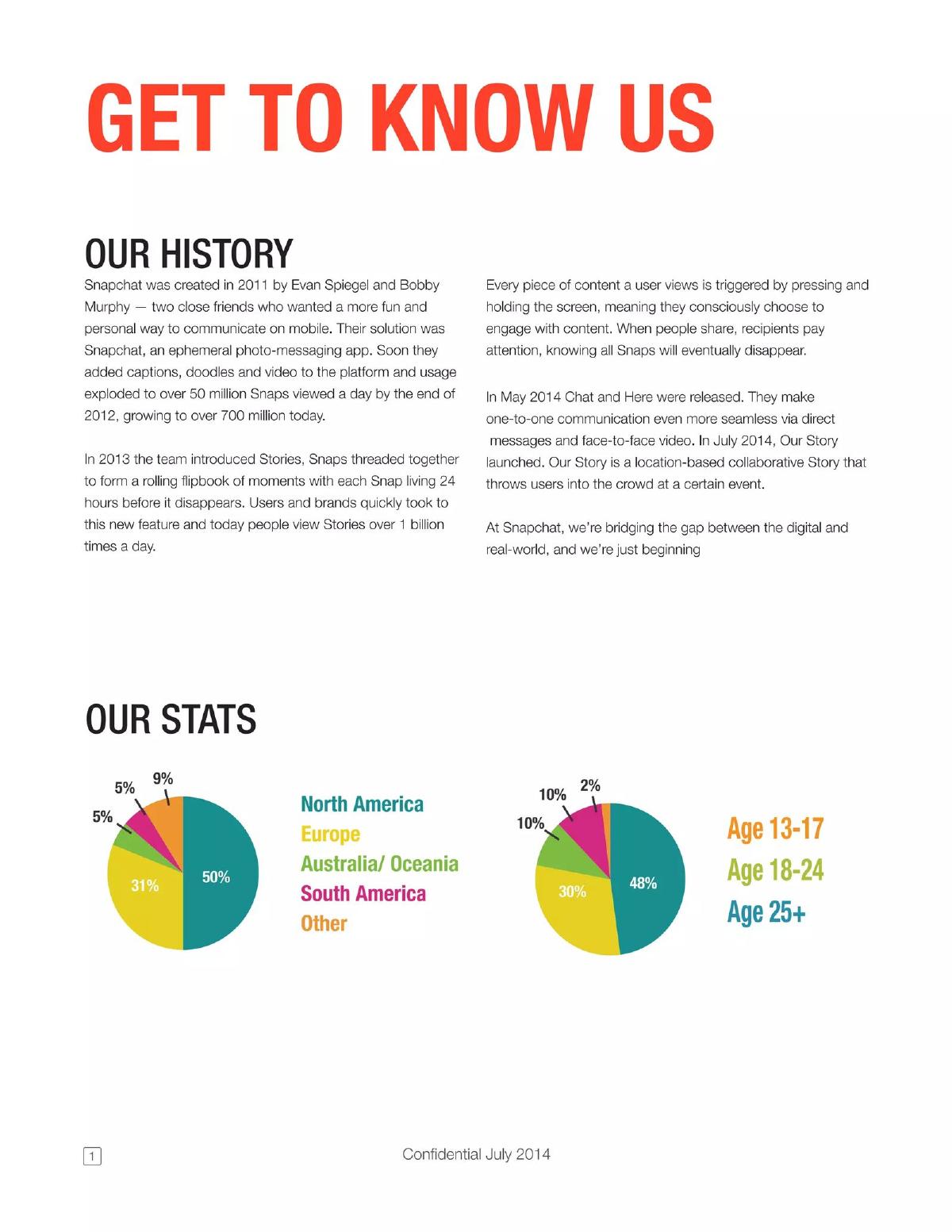
- Snapchat reported over 700 million Snaps viewed daily by July 2014 (Slide 1).
- The platform's demographic was heavily skewed toward youth, with 48% of users aged 13-17 and 30% aged 18-24 (Slide 1).
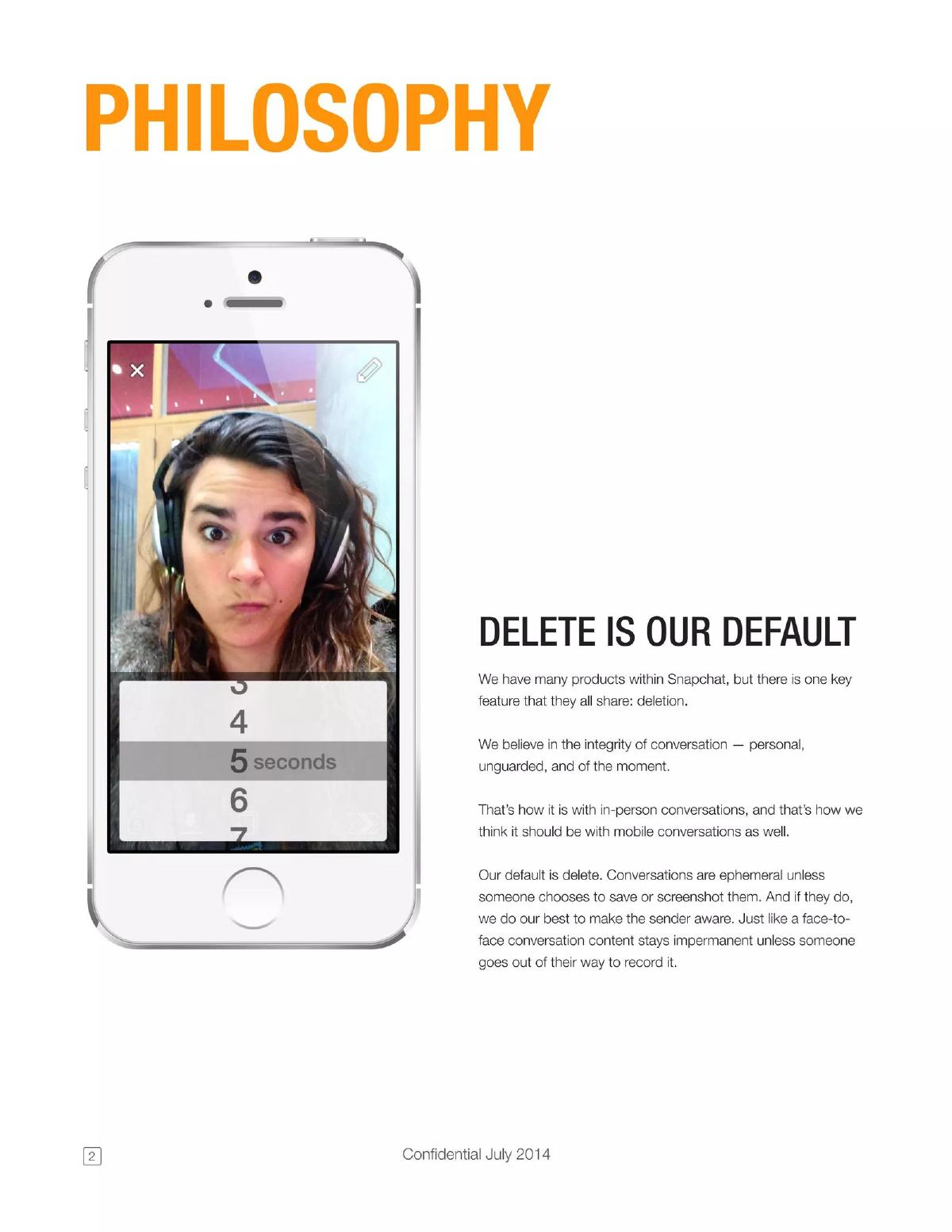
- The core value proposition is defined as 'Delete is our default,' emphasizing the integrity of unguarded conversation (Slide 2).
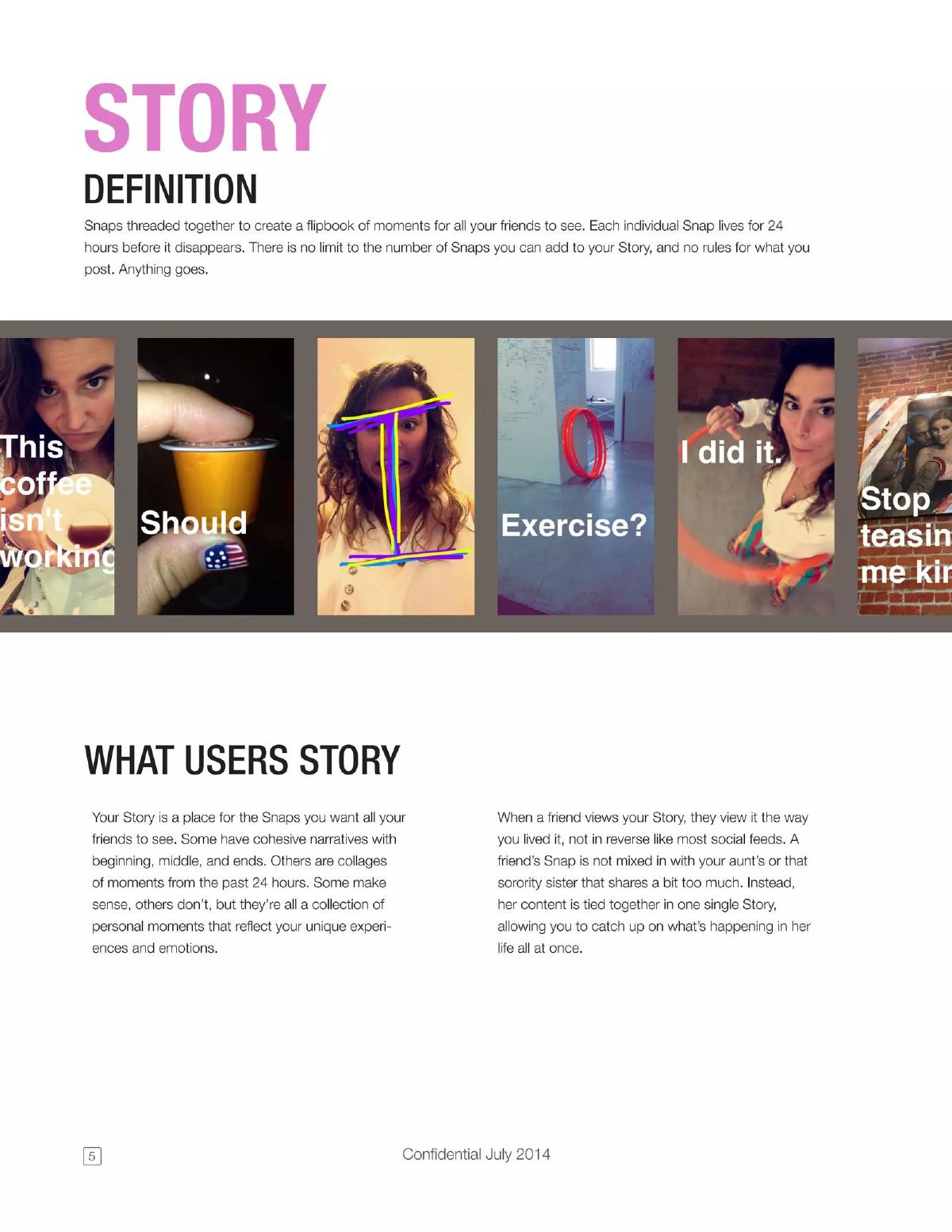
- Snapchat defined a 'Story' as a rolling flipbook of moments where each Snap lives for 24 hours (Slide 5).
- The 'Our Story' feature introduced collaborative, location-based content, such as 80 hours of Snaps submitted for EDC (Slide 7).
- The deck explicitly instructs businesses to skip phone number verification when creating accounts (Slide 9).
- Early brand adopters included HBO's 'Girls,' which produced a 220-second story for a red carpet premiere (Slide 12).
- Analytics for brands were limited to two primary metrics: number of views (purple eye) and number of screenshots (green arrow) (Slide 13).
The 2014 Snapchat for Business Strategy
The July 2014 Snapchat deck is a fascinating artifact from a transitional period in social media history. While the company was already a household name among teenagers, it faced a significant hurdle: convincing risk-averse brands to invest time and content into a platform where everything vanished. This deck is not a pitch for capital—Snapchat was already well-funded by this point—but a pitch for participation . It serves as a manual for the 'Snapchat way' of marketing, emphasizing authenticity over production value.
Slides 1-2: History, Stats, and Philosophy
The deck opens with a high-level overview of the company’s trajectory. On Slide 1, under 'Our History,' the founders establish their origin story: Evan Spiegel and Bobby Murphy created the app in 2011 to provide a 'more fun and personal way to communicate on mobile.' The growth figures are staggering for the time: 700 million Snaps viewed daily and 1 billion Story views per day. The 'Our Stats' section on the same slide clarifies the target audience. With 50% of users in North America and 78% of the total user base under the age of 24 (48% aged 13-17 and 30% aged 18-24), the demographic appeal to brands was undeniable.
Slide 2 introduces the 'Philosophy' that defined the platform: Delete is our Default . This was a radical departure from the 'permanent record' nature of Facebook or Instagram. Snapchat argues that this mirrors real-life conversation—unguarded and 'of the moment.' For a business audience, this was a strategic move to lower the 'perfection' barrier. Brands didn't need a studio; they just needed a phone.
Slides 3-6: Product Definitions and Mechanics
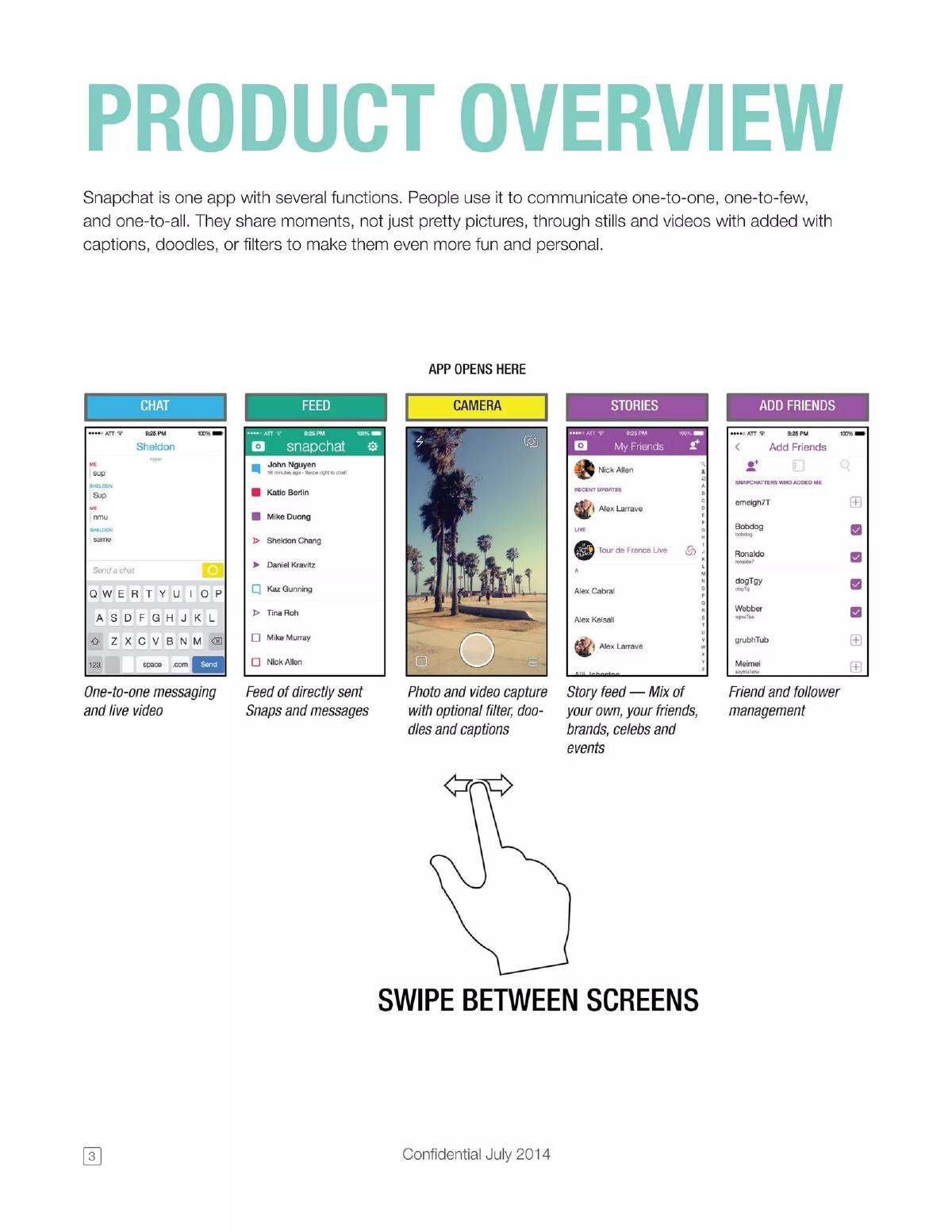
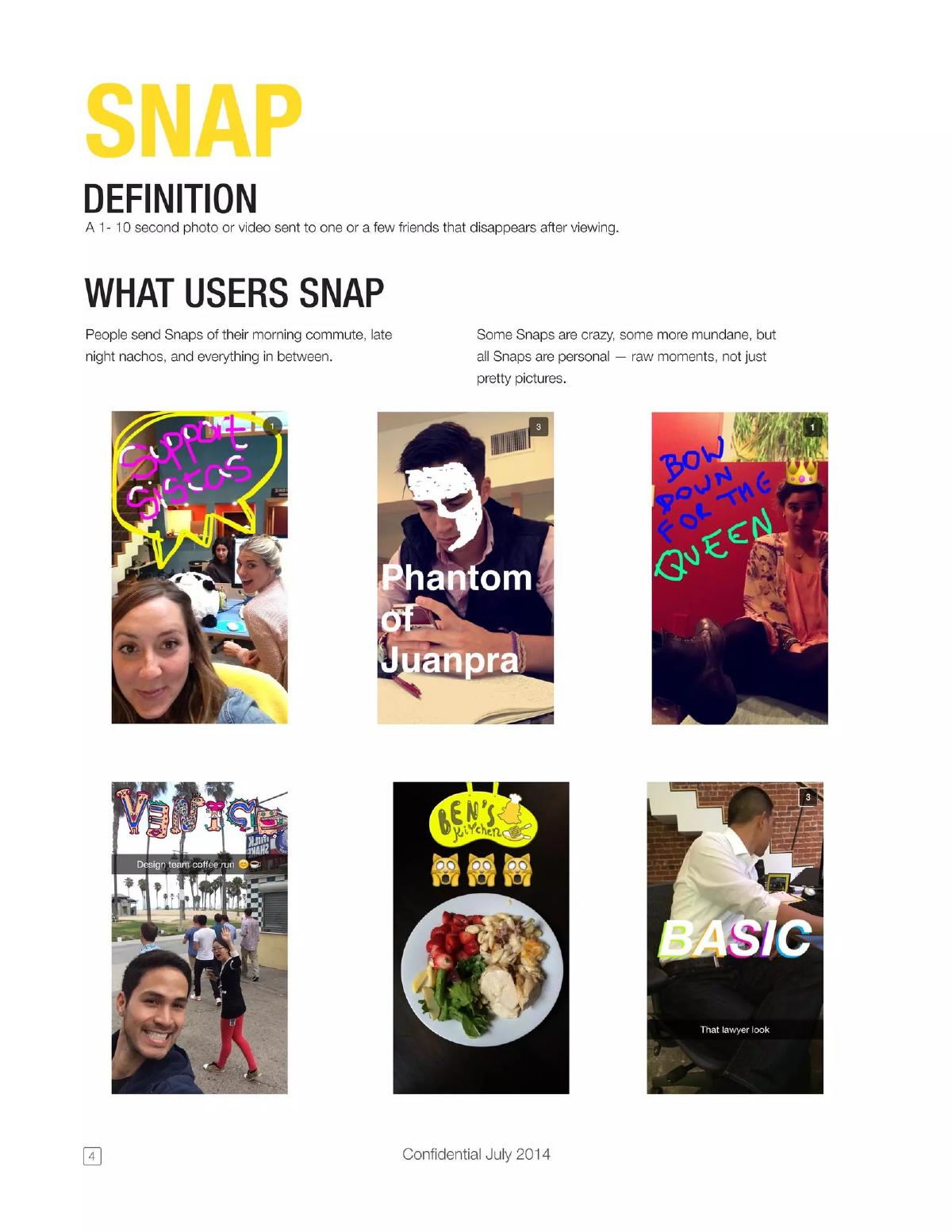
Because the UI of Snapchat was famously non-intuitive, Slides 3 and 4 act as a primer. Slide 3, 'Product Overview,' shows the five main screens: Chat, Feed, Camera, Stories, and Add Friends. It highlights the 'Swipe Between Screens' gesture, which was unique at the time. Slide 4 defines a 'Snap' as a 1-10 second photo or video that disappears after viewing. The examples provided—'Phantom of Juanpra' and 'Design team coffee run'—emphasize the mundane, personal nature of the content.
Slide 5 defines the 'Story' as a 'flipbook of moments' that lives for 24 hours. This is the slide that essentially sold the concept that would later be cloned by every major social media platform. It explains that Stories are viewed in chronological order ('the way you lived it'), which allows brands to build narratives. Slide 6 details 'Chat' and 'Here' (real-time video), further explaining the mechanics of one-to-one engagement.
Slides 7-8: Collaborative Content and Curation
Slide 7 introduces 'Our Story,' a location-based collaborative feature. This was Snapchat’s play for live events. The slide cites the Electric Daisy Carnival (EDC), where users submitted 80 hours of content, which the Snapchat team curated into three 8-minute stories. Similarly, for the World Cup in Rio, 45 hours of submissions were distilled into a 5-minute story. Slide 8, 'How It Works,' explains the 'geo-fence' concept, showing how users within a specific area can contribute to a collective narrative that the Snapchat team curates in real-time.
Slides 9-11: Onboarding the Business User
Slide 9, 'Now It's Your Turn,' transitions from theory to practice. It provides tactical 'Tips on Creating a Business Account.' Interestingly, it explicitly tells brands to 'Skip verifying your phone number' to avoid linking the account to a specific employee's mobile device. It also reminds users that they must be over 13 to comply with federal law.
Slide 10, 'What Do I Snap?', is a brainstorm for brand managers. It suggests six content pillars:
Personal: Behind the scenes (e.g., MTV at dinner). · Exclusive: Red carpet access (e.g., HBO’s 'Girls'). · In the Moment: Pregame huddles (e.g., New Orleans Saints). · Celebrity Takeovers: Influencer partnerships (e.g., Nat Young). · Promo Codes: Quirky doodles with discounts (e.g., Karmaloop). · Teasers: Building hype for commercial shoots (e.g., McDonald's).
Slide 11, 'Get the Word Out,' addresses the discovery problem. Since Snapchat had no 'suggested accounts' algorithm at the time, brands had to promote their usernames on Twitter, Instagram, websites, and even 'On Air' during television broadcasts (as shown by a screenshot from 'The Voice').
Slides 12-14: Case Studies and Early Adopters
Slide 12 provides deep-dive examples of early success. HBO’s 'Girls' used the platform for a 220-second red carpet story, while GrubHub used a 'tasty food sequence' to unveil a promo code ('SLICE'). These examples proved that the ephemeral format could drive both brand affinity and direct response.
Slide 13, 'How to See Your Stats,' reveals the simplicity of Snapchat’s 2014 analytics. Brands were told to look for the 'purple eye' (views) and the 'green arrow' (screenshots). The slide concludes with a massive list of 'Accounts to Check Out,' categorized by industry (Sports, Music, Fashion, etc.), proving that the platform already had significant B2B momentum.
What Works in This Deck
Clear Definitions: In 2014, 'Stories' and 'Snaps' were new concepts. The deck does an excellent job of defining these terms simply before moving into strategy. · Demographic Focus: By leading with the 13-17 and 18-24 age brackets, Snapchat made it clear exactly who brands would be reaching. · Visual Proof: The deck is heavy on screenshots and actual user content, which reinforces the 'raw and personal' brand identity they were preaching. · Tactical Advice: Including a 'How to' for account creation and content ideas made the platform feel accessible to marketing teams who might have been intimidated by the app's interface.
What is Missing
Revenue Models: There is no mention of paid advertising, sponsored lenses, or discovery placement costs. This deck focuses entirely on organic brand accounts. · Deep Analytics: The lack of data on completion rates, demographics of specific story viewers, or conversion tracking is a glaring omission by modern standards. · Team Slide: As this is a business-facing sales deck rather than a VC pitch, there is no information on the executive team or company structure. · Competition: The deck completely ignores other social platforms, choosing to position Snapchat as a unique 'philosophy' rather than a competitor to Facebook or Instagram.
What a Founder Should Copy
The 'Philosophy' Slide: If your product challenges industry norms (like 'permanent' social media), dedicate a slide to the 'Why' behind your unconventional choices. · Use Cases for Different Verticals: Slide 10 is a perfect template for showing potential customers exactly how they can use your tool. Don't just tell them it's a 'blank canvas'; show them what to paint. · Social Proof via Logos: The 'Accounts to Check Out' list on Slide 13 is a powerful way to show market validation without needing a complex 'Customers' slide. · Onboarding as Marketing: By including 'Tips on Creating an Account,' Snapchat turned a sales deck into an onboarding tool, reducing the friction for a brand to get started immediately after the presentation.
Frequently asked questions
- What was Snapchat's primary growth metric in 2014?
- According to Slide 1, Snapchat focused on engagement volume, stating that usage had exploded to over 700 million Snaps viewed per day by mid-2014. Additionally, they highlighted that 'Stories'—a then-new feature—were being viewed over 1 billion times daily, demonstrating a massive shift from one-to-one messaging to one-to-many broadcasting.
- How did Snapchat justify its 'disappearing' content to businesses?
- Snapchat framed ephemerality as a 'Philosophy' on Slide 2. They argued that 'Delete is our default' mimics the integrity of in-person, face-to-face conversations which are naturally impermanent. For businesses, this meant an opportunity to share 'raw moments' rather than 'pretty pictures,' lowering the barrier for content production and increasing the sense of urgency for the viewer.
- What was the 'Our Story' feature described in the deck?
- As shown on Slide 7, 'Our Story' was a location-based collaborative feature. It aggregated user-generated content from specific events, like the Electric Daisy Carnival (EDC) or the World Cup in Rio. Snapchat's team curated these submissions in real-time to create a 'sharp and immersive' narrative from multiple perspectives, which brands could then leverage for visibility.
- Which brands were already using Snapchat in 2014?
- Slide 13 lists dozens of early adopters across sports (NBA, MLB), music (Tiesto), fashion (Nasty Gal), and food (Taco Bell, McDonald's). Slide 12 specifically highlights GrubHub’s use of promo codes hidden in pizza sequences and HBO’s 'Girls' account, which provided exclusive behind-the-scenes access to red carpet events.
- What metrics did Snapchat provide to business accounts at this stage?
- Analytics were rudimentary compared to modern standards. Slide 13 shows that brands could only see two stats: the number next to the 'purple eye' icon (total views) and the number next to the 'green arrow' icon (total screenshots). This lack of deep funnel data emphasized the platform's focus on top-of-mind awareness and direct engagement over complex attribution.