Juked’s 2019 pitch deck is a masterclass in leveraging founder-market fit to address a specific, growing pain point: the fragmentation of the esports fan experience. With a founding team that includes a member of the Twitch founding team, the deck quickly establishes credibility. It utilizes high-impact industry data, such as the fact that 44 million concurrent viewers watched the 2019 LoL World Finals (Slide 3), to prove the market's scale. The deck identifies that fans are currently forced to juggle dozens of platforms for streaming, stats, and news, proposing Juked as the all-in-one soluti…
Key takeaways
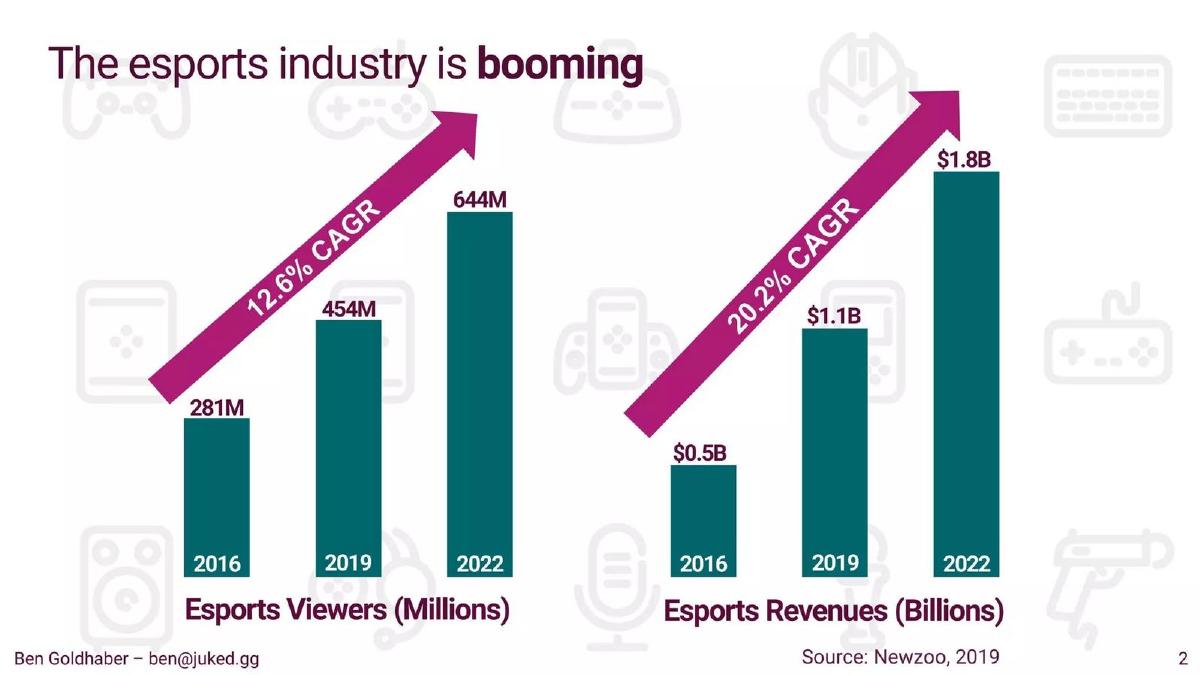
- The deck relies heavily on the 'booming' esports industry, citing a 12.6% CAGR in viewers and 20.2% CAGR in revenue (Slide 2).
- Juked uses a powerful comparison to traditional sports, noting the LoL World Finals had 2x the concurrent viewers of the 2019 NBA Finals Game 6 (Slide 3).
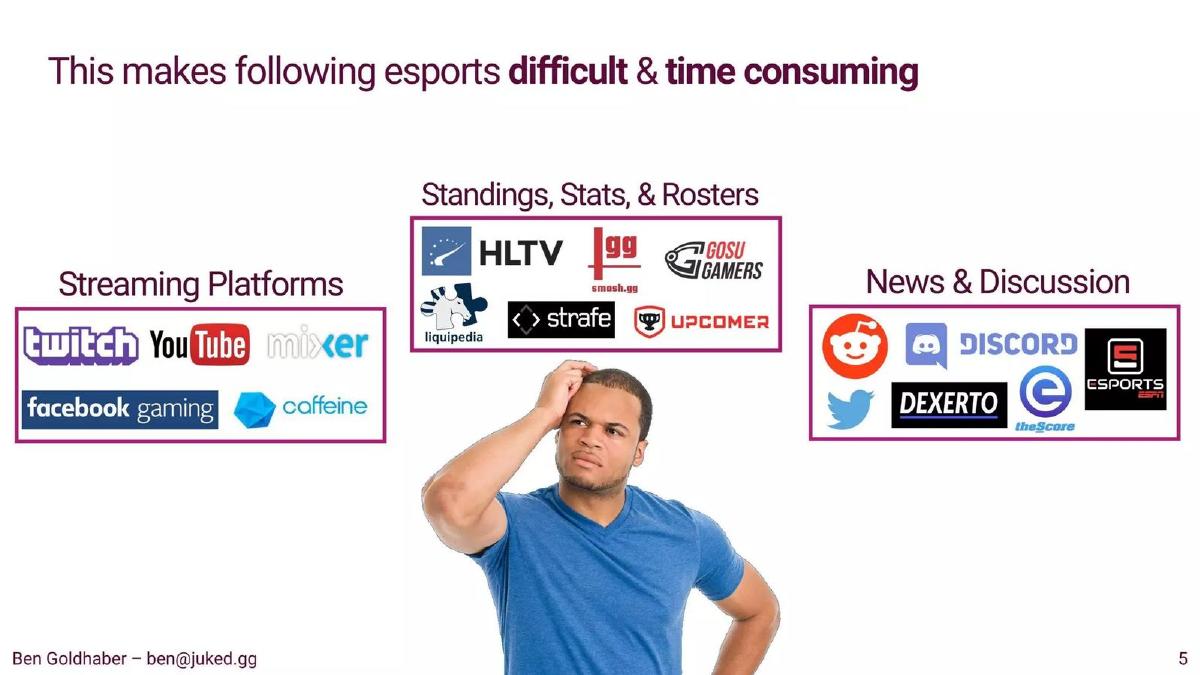
- The core problem is defined as fragmentation across 15+ different logos including Twitch, Reddit, and Liquipedia (Slide 5).
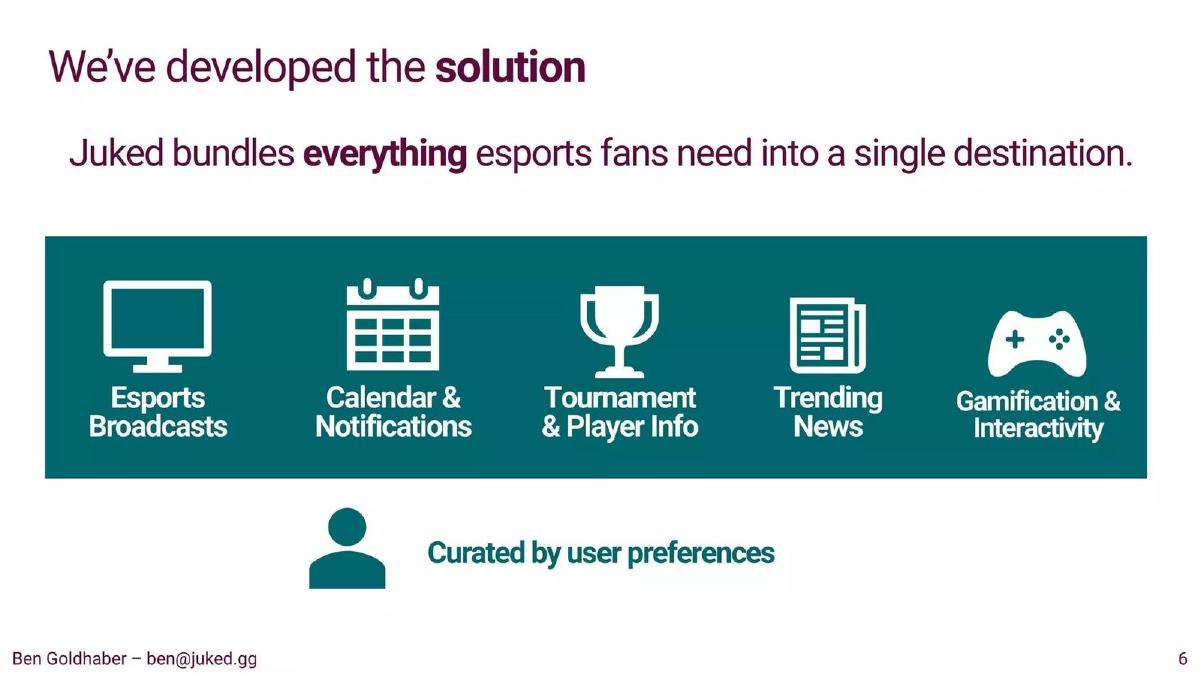
- The solution is presented as a bundle of five pillars: broadcasts, calendars, player info, news, and gamification (Slide 6).
- Traction is the deck's strongest metric, showing a jump from 750 to 25,000 MAU since a September launch (Slide 8).
- The team slide highlights significant pedigree, specifically Ben Goldhaber's role on the founding team at Twitch (Slide 9).
- The deck features an 'awesome backers' slide with heavyweights like Mike Morhaime (Blizzard) and 500 Startups (Slide 10).
- There is no slide dedicated to monetization, unit economics, or a specific capital ask in this version of the deck.
The Aggregation Play: Juked’s 2019 Pitch Deck Analysis
Juked entered the market at a time when esports was transitioning from a niche hobby to a global entertainment powerhouse. Their 12-slide pitch deck, used to raise $2.2 million, focuses on a classic 'aggregator' strategy. By identifying that the fan experience was scattered across dozens of platforms, Juked positioned itself as the glue for the industry. This teardown examines how they used industry tailwinds and founder pedigree to overcome a lack of revenue data.
Slides 1-3: The Macro Opportunity
Slide 1 is a standard title slide featuring the company logo and the tagline: "The New Home for Esports Entertainment." The branding is clean, using a dark gradient that appeals to the gaming demographic.
Slide 2 establishes the market size using Newzoo data from 2019. It highlights two key metrics: Esports Viewers (growing from 281M in 2016 to a projected 644M in 2022 at a 12.6% CAGR) and Esports Revenues (growing from $0.5B to a projected $1.8B at a 20.2% CAGR). By showing that revenue is growing faster than viewership, Juked hints at an increasing ability to monetize the fan base.
Slide 3 provides a 'shock and awe' statistic to ground the market size in reality for generalist investors. It states that 44 million concurrent viewers watched the 2019 League of Legends (LoL) World Finals, which was "More than 2x 2019 NBA Finals Game 6." This comparison to traditional sports is a common tactic to prove that esports is no longer a subculture but a mainstream competitor for attention.
Slides 4-5: Defining the Friction
Slide 4 acts as a transition, simply stating: "But there’s a problem... The esports industry is highly fragmented."
Slide 5 visualizes this fragmentation. It shows a confused user surrounded by three categories of logos: Streaming Platforms (Twitch, YouTube, Mixer, Facebook Gaming, Caffeine), Standings, Stats & Rosters (HLTV, Liquipedia, Strafe, etc.), and News & Discussion (Reddit, Discord, Twitter, Dexerto, ESPN). The slide effectively argues that the current fan experience is "difficult & time consuming" because the data and content live in silos. This sets the stage for a 'portal' or 'dashboard' solution.
Slides 6-8: The Solution and Early Traction
Slide 6 introduces the Juked product. It lists five core pillars of the platform: Esports Broadcasts, Calendar & Notifications, Tournament & Player Info, Trending News, and Gamification & Interactivity. The bottom of the slide notes that this content is "Curated by user preferences," suggesting a personalized feed rather than a static directory.
Slide 7 provides social proof. It features a tweet from Christopher LaPorte comparing Juked to "NFL RedZone" for esports. Below the tweet is a screenshot of the Juked web interface, showing multiple live streams (Rocket League, Overwatch, Call of Duty) with viewer counts and schedules. This slide is crucial because it shows the product is live and functional, not just a concept.
Slide 8 delivers the 'Traction' metrics. It claims that since launching in September, the platform grew from 750 to 25,000 Monthly Active Users (MAU). The slide highlights a "131% Monthly User Growth" rate. While 25,000 MAU is small in absolute terms for a social/content platform, the growth velocity is what attracts venture capital.
Slides 9-10: The Pedigree and The Backers
Slide 9 is perhaps the most important slide in the deck for a pre-revenue company. It introduces the team. CEO Ben Goldhaber is listed as a member of the "Founding Team @ Twitch" and former Director of Marketing. CPO Chris Chan is credited with 15 years of product experience and creating 8 top esports podcasts. VP of Engineering Delan Tai is noted as the former CTO of Roostr (acquired by Chartboost). This slide effectively tells investors: "We have already built the biggest platform in this space; we can do it again."
Slide 10 reinforces this credibility with a list of "awesome backers." The inclusion of Mike Morhaime (Co-founder/CEO of Blizzard) is a massive signal, as Blizzard owns the intellectual property for many of the games Juked aggregates. Other backers include the founders of MyFitnessPal and RotoGrinders, along with the accelerator 500 Startups.
Slides 11-12: The Vision and Closing
Slide 11 is a vision statement superimposed over a photo of a packed esports arena: "Juked is where the next 500 million esports fans will be born." This shifts the narrative from a utility tool (checking stats) to a growth engine for the entire industry.
Slide 12 is the contact slide, providing Ben Goldhaber’s email address. Notably, this deck ends without a formal 'Ask' slide or a 'Use of Funds' breakdown, which are typically found in final-stage pitch decks.
What Works in the Juked Deck
Founder-Market Fit: The team slide (Slide 9) is the deck's strongest asset. Having a Twitch founder building an esports platform is a narrative that almost sells itself. · The 'Red Zone' Analogy: By using a customer testimonial to compare the product to NFL RedZone (Slide 7), Juked gives investors an immediate mental model for how the product creates value through aggregation. · Clear Problem Definition: Slide 5 does an excellent job of showing, not just telling, the fragmentation. The sea of logos makes the pain point feel visceral. · Market Context: Comparing LoL viewership to the NBA Finals (Slide 3) is an effective way to translate the scale of the opportunity to investors who might not be gamers themselves.
What is Missing from the Juked Deck
Business Model: There is no mention of how Juked intends to make money. Whether through advertising, subscriptions, affiliate betting links, or data sales, the path to revenue is completely omitted. · Competitive Analysis: While Slide 5 lists other platforms, it treats them as components to be aggregated rather than competitors. The deck doesn't address other aggregators or how Juked will maintain a moat if Twitch or Discord decides to build similar features. · The Ask: The deck does not specify how much capital is being raised or what the milestones for the next 18 months are. · Unit Economics: There is no data on user retention, time spent on site, or customer acquisition cost (CAC). For a social/content play, these are usually vital metrics.
What a Founder Should Copy
The 'Booming' Slide: If you are in a high-growth sector, use a slide like Slide 2. It uses reputable third-party data (Newzoo) and clear CAGR percentages to prove you are riding a wave. · Logo Grouping: The way Slide 5 groups logos into categories is a great way to map out a complex ecosystem for an outsider. It shows you understand the landscape deeply. · High-Impact Imagery: The use of full-bleed arena photos (Slide 3 and Slide 11) conveys the 'bigness' of the industry and the emotional connection fans have with the content. · Pedigree Highlighting: If your team has a 'big win' (like being a founding member of a unicorn), make it the centerpiece of your team slide. Use the logos of those former companies prominently.
Frequently asked questions
- How did Juked demonstrate market demand without a long history?
- Juked focused on short-term, high-velocity growth. Slide 8 shows they grew from 750 to 25,000 Monthly Active Users (MAU) in just a few months, representing a 131% average monthly growth rate. This velocity, combined with a testimonial comparing them to 'NFL RedZone' (Slide 7), suggested immediate product-market fit to investors.
- What is the 'fragmentation' problem Juked refers to?
- As shown on Slide 5, esports fans have to visit different sites for streaming (Twitch/YouTube), stats (HLTV/Liquipedia), and discussion (Reddit/Discord). Juked argues this is 'difficult and time consuming.' Their solution (Slide 6) is to aggregate these disparate functions into a single, curated dashboard.
- Why was the team slide so critical for this $2.2M raise?
- In a crowded gaming market, founder pedigree is a primary filter for VCs. CEO Ben Goldhaber was part of the founding team at Twitch and served as Director of Marketing (Slide 9). This specific experience in building the world's largest gaming video platform gave investors confidence that the team understood the technical and cultural nuances of esports.
- Who were the key investors mentioned in the deck?
- Slide 10 lists several high-profile angel and institutional backers, including Mike and Amy Morhaime (Co-founder/CEO of Blizzard Entertainment), Mike and Albert Lee (Co-founders of MyFitnessPal), and the accelerator 500 Startups. Having the founder of Blizzard—the company behind major esports like Overwatch and StarCraft—backing the project served as a massive industry validation.
- What essential startup metrics are missing from this deck?
- The deck is notably missing a business model slide, financial projections, and a specific 'Ask' slide detailing how the $2.2M would be spent. It also lacks a competitive landscape analysis beyond the logos of the fragmented services it aims to aggregate. This suggests the round was likely driven by team pedigree and top-line user growth rather than immediate revenue potential.