Joyixir’s 2020 pitch deck functions as a bridge between their established regional success in Iran and their ambitions for the global mobile gaming market. The studio demonstrates a clear track record, citing four specific titles developed between 2015 and 2020, including 'Words Tour,' which achieved competitive metrics in Turkish and Iranian markets. A significant portion of the deck is dedicated to translating regional performance data (denominated in IRR) into global projections (denominated in USD), assuming a 1% paying user ratio. While the deck excels at showing technical competency and…
Key takeaways
- The studio has a five-year development history, starting with the arcade game Zoobi in 2015 (Slide 3).
- Joyixir successfully collaborated with developer Caspian on 'Words Tour,' reaching high metrics in Iran and Turkey before the partnership ended (Slide 4).
- The company targets a $350M market share within a projected $96B mobile gaming market for 2022 (Slide 7).
- Performance is measured through six core indices: Feedbacks, Retention, IAP Conversion, User Behavior, Session Length, and Stickiness (Slide 5).
- The deck provides a direct comparison between 'World of Words' KPIs and assumed global projections, showing a 3.3% actual paying user ratio versus a conservative 1% projection (Slide 8).
- Revenue modeling segments users into three types, with Type 3 users projected to generate $50 in average revenue (Slide 8).
- The studio's 2020 roadmap focused on 'Captain Starla,' an action RPG with hyper-casual mechanics (Slide 4).
- The team slide lacks names, titles, or professional histories, featuring only a group photo of 11 members (Slide 9).
Joyixir Pitch Deck Analysis: From Regional Success to Global Ambition
Joyixir’s 2020 pitch deck is a study in how regional startups attempt to bridge the gap between local traction and global investment. The studio, based on the context of their games, has deep roots in the Iranian development scene but uses this deck to project a future in the broader international mobile gaming market. The narrative is built on a foundation of historical execution, moving from simple arcade mechanics to more complex, monetizable genres.
Slide 1: Title and Brand Identity
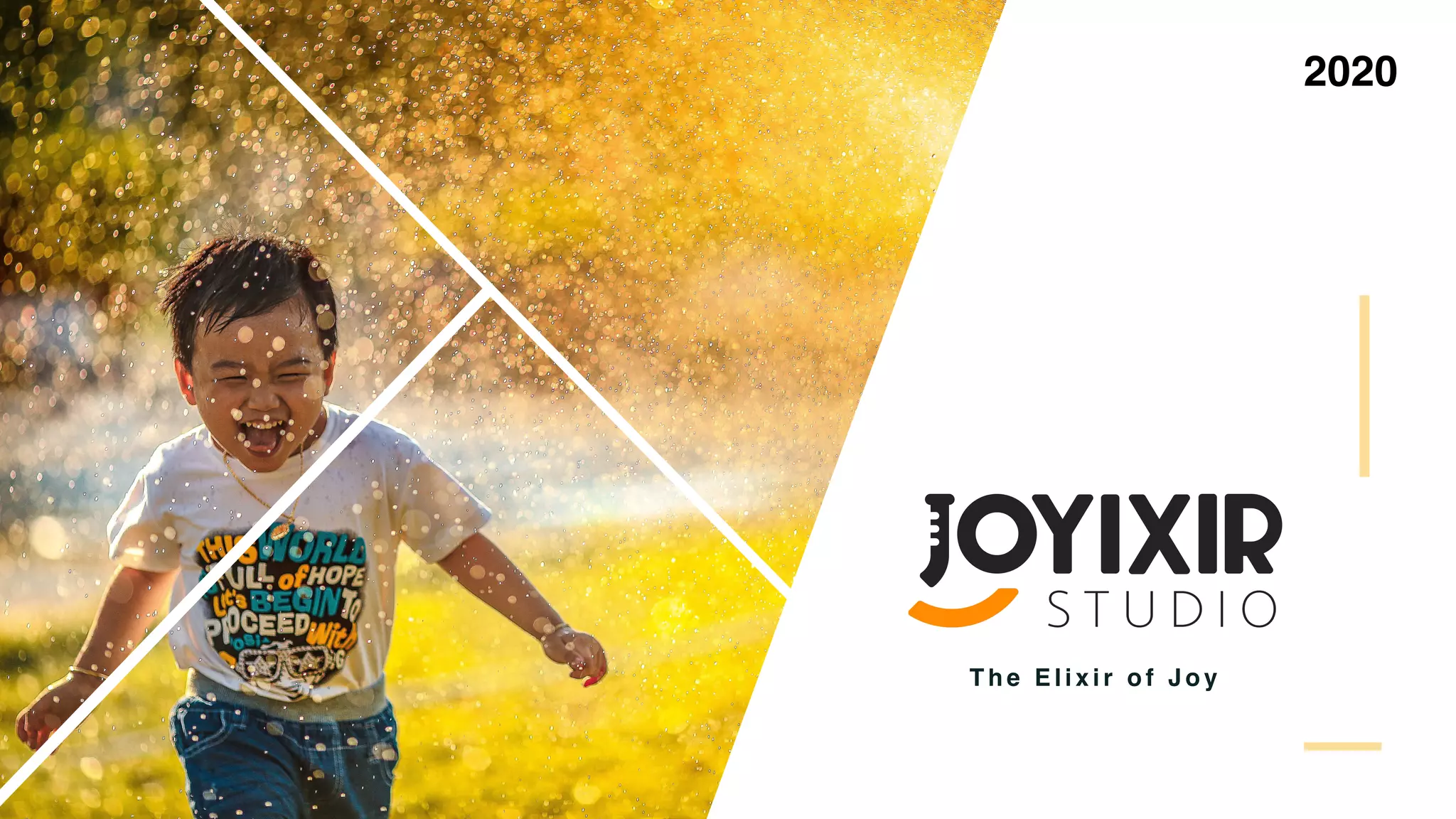
The cover slide establishes the brand 'Joyixir Studio' with the tagline 'The Elixir of Joy.' The imagery of a child playing in water suggests a focus on lighthearted, accessible entertainment. The '2020' timestamp marks this as a mid-pandemic era deck, a time when mobile gaming saw significant tailwinds globally. The branding is clean, utilizing a yellow and white color palette that persists throughout the presentation.
Slide 2: Core Values
Slide 2 outlines the company's cultural pillars: Creativity, Integrity, Humanity, and Openness . While these are standard corporate values, the inclusion of 'Humanity' and 'Openness' alongside a photo of a handshake suggests a focus on the collaborative nature of the studio. In the gaming industry, where crunch culture is a common critique, emphasizing these values can be a subtle signal to investors about studio stability and talent retention.
Slide 3: Project Timeline (2015-2016)
The 'Our Experience' section begins on Slide 3, providing much-needed proof of execution. They highlight two early projects: Zoobi (2015) , an arcade game featuring an alien character, and Sonjoo Escape (2016) , an endless runner. Notably, Sonjoo Escape is described as being 'inspired by kids in the early 90's of Iran,' which explicitly identifies the studio's cultural and geographic origin. This slide establishes that the team is not new to the industry and has a history of shipping products.
Slide 4: Project Timeline (2019-2020)
Slide 4 shows the evolution of the studio's complexity. Words Tour (2019) is noted as a collaboration with Caspian that reached 'highly competitive metrics' in Iranian and Turkish markets. The slide honestly notes that the cooperation has 'ended,' which is a transparent move for a pitch deck. The final project mentioned is Captain Starla (2020) , described as an action RPG with hyper-casual mechanics. This represents a strategic shift toward 'hybrid-casual' games, a genre that was gaining significant investment interest in 2020 due to its high retention and monetization potential.
Slide 5: Performance Indices
This slide moves from 'what' they build to 'how' they measure it. Joyixir lists six KPIs: Feedbacks, Retention, In-app Purchase Conversion Rate, User Behavior, Session Length, and Stickiness . By presenting these as 'Performance Indices' measured throughout the product lifecycle, the studio positions itself as a data-informed entity rather than just a creative shop. This is a critical distinction for gaming investors who look for repeatable processes rather than 'one-hit wonders.'
Slide 6: Competency and Philosophy
Slide 6 attempts to define the studio's 'secret sauce.' It focuses on 'Engagement Control,' stating that success is about 'knowing people rather than games.' The slide mentions the use of machine-learned and individualized patterns to drive engagement. This suggests that Joyixir is building, or intends to build, a backend layer that optimizes the player experience (reward vs. challenge) in real-time. This technical competency is a higher-value proposition than game design alone.
Slide 7: Size of Market
The market slide uses a standard 'nested circle' diagram to show the Total Addressable Market (TAM) and Serviceable Addressable Market (SAM). Citing a 2022 forecast, they value the Global Game Market at $196B and the Mobile Game Market at $96B . They claim a target Market Share of $350M . While the $350M figure is ambitious for a mid-sized studio, it provides a sense of the scale they believe their portfolio can achieve globally.
Slide 8: KPI Experiments vs. Assumptions
This is arguably the most important slide in the deck. It provides a side-by-side comparison of actual metrics from 'World of Words' (likely the same as Words Tour) against global projections. World of Words achieved a 3.3% Paying User/Active User Ratio . For their global projections, they conservatively drop this to 1% . They also convert revenue from IRR (Iranian Rial) to USD, projecting that 'Type 3' users (whales) will generate $50 in average revenue. This level of granular modeling shows a sophisticated understanding of unit economics.
Slide 9: The Team
The final slide in the provided set is a team photo featuring 11 members. It includes a quote from Jane McGonigal: 'Reality is broken. Game designers can fix it.' While the photo shows a diverse and sizable team, the slide is critically missing names, roles, and professional backgrounds . Investors invest in people, and without knowing if the lead developer came from a major studio or if the CEO has prior exits, the 'Team' slide fails to build the necessary trust.
What Joyixir Does Well
Joyixir excels at demonstrating a long-term track record . Many gaming decks focus on a single prototype; Joyixir shows five years of shipping games across different genres. Their transparency regarding the end of the Caspian partnership and their conservative approach to global KPI projections (dropping from 3.3% to 1%) suggests a level of maturity and realism that is often missing in early-stage pitches. The transition from IRR to USD is also handled logically, making their regional success legible to international investors.
What is Missing from the Deck
The most glaring omission is the Financial Ask . There is no mention of how much capital is being raised, the valuation, or the specific milestones that the capital will unlock. Furthermore, the Team Slide is purely decorative; it lacks the credentials required to vet the studio's leadership. There is also no Competitor Analysis slide. In the crowded mobile gaming space, failing to mention how Joyixir differentiates itself from giants like Voodoo or Playrix is a missed opportunity to define their unique market position. Finally, there is no User Acquisition (UA) strategy , which is the lifeblood of mobile gaming success.
Founder Takeaways: What to Copy
The 'Experiments vs. Assumptions' Model: If you have data from a soft launch or a specific region, show how you are discounting that data to be conservative for a global rollout. It builds immense credibility. · Genre Evolution: Showing a timeline that moves from simple mechanics (arcade) to complex ones (Action RPG) demonstrates that the studio is learning and growing its capabilities. · Metric-Driven Design: Listing specific performance indices shows that you aren't just 'hoping' a game is fun; you are measuring if it is engaging. · Cultural Context: Don't be afraid to mention your roots. Joyixir's mention of 90s Iran for 'Sonjoo Escape' adds a unique narrative flavor that makes the studio memorable.
Frequently asked questions
- What is Joyixir's primary product focus?
- Based on the project timeline on slides 3 and 4, Joyixir focuses on mobile gaming across various genres. Their history includes arcade games (Zoobi), endless runners (Sonjoo Escape), word games (Words Tour), and action RPGs with hyper-casual mechanics (Captain Starla). This suggests a versatile studio capable of pivoting based on market trends rather than a single-genre specialist.
- How does the company justify its global revenue projections?
- On slide 8, Joyixir uses 'Experiments vs Assumptions.' They take actual data from their 'World of Words' title, which had a 3.3% paying user ratio, and apply a more conservative 1% ratio for their global projections. They also convert Iranian Rial (IRR) revenue figures into USD to demonstrate how regional engagement translates to international currency value.
- What specific metrics does Joyixir track to determine game success?
- Slide 5 outlines their 'Performance Indices,' which include Feedback (qualitative), Retention (longevity), In-app Purchase Conversion Rate (monetization), User Behavior (engagement patterns), Session Length (depth), and Stickiness (frequency). This indicates a data-driven approach to game development and live-ops.
- What is the size of the market Joyixir is targeting?
- According to slide 7, Joyixir cites a 2022 forecast where the Global Game Market is $196B and the Mobile Game Market is $96B. From this, the company identifies 'Our Market Share' as a $350M opportunity, though the slide does not specify the timeframe for reaching this share.
- Is there a clear investment 'Ask' in the deck?
- No. The provided slides do not include a funding request, valuation, or a 'Use of Funds' breakdown. The deck functions more as a capability statement and a strategic overview of the studio's competency and market potential rather than a transactional fundraising document.