Sorare’s 22-slide deck, used during their transition from early traction to global scale, focuses heavily on the 'why now' of blockchain gaming. By identifying a $370B annual collectibles market (Slide 5) and the lack of digital ownership in legacy gaming (Slide 3), Sorare positioned itself as the solution for digital scarcity. The deck highlights a significant competitive advantage: official licenses from 70+ clubs (Slide 11), creating a barrier to entry for competitors. With €1M in sales achieved in just 10 months (Slide 15) and 100% organic customer acquisition (Slide 12), the team proved…
Key takeaways
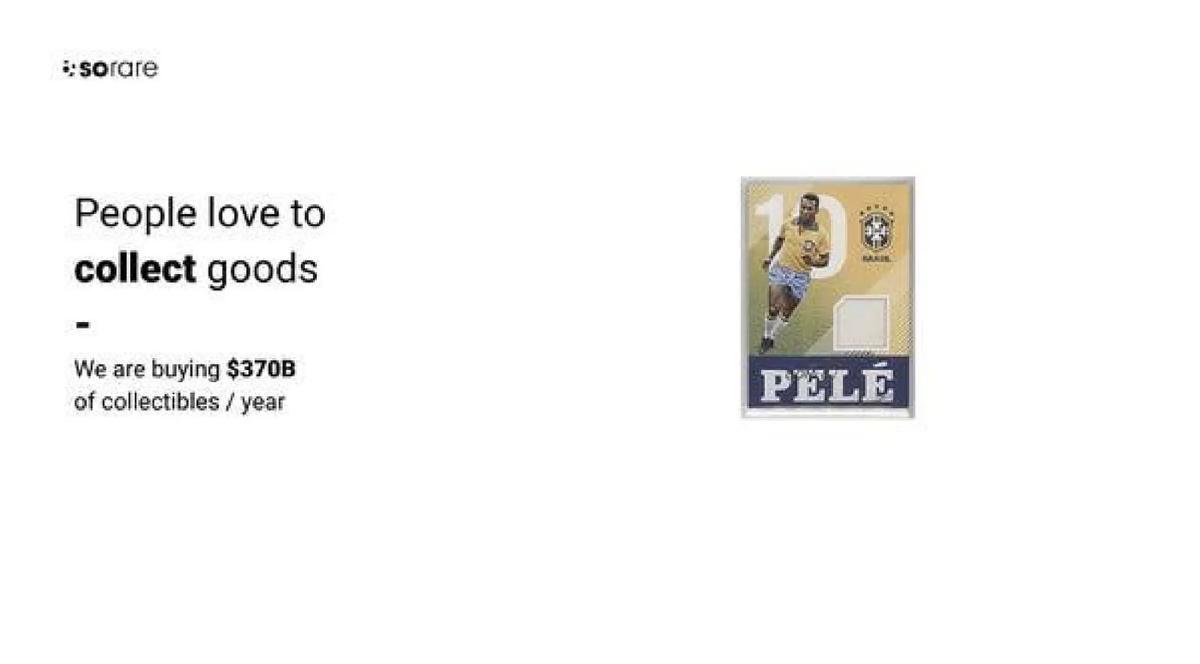
- The deck identifies a massive $370B annual market for physical collectibles as the primary target for digital disruption (Slide 5).
- Sorare established a significant moat by signing 70 football clubs within their first 10 months of operation (Slide 11).
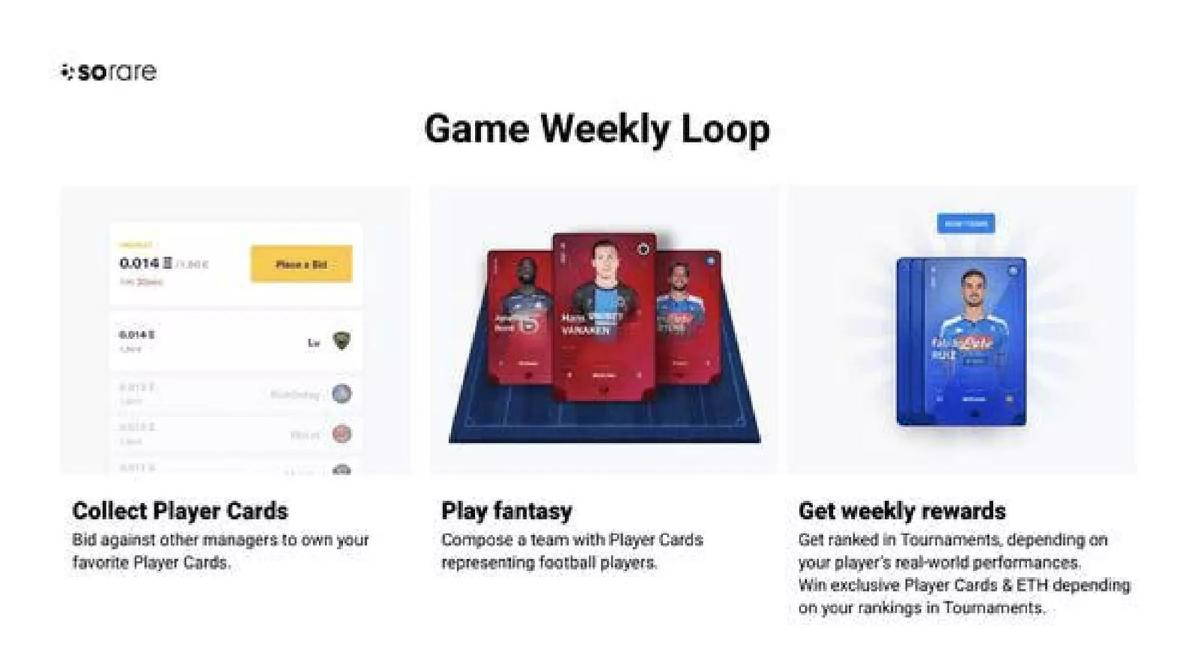
- The business model leverages a 'Game Weekly Loop' where users collect, play, and earn rewards in ETH or cards (Slide 6).
- Traction was proven with €1M in total sales volume generated by a small team of just 6 people (Slide 15).
- Customer acquisition is claimed to be 100% organic, driven by club announcements, word of mouth, and Discord (Slide 12).
- The deck highlights a 'mainstream' design philosophy requiring no crypto knowledge and a simple payment flow (Slide 8).
- The market opportunity is framed across three sectors: Fantasy Sports ($20B), Sport Licensing ($25B), and Sport Betting ($250B) (Slide 7).
- The founding team has direct experience in blockchain engineering and operations from their time at Stratumn (Slide 2).
The Strategy of Scarcity: Analyzing the Sorare Pitch Deck
Sorare’s pitch deck is a definitive example of how to pitch a Web3 product to a Web2 audience. At a time when NFTs were still a niche concept, Sorare focused on the universal human desire to collect and the global passion for football. The deck doesn't lead with blockchain; it leads with the game and the licenses that make the game possible.
The Foundation: Team and Problem (Slides 1-3)
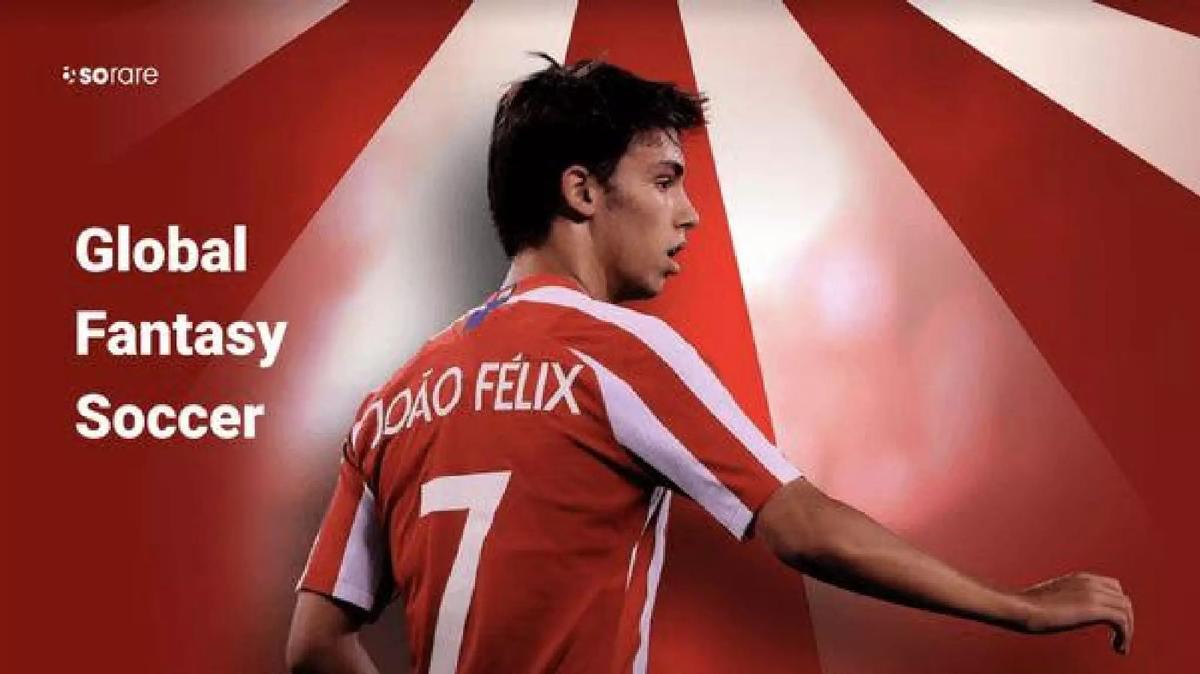
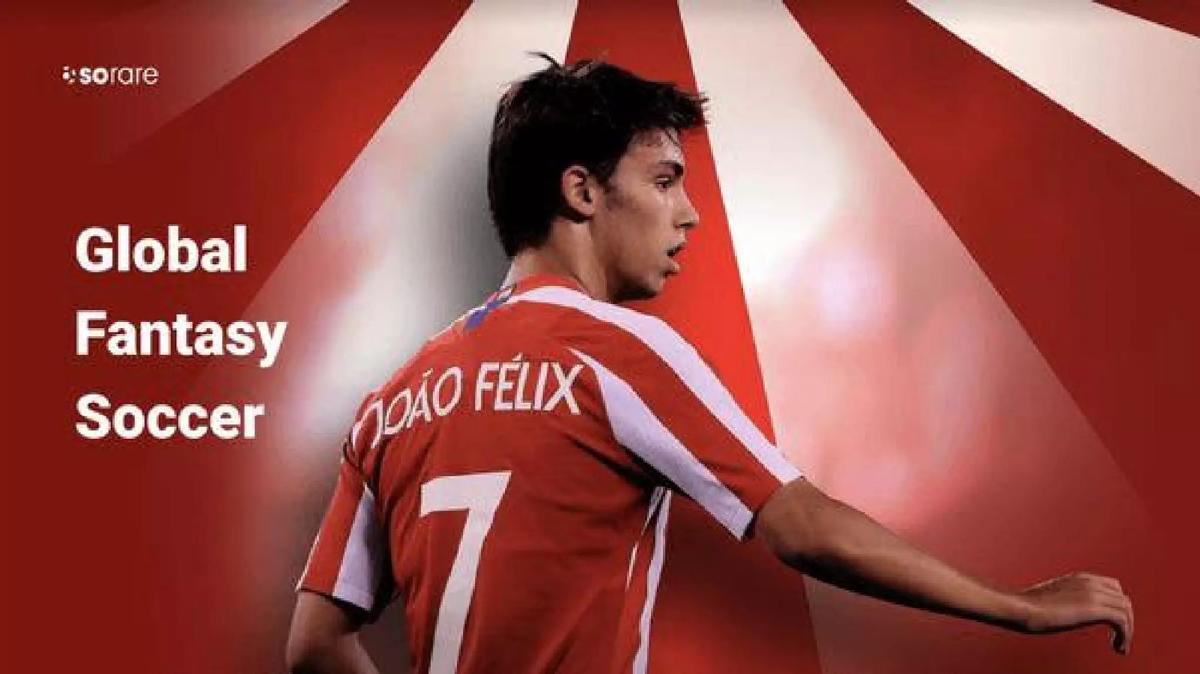
Slide 1 sets the stage with a high-impact visual of João Félix, immediately signaling the company's focus on top-tier football talent. The tagline 'Global Fantasy Soccer' is simple and broad.
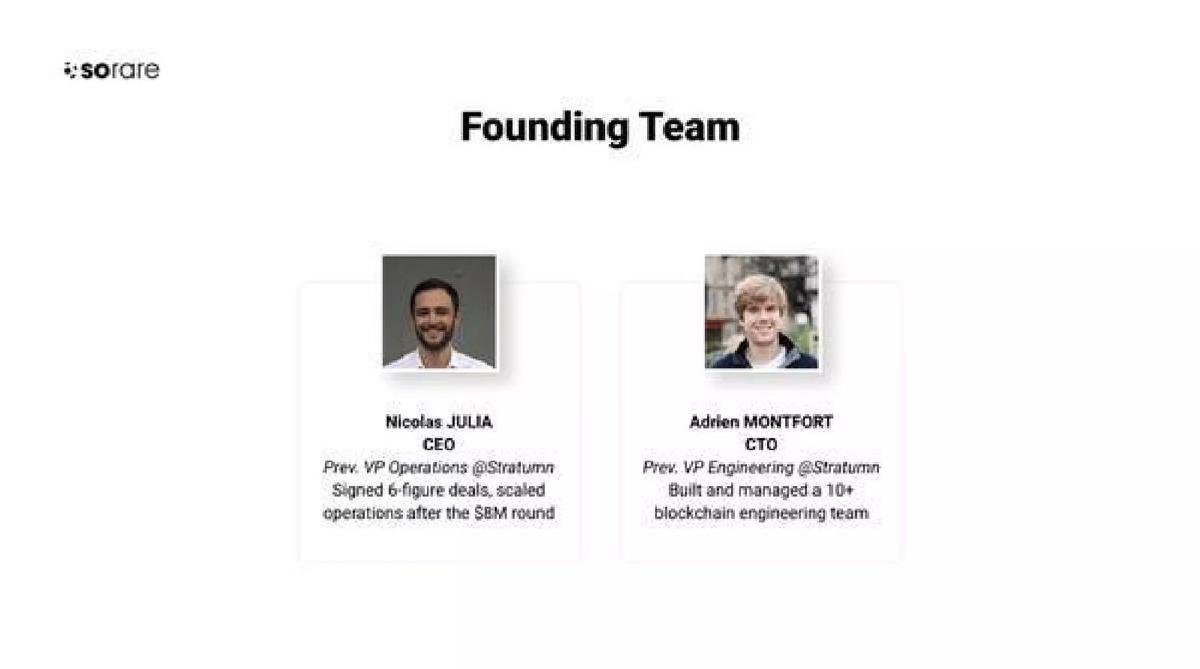
Slide 2 introduces the Founding Team. Nicolas Julia (CEO) and Adrien Montfort (CTO) both come from Stratumn, where they held VP roles in Operations and Engineering respectively. The slide highlights their ability to scale operations and manage blockchain engineering teams, providing the necessary technical credibility for a crypto-adjacent startup.
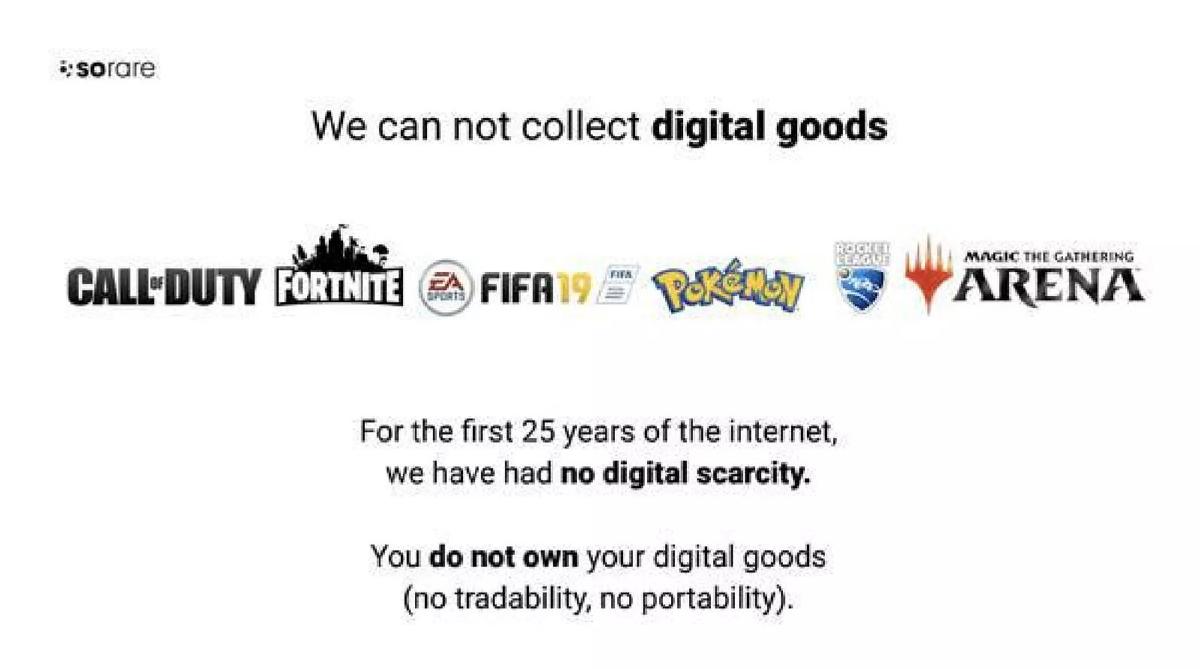
Slide 3 defines the core problem: 'We can not collect digital goods.' By showing logos of massive franchises like Fortnite, FIFA 19, and Pokémon, they illustrate that despite spending billions, users have 'no digital scarcity' and 'no ownership.' This slide effectively frames the 'Why Now'—the first 25 years of the internet lacked tradability and portability for digital assets.
Market Dynamics and Opportunity (Slides 4-5)
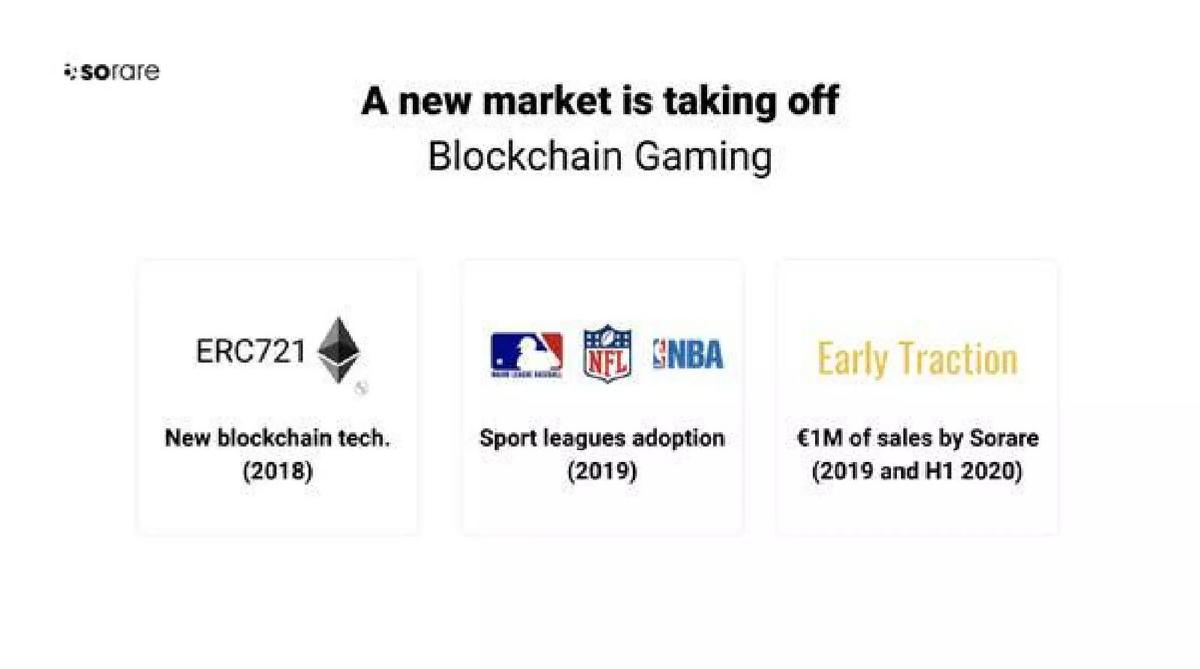
Slide 4 highlights the takeoff of 'Blockchain Gaming.' It cites the emergence of ERC721 in 2018 and the adoption by major leagues like MLB, NFL, and NBA in 2019. Crucially, it inserts Sorare's early traction (€1M sales) as proof that they are part of this rising tide.
Slide 5 provides the 'Big Number' anchor. It states that people are buying $370B of collectibles per year. By placing a physical Pelé card next to this figure, they bridge the gap between traditional sports memorabilia and their digital offering.
Product Mechanics and Market Size (Slides 6-8)
Slide 6 explains the 'Game Weekly Loop.' This is a vital slide for any gaming startup. It breaks the user journey into three clear steps: Collect, Play, and Reward. It mentions that rewards can be 'exclusive Player Cards & ETH,' introducing the play-to-earn element without overcomplicating the terminology.
Slide 7 expands the TAM (Total Addressable Market). They don't just look at collectibles; they eye the $20B Fantasy Sports market, the $25B Sport Licensing market, and the massive $250B Sport Betting market. This suggests that Sorare isn't just a card game; it's a platform that could eventually disrupt multiple high-value industries.
Slide 8 addresses the friction of crypto. They explicitly state they are designing a 'mainstream game' with 'No crypto knowledge' required. This is a key de-risking statement for traditional VCs who might be wary of the technical barriers to user adoption.
The Moat: Licenses and Traction (Slides 9-11)
Slide 9 lists their competitive advantages: Licenses, Community, and Technology. They describe their execution with clubs as 'superfast,' which is their primary defense against competitors.
Slide 10 shows the 'Growth - Monthly Sales' chart. The graph shows a classic 'hockey stick' curve starting in late 2019. They label this growth as 'Covid resilient,' a timely and important note for investors during the 2020 fundraising environment.
Slide 11 is the 'Money Slide.' It displays the logos of 70 clubs, including giants like Juventus, Roma, and Atletico Madrid. It also mentions the MLS Player Association and Belgian Pro League. In the world of sports gaming, licenses are the ultimate moat, and Sorare uses this slide to prove they have already won the first phase of the licensing war.
Acquisition and Community (Slides 12-13)
Slide 12 claims '100% organic' customer acquisition. They rely on club announcements (leveraging the clubs' own social media), word of mouth, and Discord. This implies a very low CAC (Customer Acquisition Cost), which is highly attractive to Series B investors looking for efficient scaling.
Slide 13 shows a high-action shot of a player with the text 'Collecting requires scarcity.' This reinforces the psychological driver behind the product's value.
Validation and Vision (Slides 14-18)
Slide 14 details their Pre-Seed round from April 2019, which raised 545k€. The list of investors (Seedcamp, Kima, ConsenSys) shows strong early-stage institutional backing.
Slide 15 summarizes their achievements in 10 months: a team of 6 'A-Players,' 76 football clubs signed, and €1M in total sales volume. This slide is a masterclass in 'doing a lot with a little.'
Slide 16 shows that the community is already building 'side games & apps' using Sorare cards. This indicates that Sorare is becoming a protocol or a platform, not just a single game, which significantly increases its long-term value.
Slide 17 states the Vision: 'Become the go-to game to increase the enjoyment of live football.' This ties the digital product back to the real-world experience of being a fan.
Slide 18 provides the 'Round Status.' It notes the round is 'full' and closing on May 12th, led by e.ventures and Partech. Including a world-champion athlete like André Schürrle as an investor adds a final layer of industry validation.
Appendix and Deep Dives (Slides 19-22)
The appendix ( Slide 19 ) leads into more granular details. Slide 20 explains the value proposition for the clubs themselves: a new revenue stream with 'little investment' and a way to reach a 'new customer segment' (blockchain adopters). Slide 21 reiterates 'Why blockchain?'—focusing on digital scarcity, freedom over assets, and secondary market royalties for clubs. Finally, Slide 22 provides social proof through Discord screenshots, showing real users expressing love for the game's mechanics and investment potential.
What Works in This Deck
The Licensing Moat: By Slide 11, the investor knows that Sorare has a massive head start that would be incredibly expensive and time-consuming for a competitor to replicate. · Simplicity of Concept: They avoid 'crypto-babble.' They talk about 'cards,' 'teams,' and 'rewards' rather than 'non-fungible tokens' or 'decentralized ledgers' on the main slides. · Efficiency: Achieving €1M in sales with only 6 employees (Slide 15) is a powerful indicator of a high-leverage business model. · B2B2C Strategy: They clearly explain how they help the clubs (Slide 20), which explains how they were able to sign so many licenses so quickly.
What Is Missing
Unit Economics: While they show total sales, there is no mention of LTV (Lifetime Value) or the specific take-rate Sorare keeps from primary vs. secondary sales. · Churn/Retention Data: For a game, 'Weekly Loop' is a promise, but data on how many users actually return week-over-week would have strengthened the traction section. · Detailed Roadmap: The deck is very focused on what has been achieved. It lacks a clear 'What's Next' in terms of new sports or specific platform features beyond 'more clubs.'
What a Founder Should Copy
The 'Why Now' Slide (Slide 3): Frame your technology as the solution to a long-standing limitation of the internet. · The Achievement Summary (Slide 15): Use a single, clean slide to show the ratio of 'Resources Used' to 'Results Achieved.' · Social Proof (Slide 22): Don't just say people love your product; show the raw, unedited conversations from your community. · Market Bridging (Slide 5): If you are in a new tech sector (like NFTs were in 2020), anchor your market size in a well-understood physical equivalent.
Frequently asked questions
- What was Sorare's primary competitive advantage according to the deck?
- According to Slide 9 and Slide 11, their primary advantage is 'Licenses.' They executed 'superfast' with clubs and leagues, securing 70 official club licenses including Juventus, Atletico Madrid, and West Ham. This created a high barrier to entry and served as their main customer acquisition channel.
- How did Sorare handle the complexity of blockchain for average users?
- Slide 8 explicitly states they design for a 'mainstream game' by requiring 'No crypto knowledge' and providing a 'Simple Payment flow.' They positioned the technology (ERC721) as the backend enabler for scarcity rather than a hurdle for the user experience.
- What were the key financial metrics shared in the deck?
- The deck highlights €1M in total sales volume achieved within the first 10 months (Slide 15). Slide 10 shows a growth chart of monthly sales, indicating a sharp upward trajectory from late 2019 through early 2020, which they describe as 'Covid resilient.'
- Who were the early investors in Sorare?
- Slide 14 and Slide 18 list their early backers. Pre-seed investors included Seedcamp, Kima Ventures, ConsenSys, and Tiny VC. The round mentioned in the deck was led by e.ventures and Partech, with participation from World Champion footballer André Schürrle.
- What is the 'Game Weekly Loop' described by Sorare?
- Slide 6 breaks the game down into three steps: 1. Collect Player Cards (bidding against others), 2. Play Fantasy (composing a team), and 3. Get Weekly Rewards (earning cards or ETH based on real-world player performance).