Sooho’s 10-slide deck is a masterclass in technical credibility for the Web3 space. By raising $4.5M in a 2022 Series A round, the company demonstrated that in the world of smart contract auditing, pedigree and performance metrics outweigh flashy marketing. The deck leans heavily on its association with ConsenSys and its track record of protecting over $2.9 billion in assets. While it lacks a traditional team slide with headshots or a detailed financial roadmap, it compensates with granular workflow diagrams and a clear value proposition: reducing the risk of the 'zero-day' vulnerabilities th…
Key takeaways
- The deck establishes immediate institutional credibility by noting it is 'backed by ConsenSys' and used by global enterprises like Samsung SDS and LG CNS (Slide 2).
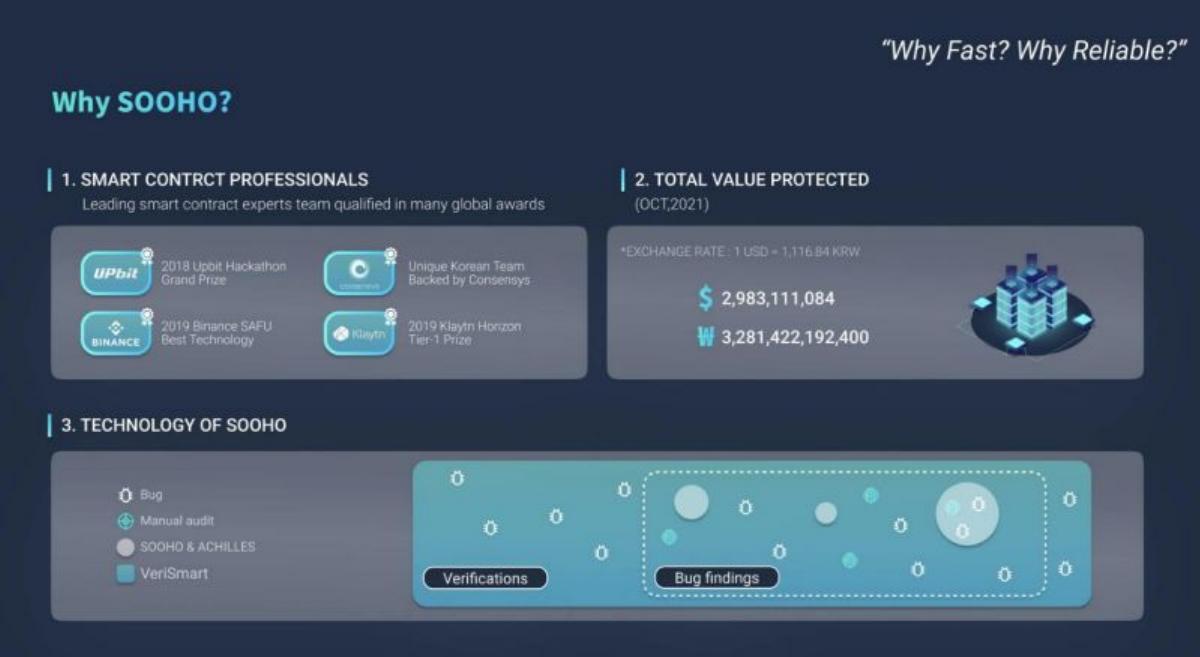
- Sooho uses a 'Total Value Protected' metric of $2,983,111,084 to quantify its market impact as of October 2021 (Slide 4).
- The problem is framed through high-impact loss statistics, specifically citing the $604M Poly Network hack (Slide 3).
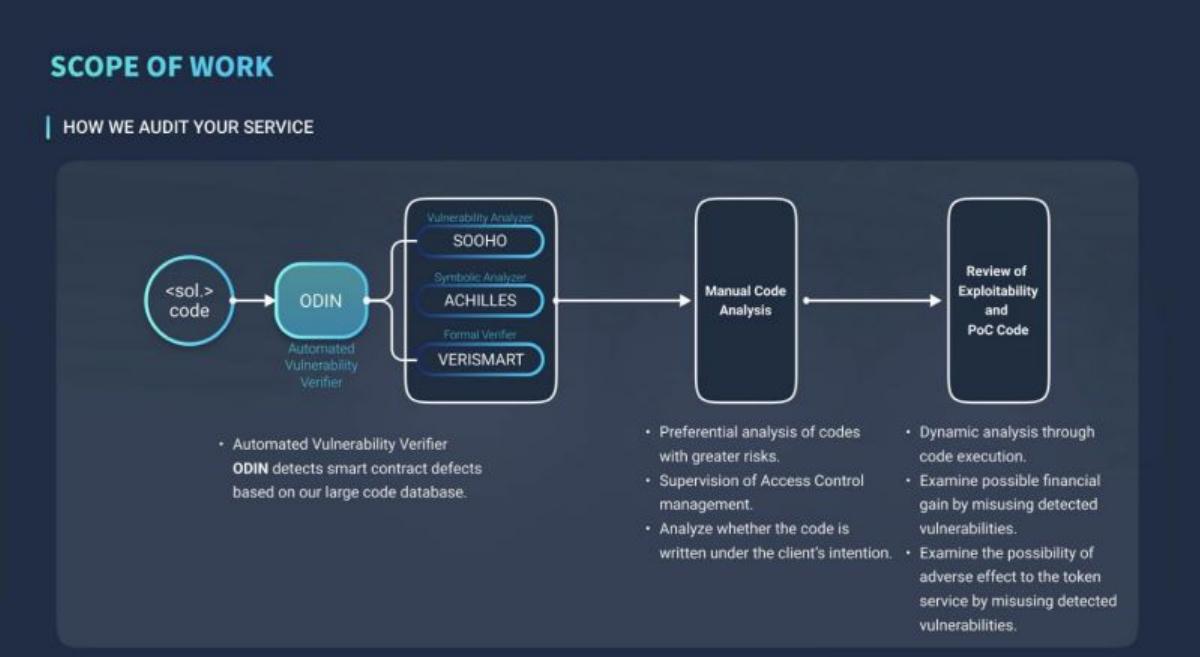
- Technical differentiation is shown through a multi-layered automated verifier system consisting of ODIN, Achilles, and VeriSmart (Slide 6).
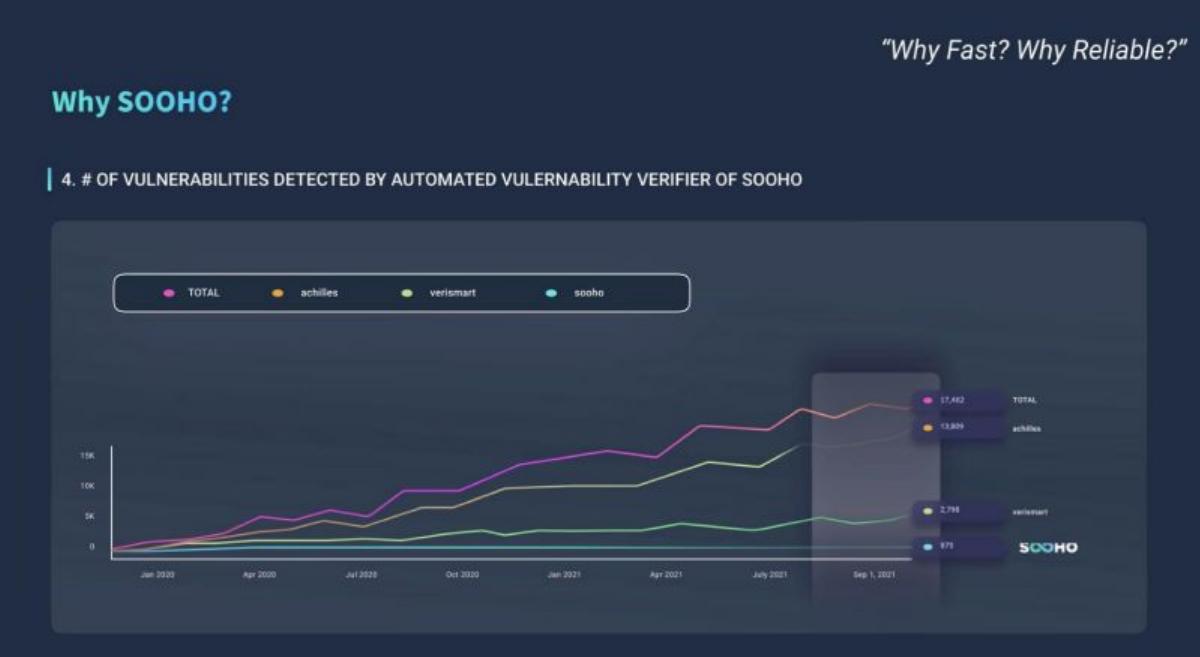
- The company demonstrates growth through a cumulative vulnerability detection chart, showing over 17,000 vulnerabilities detected by late 2021 (Slide 5).
- The deck explicitly defines its deliverables, showcasing a 'Security Assessment Report' and a 'SOOHO Certificate' to prove tangible value to clients (Slide 8).
- There is a notable omission of a dedicated team slide, though the company mentions a staff of Ph.D. security researchers and white-hat hackers (Slide 2).
- The 'Audit Process' slide provides a clear operational roadmap from initial request to the final audit report, which is essential for B2B service sales (Slide 7).
The Technical Trust Play: Sooho's $4.5M Series A Teardown
In the blockchain industry, security is not just a feature; it is the entire foundation of the business. Sooho’s 2022 pitch deck reflects this reality by focusing almost exclusively on technical rigor, institutional validation, and a proven track record of asset protection. While many startup decks lead with a visionary 'why,' Sooho leads with a professional 'how' and 'who trusts us.'
Slide 1: Title and Positioning
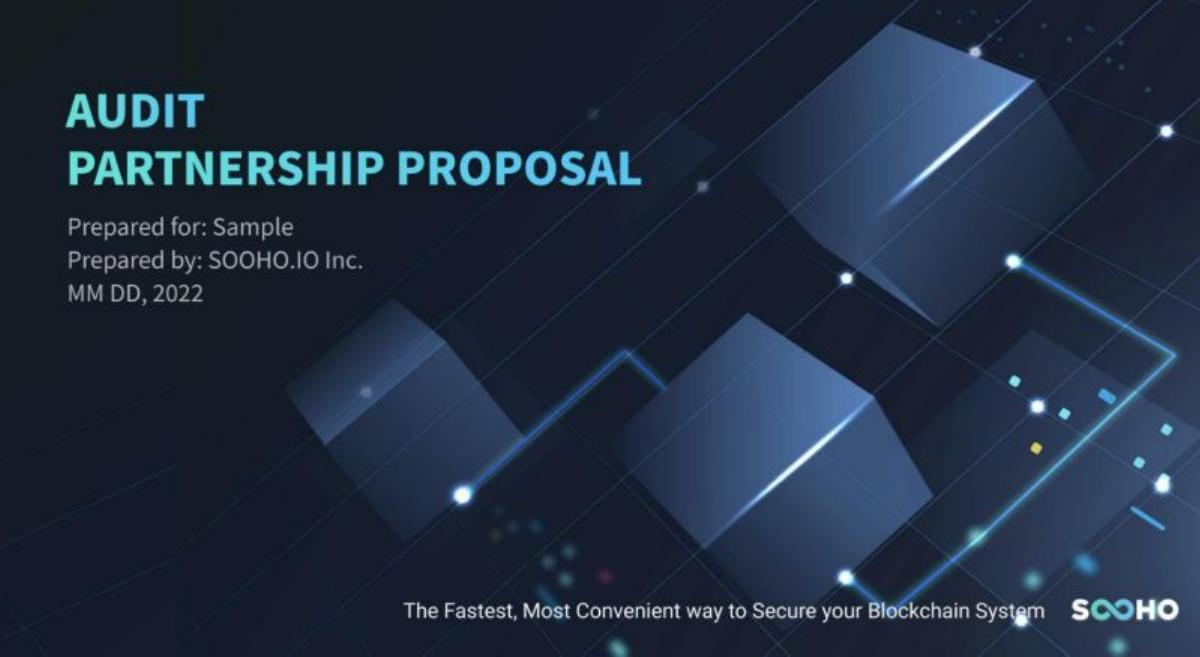
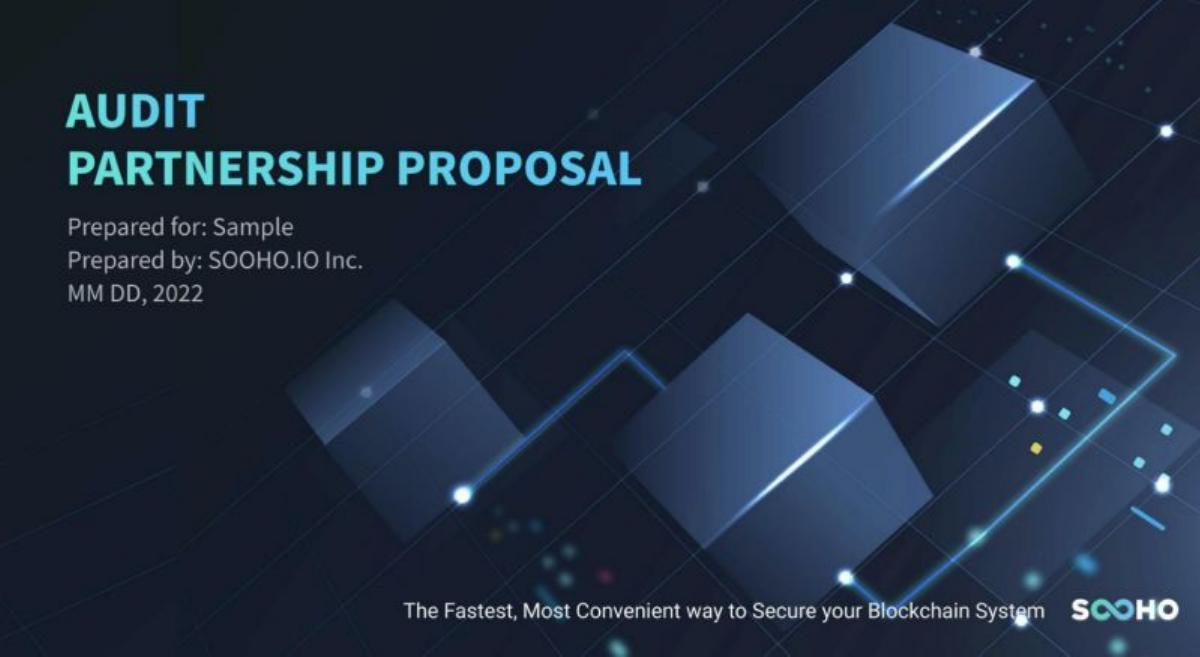
The cover slide is titled 'AUDIT PARTNERSHIP PROPOSAL.' This suggests the deck was designed to serve a dual purpose: pitching to potential enterprise clients and pitching to investors. The subtitle, 'The Fastest, Most Convenient way to Secure your Blockchain System,' establishes the core value proposition. The date is listed as 'MM DD, 2022,' placing this in the heart of the post-DeFi-summer security boom.
Slide 2: Partnership and Pedigree
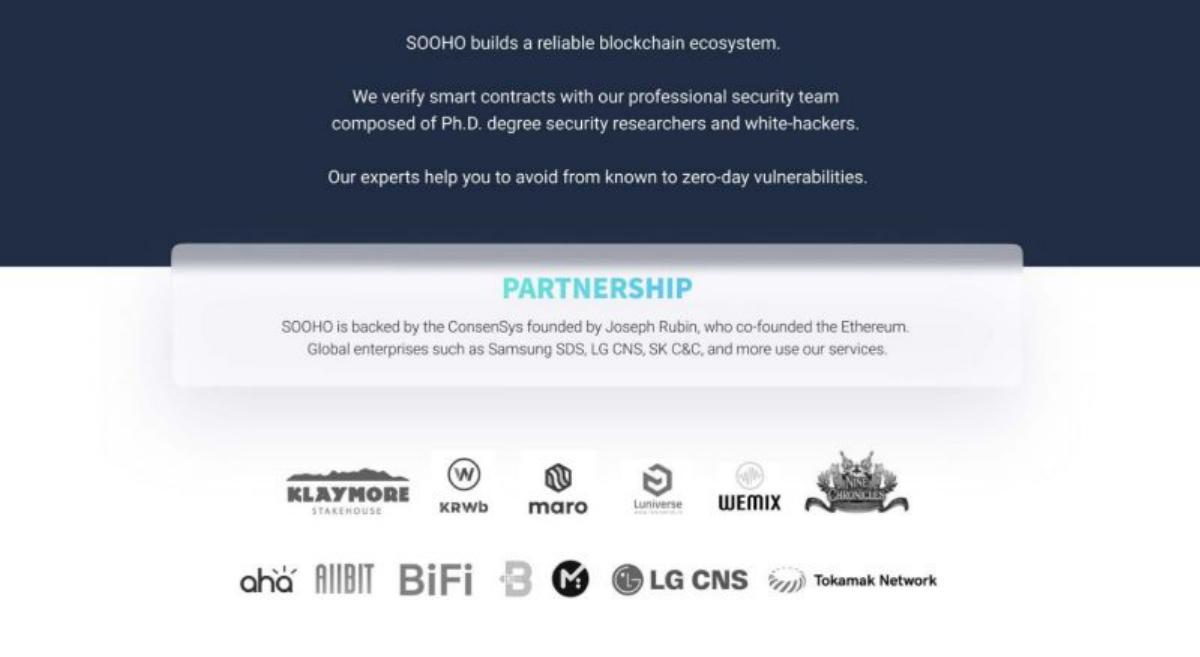
Slide 2 is arguably the most important slide in the deck for establishing trust. It states that Sooho is 'backed by the ConsenSys founded by Joseph Rubin [sic], who co-founded the Ethereum.' In the crypto world, an investment from ConsenSys is a significant seal of approval. The slide also lists heavy-hitting enterprise users: Samsung SDS, LG CNS, and SK C&C. Below the text, a logo cloud features 13 partners, including LG CNS, Wemix, and Tokamak Network. This slide effectively answers the 'Why you?' question before the 'What?' has even been fully explained.
Slide 3: The High Stakes of Blockchain Security
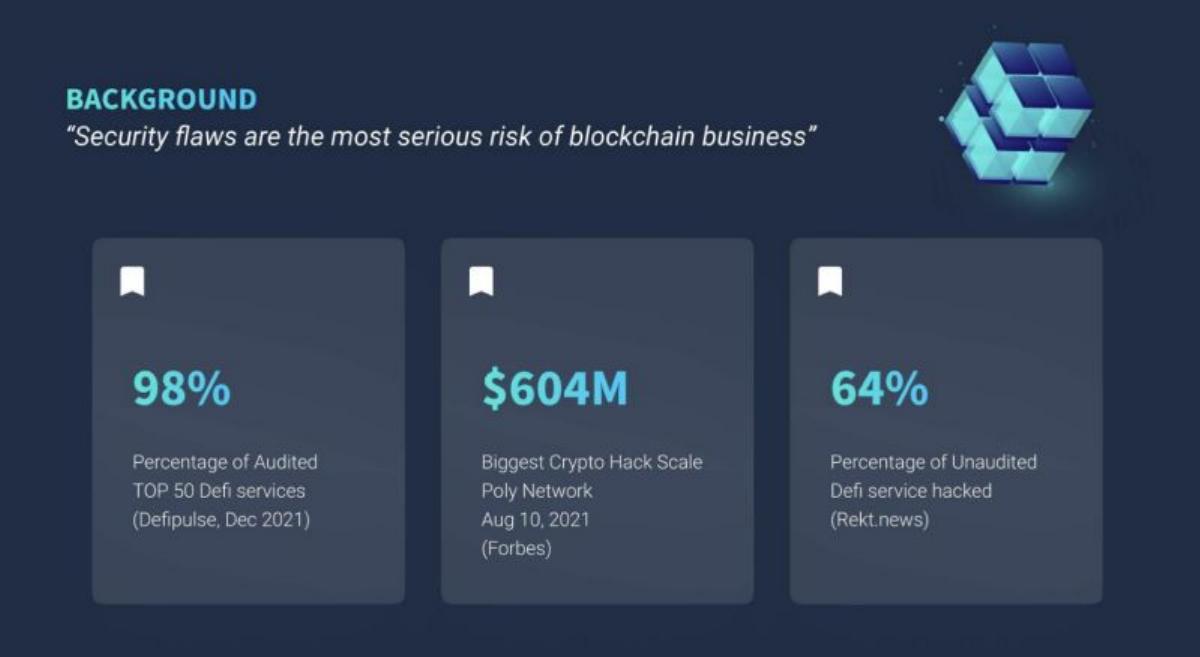
Under the heading 'BACKGROUND,' Slide 3 uses three data points to create urgency. First, it notes that 98% of the Top 50 DeFi services were audited as of Dec 2021, suggesting that auditing is a mandatory industry standard. Second, it cites the $604M Poly Network hack as the 'Biggest Crypto Hack Scale.' Third, it points out that 64% of unaudited DeFi services have been hacked. This creates a clear 'fear, uncertainty, and doubt' (FUD) narrative that positions Sooho’s services as an essential insurance policy.
Slide 4: Quantifying Success (TVP)
Slide 4 introduces the 'Why SOOHO?' section. It breaks this down into three pillars. Pillar 1 highlights awards from Upbit, Binance, and Klaytn. Pillar 2 introduces the 'TOTAL VALUE PROTECTED' metric, which is cited as $2,983,111,084 (nearly $3 billion) as of October 2021. This is a critical metric for security firms, as it proves they can handle high-stakes environments. Pillar 3 provides a visual representation of their technology, contrasting manual audits with their automated 'SOOHO & ACHILLES' and 'VeriSmart' tools.
Slide 5: Vulnerability Detection Growth
Slide 5 provides a line graph showing the '# OF VULNERABILITIES DETECTED BY AUTOMATED VULNERABILITY VERIFIER OF SOOHO.' The chart shows a cumulative growth from early 2020 to late 2021. By September 1, 2021, the 'TOTAL' vulnerabilities detected reached 17,482. The graph breaks this down by tool: Achilles (13,809), VeriSmart (2,798), and Sooho (875). This slide demonstrates that their software is actively learning and scaling, rather than relying solely on human labor.
Slide 6: The Technical Workflow
Slide 6, titled 'SCOPE OF WORK,' explains the 'How.' It shows a flow chart starting with code, moving into an 'Automated Vulnerability Verifier' named ODIN. ODIN then utilizes three sub-analyzers: SOOHO (Vulnerability Analyzer), ACHILLES (Symbolic Analyzer), and VERISMART (Formal Verifier). The process then moves to 'Manual Code Analysis' and finally a 'Review of Exploitability and PoC Code.' This hybrid approach—automation for scale and manual review for nuance—is the industry standard for high-end security firms.
Slide 7: The Operational Roadmap
Slide 7 outlines the 'AUDIT PROCESS.' It is a linear path: Request -> Proposal -> Contract -> Payment -> Analysis -> Audit Report -> Feedback -> Reaudit -> Final Audit Report. This slide is likely more for the 'Partnership Proposal' aspect of the deck, but for an investor, it shows a mature, repeatable business process that is ready for enterprise-level engagement.
Slide 8: Tangible Deliverables
Slide 8 shows what the customer actually receives: a 'Security Assessment Report' and a 'SOOHO Certificate.' The slide includes mockups of these documents. The report is noted to support English and Korean by default. The certificate is described as something to 'Share with Investors, Exchanges, and your community.' This highlights the marketing value Sooho provides to its clients—the audit isn't just for security; it's a badge of trust for the client's own fundraising and listing efforts.
Slide 9: Contact Information
The penultimate slide is a standard 'THANK YOU' with a contact email (audit@sooho.io) and social media icons for Twitter, Medium, GitHub, and Facebook. It maintains the dark, professional aesthetic of the rest of the deck.
Slide 10: Catalogue Reference
The final slide is a promotional slide for the source of the deck, bestpitchdeck.com, and does not contain company-specific information.
What Sooho’s Deck Does Well
1. Institutional Validation: By leading with ConsenSys and Samsung, Sooho bypasses the need to prove they are a 'real' company. In a sector as crowded and technical as blockchain security, these names do the heavy lifting of due diligence for the reader.
2. Metric-Driven Credibility: The 'Total Value Protected' (TVP) of $2.9B is a powerful figure. It tells an investor that the market has already trusted this team with billions of dollars in assets. Similarly, the 17,000+ vulnerabilities detected chart shows a high level of activity and product-market fit.
3. Process Transparency: The deck does a great job of demystifying the audit process. By naming their specific tools (ODIN, Achilles, VeriSmart), they move away from 'black box' security and toward a proprietary, defensible technology stack.
What is Missing from the Sooho Deck
1. The Team Slide: While Slide 2 mentions 'Ph.D. degree security researchers and white-hackers,' there is no dedicated team slide. Investors generally want to see the specific founders, their backgrounds, and their previous exits or technical contributions. For a Series A, this is a significant omission.
2. Financials and Projections: There is no mention of revenue, burn rate, or future financial targets. While the TVP is impressive, it doesn't tell an investor how much Sooho is actually charging for its services or what the margins look like on a manual-plus-automated audit.
3. Competitive Landscape: The deck does not mention competitors like CertiK, OpenZeppelin, or Trail of Bits. A Series A deck usually needs to explain why their specific automated tools are superior to those already on the market.
4. The 'Ask': There is no slide detailing how much money is being raised or how it will be used (e.g., hiring more researchers, expanding to new chains, marketing). This information was likely handled in a separate document or a verbal presentation.
What Other Founders Should Copy
1. Use 'Value Protected' as a North Star Metric: If you are in security, fintech, or insurance, don't just talk about your tech. Talk about the dollar value of the assets that rely on your tech. It is the most direct way to communicate the scale of your responsibility and impact.
2. Visualize the Workflow: Sooho’s 'Scope of Work' slide is excellent. It breaks down a complex technical process into a digestible flow chart. Founders in deep tech should use this style to show how their proprietary 'magic' actually works in practice.
3. Leverage Your Backers: If you have a high-profile investor or a pilot with a Fortune 500 company, put it on Slide 2. Don't bury it at the end. In the early stages of a startup, you are often selling the reputation of your associates as much as your own product.
Conclusion: Sooho’s deck is a highly professional, albeit narrow, presentation. It succeeds by focusing on the one thing that matters most in its niche: trust. By the end of the 10 slides, a reader is convinced that Sooho is a legitimate, technically capable firm backed by the biggest names in the industry. For a $4.5M Series A, that foundation of trust is often the most difficult and important hurdle to clear.
Frequently asked questions
- What is Sooho's primary product?
- Sooho provides an advanced contract auditing platform and security services for blockchain companies. Their technology uses a combination of automated tools—specifically ODIN, Achilles, and VeriSmart—alongside manual code analysis by security researchers to identify vulnerabilities in smart contracts before they can be exploited.
- How much did Sooho raise with this deck?
- According to the catalogue facts, Sooho raised $4.5M in a Series A round in 2022. The deck itself focuses more on the partnership proposal and technical validation than the specific financial 'ask' or use of funds, which is common in decks used for both client acquisition and investor discussions.
- Who are Sooho's major partners and backers?
- The deck highlights that Sooho is backed by ConsenSys, the firm founded by Ethereum co-founder Joseph Lubin. It also lists major enterprise clients and partners including Samsung SDS, LG CNS, SK C&C, and various blockchain projects like Wemix and Klaytn.
- What metrics does Sooho use to prove its effectiveness?
- Sooho relies on three primary metrics: Total Value Protected (TVP), which was nearly $3 billion as of late 2021; the number of vulnerabilities detected, which surpassed 17,000; and industry awards, such as the 2018 Upbit Hackathon Grand Prize and the 2019 Binance SAFU Best Technology award.
- What is missing from the Sooho pitch deck?
- The deck lacks several traditional venture capital slides, including a detailed team slide with individual bios, a competitive landscape analysis, and a financial projection slide. It also does not explicitly state the terms of the Series A round or the specific 'ask' for investors on any of the 10 slides.