Sourcepoint’s 16-slide deck is a textbook example of 'founder-market fit' and 'regulatory tailwinds.' By leading with a team that previously sold Admeld to Google for $400 million (Slide 2), the company establishes immediate authority in the complex digital advertising space. The deck leans heavily into the existential threat posed by GDPR and CCPA, citing specific fines like British Airways' $230M penalty (Slide 8) to create urgency. While the deck is visually polished and excels at explaining the 'why now,' it is notably silent on current revenue, customer logos, and the specific investment…
Key takeaways
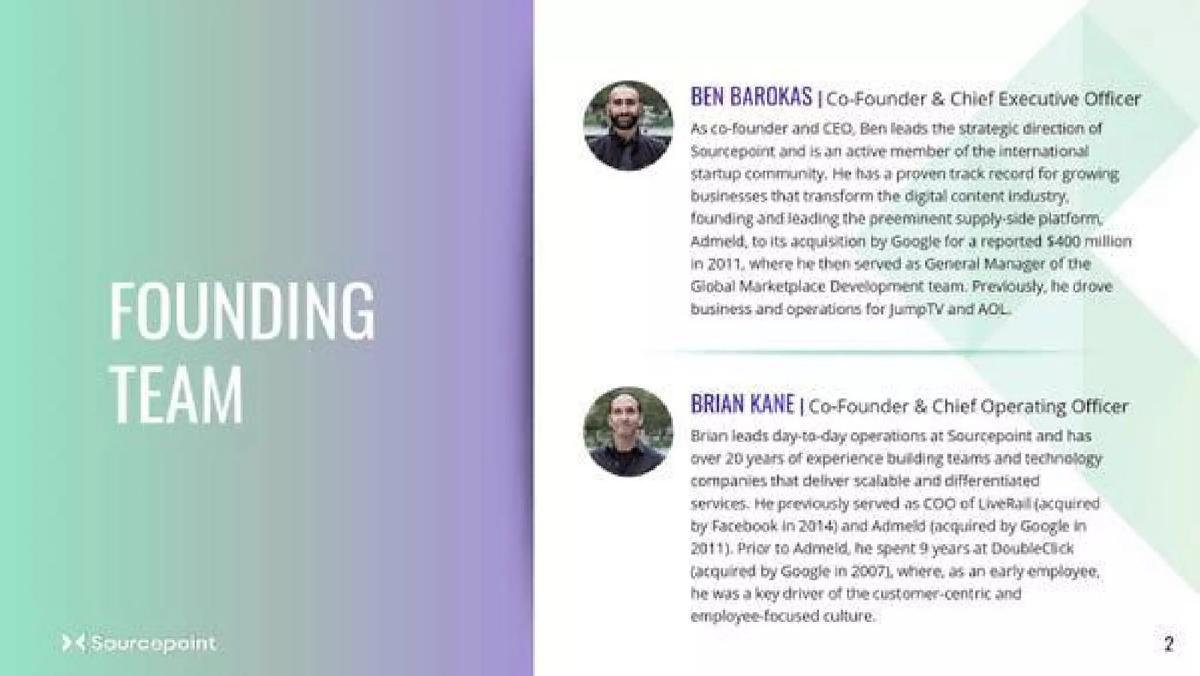
- The deck leads with founder pedigree, highlighting Ben Barokas's $400 million exit of Admeld to Google in 2011 (Slide 2).
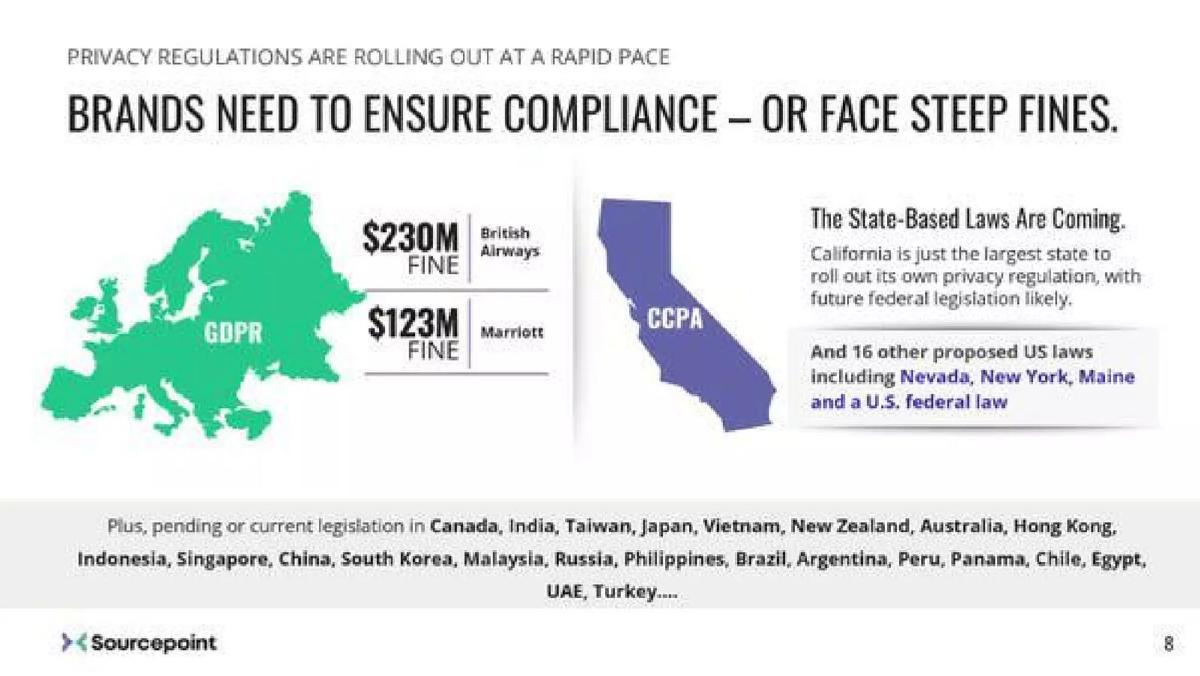
- Regulatory urgency is established by citing massive fines, including $230M for British Airways and $123M for Marriott under GDPR (Slide 8).
- The platform addresses a significant revenue threat, noting that publisher revenue decreases by 52% on impressions without cookies (Slide 9).
- Sourcepoint positions itself as a 'two-way communication' tool, claiming 73% of consumers share data when presented with transparent choices (Slide 10).
- The product is split into two distinct pillars: DIALOGUE for consent management and DIAGNOSE for back-end vendor monitoring (Slide 14).
- The deck emphasizes cross-platform capability, supporting Browser, In-App (iOS/Android), OTT, and AMP environments (Slide 17).
- Proprietary scanning technology is used to flag 'risky vendors' and 'fraudulent consent strings' that cause latency or data leakage (Slide 21).
- The deck completely omits a financial 'Ask' slide, current revenue metrics, and a specific use-of-funds breakdown.
Introduction: The Power of the Pedigree
Sourcepoint’s pitch deck is a masterclass in establishing authority. In the world of venture capital, particularly in complex sectors like ad-tech and data privacy, the 'who' often matters as much as the 'what.' This deck, dated around 2015-2020 based on the regulatory references, leans into a high-stakes environment where the cost of failure is measured in hundreds of millions of dollars in fines. The company positions itself not just as a software provider, but as a necessary shield for the digital marketing ecosystem.
The Executive Summary and Team (Slides 1-4)
Slide 1 sets the stage with a clear, utilitarian title: "Data Privacy Compliance for Digital Marketing." It doesn't use flowery language; it identifies a specific problem for a specific industry. However, the real heavy lifting begins on Slide 2, the "Founding Team" slide. It is rare to see a team slide this early in a deck unless the founders are 'superstars.' Ben Barokas is highlighted for founding Admeld and leading it to a "reported $400 million" acquisition by Google in 2011. Brian Kane is similarly credentialed, with stints at LiveRail (acquired by Facebook) and DoubleClick (acquired by Google). By placing this on Slide 2, Sourcepoint tells investors: 'We have already won this game once; we are the only ones who can win it again.'
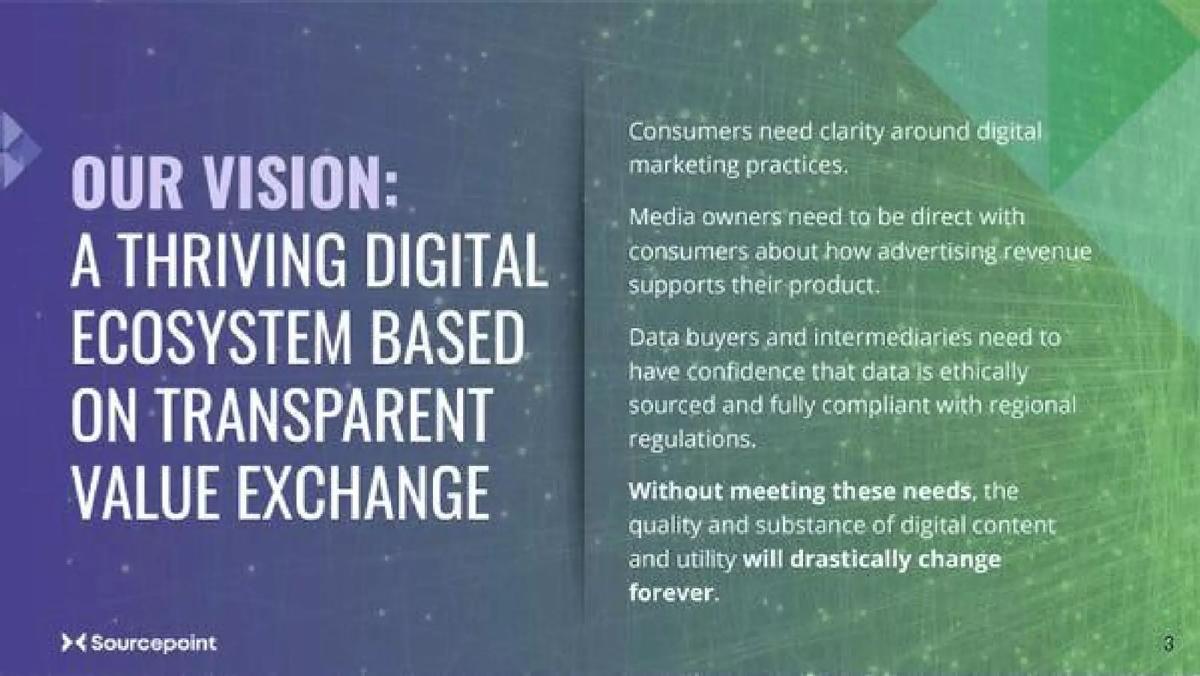
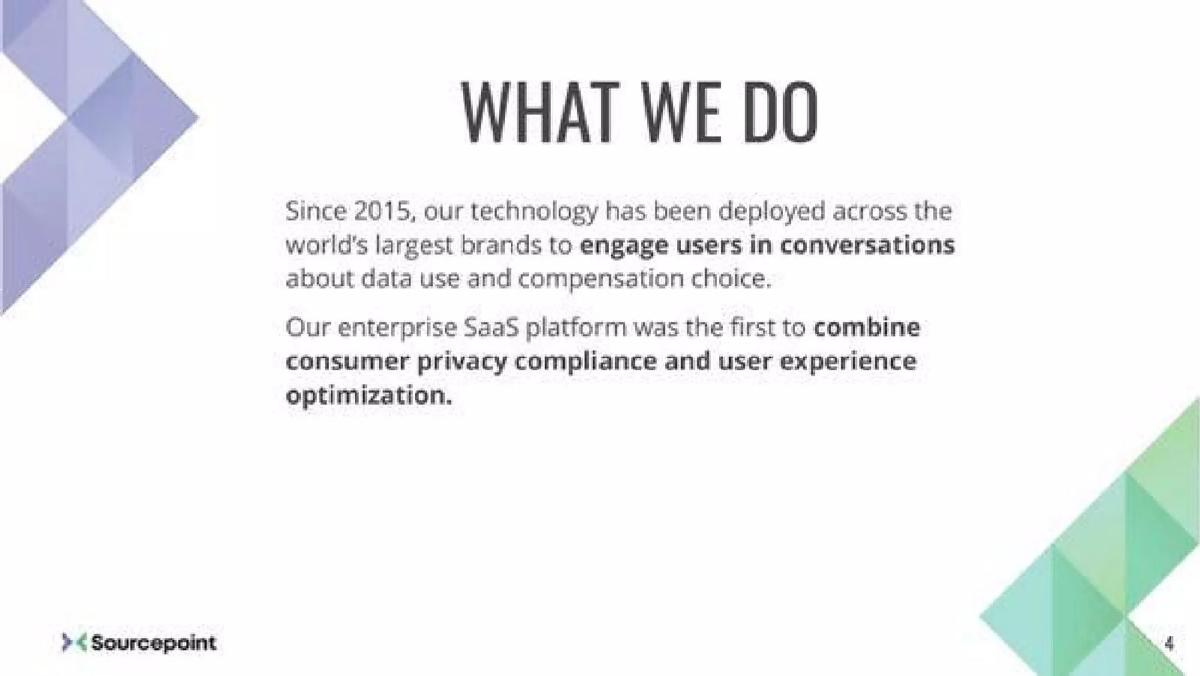
Slide 3 and 4 define the vision and mission. The vision is a "thriving digital ecosystem based on transparent value exchange." This is a sophisticated way of saying they want to fix the broken relationship between advertisers and consumers. Slide 4 notes that their technology has been deployed since 2015 across "the world’s largest brands," though it stops short of naming them on this specific slide.
The Regulatory 'Why Now' (Slides 7-9)
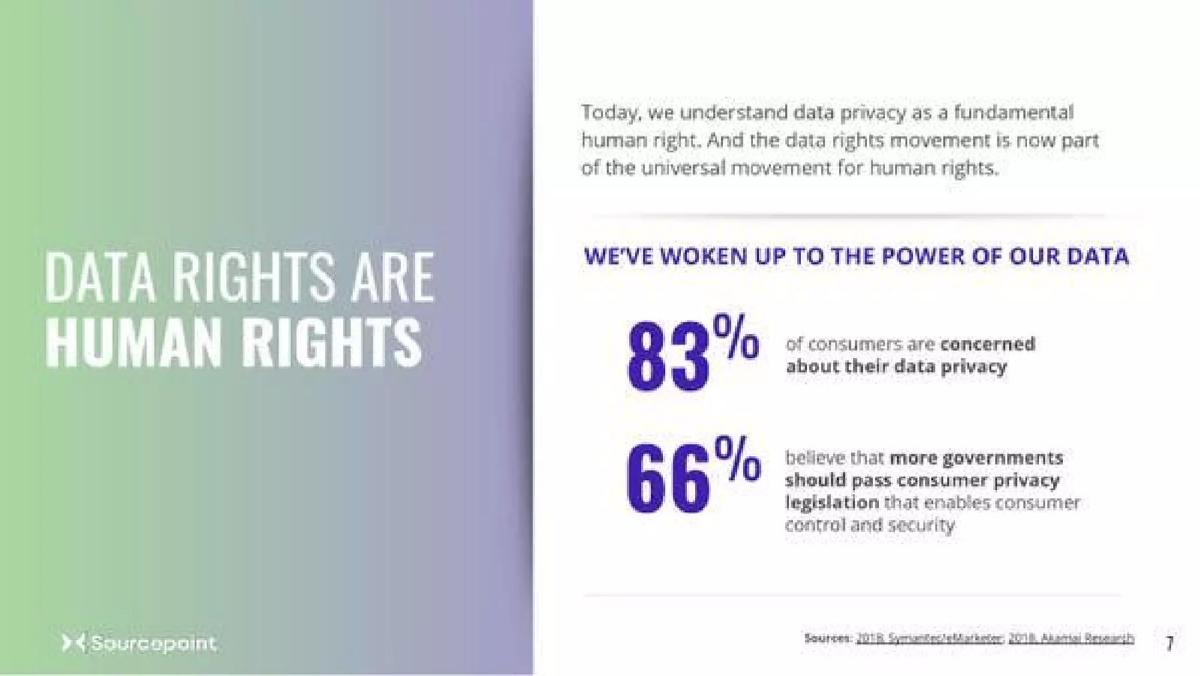
Fundraising is often about timing, and Sourcepoint uses Slides 7 through 9 to create an intense sense of urgency. Slide 7 cites that "83% of consumers are concerned about their data privacy." This establishes the consumer sentiment shift. Slide 8 then introduces the 'stick': regulation. It features a map of Europe highlighting GDPR and a map of California for CCPA. The slide lists specific, massive fines: "$230M Fine" for British Airways and "$123M Fine" for Marriott. It also lists dozens of other countries with pending legislation, from Brazil to Turkey, suggesting a global, unavoidable market shift.
Slide 9, titled "Compliance is Expensive," connects these regulations to the bottom line. It notes that "Publisher revenue decreases 52% on impressions without cookies" and that location-based advertising worth "$26.5B" is at risk due to Apple’s iOS changes. This slide is crucial because it transforms 'compliance' from a legal headache into a direct threat to survival for digital publishers. Sourcepoint isn't selling a 'nice-to-have' tool; they are selling a revenue preservation engine.
The Ethos and Solution (Slides 10-14)
Slide 10 introduces the concept of "Dialogue." It claims that "73% of consumers are willing to share their data when presented with transparent choices." This is the core thesis of their product: transparency leads to consent, and consent leads to revenue. Slide 14 breaks down the "Current Solution Components" into two pillars. The first is the "Consumer-Facing Privacy Management Experience" (the DIALOGUE Consent Management Platform), which handles opt-outs and cross-environment UX. The second is "Back-End Compliance Management," which includes proprietary scanning technology to flag risky vendors and data leakage.
Product Deep-Dive (Slides 16-22)
The middle section of the deck functions as a product walkthrough. Slide 16 shows a mockup of the "Privacy Notice" UI, emphasizing that the platform syndicates consent signals to various ecosystems. Slide 17 highlights the platform's versatility, showing it works across "Browser, In-App, OTT, and AMP." This is a technical flex, as managing consent across Smart TVs (OTT) and mobile apps is significantly more difficult than simple web cookies.
Slides 20 and 21 introduce "DIAGNOSE Insights," which appears to be a result of their acquisition of Redbud (indicated by the logo in the top right). This tool provides "Automated Vendor Assessment." Slide 21 is particularly effective, listing specific technical failures the tool flags, such as "Unauthorized, redirected vendors," "Slow tags leading to lower advertising revenue," and "Fraudulent consent strings." This level of detail appeals to the technical buyer and the sophisticated investor who understands the 'plumbing' of the internet.
Slide 22 provides a process flow diagram titled "Privacy by Design." it shows how DIAGNOSE generates a curated vendor list, which is then ingested by the DIALOGUE CMP, which then feeds back into ongoing monitoring. This 'closed-loop' system is presented as a way to automate compliance, reducing the manual burden on the brand.
The Iceberg Metaphor (Slide 23)
The deck concludes its narrative with a powerful visual on Slide 23: an iceberg. The visible tip is "Consent Management" (Dialogue), the part the consumer sees. The massive, submerged portion is "Data Governance Insights" (Diagnose), the complex back-end behavior of vendors. This slide perfectly summarizes their value proposition: they handle the obvious compliance needs while protecting the brand from the hidden risks lurking beneath the surface of their own websites.
What Works in This Deck
1. The 'Fear, Uncertainty, and Doubt' (FUD) Factor: By citing specific, nine-figure fines on Slide 8, the founders make the cost of their software seem negligible compared to the cost of non-compliance. This is a classic enterprise sales tactic that works exceptionally well in regulatory tech.
2. Founder-Market Fit: The deck spends significant real estate on the founders' history. In a sector as volatile as ad-tech, investors want to know the team has seen multiple cycles and has successfully exited to major players like Google and Facebook. The mention of the $400M Admeld exit is the strongest piece of social proof in the deck.
3. Technical Granularity: Unlike many decks that stay at a high level, Sourcepoint gets into the weeds of "fraudulent consent strings" and "OTT devices." This builds confidence that the product is a robust enterprise solution, not just a simple UI overlay.
What Is Missing from This Deck
1. The Ask: There is no slide stating how much money the company is raising, at what valuation, or what the specific milestones for the next 18 months are. This is common in 'insider' decks or later-stage rounds where the terms are negotiated privately, but for a standard teardown, its absence is a major gap.
2. Traction Metrics: While the deck mentions being deployed across "the world's largest brands," it doesn't provide a single logo, an ARR (Annual Recurring Revenue) figure, or a growth rate. For a company founded in 2015, investors would expect to see a clear trajectory of commercial success.
3. Competitive Landscape: The privacy tech space is crowded with players like OneTrust and TrustArc. Sourcepoint completely ignores the competition, choosing instead to focus on their unique 'Dialogue' ethos. While this keeps the narrative clean, it leaves the 'why you vs. them' question unanswered.
What a Founder Should Copy
1. Use Specificity to Drive Urgency: Don't just say 'privacy is important.' Say 'British Airways was fined $230 million.' Use real-world consequences to frame your solution as a necessity.
2. The 'Iceberg' Visual: If your product has a simple front-end but a complex back-end, use a visual metaphor like the one on Slide 23. It helps non-technical investors understand where the real 'moat' and value of the technology lie.
3. Lead with Your Wins: If you have a successful exit or relevant deep-industry experience, put it on Slide 2. Don't hide your best credentials at the end of the deck. Use them to buy the investor's attention for the rest of the presentation.
Conclusion
Sourcepoint’s deck is a high-conviction play on the inevitability of data privacy regulation. It succeeds by leveraging the immense credibility of its founders and the undeniable 'burning platform' of GDPR and CCPA. While it lacks the financial transparency of an early-stage seed deck, it functions as a powerful strategic document that positions the company as the adult in the room in a chaotic, high-stakes industry. For founders in regulatory spaces, the lesson is clear: anchor your product in the reality of the law and the proven capability of your team.
Frequently asked questions
- What is the primary problem Sourcepoint is solving?
- Sourcepoint addresses the friction between consumer privacy demands and digital marketing revenue. According to Slide 9, publisher revenue drops by 52% when cookies are restricted. The platform provides a way for brands to maintain compliance with regulations like GDPR and CCPA while optimizing the user experience to maintain high consent rates and, consequently, advertising revenue.
- How does Sourcepoint establish its credibility in the ad-tech space?
- The deck relies heavily on the track record of its founders, Ben Barokas and Brian Kane. Slide 2 details their leadership at Admeld, which was acquired by Google for $400 million in 2011. Brian Kane also has experience at LiveRail (acquired by Facebook) and DoubleClick (acquired by Google). This 'veteran' status is the core of their pitch.
- What are the two main components of the Sourcepoint platform?
- As shown on Slide 14 and Slide 23, the platform consists of 'DIALOGUE' and 'DIAGNOSE.' DIALOGUE is the consumer-facing Consent Management Platform (CMP) that handles opt-outs and UI customization. DIAGNOSE is the back-end data governance tool that scans for risky third-party vendors, data leakage, and performance issues like latency.
- What market trends does the deck use to justify its timing?
- The deck highlights a 'rapidly changing landscape' driven by both legislation and browser changes. Slide 8 lists 16 proposed US laws and pending legislation in dozens of countries. Slide 9 points to technical restrictions from Google, Apple, and Firefox regarding third-party cookies, and Apple's iOS changes limiting geolocation data, valued at a $26.5 billion risk.
- What is missing from this pitch deck that investors usually expect?
- The deck is missing several standard components: a specific funding ask, a slide on unit economics or current ARR, a competitive analysis, and a list of current customers or case studies. It functions more as a high-level strategic overview and a validation of the team's vision rather than a detailed operational report.