The so-sure pitch deck, dating from 2015, is a study in minimalist storytelling. With only 12 slides, it manages to define a massive $1.8tn global problem, present a solution rooted in 17th-century social insurance principles, and demonstrate significant early traction. The company positions itself as an 'insurance co. with no balance sheet risk,' leveraging partnerships with Munich RE and Salva to remain asset-light. While the deck is light on specific product mechanics and unit economics, it excels at showcasing momentum, citing a 9% week-over-week growth rate and a Net Promoter Score (NPS)…
Key takeaways
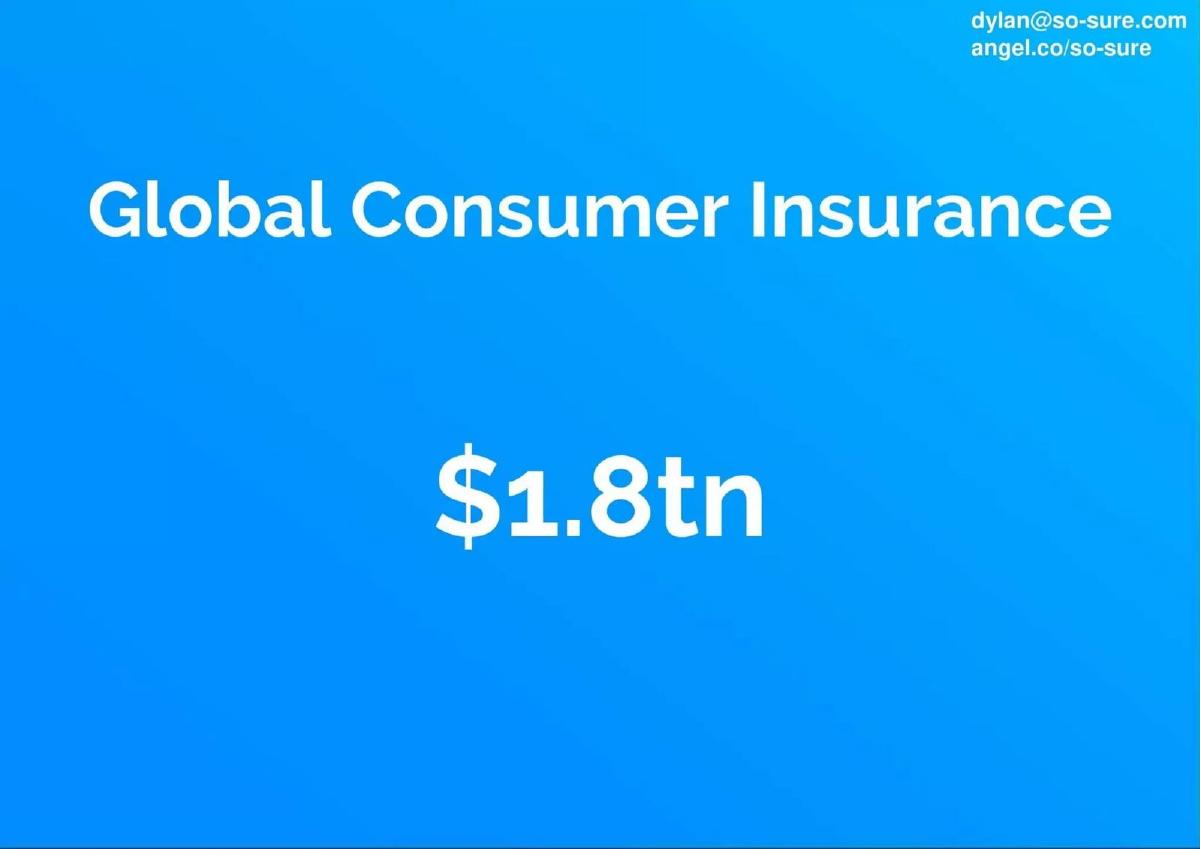
- The deck identifies a massive $1.8tn global consumer insurance market on slide 2.
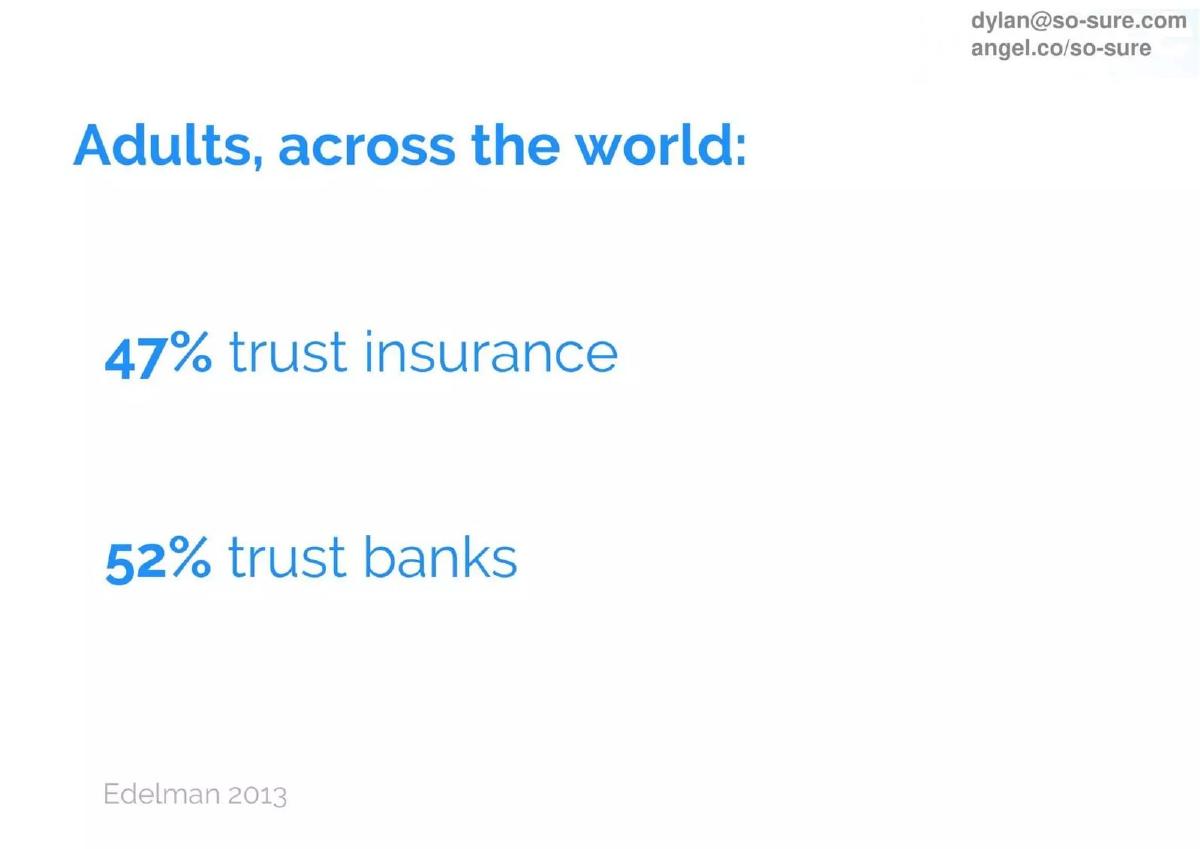
- Trust is the central theme, citing Edelman 2013 data that only 47% of adults trust insurance on slide 4.
- The business model is described as an 'insurance co. with no balance sheet risk' on slide 8.
- Strategic partnerships with Munich RE and Salva are highlighted on slide 8 to validate the asset-light approach.
- The company claims a high customer satisfaction rating with an NPS of 79 on slide 9.
- Traction is shown through an annualised revenue chart exceeding an 8% WoW growth target on slide 9.
- The team slide (slide 10) emphasizes deep experience, including a CEO with 10 years in insurance and a CTO with 20 years in full-stack development.
- The deck lacks a specific 'Ask' slide, omitting the funding amount or valuation sought during the presentation.
The Minimalist Approach to InsurTech
The so-sure pitch deck is a 12-slide presentation that leans heavily on the 'less is more' philosophy. In an industry as complex and regulated as insurance, founders often fall into the trap of over-explaining actuarial tables or regulatory hurdles. so-sure takes the opposite path, focusing on a single emotional hook: trust. By framing the $1.8tn insurance industry as fundamentally broken and untrusted, they position their technology as a necessary restorative force. This teardown examines how they balanced high-level vision with concrete traction metrics to build a compelling narrative.
Slides 1-2: The Hook and the Scale
Slide 1 introduces the brand with the tagline 'Restoring trust in consumer insurance.' The bottom of the slide is crowded with logos, including Munich RE, 500 Startups, and the Financial Times. This is a classic 'borrowed credibility' move, signaling to investors that despite being a startup, the company is already vetted by major institutions. Slide 2 immediately follows with the Total Addressable Market (TAM): '$1.8tn' for Global Consumer Insurance. It is a bold, simple slide designed to stop any questions about the potential ceiling of the business.
Slides 3-5: The Problem and the Historical Solution
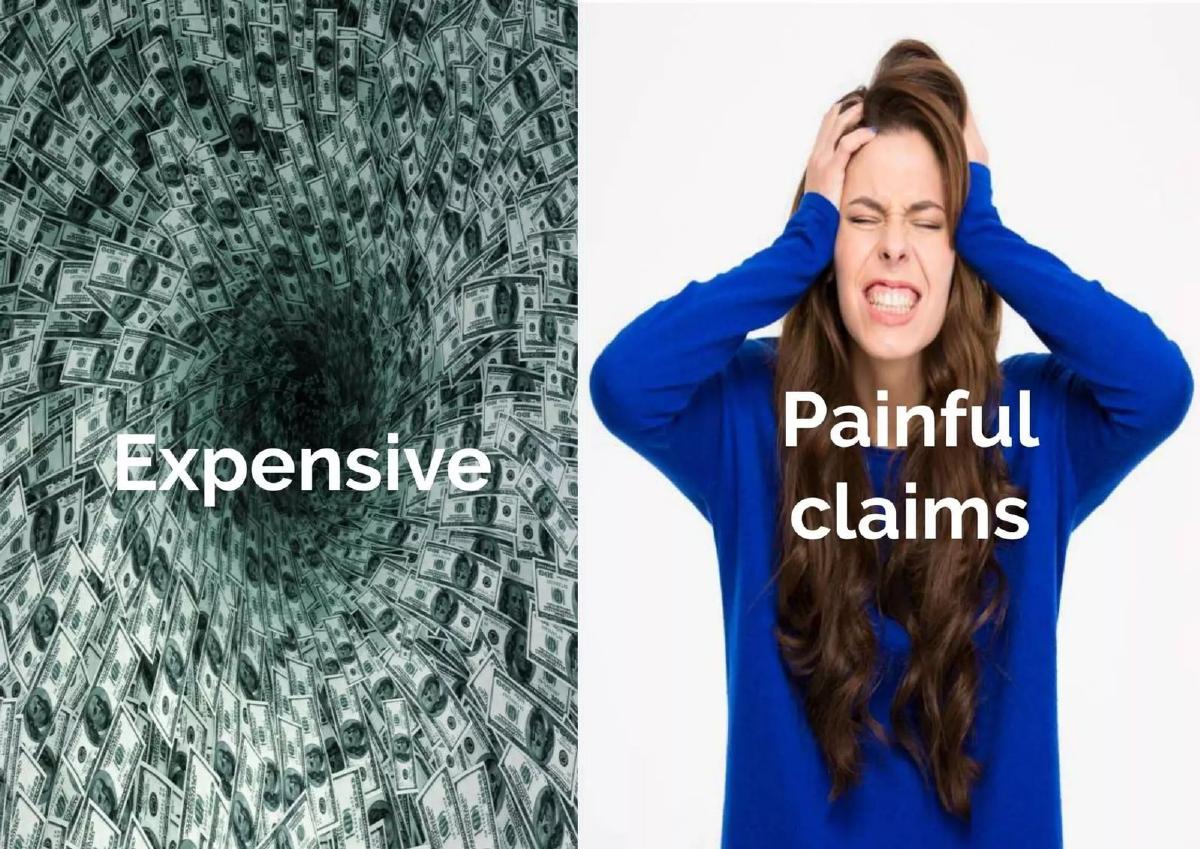
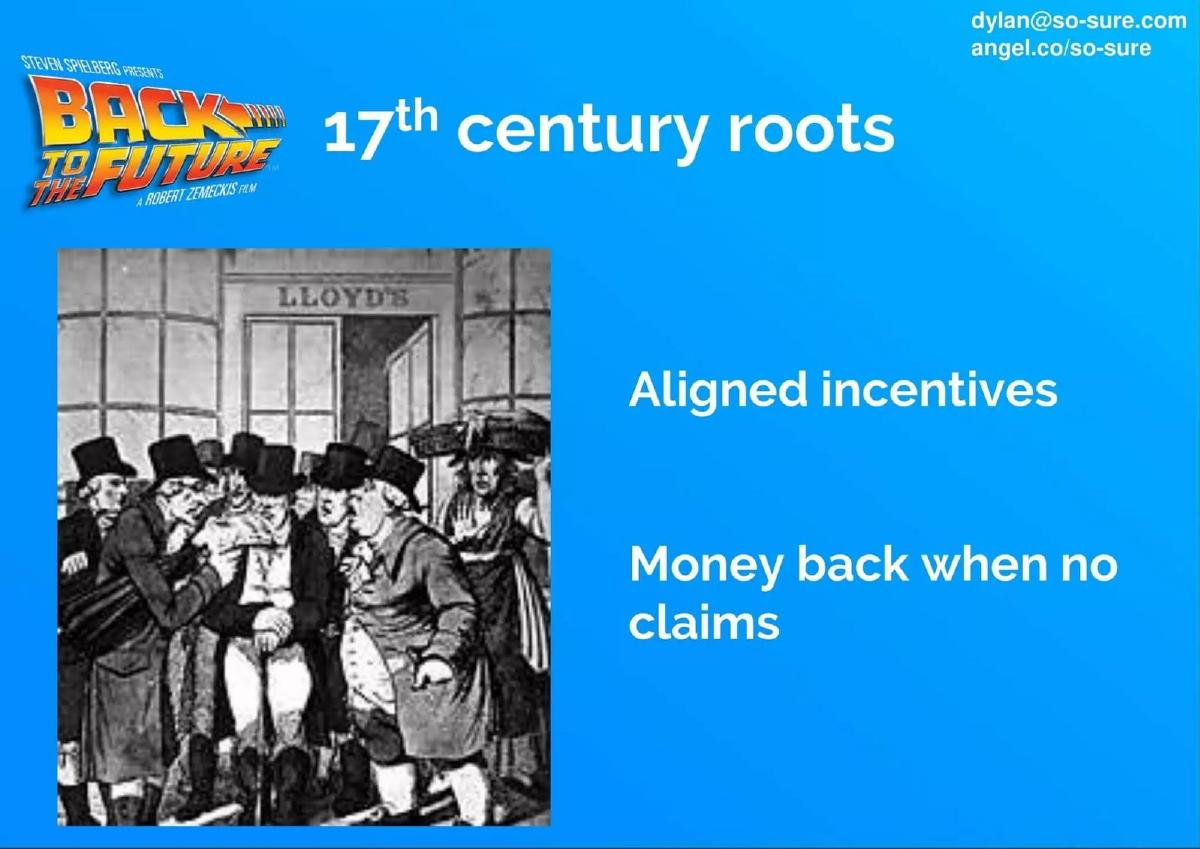
Slide 3 uses visceral imagery—a vortex of money labeled 'Expensive' and a frustrated consumer labeled 'Painful claims.' It identifies the two primary pain points of the incumbent model. Slide 4 backs this up with data, citing an Edelman 2013 study showing that only 47% of adults trust insurance, which is even lower than the 52% who trust banks. This establishes the 'Trust Gap' as the primary market opportunity. Slide 5 is perhaps the most unique in the deck, titled '17th century roots' with a 'Back to the Future' logo. It argues that the future of insurance is actually a return to its past: aligned incentives and 'money back when no claims.' This suggests a social or P2P insurance element without using confusing modern jargon.
Slides 6-7: The Value Proposition and Expansion Strategy
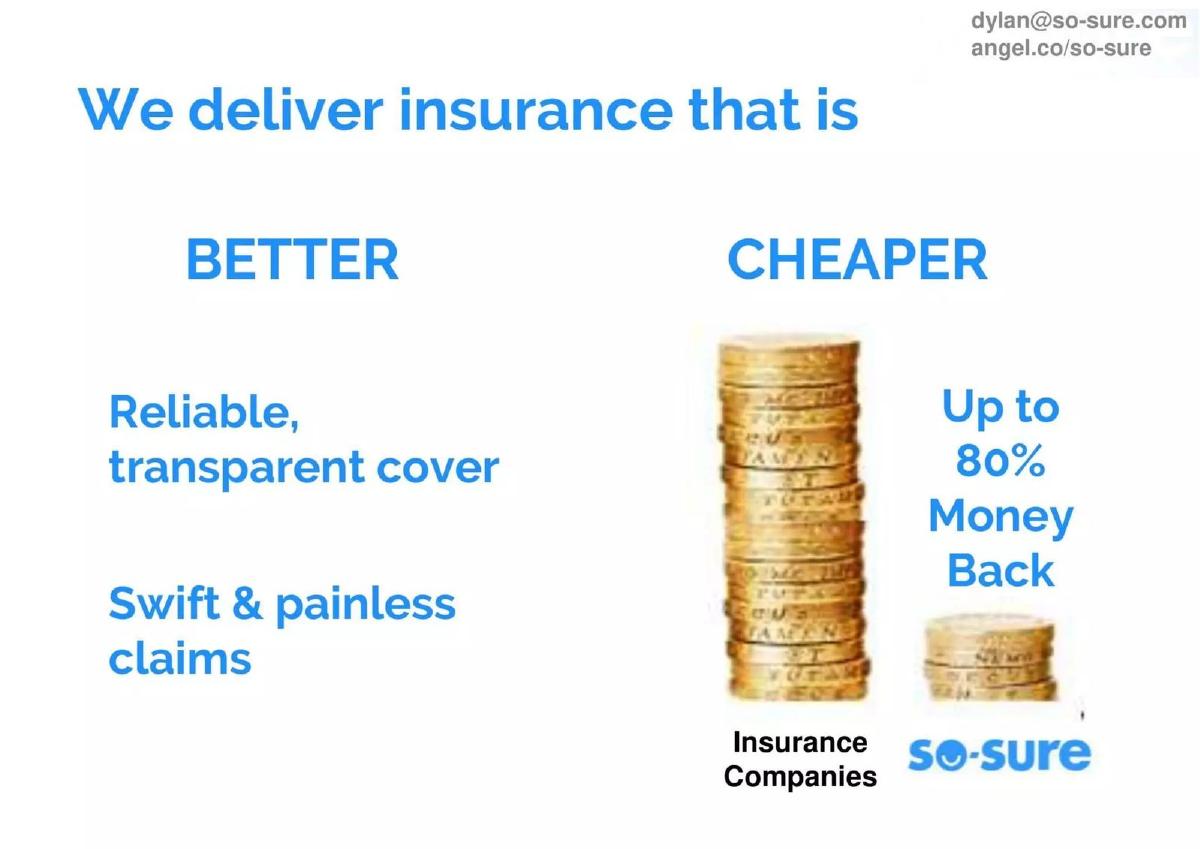
Slide 6 compares 'Insurance Companies' to 'so-sure' using stacks of coins. It claims so-sure is 'Better' (reliable, transparent, swift claims) and 'Cheaper' (up to 80% money back). The 80% figure is a powerful anchor, though the deck does not explain the mechanics of how such a high rebate is sustainable. Slide 7 shifts to the future, showing a world map with icons for mobile phones, houses, and airplanes. This signals that while they are starting small, their 'Global ambitions' cover all major consumer insurance lines.
Slides 8-9: Execution and Traction
Slide 8 brings the deck down to earth by detailing the Go-To-Market (GTM) strategy. They 'Launched in $1bn UK cell phone insurance market.' Crucially, this slide defines their business model as an 'Insurance co. with no balance sheet risk,' naming Munich RE and Salva as their risk partners. This is a vital piece of information for investors who might be wary of the capital intensity of insurance. Slide 9 provides the 'proof of life.' It features a large 'NPS 79' and a revenue chart showing actual growth exceeding an 8% WoW target. The chart shows a sharp upward curve from March to July, providing the necessary momentum to justify a 'Later' stage investment.
Slides 10-12: The Team and Summary
Slide 10 introduces the 'Experienced Team.' It lists Dylan (CEO, 10yrs insurance), Patrick (CTO, 20yrs full stack), Marta (CPO, 14yrs product), and Vish (Marketing Head, 12yrs marketing). The inclusion of logos like Omnicom and SecretSales.com provides further professional validation. Slide 11 serves as a summary slide, reiterating the three key pillars: no balance sheet risk, 9% WoW growth, and NPS 79. Slide 12 returns to the cover image, providing a clean bookend to the presentation.
What Works in the so-sure Deck
1. Clarity of Mission: The deck never wavers from its 'Restoring Trust' theme. Every slide, from the problem statement to the NPS score, supports the idea that the company is solving a psychological and systemic issue in insurance, not just a technical one.
2. Asset-Light Positioning: By explicitly stating they have 'no balance sheet risk' on slide 8, they remove a major objection for tech-focused VCs who generally avoid capital-heavy businesses. Naming Munich RE as a partner provides the 'adult in the room' validation needed for this model to work.
3. Momentum-First Traction: Slide 9 is the strongest slide in the deck. Showing that they are not just growing, but outperforming their own aggressive 8% weekly growth targets, creates a sense of urgency for investors.
What is Missing from the so-sure Deck
1. The 'Ask': There is no slide indicating how much money is being raised, what the milestones for that capital are, or what the current cap table looks like. While this is sometimes omitted in 'teaser' decks, its absence in a full pitch deck leaves the narrative unfinished.
2. Unit Economics: While the deck mentions '80% money back,' it doesn't explain the take-rate for so-sure. Investors need to see the Lifetime Value (LTV) to Customer Acquisition Cost (CAC) ratio, especially in a crowded market like mobile phone insurance where marketing costs can be high.
3. Product Mechanics: The '17th-century roots' and 'social' aspect are intriguing but vague. The deck doesn't show the app interface or explain how the 'money back' pools are managed. A single slide showing the user journey would have grounded the high-level vision in reality.
What a Founder Should Copy
1. Use High-Signal Logos: If you have a partnership with a giant like Munich RE or have been through an accelerator like 500 Startups, put those logos on the first and last slides. It builds immediate trust before you've said a word.
2. Simplify the Problem: so-sure didn't talk about 'underwriting inefficiencies' or 'legacy software stacks.' They talked about 'Expensive' and 'Painful.' Use emotional language to describe the problem, then use data (like the Edelman trust stats) to prove it's a widespread sentiment.
3. Benchmark Your Growth: Don't just show a line going up. Show a line going up relative to a target . As seen on slide 9, showing that you are beating your own internal goals is a much stronger signal than just showing raw numbers.
Conclusion
The so-sure deck is a masterclass in narrative focus. It identifies a massive, trillion-dollar market that is fundamentally unloved by its customers and proposes a simple, historically-grounded solution. By offloading financial risk to partners and focusing on a high-growth, high-satisfaction consumer experience, they built a pitch that feels both ambitious and attainable. While more detail on the 'how' would be necessary for due diligence, as a tool for capturing investor interest, this deck is highly effective.
Frequently asked questions
- What is the core value proposition of so-sure?
- so-sure proposes a 'win-win' insurance model that restores trust by aligning incentives between the insurer and the insured. According to slide 5, this involves a return to social insurance roots where customers get money back if they don't make claims. Slide 6 quantifies this, suggesting customers can receive up to 80% money back, making the service significantly cheaper than traditional insurance companies.
- How does so-sure handle the financial risk of insurance claims?
- The company operates an asset-light model. Slide 8 explicitly states they are an 'insurance co. with no balance sheet risk.' They offload the actual risk to established balance sheet partners, specifically naming Munich RE and Salva. This allows so-sure to focus on the technology, customer experience, and distribution without the capital requirements of a traditional carrier.
- What market did so-sure choose for its initial launch?
- so-sure launched in the UK cell phone insurance market. Slide 8 values this specific niche at $1bn. While the initial focus was narrow, slide 7 outlines 'global ambitions across consumer lines,' using icons to represent future expansion into home and travel insurance markets worldwide.
- What metrics does the deck use to prove product-market fit?
- The deck relies heavily on two metrics: growth and satisfaction. Slide 9 shows a revenue chart where 'Actual' performance is significantly outstripping an 8% week-over-week growth target. Additionally, the deck highlights a Net Promoter Score (NPS) of 79, which is exceptionally high for the insurance industry, supporting their claim of 'restoring trust.'
- What is missing from the so-sure pitch deck?
- The deck is notably missing a slide detailing the specific 'Ask' (how much money they are raising and on what terms). It also lacks a detailed breakdown of unit economics, a competitive landscape analysis, and a technical deep-dive into how their 'social' or '17th-century' model actually functions algorithmically to prevent fraud or manage the money-back pools.