The Sourceeasy pitch deck is a minimalist, high-impact presentation that prioritizes traction over theory. Spanning only 7 slides, it moves immediately from a title slide to a revenue graph showing a jump from $63k to $163k in just two months. By leading with a $2M run rate and 45% margins, the founders established immediate credibility before even explaining the product. The deck relies heavily on social proof, showcasing logos like Uber and Groupon India to validate their B2B model. While it lacks a formal 'Ask' slide or detailed financial projections, the strength of the existing growth an…
Key takeaways
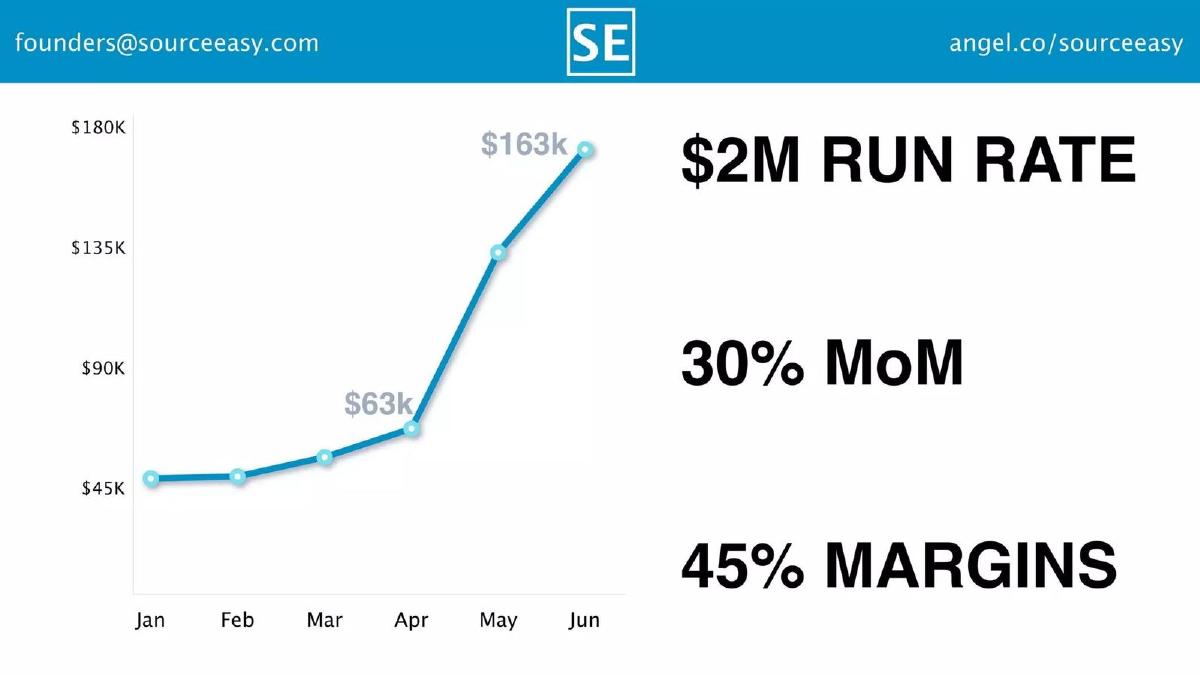
- The deck leads with traction on Slide 2, showing a revenue increase from $63k in April to $163k in June.
- Sourceeasy claims a $2M run rate with 30% Month-over-Month growth and 45% margins on Slide 2.
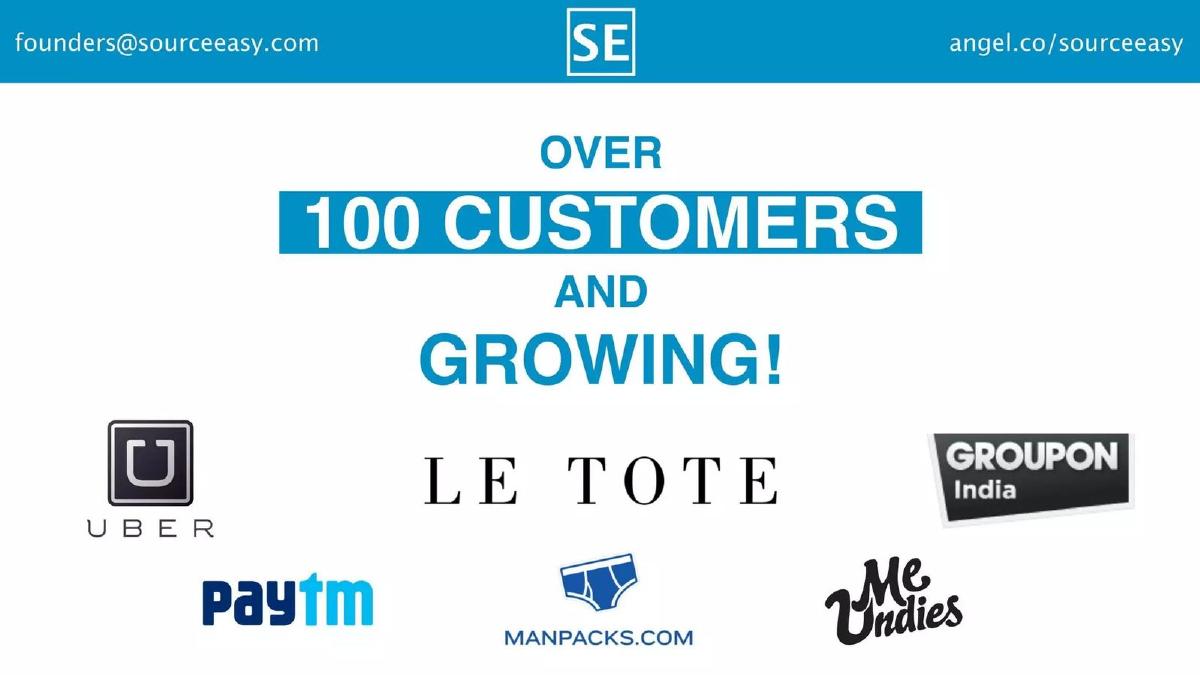
- The company utilizes high-profile logos including Uber, Le Tote, and Groupon India to demonstrate a diverse customer base of over 100 clients (Slide 3).
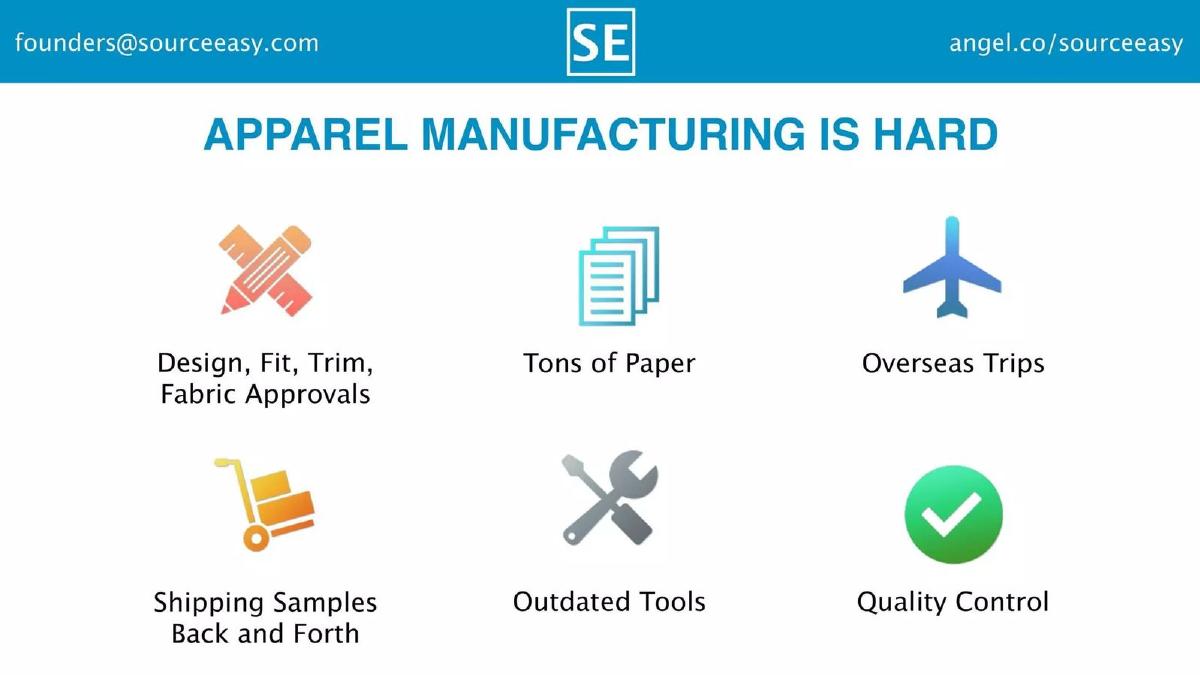
- The problem slide (Slide 4) identifies six specific pain points in apparel manufacturing, such as 'Tons of Paper' and 'Overseas Trips'.
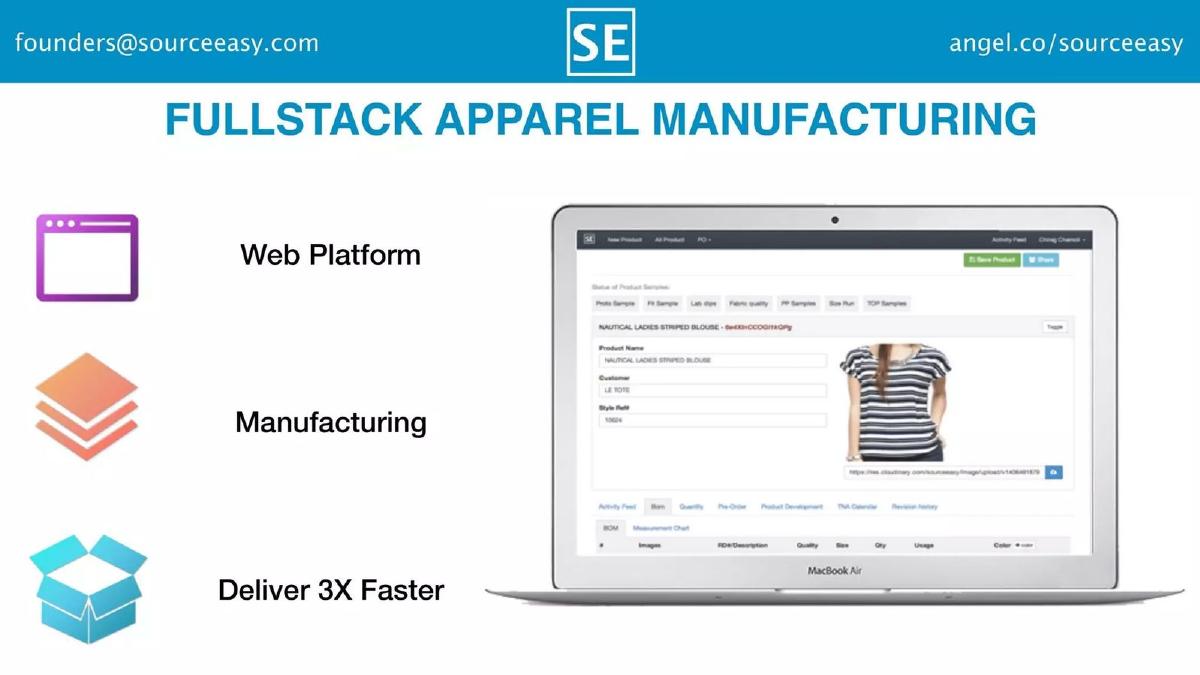
- The product is positioned as a 'Fullstack' solution that delivers 3X faster through a web platform (Slide 5).
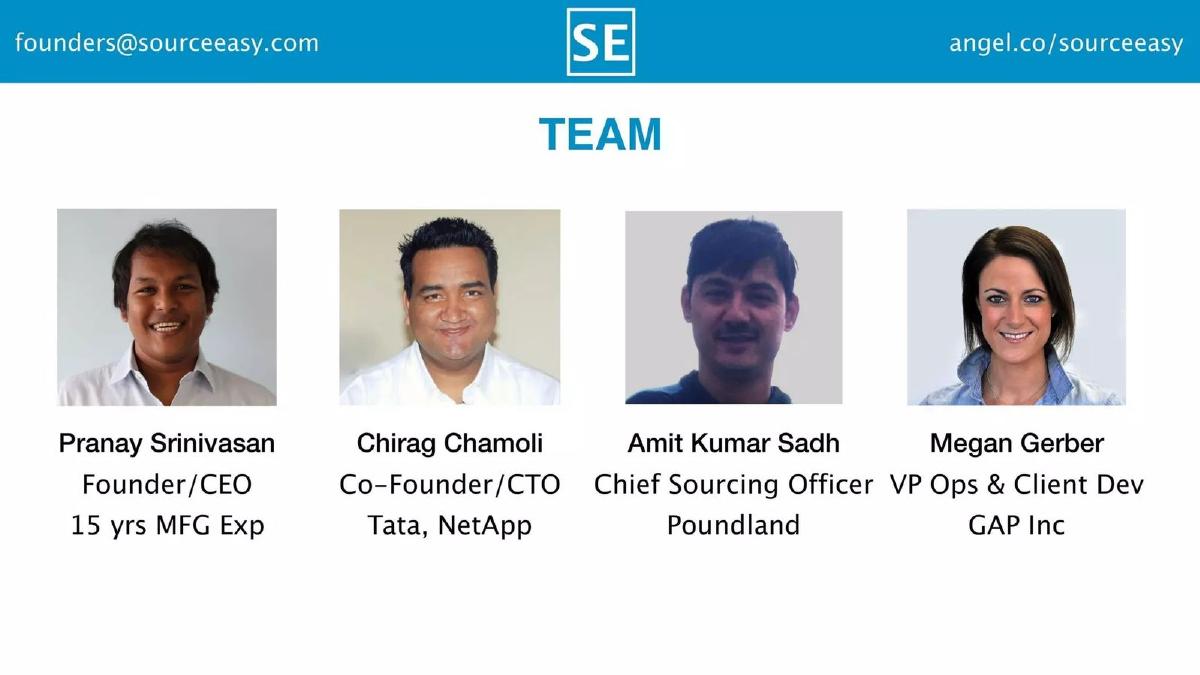
- Founder Pranay Srinivasan brings 15 years of manufacturing experience, providing critical domain authority (Slide 6).
- The deck completely omits a formal 'Ask' slide, valuation, or use of funds breakdown.
- The final slide (Slide 7) reinforces the core metrics of $2M run rate and 100+ customers as the closing argument.
The Power of Brevity: Sourceeasy’s 7-Slide Strategy
The Sourceeasy pitch deck is an anomaly in the world of venture capital. While many founders struggle to condense their vision into 15 slides, Sourceeasy managed to raise $5.8 million using only seven. This teardown explores how a company in the traditionally 'unsexy' sector of apparel manufacturing used raw data and domain expertise to capture investor interest. The deck doesn't waste time on fluff; it treats the pitch like a business report, focusing on the three things investors care about most: growth, margins, and the team's ability to execute.
The Hook: Leading with the Numbers
Slide 1: Title Slide The deck opens with a clean, blue title slide. The tagline is simple: "FULL STACK APPAREL MANUFACTURING." It includes contact information and an AngelList link in the corners, signaling that the company is ready for immediate due diligence. There are no aspirational images of clothing or factories—just the brand and the category.
Slide 2: Traction and Margins Most decks put the traction slide at the end. Sourceeasy puts it second. This is a bold move that immediately answers the question of product-market fit. The slide features a line graph showing revenue growth from January to June. Two specific data points are highlighted: $63k in April and $163k in June. To the right, three massive text blocks scream the value proposition: "$2M RUN RATE," "30% MoM," and "45% MARGINS." By leading with 45% margins in a manufacturing business, Sourceeasy differentiates itself from low-margin competitors right out of the gate.
Validation and Problem Identification
Slide 3: Social Proof Slide 3 is a logo wall. It claims "OVER 100 CUSTOMERS AND GROWING!" The logos are strategically chosen to show breadth. You have tech giants (Uber, Paytm), e-commerce heavyweights (Groupon India), and apparel-specific startups (Le Tote, MeUndies, Manpacks.com). This tells investors that the platform is versatile enough to handle everything from corporate swag to high-end fashion subscriptions.
Slide 4: The Problem Titled "APPAREL MANUFACTURING IS HARD," this slide uses six icons to break down the industry's inefficiencies. The points are specific: Design/Fit/Trim approvals, Tons of Paper, Overseas Trips, Shipping Samples Back and Forth, Outdated Tools, and Quality Control. This slide is crucial because it translates the 'Full Stack' buzzword into tangible solutions for real-world headaches. It shows the founders understand the granular pain points of their customers.
The Solution and The Architects
Slide 5: The Product The solution slide mirrors the title slide's "Fullstack" claim. It shows a MacBook Air displaying the Sourceeasy web platform. The interface appears to be a dashboard for managing product samples and specifications. The three pillars of the solution are listed as: Web Platform, Manufacturing, and Deliver 3X Faster. This slide confirms that Sourceeasy is a tech-enabled service, not just a software-as-a-service (SaaS) play.
Slide 6: The Team In a complex industry like global manufacturing, the team is everything. Slide 6 features four leaders. CEO Pranay Srinivasan is highlighted for having "15 yrs MFG Exp." The other members bring pedigrees from Tata, NetApp, Poundland, and GAP Inc. The inclusion of a VP of Ops from GAP Inc. (Megan Gerber) is a high-signal hire that suggests the company has the internal knowledge to scale a global supply chain.
The Closing Argument
Slide 7: Summary and Contact The final slide is a reiteration of the deck's strongest points. It repeats the $2M run rate, the 100+ customers, and the 30% MoM growth. It functions as a permanent 'leave-behind' that keeps the most impressive metrics in front of the investor as the meeting concludes. Notably, there is no 'Ask' slide. The deck assumes that if you are interested in these numbers, you will reach out to the email provided.
What Works in This Deck
The 'Traction First' Approach: By putting the revenue graph on Slide 2, Sourceeasy eliminates skepticism. It is much harder for an investor to pick apart a business model when that model is already generating a $2M run rate with high margins.
Clarity of Margins: In manufacturing, margins are the primary indicator of scalability and health. Explicitly stating a 45% margin is a powerful signal that Sourceeasy has found a way to automate or optimize costs that traditional players haven't.
Domain Authority: The team slide isn't just a list of schools; it’s a list of relevant industry experience. Mentioning 15 years of manufacturing experience and a background at GAP Inc. provides the 'Why You' answer that investors look for in complex B2B sectors.
What is Missing
The Market Opportunity: There is no mention of the Total Addressable Market (TAM). While the apparel industry is obviously large, investors usually want to see the founder's perspective on which specific segment they are capturing (e.g., fast fashion vs. luxury).
The Competitive Landscape: The deck doesn't mention competitors. Whether they are traditional sourcing agents or other tech-enabled platforms, a slide addressing why Sourceeasy wins against the status quo would have added depth.
The Financial Ask: The most glaring omission is the lack of a funding goal. The deck doesn't state how much they are raising or what they plan to do with the money. While this might be intentional for a 'teaser' deck, it usually requires a follow-up conversation to establish the terms of the round.
What a Founder Should Copy
The Minimalist Aesthetic: Use high-contrast colors and large fonts. Sourceeasy’s deck is readable in seconds. Each slide has one clear job.
Specific Pain Points: Don't just say the industry is "inefficient." Use Slide 4 as a template to list the specific, annoying tasks your product eliminates (e.g., "Shipping samples back and forth").
The 'Traction Sandwich': Start with your best numbers and end with your best numbers. Sourceeasy uses its growth metrics as both the hook and the closer, ensuring the investor remembers the data above all else.
Conclusion
The Sourceeasy deck is a testament to the idea that traction solves all problems. It lacks many of the 'standard' slides found in a Sequoia-style template, yet it successfully raised nearly $6 million. For founders with significant revenue and high growth, this 'less is more' approach can be incredibly effective at driving a fast, data-driven fundraising process.
Frequently asked questions
- How much did Sourceeasy raise with this deck?
- According to catalogue facts, Sourceeasy raised $5,800,000 in 2013 during its Seed stage. This is a significant amount for a seed round, likely driven by the high margins (45%) and rapid revenue growth shown in the deck.
- What is the 'Full Stack' approach mentioned in the deck?
- On Slide 5, Sourceeasy defines 'Fullstack Apparel Manufacturing' as a combination of a web platform and physical manufacturing capabilities. This suggests they aren't just a software layer, but an end-to-end service provider that manages the production and delivery process to achieve 3X faster speeds.
- Who are Sourceeasy's customers?
- Slide 3 highlights over 100 customers. Notable logos include Uber, Le Tote, Groupon India, Paytm, Manpacks.com, and MeUndies. This indicates the platform serves both tech companies needing promotional apparel and dedicated fashion/subscription brands.
- Is there a team slide in the Sourceeasy deck?
- Yes, Slide 6 introduces four key team members. It emphasizes '15 yrs MFG Exp' for CEO Pranay Srinivasan and lists previous experience at major corporations like Tata, NetApp, Poundland, and GAP Inc. for the rest of the leadership team.
- What is missing from the Sourceeasy pitch deck?
- The deck is very brief at only 7 slides. It lacks a market size (TAM/SAM/SOM) analysis, a competitor matrix, a detailed financial roadmap, and a specific 'Ask' slide detailing how much capital they are seeking and how it will be spent.