How fashion and apparel startups present the solution in a pitch deck: answer each problem point by point, show how the garment or service works.
Fashion Startup Solution Slide: Real Pitch Deck Examples
Eight solution slides from fashion and apparel startups, shown in full, compare whether each slide answers its own problem slide point by point, shows how the product works, and gives one proof.
TL;DR
A fashion solution slide has to answer the problem slide point by point. The stronger slides mirror it. Poshmark (then GoshPosh) had said listing was "time consuming and daunting" and marketplaces were "built on search"; its solution answers each: "Users list items using mobile smartphone (iPhone) and convert the photo into a fashion quality image" and "Users discover products through people". Abacus names the fabric technology ("37.5") and a customer who came back ("The European Solheim Cup team chose abacus for 5 times in a row"). My Beautiful Africa's three boxes labelled "Icon 1", "Icon 2", "Icon 3" (virtual reality, AI, social media), with no link to a customer, are the weaker pattern.
Fashion solution slides from real pitch decks
Each example shows the exact stored slide above its analysis and links to the full teardown. Claims are as shown on the slides; we have not verified them.
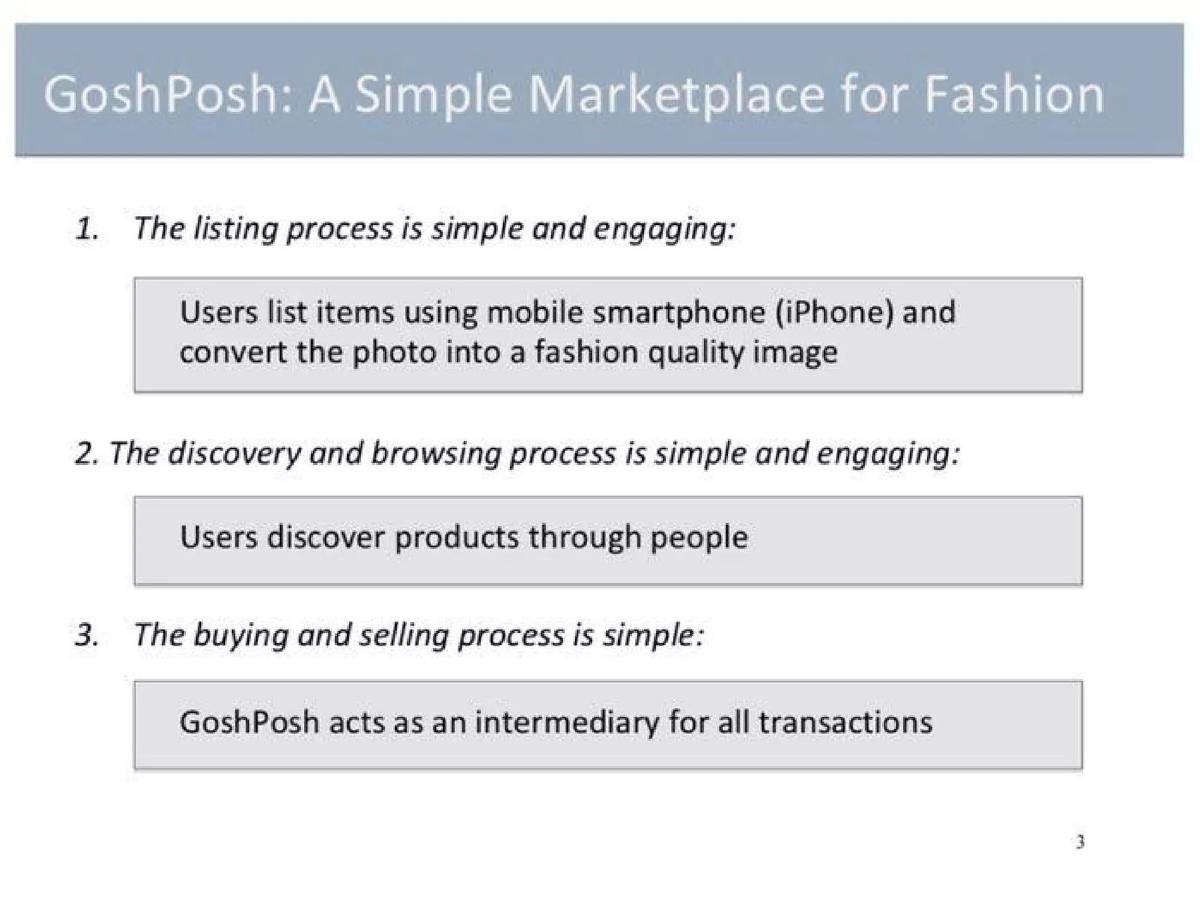
Poshmark (as GoshPosh) solution slide — slide 3
Fashion resale marketplace, pitched under its early name. Three numbered points, each with one line of detail.
Poshmark deck, slide 3. Exact stored slide matched to this analysis.
Our analysis: The strongest slide here: each point answers a pain on its problem slide, in the same words (listing, discovery, buying).
Evidence and limitation: No figures.
What a founder can adapt: Reuse your problem slide's words as the headings of your solution points.
Supporting analysis
What the deck claims: "GoshPosh: A Simple Marketplace for Fashion." "1. The listing process is simple and engaging: Users list items using mobile smartphone (iPhone) and convert the photo into a fashion quality image." "2. The discovery and browsing process is simple and engaging: Users discover products through people." "3. The buying and selling process is simple: GoshPosh acts as an intermediary for all transactions."
Presentation choice: "Users discover products through people" is the direct answer to marketplaces "built on search".
When it does not fit: "Simple and engaging" appears twice; the detail lines do the work, so lead with them.
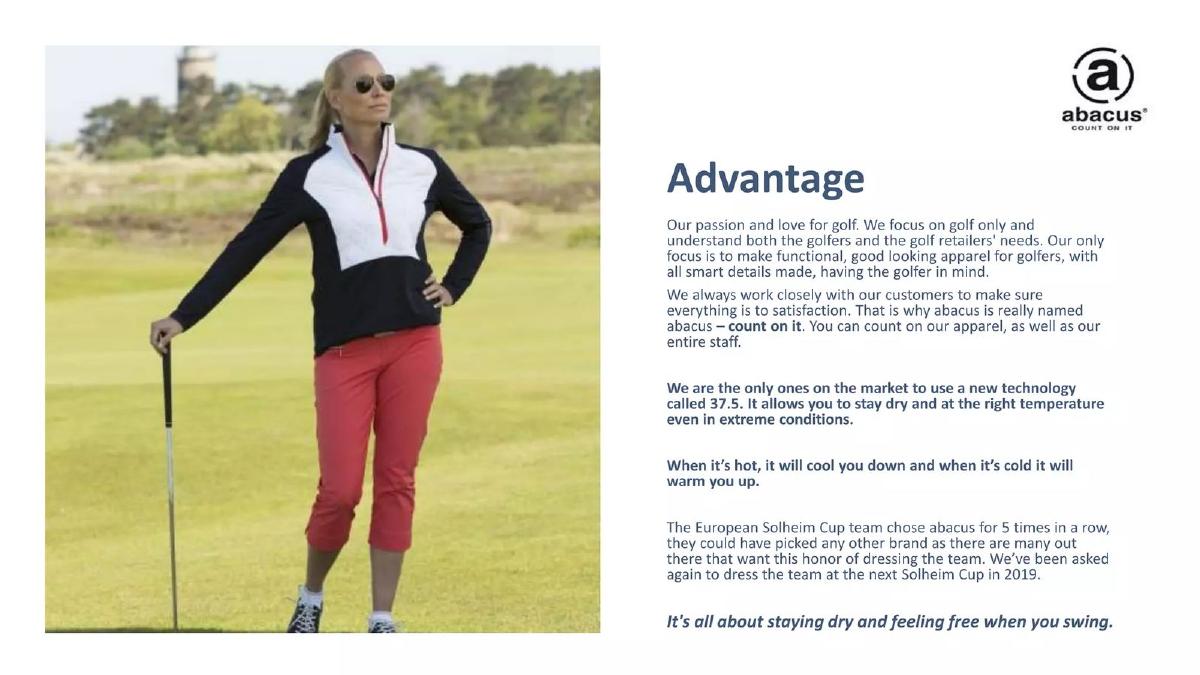
Golf clothing. A photo of a golfer beside five short paragraphs.
Abacus deck, slide 6. Exact stored slide matched to this analysis.
Our analysis: It answers the golfer's need from its problem slide (clothes that move and breathe) with a named fabric and a named team.
Evidence and limitation: A named repeat customer; "only ones" is unsupported.
What a founder can adapt: Name the material or process behind your garment and one customer who chose it again.
Supporting analysis
What the deck claims: "Advantage." "We focus on golf only and understand both the golfers and the golf retailers' needs." "We are the only ones on the market to use a new technology called 37.5. It allows you to stay dry and at the right temperature even in extreme conditions." "When it's hot, it will cool you down and when it's cold it will warm you up." "The European Solheim Cup team chose abacus for 5 times in a row." "It's all about staying dry and feeling free when you swing."
Presentation choice: The Solheim Cup line is proof from a demanding customer, not a claim.
When it does not fit: "The only ones on the market" needs a source or softer wording.
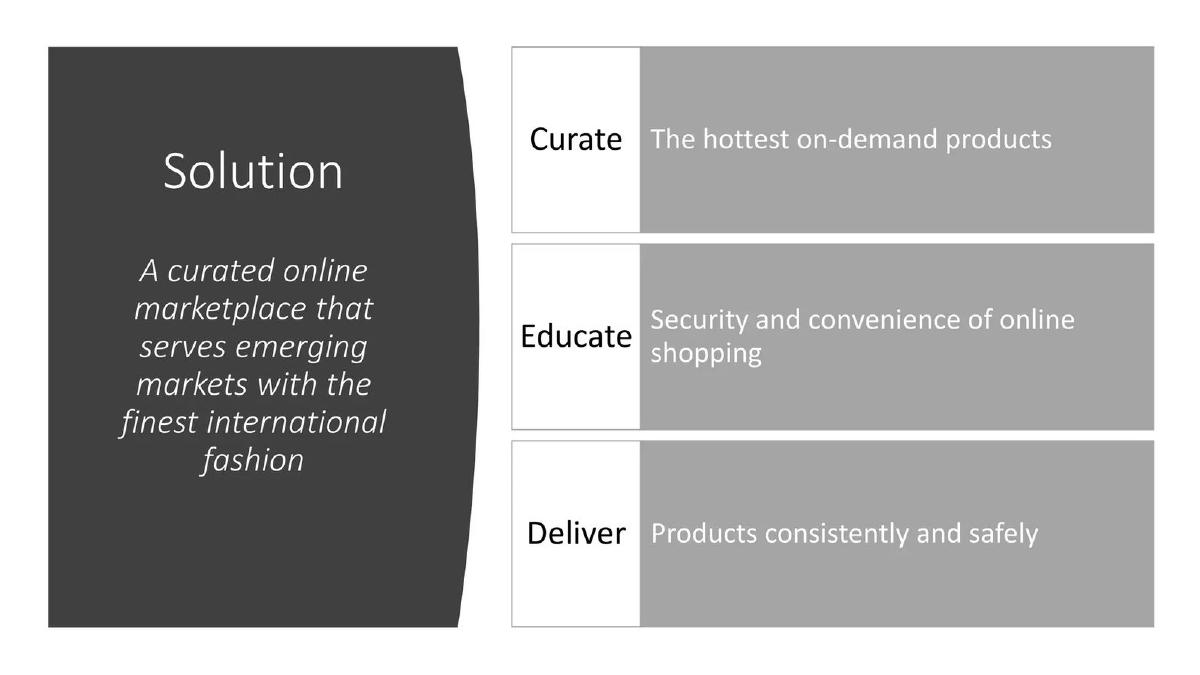
International fashion delivery in Nigeria. A one-line summary beside three labelled rows.
House of Highness deck, slide 3. Exact stored slide matched to this analysis.
Our analysis: Its three rows answer the three barriers on its problem slide (access, payment trust, delivery).
Evidence and limitation: No figures.
What a founder can adapt: Mirror the barriers from your problem slide with one verb each.
Supporting analysis
What the deck claims: "Solution." "A curated online marketplace that serves emerging markets with the finest international fashion." "Curate: The hottest on-demand products." "Educate: Security and convenience of online shopping." "Deliver: Products consistently and safely."
Presentation choice: One verb per row makes the plan easy to remember.
When it does not fit: "Consistently and safely" needs a delivery time to beat the unreliable network it named.
Loungewear. A screenshot of the funded Kickstarter page above the founder's account.
Lazy Creatures deck, slide 4. Exact stored slide matched to this analysis.
Our analysis: It shows the solution as a test customers paid for, following the problem slide's "ratty old T-shirts".
Evidence and limitation: Crowdfunding result: 81 backers, $9,603.
What a founder can adapt: If you tested with pre-orders or crowdfunding, show the result on the solution slide.
Supporting analysis
What the deck claims: "My Experiment." Kickstarter page: "Lazy Creatures: Super Soft & Stylish Loungewear." "81 backers." "$9,603." "Funded!" "In February of 2014, I started planning a Kickstarter campaign to test for product/market fit. I designed, sewed, photographed, videotaped, and called out to my social network for help and suggestions. I launched the campaign in May, and hit my goal amount in June."
Presentation choice: Money from strangers is stronger than a product description.
When it does not fit: The product itself is only in the thumbnail; add one line on what makes it "super soft" and cute.
Sneaker trading app. A site screenshot beside three numbered services.
SnkTrd deck, slide 4. Exact stored slide matched to this analysis.
Our analysis: Point 2 is a clear trading flow (collection, list, offers); the community and magazine are extras.
Evidence and limitation: No figures.
What a founder can adapt: Lead with the one flow that answers your problem, and put extras after.
Supporting analysis
What the deck claims: "Demo." "Core Services." "1. Global Community: Users are given the opportunity to create a profile and upload pictures of new purchases, while interacting with other sneaker enthusiasts, globally." "2. Innovative Marketplace: The marketplace allows a user to pull shoes from his/her pre-loaded collection, and place them in the marketplace, where others are able to make offers on the post." "3. Web-Based Magazine."
Presentation choice: "Pull shoes from his/her pre-loaded collection" shows listing is quick.
When it does not fit: The screenshot is too dark and small to read.
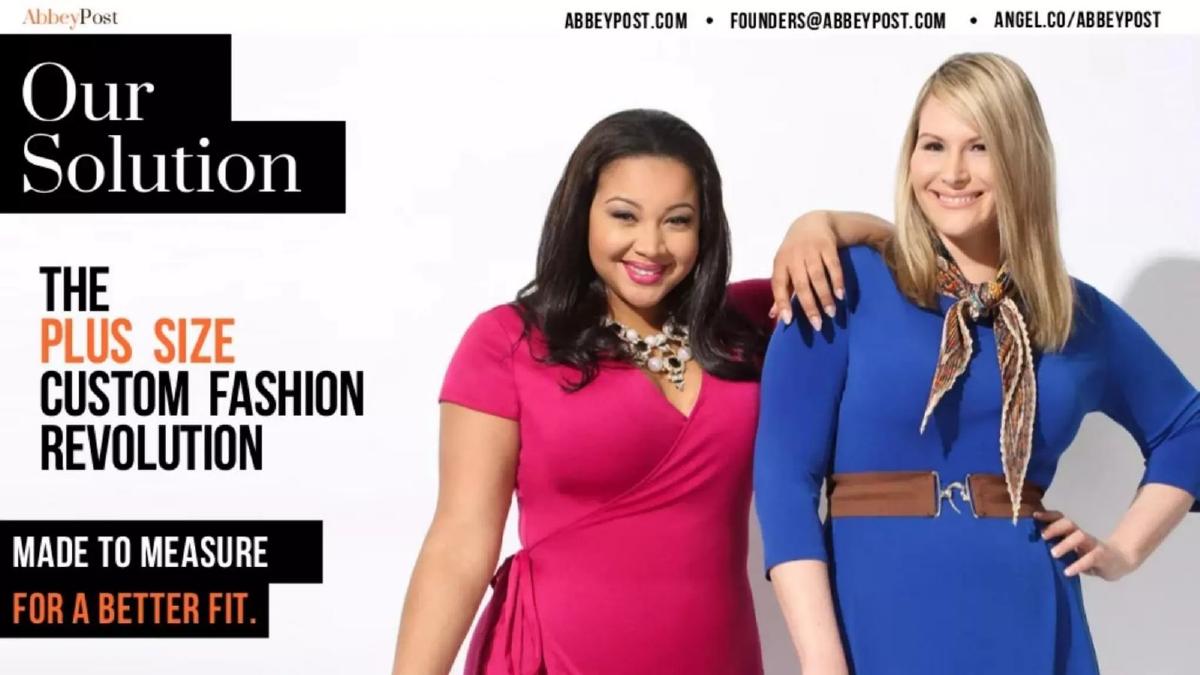
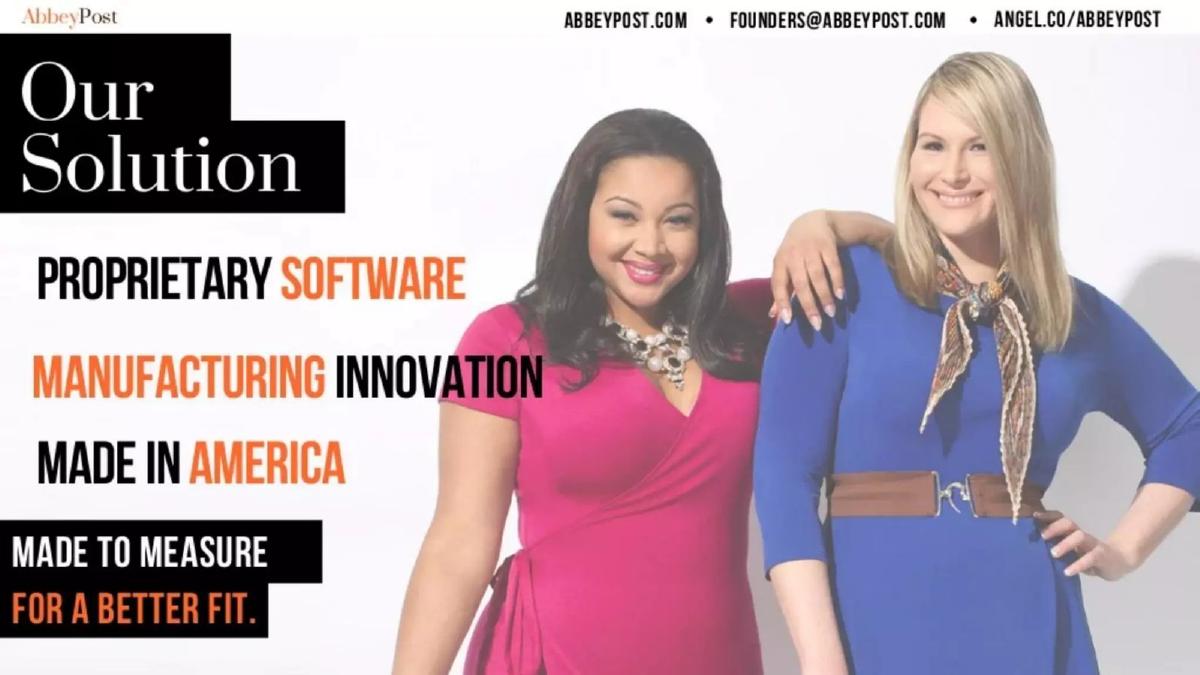
Custom plus-size clothing. Two slides with the same photo and different captions.
AbbeyPost deck, slide 4. Exact stored slide matched to this analysis.AbbeyPost deck, slide 5. Exact stored slide matched to this analysis.
Our analysis: Partial: "made to measure" answers "cut for one shape" exactly, but neither slide shows how a customer is measured or what it costs.
Evidence and limitation: No figures.
What a founder can adapt: Show the fitting step: how measurements are taken, and how long until the garment arrives.
Supporting analysis
What the deck claims: Slide 4: "Our Solution." "The plus size custom fashion revolution." "Made to measure for a better fit." Slide 5: "Proprietary software." "Manufacturing innovation." "Made in America."
Presentation choice: The answer to the problem is in four words.
When it does not fit: "Proprietary software" and "manufacturing innovation" are labels; say what they do.
African-inspired fashion and travel brand. A paragraph above three icon boxes.
My Beautiful Africa deck, slide 4. Exact stored slide matched to this analysis.
Our analysis: Weak on purpose: a five-year ambition and three technologies, with placeholder labels left in, and no product or customer.
Evidence and limitation: No figures.
What a founder can adapt: Say what a traveller buys and how they receive it.
Supporting analysis
What the deck claims: "Solution." "Within the next 5 years, we shall seek to create the most sought after elegant fashion travel and Lifestyle Company, delivering packages and experiences that represent the true essence of the spirit of Africa enabled by Technology." "Icon 1: Virtual Reality." "Icon 2: Artificial Intelligence." "Icon 3: Social Media."
Presentation choice: Kept as a contrast; it's the companion of the weakest slide in the problem guide.
When it does not fit: Template text ("Icon 1") and technology names in place of a product.
Whether each slide answers its problem slide, shows how it works, and gives one proof.
Example
Answers the problem
How it works
Proof
Poshmark
Yes (point by point)
Yes
No
Abacus
Yes
Yes (fabric)
Yes (repeat team)
Sourceeasy
Yes
Partly
Partly (3X, unsourced)
House of Highness
Yes (three rows)
Partly
No
Lazy Creatures
Partly
No
Yes (Kickstarter)
SnkTrd
Partly
Yes (trading flow)
No
AbbeyPost
Yes (made to measure)
No
No
My Beautiful Africa
No
No
No
Key Takeaways
Answer each point of your problem slide in the same order.
Show how it works for the shopper, seller or maker: a listing, a fitting, a sample round.
Name what makes the garment different: a fabric, a fit process, a sourcing network.
Give one proof: a repeat customer, a crowdfunding result, a speed figure.
Technology buzzwords and brand ambitions are not a solution.
Build your fashion solution slide
Mirror the problem, show how it works, one proof.
Mirror. List your problem slide's points; write one answer per point.
How it works. What does the shopper, seller or maker do, step by step?
Difference. What fabric, fit method or process makes it work?
Proof. One repeat customer, pre-order result or speed figure.
Copyable framework: Instead of [problem point], [customer] [does what with the product]. It works because [difference]. [Proof].
Illustrative example 1 — written by us
Before: A revolutionary tech-enabled fashion platform redefining style.
After: Instead of returning ill-fitting jeans, shoppers scan their body with a phone in 90 seconds and get a pair cut to measure in 10 days; 3% are returned, against 30% in online denim.
What improved: Our illustrative rewrite; the figures are invented for the example. It answers the problem, shows the steps and gives a comparison.
What this guide adds
This guide follows the fashion startup problem guide: all eight decks appear in both, so you can see whether each solution answers its own problem slide.
The slides range from resale (Poshmark, SnkTrd) and fit (AbbeyPost, Abacus) to loungewear (Lazy Creatures), delivery in Nigeria (House of Highness), manufacturing (Sourceeasy) and a lifestyle brand (My Beautiful Africa).
Three things a fashion solution slide proves
It answers the problem: listing and discovery (Poshmark), access, payment and delivery (House of Highness: "Curate", "Educate", "Deliver").
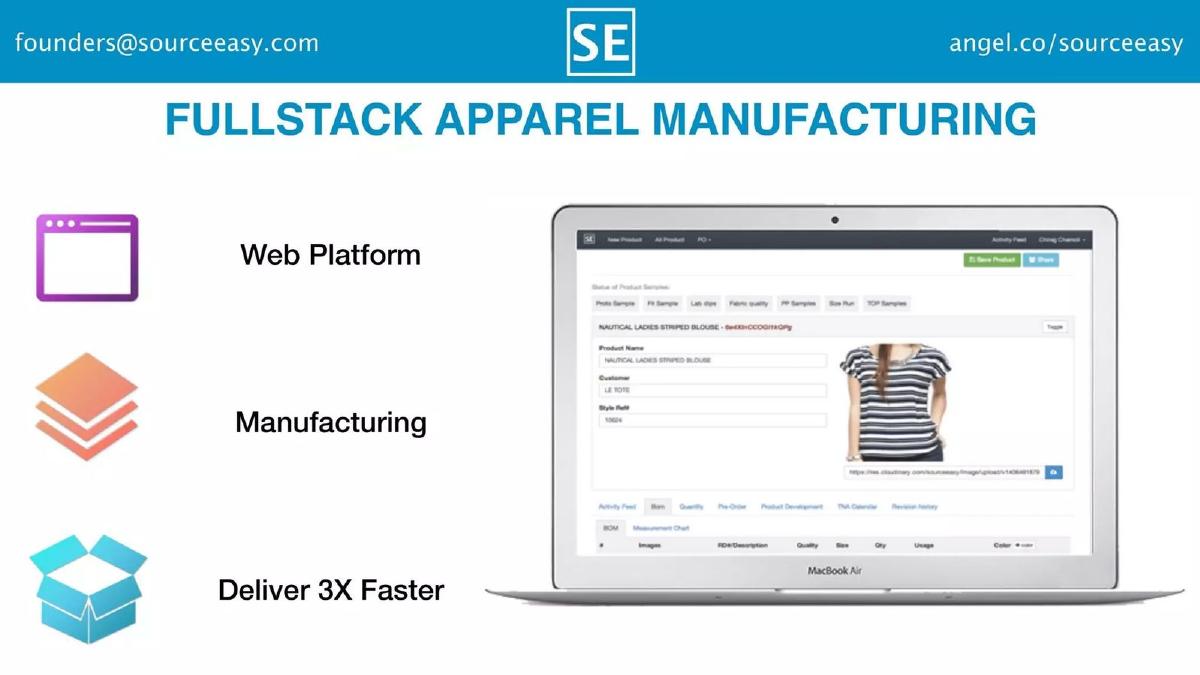
How it works: a phone photo turned into "a fashion quality image" (Poshmark), "Web Platform", "Manufacturing", "Deliver 3X Faster" (Sourceeasy).
One proof: "Solheim Cup team chose abacus for 5 times in a row" (Abacus), a funded Kickstarter (Lazy Creatures).
Common mistakes
Not mirroring the problem. Each problem point needs its answer.
Labels instead of steps. "Proprietary software" says nothing about the customer's experience.
Speed with no baseline. "3X faster" than what, in weeks?
Technology names as the product. VR, AI and social media are tools, not what the customer buys.
Leftover template text. "Icon 1" on an investor slide undermines trust.
Diagnostic checklist
It answers each point on the problem slide.
It shows the steps for the customer.
It names what makes the product work.
It gives one proof.
No template text or buzzwords remain.
Frequently asked questions
How we chose these examples
Corpus: published pitch deck teardowns on StartupFundraising.com. Founder-uploaded private decks are excluded.
Selection (2026-09-25): we looked at slides 3–6 of the eight decks in the fashion startup problem guide and chose each deck's solution slide. Nine stored images were inspected. Where no slide is labelled "Solution", we used the slide that plays that role: Abacus slide 6 ("Advantage"), Lazy Creatures slide 4 ("My Experiment") and SnkTrd slide 4 ("Core Services"). AbbeyPost is marked partial; My Beautiful Africa is kept as a weaker contrast.
Overlap check: none of these slides appears in another guide.
Review: all nine stored slide images (AbbeyPost has two) were inspected on 2026-09-25 and matched to company, deck and slide number (editorial model review). No person has yet completed an editorial review of this page.
Claims are as shown on the slides; we have not verified them. We make no claim that any slide caused a fundraising outcome.