The Abacus Sportswear US pitch deck outlines a strategy to expand the established Swedish golf apparel brand into the United States. Led by Sandrine Mork, the business model relies on leveraging existing brand equity from Europe—where it is cited as the #1 brand in Sweden and Denmark—to capture a niche in the mature US golf market. The financials project a growth trajectory from $20,000 in 2018 to $833,400 by 2023, with a heavy emphasis on wholesale sales and a growing sales force. While the deck provides a granular six-year financial table, it lacks a specific dollar amount for the funding a…
Key takeaways
- The company is led by Sandrine Mork, who previously managed over 2,500 global accounts and drove $1 million in revenue (Slide 2).
- Abacus claims to be the #1 golf apparel brand in Sweden and Denmark, outperforming global competitors like Nike and Adidas in those regions (Slide 13).
- The business model is heavily weighted toward wholesale, which is projected to account for $819,000 of the $833,400 total revenue by 2023 (Slide 16).
- The financial plan includes scaling the sales force from 8 reps in 2019 to 13 reps by 2023 (Slide 16).
- Inventory is the primary expense driver, projected to reach $378,000 by 2023, including 25% royalties and 22% duties (Slide 16).
- The deck identifies Galvin Green as a primary rainwear competitor but argues their use of Gore-Tex is an 'aged technology' (Slide 13).
- The funding request is presented as a pie chart showing 'Owner Investment' vs. 'Funding' but does not state a specific capital requirement in dollars (Slide 19).
Executive Summary: The Scandinavian Challenger
Abacus Sportswear US, LLC is a regional expansion play designed to bring a dominant European golf brand to the United States. The deck positions the company not as a new startup, but as a proven entity in international markets (specifically Sweden and Denmark) looking to replicate that success in the American market through a dedicated US-based LLC. The narrative centers on technical superiority in fabrics and a lean, wholesale-heavy distribution model.
Slide 1: Title Slide
The title slide features the company name, Abacus Sportswear US, LLC , and the brand logo with the tagline "Count on it." The background image shows a golfer in the rain, emphasizing the brand's focus on technical, weather-resistant performance apparel. The branding is clean and professional, establishing the company as a premium athletic wear provider.
Slide 2: The Team
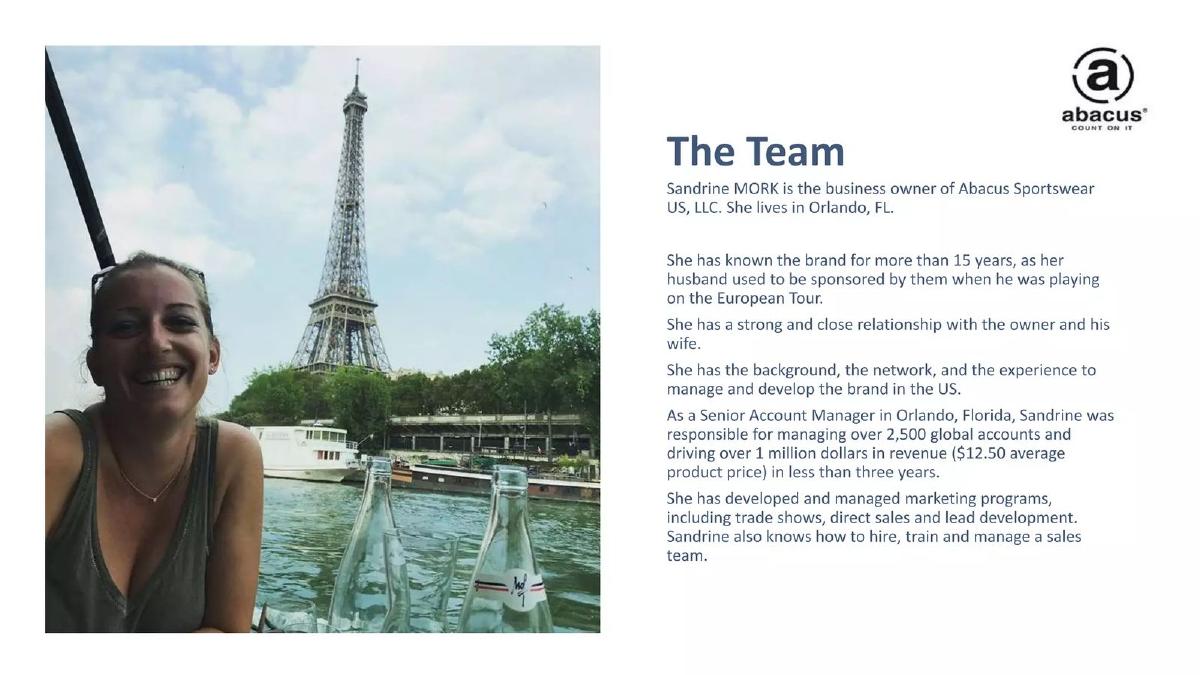
This slide focuses exclusively on Sandrine Mork , the business owner. It provides a mix of personal and professional context. Mork is based in Orlando, FL, and has a 15-year history with the brand. Professionally, the slide notes her experience as a Senior Account Manager responsible for 2,500 global accounts and generating over $1 million in revenue at a $12.50 average product price. This metric is intended to demonstrate her ability to handle high-volume sales and account management. The slide also mentions her capability in hiring and training sales teams, which is critical for the projected growth of the US sales force.
Slide 3: Solution
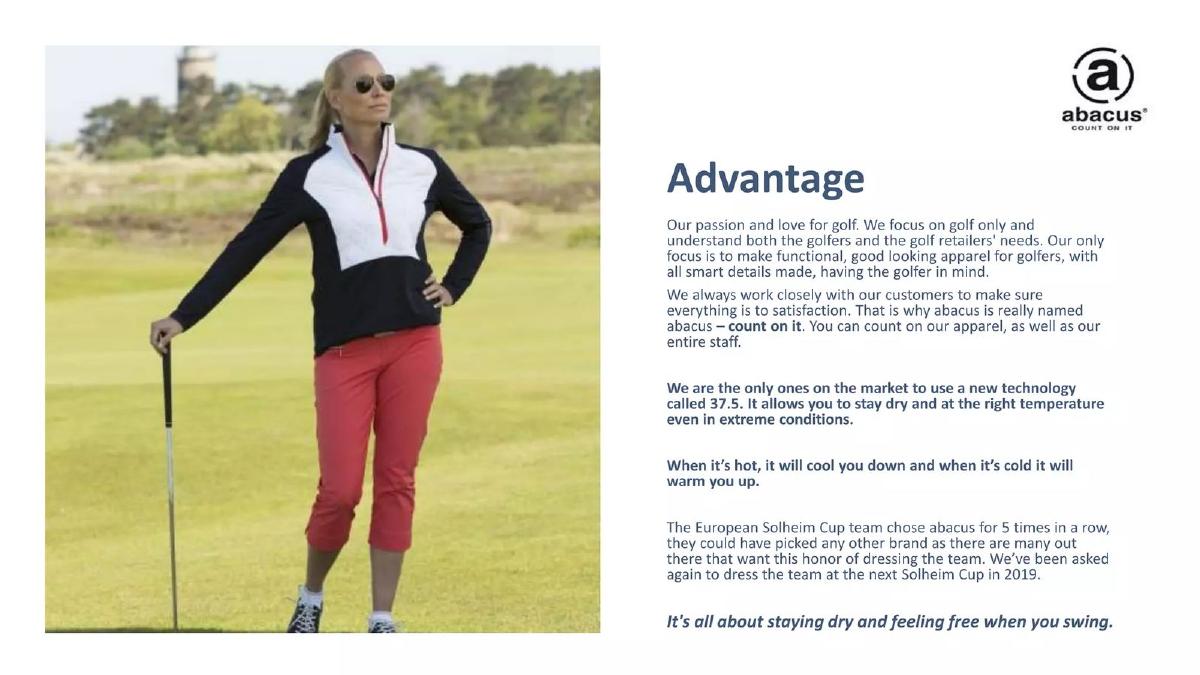
The solution is defined as "good looking and functional apparel with the latest fabric technologies." The core focus is on freedom of movement . The slide lists four key attributes for their athletic wear: perfectly fitted, stretchable, lightweight, and breathable. The product range is broad, covering men, women, juniors, and accessories. This slide serves as the primary product value proposition, moving away from fashion toward performance utility.
Slide 4: Brand Identity and Technology
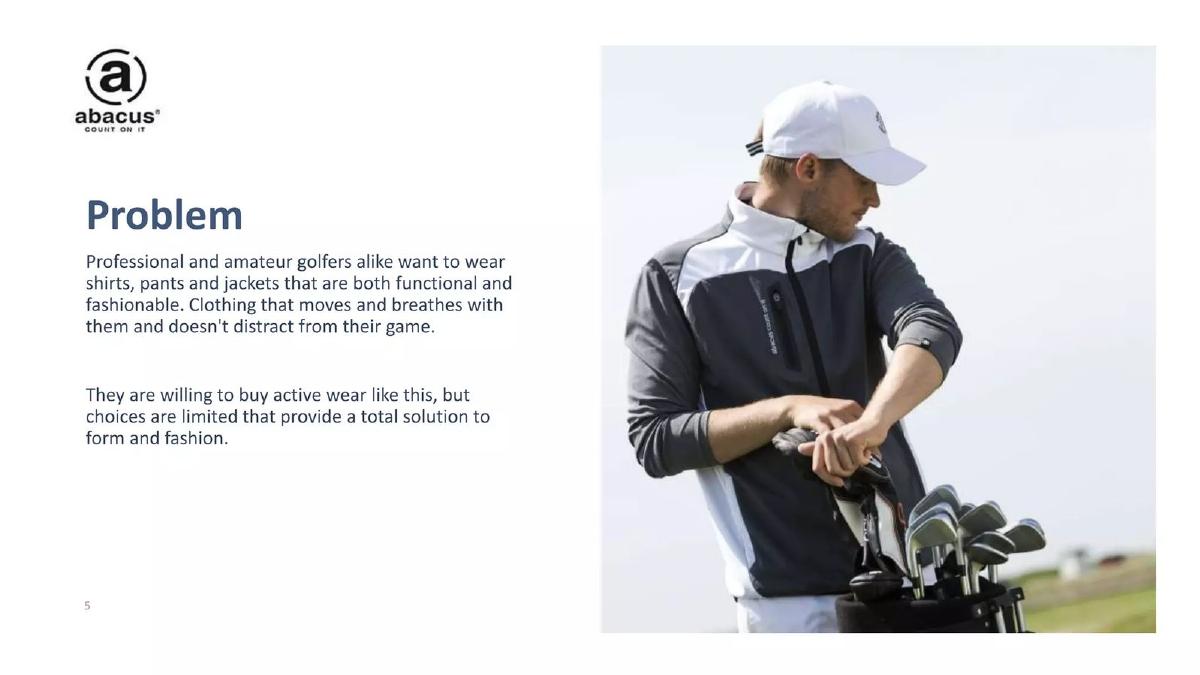
This slide is a visual reinforcement of the brand's technical focus. It features a runner wearing the "X by abacus" line. The text highlights "world leading technologies and fabrics" and "lightweight materials." This suggests that while golf is the primary entry point, the brand has aspirations or existing products in the broader activewear and running categories.
Slide 13: Competition
The competitive landscape is divided into two categories: large incumbents and direct technical rivals. Nike, Adidas, Footjoy, Under Armour, and Ralph Lauren are listed as the major players. The slide claims a unique niche through exclusive fabric technology. Interestingly, it calls out Galvin Green specifically regarding rainwear, criticizing their use of Gore-Tex as an "aged technology." The slide concludes with a strong traction signal: Abacus is the #1 brand in Sweden and Denmark, even when competing against global giants like Nike and UA.
Slide 16: Financials
This is a detailed P&L projection from 2018 to 2023. Key figures include:
Total Revenues: Growing from $20,000 (2018) to $833,400 (2023). · Wholesale vs. Online: The business is almost entirely wholesale. By 2023, wholesale is projected at $819,000 while online sales are only $14,400. · Sales Force: The plan scales from 8 reps in 2019 to 13 reps in 2023, with commissions set at 15%. · Inventory Costs: This is the largest line item, including a 25% royalty fee, 22% duties, and 10% shipping. · Profitability: The company projects a loss of -$71,775 in 2018, reaching a net profit of $258,390 by 2023.
Slide 19: Funding
The final slide in this selection addresses the capital requirement. It states that the owner has already invested to launch the company and is now seeking equity to fund inventory and operating expenses. A pie chart shows the ratio of "Owner Investment" to "Funding," with the external funding portion being significantly larger. However, the slide omits the specific dollar amount being raised and the valuation being offered.
What Abacus Sportswear US Does Well
The deck excels at establishing market proof . By citing their #1 status in Sweden and Denmark, they bypass the "will people buy this?" question that plagues most fashion startups. They aren't testing a product; they are testing a new geography for a proven product. The financial slide is also exceptionally granular for a pitch deck, showing a clear understanding of the costs associated with importing goods, specifically the 22% duties and 25% royalties, which are often overlooked by founders in the licensing space.
What is Missing from the Deck
The most glaring omission is a specific funding ask . Investors cannot evaluate a deal without knowing how much capital is required and what milestones that capital will achieve. Additionally, the deck lacks a Customer Acquisition Cost (CAC) analysis for the wholesale channel. While they list sales rep commissions, they don't detail the cost of opening a new green-grass shop or retail account. The "Team" slide is also very thin; while Sandrine Mork has relevant experience, a national rollout usually requires a broader leadership team including logistics, finance, and marketing specialists, none of whom are mentioned.
Founder's Guide: What to Copy and What to Avoid
Copy the competitive framing: The way Abacus identifies a specific technical weakness in a competitor (calling Gore-Tex "aged technology") is a powerful way to carve out a niche. It moves the conversation from "we make shirts too" to "we have a better engine." Founders should look for these specific technical differentiators rather than relying on vague terms like "high quality."
Avoid the single-person team slide: Even if you are a solo founder, you should list your advisors, your board, or your key strategic partners (like the manufacturing team in Sweden, in this case). A slide with a single person and a vacation-style photo (the Eiffel Tower background on Slide 2) can appear less professional than a standard corporate headshot or a photo of the team in a work environment.
Avoid the vague funding pie chart: A pie chart without numbers is essentially a decorative element. If you are presenting to investors, you must be specific. State the amount, the use of funds in dollars, and the expected runway that the investment provides. Vague asks often lead to a lack of follow-up from serious investors.
Frequently asked questions
- What is the primary value proposition of Abacus Sportswear US?
- The brand focuses on 'freedom of movement' and functional apparel using advanced fabric technologies. According to Slide 3, the goal is to provide perfectly fitted, stretchable, and breathable athletic wear that allows golfers to perform without being hindered by their clothing. They position themselves as a premium, technology-forward alternative to traditional brands that rely on older materials like Gore-Tex.
- How does the company plan to compete with giants like Nike and Adidas?
- Slide 13 acknowledges that the industry is mature with massive players. Abacus intends to compete by focusing on a 'unique niche' with exclusive fabric technology not found elsewhere. They also emphasize providing a more 'customer friendly and personalized service' compared to larger corporations, leveraging their existing status as a market leader in Scandinavia to build credibility with US retailers.
- What are the key financial projections for the US expansion?
- The company projects significant growth over a six-year period. Revenue is expected to rise from $20,000 in 2018 to $833,400 in 2023. Profitability is projected to begin in 2020 ($54,015) following two years of losses. By 2023, the company forecasts a net profit of $258,390, driven largely by wholesale volume and a controlled increase in administrative and sales costs.
- What is the background of the leadership team?
- The deck focuses entirely on Sandrine Mork. She is described as having a 15-year history with the brand, including personal ties to the original owners. Her professional background includes serving as a Senior Account Manager where she managed 2,500 global accounts. The deck highlights her experience in hiring and training sales teams and managing marketing programs like the PGA Show (Slide 2).
- What is missing from the funding slide?
- Slide 19 is notably vague. While it states the company is looking for equity to buy inventory and cover operating expenses, it does not list a target raise amount, a valuation, or specific terms. The pie chart illustrates that 'Funding' will make up the majority of the capital structure compared to 'Owner Investment,' but without raw numbers, the scale of the ask remains unclear.