Andean American Gold (TSX.V: AAG) utilizes a 24-slide deck (8 slides analyzed here) to detail the economic viability of its Invicta mining project in Peru. Unlike typical tech startups, this deck is built on geological certainty and industrial partnerships. The company highlights a measured resource of 868,000 tonnes and a projected 1-year payback period on a $68M CapEx. A critical component of the pitch is the strategic relationship with Trafigura, which provides a $15M sub-debt facility and an off-take agreement for base metal concentrates. The deck succeeds by replacing speculative growth…
Key takeaways
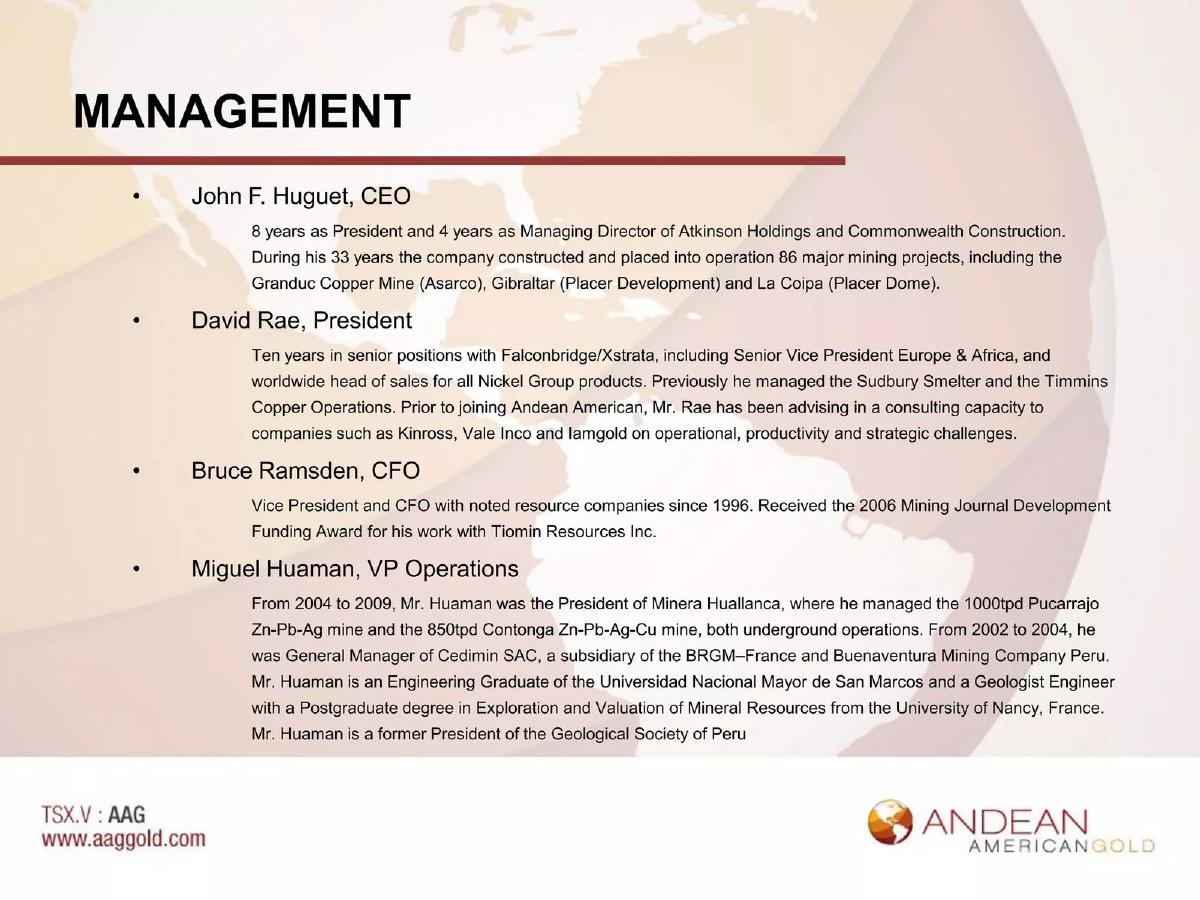
- The management team boasts over 33 years of experience and 86 major mining projects under the CEO alone (Slide 2).
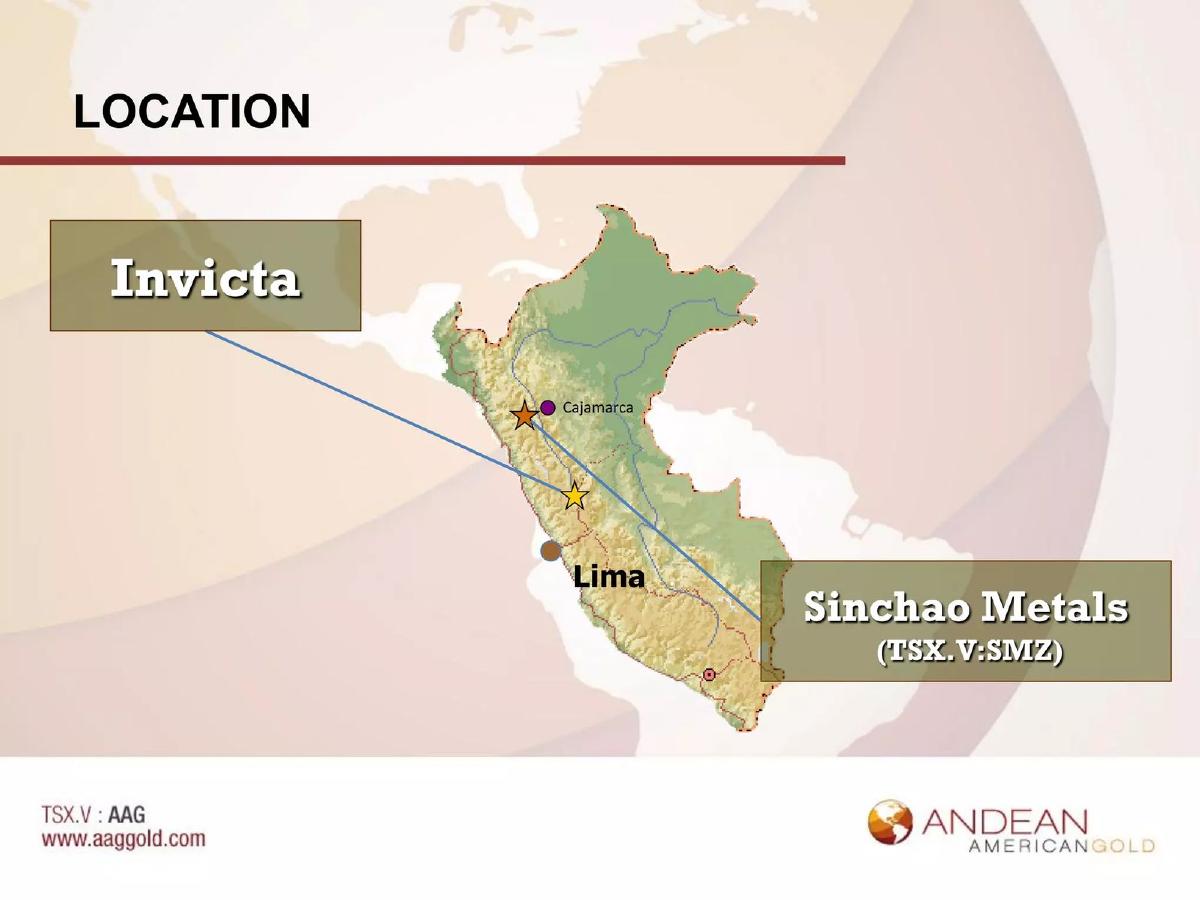
- The Invicta project is strategically located near numerous active production units and exploration projects in Peru (Slide 3).
- Resource estimates are granular, detailing 75,724 Oz of gold in the 'Measured' category and over 632,336 Oz in 'Indicated' (Slide 4).
- The project demonstrates high capital efficiency with an estimated 1-year payback on $68M in CapEx (Slide 6).
- Operational costs are pegged at $28.31 US/tonne, with a by-product cash cost per ounce of gold at negative $126.91 (Slide 6).
- A strategic partnership with Trafigura, the world's 2nd largest non-ferrous trading company, provides significant financial and operational backing (Slide 7).
- The deck lists specific operational and strategic catalysts from the last 8 months, including a $3M private placement and EIA approval (Slide 8).
- Financial modeling is based on conservative price decks, such as gold at $900/oz and silver at $12.50/oz (Slide 6).
Executive Summary: The Industrial Logic of Mining
Andean American Gold (AAG) provides a stark contrast to the typical software-as-a-service (SaaS) pitch deck. In the mining sector, the 'product' is a commodity with a global market price, so the pitch focuses entirely on the cost of extraction, the volume of the resource, and the credibility of the team. This deck is a technical document designed for institutional investors who understand the TSX Venture Exchange (TSX.V) environment.
Slide 1: Title and Branding
The cover slide is functional, featuring the company logo and a high-resolution landscape photo of the Andean region. Critically, it includes the stock ticker (TSX.V: AAG) and the corporate website. This immediately signals that the company is publicly traded, which changes the nature of the pitch from a private equity raise to a liquidity-focused investment.
Slide 2: Management Experience
In resource extraction, the team is the primary hedge against operational failure. Slide 2 lists four key executives. The CEO, John F. Huguet, is credited with 33 years of experience and the construction of 86 major mining projects. This is a staggering number that establishes immediate authority. The inclusion of Miguel Huaman as VP Operations is also strategic; his background as a former President of the Geological Society of Peru and his experience managing 1000tpd mines in-country provides the local expertise necessary to navigate Peruvian regulations and logistics.
Slide 3: Geographic Context and Infrastructure
Slide 3 uses a map of Peru to show the Invicta project's location. The slide highlights proximity to other major mines like Atacocha and Milpo. In mining, being in a 'proven neighborhood' is essential. It suggests that the geological formations are likely to be productive and, more importantly, that infrastructure (roads, power, labor) already exists in the region. The legend distinguishes between exploration projects and units in production, positioning Invicta within a cluster of active industrial activity.
Slide 4: The Resource Audit
This is the most critical slide for a mining investor. It breaks down the 'Reserves/Resources' into three regulatory categories: Measured, Indicated, and Inferred. AAG reports 868,000 tonnes in the 'Measured' category with a gold grade of 2.71 g/t. The slide also details secondary metals: Silver, Copper, Lead, and Zinc. By showing the 'Mineable Reserves' for the first 5 years (7.8 million tonnes), the company provides a clear window into the project's immediate economic lifespan. The specificity of these numbers—down to the single ounce—reflects a high level of geological confidence.
Slide 5: 3D Site Visualization
Slide 5 provides a 3D topographical view of the tailings, plant, and mine. While less data-heavy than the previous slide, it serves to prove that the project has moved beyond theoretical exploration into site planning. It identifies the 'Main Road from Choques to Plant,' which addresses the logistical 'last mile' problem often faced by remote mining operations.
Slide 6: The Feasibility Study
This slide presents the economic 'bottom line.' The most compelling figure is the '1 Year Payback' period on a $68M CapEx. For a project of this scale, a one-year payback is exceptional. The slide also introduces the concept of 'by-product' accounting. Because the mine produces silver, copper, lead, and zinc alongside gold, the revenue from those metals can be used to offset the cost of gold production. This results in a 'negative' cash cost of ($126.91) per ounce of gold. This is a powerful selling point: the mine is so efficient that the gold is essentially 'free' once the other metals are sold.
Slide 7: Strategic Partnership with Trafigura
Slide 7 details the relationship with Trafigura, a global commodities giant with $47.3 billion in sales (2009 figures). This slide acts as a massive 'social proof' and financial safety net. Trafigura isn't just an investor; they have an off-take agreement to buy all base metal concentrates. The slide also outlines a 'backstop' facility: if project debt lenders don't fund the CapEx by December 31st, Trafigura has the option to underwrite the debt themselves in exchange for equity and board seats. This significantly de-risks the project for other investors.
Slide 8: Recent Catalysts
The final slide in this selection lists 'Catalysts – Last 8 Months.' This is a momentum slide. It lists operational wins (EIA approval, key hires) and strategic wins (debt arrangers like Barclays Capital and WestLB). By showing a consistent drumbeat of progress, AAG demonstrates that they are an active, moving target rather than a stagnant shell company. The mention of a $3M private placement with Trafigura reinforces the partnership mentioned on the previous slide.
What Works in This Deck
1. Data Transparency: The deck does not hide behind vague promises. It provides exact tonnage, grades, and cost estimates. This allows sophisticated investors to run their own models and verify the company's claims.
2. De-risking via Partnership: The Trafigura relationship is the centerpiece of the deck's credibility. Having the world's second-largest non-ferrous trader as a backstop is a level of validation that most startups can only dream of.
3. Conservative Modeling: By using a gold price of $900/oz in their feasibility study (Slide 6, footnote), they are likely under-promising. If gold prices were higher at the time of the pitch, the project's actual economics would look even better than the '1-year payback' suggested.
What is Missing
1. The Specific Ask: While the deck mentions a $68M CapEx, it doesn't explicitly state how much the company is looking to raise from the specific audience viewing this deck. Is this a debt raise, an equity round, or a search for a joint venture partner?
2. Competitive Landscape: While the map shows other mines, it doesn't discuss the competitive labor market or potential disputes over land rights, which are common risks in Peruvian mining.
3. Exit Strategy: For a TSX.V company, the goal is usually an acquisition by a major miner (a 'Major') or moving to the main TSX board. The deck doesn't explicitly outline the long-term vision for the corporate entity beyond the Invicta project.
Founder's Playbook: What to Copy
Use 'Social Proof' for Infrastructure: If your business relies on a complex supply chain or a large partner, dedicate a full slide to that relationship (like Slide 7). Don't just list a logo; explain the mechanics of the deal and how it protects the investor.
Quantify the 'Payback Period': Founders often focus on 'Total Addressable Market' (TAM). AAG focuses on 'Payback Period.' If you can show an investor exactly how many months it takes to get their principal back, you have a much easier path to a 'Yes.'
List Recent Catalysts: Slide 8 is a great template for any startup. It separates 'Operations' from 'Strategic' wins. This shows that the management team can execute on two fronts simultaneously: building the product and building the business.
Frequently asked questions
- What is the primary value proposition of Andean American Gold?
- The value proposition is centered on the Invicta project's rapid path to profitability. With a feasibility study projecting a 1-year payback period and a negative cash cost per ounce on a by-product basis, the company presents a high-margin mining opportunity backed by a massive global partner, Trafigura.
- How does the company handle project risk?
- Risk is mitigated through several layers: a management team with decades of experience, a completed Environmental Impact Assessment, and a $15M debt facility from Trafigura specifically designed to cover cost overruns and working capital. The use of 'Measured' and 'Indicated' resource categories also provides geological certainty.
- What role does Trafigura play in this deck?
- Trafigura acts as both a financier and a customer. They have provided a $3M private placement and a $15M debt facility. Furthermore, they have secured the rights to buy all base metal concentrates from the Invicta project, ensuring a guaranteed market for the mine's output.
- Are the financial projections realistic?
- The projections are based on an 'Optimized Feasibility Study Audit.' Notably, the price deck used ($900/oz gold) was conservative relative to market prices at the time of publication, suggesting the internal rate of return (IRR) could be higher if metal prices remain stable or rise.
- What is missing from this deck teardown?
- The provided slides lack a specific 'Ask' for new investors, a detailed timeline for the start of construction versus first production, and a breakdown of the share structure (dilution). While it mentions a $68M CapEx, it doesn't explicitly state how much of that is currently being raised from the audience.