Andean American Gold (TSX.V: AAG) utilizes a technical and financial framework to pitch its mining operations, specifically the Invicta Project in Peru. The deck is characterized by a heavy reliance on feasibility study data, including detailed reserve and resource tables that cite 75,724 measured gold ounces (Slide 10). A significant portion of the narrative is dedicated to de-risking the venture through a strategic relationship with Trafigura, which includes a $15M USD debt facility and off-take rights (Slide 19). The financial argument culminates in a comparison slide showing the company t…
Key takeaways
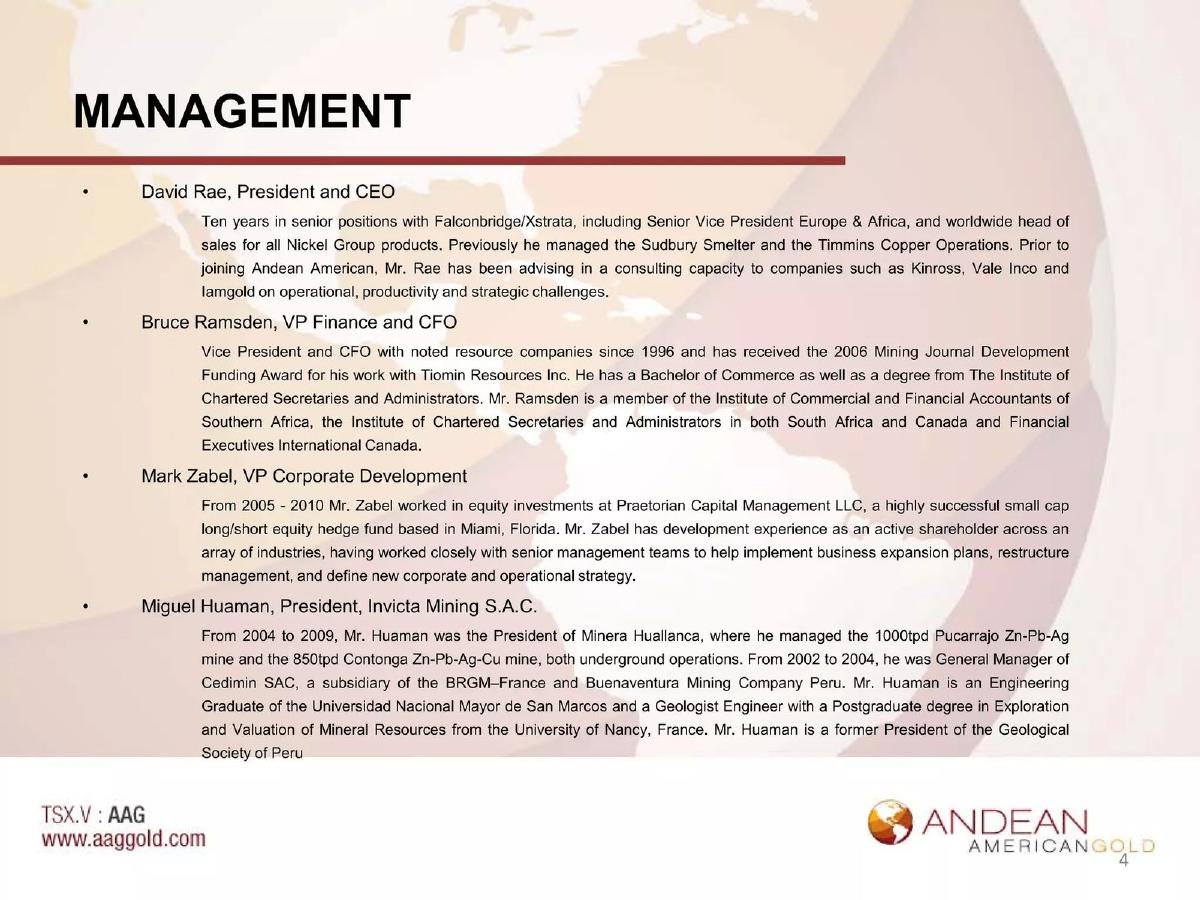
- The management team features deep institutional experience, including a CEO with ten years at Falconbridge/Xstrata and a CFO who won the 2006 Mining Journal Development Funding Award (Slide 4).
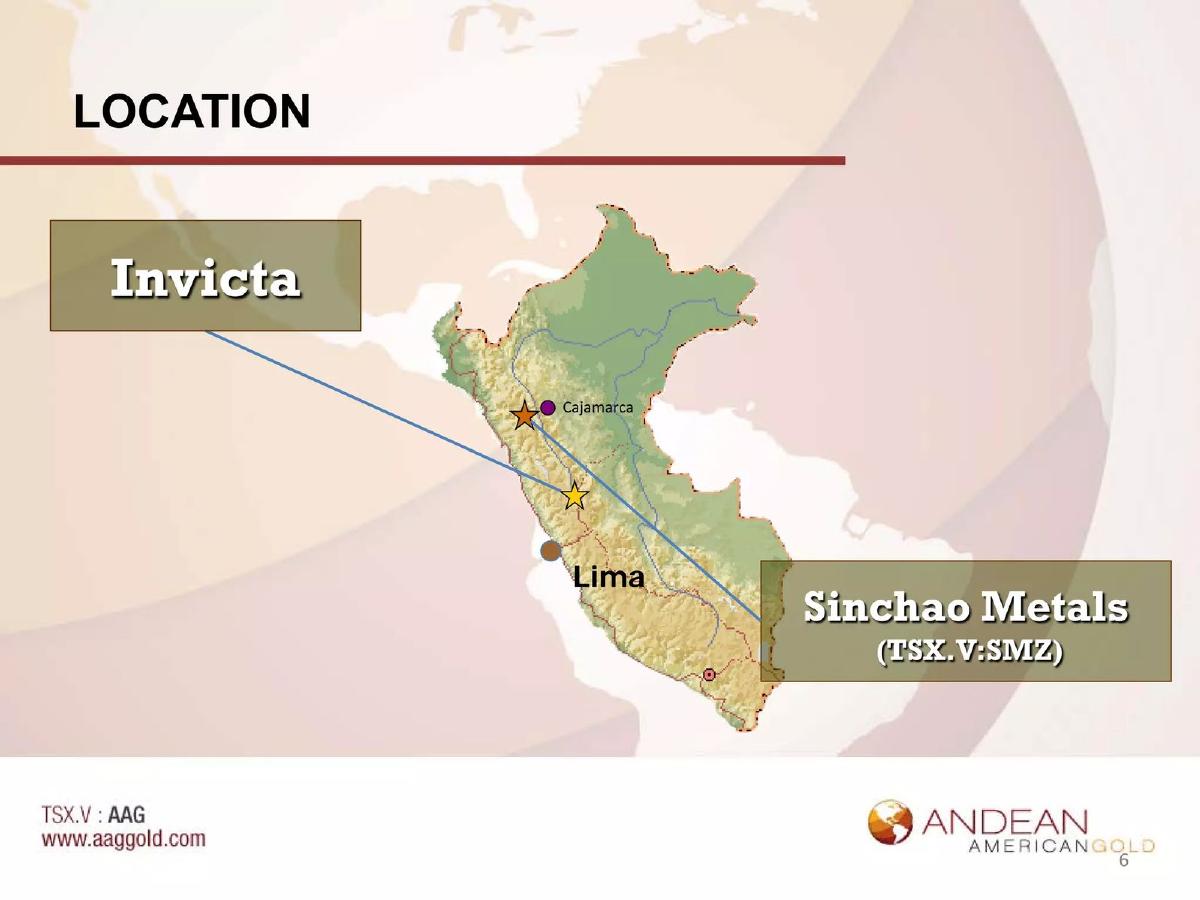
- The Invicta Project is situated in a high-density mining region in Peru, surrounded by both exploration and production projects like Mallay and Quicay (Slide 7).
- Resource estimates are granular, detailing 868,000 tonnes of measured resources with a gold grade of 2.71 g/t (Slide 10).
- The feasibility study projects an average annual production of 160,857 gold equivalent ounces over an initial 5-year mine life (Slide 16).
- Project economics are bolstered by a negative by-product cash cost of ($126.91) per ounce, assuming specific price decks for silver, copper, lead, and zinc (Slide 16).
- Strategic backing from Trafigura provides a $15M USD sub-debt facility and an option for Trafigura to underwrite project debt if other lenders fail to fund by March 31st (Slide 19).
- The company claims a massive valuation disconnect, with a market cap of $122M against estimated annual free cash flow of $65M (Slide 22).
- Environmental standards are addressed by highlighting a contained process with zero liquid effluents (Slide 16).
Executive Summary: A Technical Case for Undervaluation
The Andean American Gold pitch deck is a quintessential example of a late-stage mining exploration and development presentation. Unlike early-stage tech startups that sell a vision of a future market, this deck sells the mathematical certainty of geological reserves and the logistical feasibility of extraction. The narrative is built on three pillars: technical validation through a formal feasibility study, strategic de-risking via a partnership with a global commodities giant (Trafigura), and a financial arbitrage opportunity based on market comparables.
Slide 1: Title and Branding
The cover slide establishes the geographic focus immediately with a panoramic shot of the Andean mountains. It identifies the company as Andean American Gold and prominently displays its ticker (TSX.V : AAG) and website. This signals that the company is already public, likely pitching for a follow-on offering or project-specific debt/equity financing.
Slide 4: Management and Institutional Pedigree
Mining is a capital-intensive industry where management's track record is the primary proxy for risk. Slide 4 lists four key executives. David Rae (CEO) is highlighted for his ten-year tenure at Falconbridge/Xstrata, a major industry player. Bruce Ramsden (CFO) is credited with a 2006 Mining Journal award, providing third-party validation of his ability to secure development funding. The inclusion of Miguel Huaman, President of the local subsidiary Invicta Mining S.A.C., emphasizes local operational expertise and geological credentials from the University of Nancy, France.
Slide 7: Geographic Context and Regional Synergy
Slide 7 uses a map of Peru to show the Invicta Project's proximity to other major mines. By identifying nearby production projects like Quicay and Mallay, the company implies that the region has proven mineral wealth and existing infrastructure (roads, power, labor). The 'zoom-in' graphic identifies over a dozen exploration and production projects in the immediate vicinity, framing Invicta not as an isolated gamble, but as part of a proven mining cluster.
Slide 10: The Data Core - Reserves and Resources
This is the most critical slide for technical due diligence. It breaks down the mineral inventory into 'Measured,' 'Indicated,' and 'Inferred' categories. The table on Slide 10 lists 868,000 tonnes of measured resources with a gold grade of 2.71 g/t. It also details the 'Mineable Reserves' for the first five years, totaling 7,807,157 tonnes. By providing specific figures for silver (4.7M oz), copper (89M lb), and other metals, the company provides the raw data necessary for analysts to build their own valuation models.
Slide 13: Operational Visualization
Slide 13 provides a 3D topographical view of the Tailings, Plant, and Mine. It shows the elevation (ranging from 1100 to 3400 meters above sea level) and the layout of the main road from Choques to the plant. This slide moves the conversation from 'what is in the ground' to 'how we will get it out,' demonstrating that the physical planning of the site is well underway.
Slide 16: The Economics of the Feasibility Study
Slide 16 summarizes the financial output of the project's feasibility study. Key metrics include an average annual production of 160,857 Gold Equivalent ounces and a remarkably low by-product cash cost of ($126.91) per ounce. The slide also notes a $68M CapEx requirement and a projected 1-year payback period. The footnote is essential: it lists the commodity price assumptions used (e.g., Gold at $900/oz, Silver at $12.50/oz). These prices are conservative relative to historical peaks, which adds a layer of safety to the projections.
Slide 19: Strategic Partnership with Trafigura
To mitigate the risk of funding gaps, Slide 19 details the relationship with Trafigura, the world's 2nd largest non-ferrous trading company. The slide outlines a $15M USD sub-debt facility and an off-take agreement where Trafigura buys the base metal concentrates. The 'IF/THEN' clause is a powerful transparency tool: it explains that if project debt lenders fail to fund by March 31st, Trafigura has an option to step in, underwrite the debt, and take a 16% stake. This tells investors that the project will move forward even if the primary financing plan falters.
Slide 22: The Valuation Gap
The deck concludes its logical progression with a 'Company Comparisons' table on Slide 22. It pits Andean American against six peers like Timmins Gold and Alamos Gold. The 'Multiple of Est. Annual Free Cash Flow' column is the 'closer.' While peers trade at an average of 15.61x, Andean American is shown at 1.9x. This suggests that the market has not yet priced in the Invicta Project's potential, offering a clear entry point for value-oriented investors.
What Andean American Gold Does Well
The deck is exceptionally transparent with its data. By including the specific price deck used for calculations (Slide 16) and the exact tonnage of reserves (Slide 10), they invite scrutiny rather than hiding behind vague 'potential.' The use of a strategic partner like Trafigura (Slide 19) provides a level of institutional 'social proof' that is often missing in junior mining decks. Furthermore, the comparison slide (Slide 22) uses a specific metric—Free Cash Flow multiple—that is highly relevant to mining investors, rather than generic growth metrics.
What is Missing from the Deck
The provided slides lack a clear 'Use of Proceeds' breakdown. While the CapEx is stated as $68M, it is unclear how much of that is already raised versus how much is being sought from the audience viewing this deck. There is also no detailed timeline or 'Gantt chart' showing the path from the current state to 'first pour' of gold. While the 1-year payback is mentioned, the actual construction duration is omitted. Finally, there is no discussion of the political or social license to operate in Peru, which is a standard risk factor in modern mining presentations.
Founder's Playbook: What to Copy
Founders in capital-intensive industries should emulate the 'De-risking' slide (Slide 19). By showing a 'Plan B' (Trafigura underwriting the debt if others don't), the company removes the binary 'success or failure' risk of the fundraise. Additionally, the 'Company Comparisons' slide is a masterclass in framing valuation. Instead of just saying 'we are cheap,' they show exactly how cheap they are relative to the average of their direct competitors using a standardized financial metric. This makes the 'undervaluation' argument feel like a mathematical inevitability rather than a marketing claim.
Frequently asked questions
- What is the primary asset discussed in the Andean American Gold deck?
- The primary asset is the Invicta Project located in Peru. The deck provides extensive geological data, 3D site visualizations, and feasibility study results specifically for this location. It is positioned as being in a 'near-production' phase, surrounded by established mining operations, which serves to validate the regional infrastructure and mineral potential.
- How does the company calculate its 'negative' cash cost?
- On Slide 16, the company reports a by-product cash cost of ($126.91) US per ounce of gold. This is achieved by subtracting the revenue generated from other metals found in the mine—silver, copper, lead, and zinc—from the total cost of gold production. This accounting method suggests the secondary minerals cover all operational expenses and provide a surplus.
- What role does Trafigura play in this fundraising or operational stage?
- Trafigura acts as a strategic partner and backstop. According to Slide 19, they provide a $15M USD debt facility for overruns and have the right to buy all base metal concentrates. Crucially, they hold an option to underwrite the project debt and acquire a 16% interest if primary debt lenders do not fund the project by a specific deadline.
- What are the projected capital expenditures for the Invicta Project?
- Slide 16 estimates the total CapEx at $68M USD. This is broken down into $49M for project costs, $9M in refundable taxes (IGV), $7M in contingency funds, and a $3M startup facility. The deck highlights a 1-year payback period, which is exceptionally fast for industrial mining projects.
- How does Andean American Gold justify its valuation to investors?
- The company uses a 'Company Comparisons' table on Slide 22. It lists six competitors with an average market cap of $729M and an average cash flow multiple of 15.61x. Andean American Gold contrasts this with its own $122M market cap and 1.9x multiple, suggesting the stock is significantly undervalued relative to its production potential.