Andean American Gold (TSX.V: AAG) presents a highly technical investor deck focused on the Invicta mining project in Peru. The presentation serves as a progress report and capital solicitation, emphasizing the project's economic viability through a formal feasibility study. Key highlights include a projected average annual production of 160,857 Gold Equivalent ounces and a remarkably short 1-year payback period. The deck leans heavily on the credibility of its management team, who boast decades of experience at major firms like Falconbridge and Placer Dome, and its strategic alliance with Tra…
Key takeaways
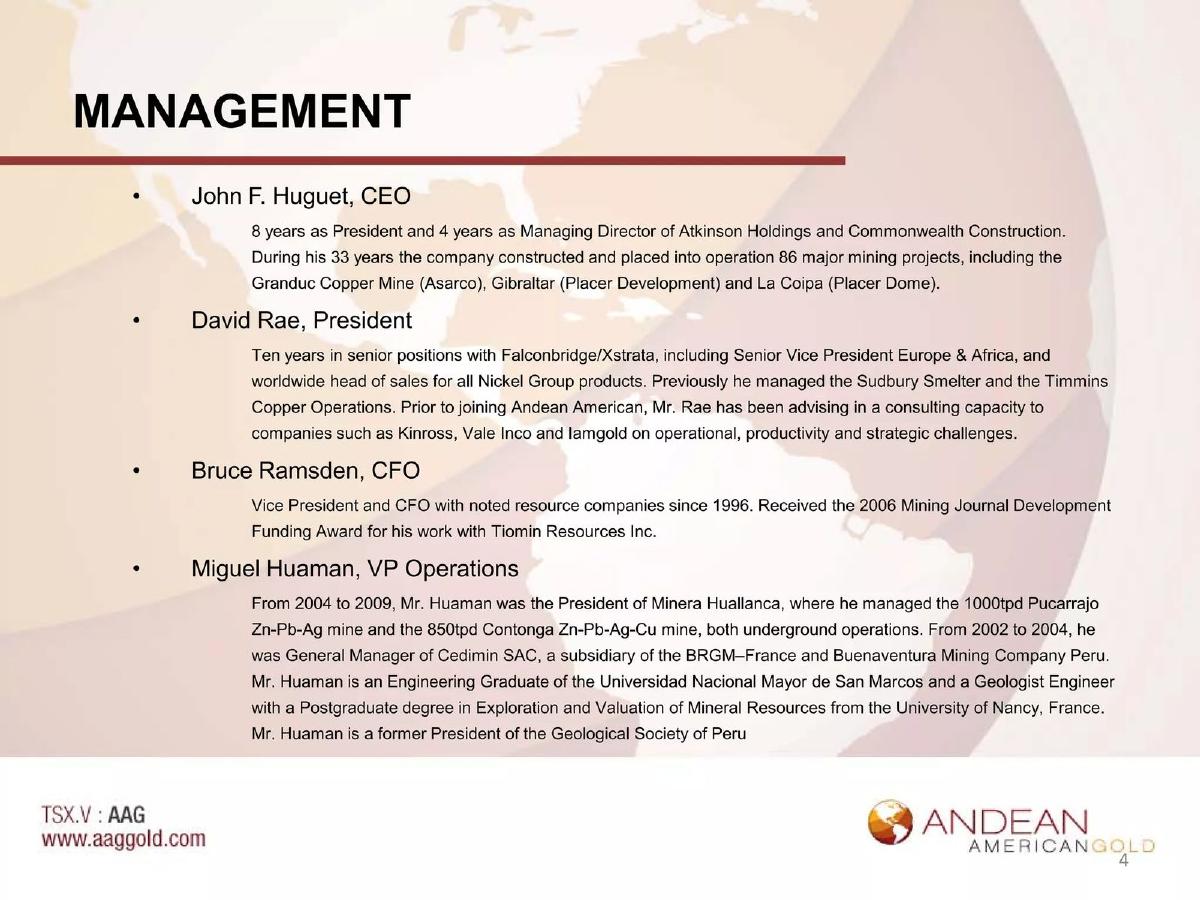
- The management team features senior leaders with experience at major mining entities including Falconbridge/Xstrata, Placer Dome, and Asarco (Slide 4).
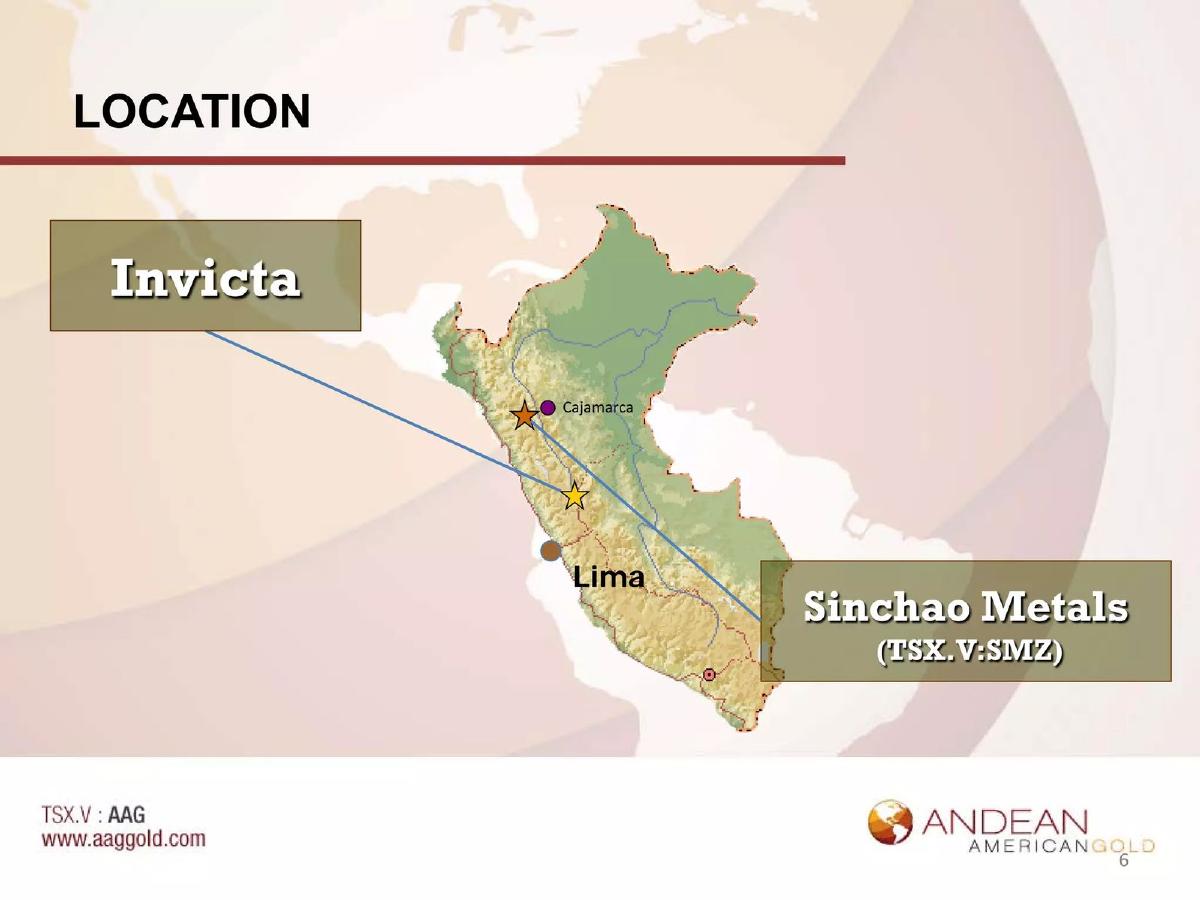
- The Invicta project is situated in a dense mining region in Peru, surrounded by numerous active production and exploration projects (Slide 7).
- Total measured and indicated resources are reported at over 10.7 million tonnes, containing approximately 708,000 ounces of gold (Slide 10).
- A feasibility study projects an initial mine life of 5 years with a CapEx requirement of $68M (Slide 16).
- The project claims a 1-year payback period and zero liquid effluents, surpassing Peruvian environmental standards (Slide 16).
- Trafigura provides a $15M USD sub-debt facility and holds the rights to buy all base metal concentrates from the project (Slide 19).
- Strategic catalysts include the appointment of Barclays Capital and WestLB as debt arrangers and a $3M private placement with Trafigura (Slide 22).
- Operational costs are estimated at $28.31 US per tonne, with cash costs per ounce of gold as low as ($126.91) on a by-product basis (Slide 16).
Andean American Gold: A Technical Deep Dive into the Invicta Project
The pitch deck for Andean American Gold (TSX.V: AAG) is a classic example of a resource-sector presentation. It moves quickly past the abstract "vision" slides common in tech and dives immediately into the three pillars of mining investment: management experience, geological data, and project economics. The deck is structured to satisfy the due diligence requirements of institutional investors and mining analysts, providing specific tonnage, grade, and cost figures that allow for independent modeling.
Slide 1: Title and Branding
The cover slide establishes the company's identity with a high-resolution landscape photo of the Andean mountains, immediately signaling the geographic focus. It prominently displays the company name, Andean American Gold, and its ticker symbol, TSX.V: AAG. The inclusion of the website URL and a clear, professional logo sets a corporate tone suitable for a publicly traded entity.
Slide 4: Management Team
In the mining industry, the "jockey" is often as important as the "horse." Slide 4 lists a management team with deep pedigree. CEO John F. Huguet is credited with 33 years of experience and the construction of 86 major mining projects, including work for industry giants like Asarco and Placer Dome. President David Rae brings ten years of experience from Falconbridge/Xstrata, specifically in nickel sales and smelter management. The inclusion of CFO Bruce Ramsden, an award-winning finance professional, and VP Operations Miguel Huaman, a former President of the Geological Society of Peru, rounds out a team that covers engineering, finance, and local regulatory navigation. The level of detail here—citing specific mines like Granduc and La Coipa—is intended to build immediate technical credibility.
Slide 7: Geographic Context and Regional Activity
Mining projects do not exist in a vacuum. Slide 7 uses a map of Peru to show the Invicta project's location relative to other major mines. The slide identifies numerous "Production projects" (yellow circles) and "Exploration projects" (red triangles) in the immediate vicinity, such as Uchucchacua, Mallay, and Atacocha. By showing that Invicta is located in a proven, active mining district, the company reduces the perceived "jurisdictional risk" and implies the presence of existing infrastructure and a skilled local workforce.
Slide 10: Reserves and Resources
This is the core technical slide of the deck. It breaks down the mineral inventory into three standard categories: Measured, Indicated, and Inferred. The table on Slide 10 shows 868,000 tonnes of Measured resources and 9,866,735 tonnes of Indicated resources. Crucially, it provides the "grade" for multiple metals: Gold (g/t), Silver (g/t), Copper (%), Lead (%), and Zinc (%). The second table details the "Mineable Reserves" for the first five years, totaling 7,807,157 tonnes. Providing these exact figures allows investors to calculate the "in-situ" value of the deposit and compare it to the company's market capitalization.
Slide 13: 3D Site Visualization
Slide 13 provides a 3D topographical model of the project site. It labels the specific locations for the Mine, the Concentrate Plant, the Tailings area, and the main access road. This visualization is important for demonstrating that the company has moved beyond theoretical exploration and into the site planning phase. It shows a clear understanding of the physical footprint required for operations, which is a prerequisite for the environmental and construction permits mentioned later in the deck.
Slide 16: Feasibility Study and Economics
Slide 16 presents the financial justification for the project. It outlines an average annual production of 160,857 Gold Equivalent ounces over an initial 5-year life. The economics are compelling: a $68M CapEx requirement paired with a projected 1-year payback period. The slide also breaks down the cash costs, showing a by-product basis cost of ($126.91) per ounce, which suggests that the sale of silver, copper, lead, and zinc could potentially cover the entire cost of gold production. The slide also notes that the project has "zero liquid effluents," a key selling point for ESG-conscious investors and local regulators.
Slide 19: The Trafigura Relationship
Strategic partnerships are a major de-risking factor. Slide 19 details the relationship with Trafigura, a global commodities giant with $47.3 billion in sales in 2009. The agreement includes a $15M sub-debt facility and an off-take agreement where Trafigura buys all base metal concentrates. The slide also describes a "backstop" option where Trafigura can underwrite the project debt if other lenders fail to materialize. This relationship provides Andean American Gold with both financial liquidity and a guaranteed buyer for its product, significantly lowering the project's commercial risk profile.
Slide 22: Recent Catalysts
The final slide in this selection summarizes the momentum generated over the last eight months. It lists operational milestones, such as the Environmental Impact Assessment approval and key hires, alongside strategic milestones like the appointment of Barclays Capital and WestLB as debt arrangers. This slide serves to show that the company is executing on its plan and that the project is moving steadily toward production. It creates a sense of urgency for investors to participate before the next set of milestones potentially re-rates the stock price.
What Works in This Deck
The deck is exceptionally transparent with its data. By providing the full grade and tonnage tables on Slide 10 and the specific CapEx breakdown on Slide 16, the company avoids the vagueness that often plagues early-stage mining pitches. The focus on a 1-year payback period is a powerful hook for capital-intensive projects. Furthermore, the emphasis on the Trafigura relationship serves as a massive "social proof" signal; if a multi-billion dollar trading house is willing to provide debt and sign off-take agreements, it suggests the project has passed rigorous external due diligence.
What Is Missing
While the technical data is strong, the deck (in the provided slides) lacks a clear "Ask" slide. It mentions debt arrangers and private placements, but it does not explicitly state how much equity capital is currently being sought or the specific valuation terms. There is also no detailed timeline or Gantt chart showing the path from the current state to "first pour" of gold. While the 3D view is helpful, more information on the current state of infrastructure (roads, power, water access) would strengthen the operational case. Finally, a slide discussing the specific political climate in Peru at the time would help address potential macro-level investor concerns.
What a Founder Should Copy
Founders in capital-intensive industries should emulate the way this deck uses "Strategic Catalysts" (Slide 22) to show momentum. Instead of just listing goals, they list completed actions. The use of a "Relationship" slide (Slide 19) to highlight a major industry partner is also a best practice; it shows that the startup is integrated into the existing value chain. Finally, the use of industry-standard reporting (Measured/Indicated/Inferred resources) is non-negotiable for mining, but the lesson for all founders is to use the specific metrics and terminology that their specific investor class expects to see.
Frequently asked questions
- What is the primary asset discussed in the deck?
- The primary asset is the Invicta project located in Peru. The deck provides a 3D view of the tailings, plant, and mine site, and details the mineral reserves including gold, silver, copper, lead, and zinc. It is positioned as a near-term production asset with a completed feasibility study and environmental approvals already in place.
- How does the company plan to fund the $68M CapEx?
- The deck outlines a multi-pronged funding strategy. This includes a $15M USD sub-debt facility from Trafigura for cost overruns and working capital. Additionally, the company has appointed Barclays Capital and WestLB as debt arrangers to secure the primary project debt, with Trafigura holding an option to underwrite the debt if other lenders fail to fund it by a specific deadline.
- What are the projected economics of the Invicta mine?
- According to Slide 16, the mine is expected to produce an average of 160,857 Gold Equivalent ounces annually over a 5-year initial life. The cash cost per ounce on a gold-equivalent basis is $274.80 USD. Most notably, the company projects a 1-year payback period on the $68M initial investment, based on specific metal price assumptions including $900/oz gold.
- What role does Trafigura play in this venture?
- Trafigura is a strategic partner and financier. They have provided a $3M private placement and a $15M sub-debt facility. In exchange, they have the right to purchase all base metal concentrates from the Invicta project. They also have an option to increase their equity stake by 16% and name two directors to the board under certain debt-funding conditions.
- What recent milestones has the company achieved?
- In the eight months prior to the deck's publication, the company received Environmental Impact Assessment approval, completed an optimized feasibility study audit, and filled key executive roles including President, CFO, and VP Operations. They also initiated the strategic relationship with Trafigura and appointed major international banks as debt arrangers.