Abatable raised $3M in 2021 with a 12-slide deck that focuses heavily on the 'Institutionalization' of the voluntary carbon market. Rather than selling to generic corporate sustainability departments, Abatable targets asset managers—a segment with high margins and low price sensitivity. The deck relies on the founders' deep pedigree at Goldman Sachs, Google, and Monzo to establish immediate credibility in a market often plagued by quality concerns. By quantifying the opportunity as a $5B annual market from Net Zero Asset Managers alone and demonstrating a secured supply of 6.3 million tCO2e,…
Key takeaways
- The company positions itself as a 'Robo-advisor for high quality carbon offsetting' on Slide 1, immediately signaling a fintech approach to climate.
- Founder Maria Eugenia Filmanovic brings direct domain expertise as a former VP at Goldman Sachs in ESG and Impact Investing (Slide 2).
- The deck identifies a specific 'reputational liability' in cheap avoidance credits, citing Bloomberg and Guardian reports to validate the problem (Slide 3).
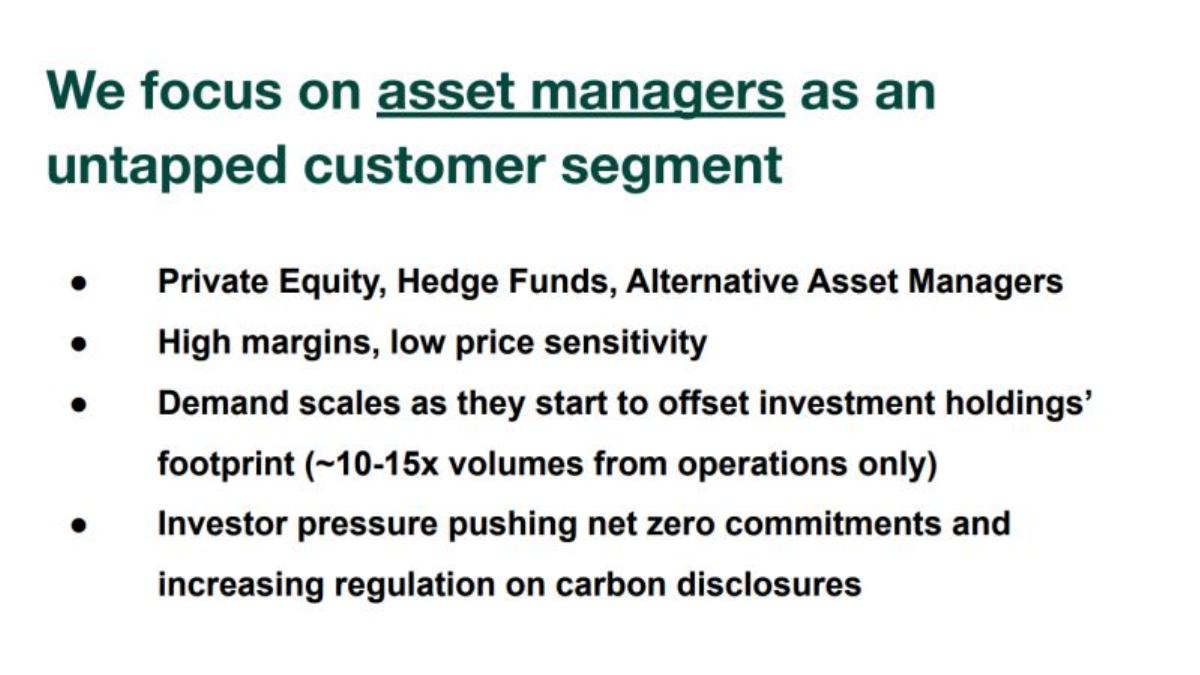
- Abatable targets asset managers specifically, noting they have 10-15x the volume requirements of standard operations (Slide 6).
- The total addressable market is anchored to the $43T in Assets under Management (AuM) committed to net zero (Slide 7).
- The 'Annual market opportunity' is specifically calculated at $5B for the Net Zero Asset Manager segment (Slide 8).
- Traction is demonstrated through a single, powerful metric: 6,300,000 tCO2e of credit supply already secured (Slide 9).
- The deck omits a traditional 'Ask' slide or detailed financial projections, focusing instead on the strategic 'Why Now' and 'Why Us'.
The Strategy of Institutional Carbon Procurement
Abatable’s 2021 seed deck arrived at a pivotal moment for the voluntary carbon market (VCM). As corporations and investment firms rushed to make 'Net Zero' pledges, the supply of high-quality, verifiable carbon offsets became a critical bottleneck. Abatable’s deck doesn't just pitch a software tool; it pitches a financial layer for a maturing asset class. By using the term 'Robo-advisor,' they immediately speak the language of their target customer: the asset manager.
Slide 1: The Hook
The cover slide is minimalist, featuring the Abatable logo and the tagline: "Robo-advisor for high quality carbon offsetting." This is a sophisticated positioning move. It moves the conversation away from 'charity' or 'compliance' and into the realm of 'wealth management' and 'automated expertise.' It suggests that carbon is an asset that needs to be managed, diversified, and optimized.
Slide 2: The Pedigree (Team)
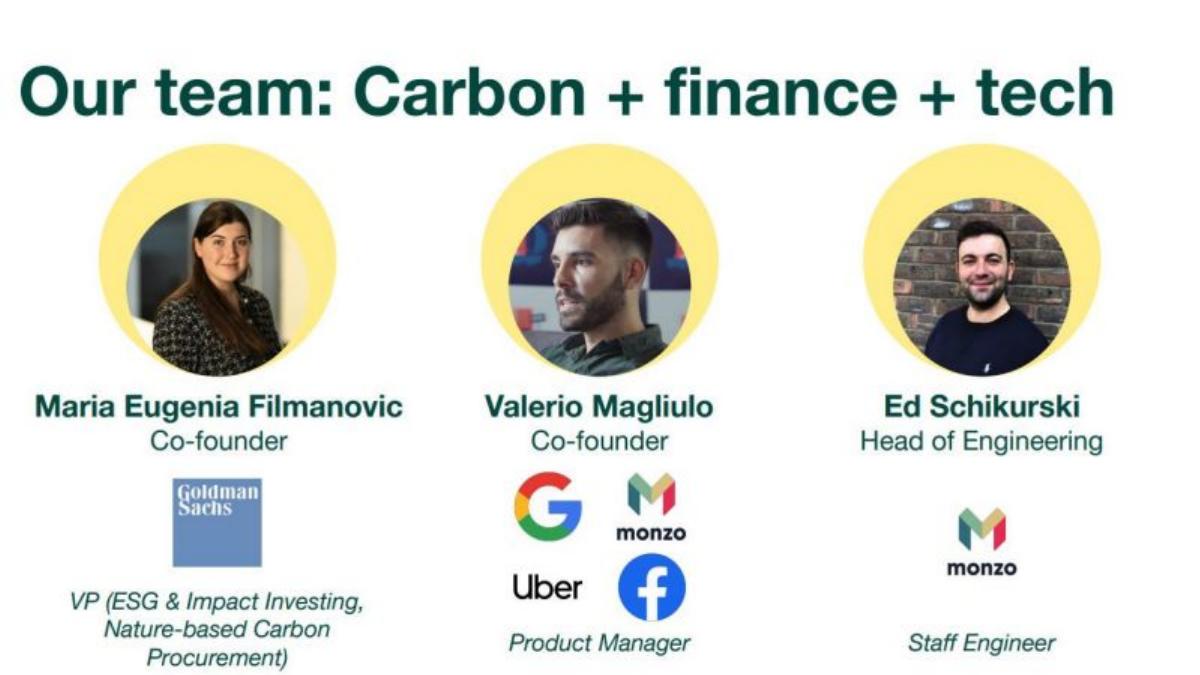
Placing the team slide second is a common tactic for founders with 'blue-chip' backgrounds. Maria Eugenia Filmanovic is highlighted as a former VP at Goldman Sachs specializing in ESG and Nature-based Carbon Procurement. This is the definition of founder-market fit. Valerio Magliulo brings product experience from Google, Uber, Monzo, and Facebook , while Ed Schikurski adds engineering depth from Monzo . The message is clear: we have the institutional finance knowledge to understand the buyer and the tech chops to build the platform.
Slide 3: The Reputational Crisis (Problem)
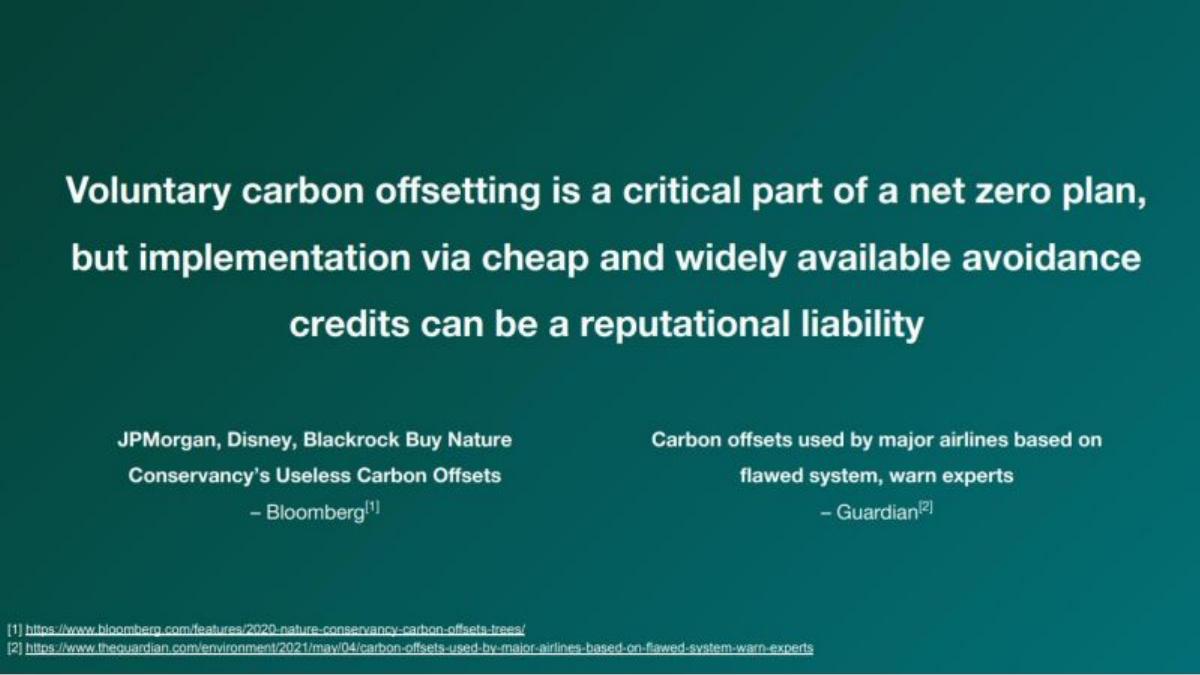
Slide 3 identifies the core pain point: "Voluntary carbon offsetting is a critical part of a net zero plan, but implementation via cheap and widely available avoidance credits can be a reputational liability." By citing Bloomberg and Guardian headlines about JPMorgan, Disney, and Blackrock buying 'useless' offsets, the deck creates a 'fear' factor. It suggests that doing carbon offsets poorly is worse than not doing them at all, creating a need for a trusted intermediary.
Slide 4: The Supply Gap
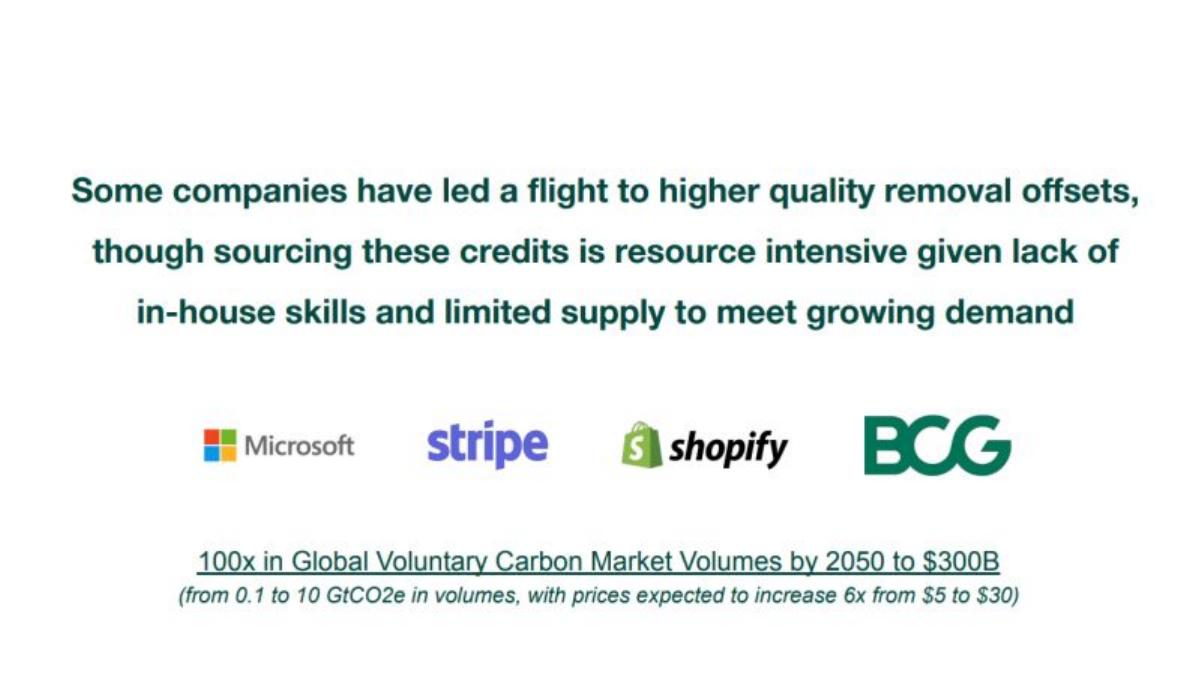
This slide highlights that leaders like Microsoft, Stripe, Shopify, and BCG are already moving toward high-quality removal offsets. However, it notes that sourcing these is "resource intensive given lack of in-house skills and limited supply." The slide includes a massive market projection: "100x in Global Voluntary Carbon Market Volumes by 2050 to $300B." This sets the stage for Abatable to act as the bridge between this massive demand and the scarce supply.
Slide 5: The Solution
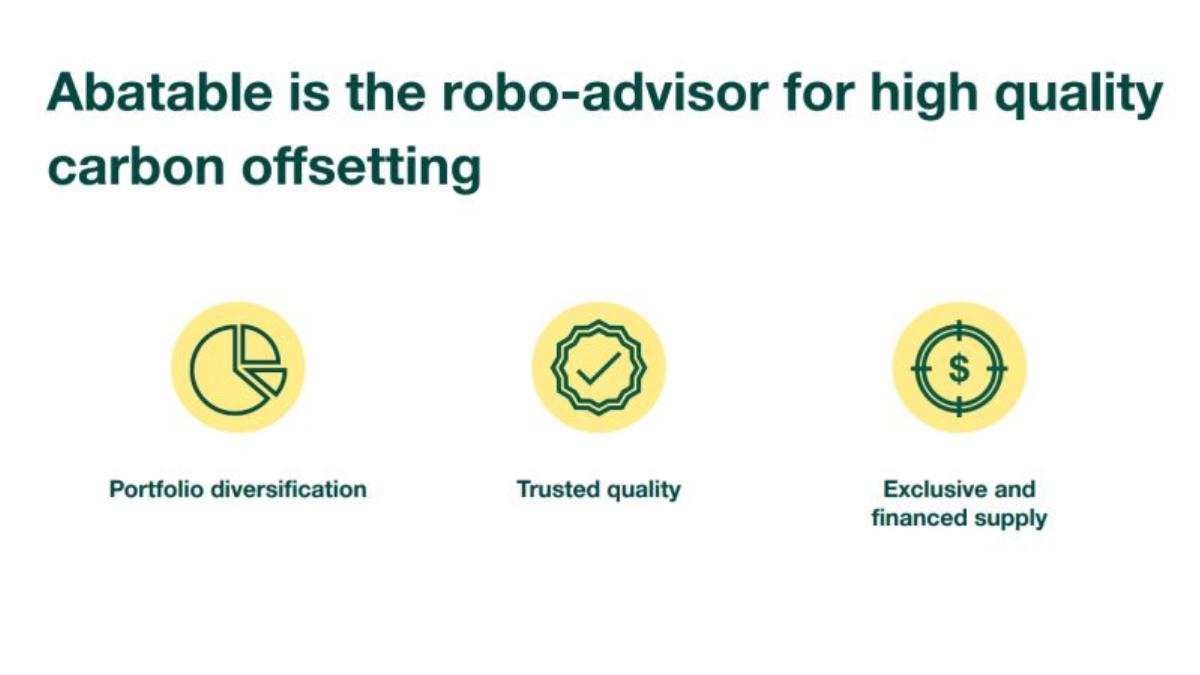
Abatable defines its role through three icons: Portfolio diversification, Trusted quality, and Exclusive and financed supply. This is the first time we see the 'how.' They aren't just a marketplace; they are helping developers secure financing to create more supply, which in turn gives Abatable's customers exclusive access. This 'financed supply' model is a key differentiator from simple listing sites.
Slide 6: The Customer Segment
Slide 6 is perhaps the most important strategic slide in the deck. It explicitly states: "We focus on asset managers as an untapped customer segment." It lists Private Equity, Hedge Funds, and Alternative Asset Managers. The logic is sound: these firms have "10-15x volumes" compared to their own operations because they eventually have to offset their entire portfolio's footprint. This is a much larger and more lucrative 'whale' to hunt than individual SMEs.
Slide 7 & 8: Quantifying the TAM
Slide 7 points to $43T in Assets under Management committed to net zero across 128 signatories, including giants like BlackRock, UBS, and Vanguard. Slide 8 then narrows this down to a "$5B annual market opportunity from Net Zero Asset Managers only." By being specific about which slice of the market they are attacking first, the founders make the $5B number feel attainable rather than speculative.
Slide 9: The Traction Metric
Traction slides in seed decks can often be messy. Abatable keeps it simple with one giant number: "6,300,000 tCO2e supply of credits already secured." In a market defined by supply scarcity, showing that you have already locked down over 6 million tonnes of inventory is the ultimate proof of execution. It proves the founders can use their Goldman-era networks to actually get deals done.
Slide 10: The Summary
The deck concludes with a summary of the four key pillars: the robo-advisor model, the experienced team, the finance solutions for developers, and the $5B immediate opportunity. It’s a clean wrap-up that reinforces the 'fintech' nature of the business.
Slide 11 & 12: The Close
The final slides are a 'Thank You' with founder names and a placeholder for further reading. Notably, there is no 'Ask' slide in this version of the deck. While the catalogue facts state they raised $3M, the deck itself does not specify the amount, the valuation, or the use of proceeds. This is common in decks shared publicly after a round, but in a live pitch, this would be a significant omission.
What Abatable Does Well
Strategic Narrowing: Most carbon startups try to sell to everyone. Abatable’s focus on Asset Managers is a brilliant move that targets the highest-value, most sophisticated buyers first. · Credibility Transfer: They use the logos of Goldman Sachs, Google, and BlackRock to transfer institutional trust to their young startup. In a market where 'trust' is the primary product, this is essential. · Supply-Side Focus: They recognize that the problem isn't just finding buyers; it's finding (and creating) quality supply. Mentioning 'financed supply' suggests a deeper moat than a simple software dashboard.
What is Missing
Product Visuals: There are zero screenshots of the 'Robo-advisor' in action. We don't know if this is a complex terminal, a simple web app, or a manual consultancy service disguised as software. · Business Model: The deck mentions 'high margins' for the customer segment but doesn't explain how Abatable makes money. Is it a SaaS fee? A transaction commission? A spread on the financed supply? · Competition: The deck ignores other carbon marketplaces and procurement platforms. Investors would likely ask how they differ from players like Patch or South Pole.
What Founders Should Copy
The 'Why Now' Slide: Slide 3 is a perfect example of using external 'bad news' (reputational liability) to create a market necessity for your 'good news' solution. · The Single Traction Metric: If you have one massive, impressive number, give it its own slide. Don't bury 6.3 million tonnes of supply in a bulleted list. · The Segment Logic: Don't just say 'our market is huge.' Explain why your specific sub-segment (Asset Managers) is better than the rest of the market (higher volume, lower price sensitivity).
Frequently asked questions
- What is Abatable's core value proposition?
- Abatable positions itself as a 'robo-advisor' for the voluntary carbon market. According to Slide 5, their value lies in three pillars: portfolio diversification, trusted quality, and providing exclusive/financed supply. They aim to help institutional buyers navigate the complexity of sourcing high-quality carbon removal offsets without needing to build massive in-house teams.
- Who is the primary target customer for Abatable?
- Unlike many carbon startups that target general corporations, Abatable focuses on asset managers, including Private Equity, Hedge Funds, and Alternative Asset Managers. Slide 6 highlights that these customers have high margins, low price sensitivity, and massive demand scales as they offset the footprints of their entire investment holdings.
- How does the deck address the issue of 'greenwashing'?
- The deck addresses this head-on in Slide 3 by labeling cheap avoidance credits a 'reputational liability.' It uses negative press examples from Bloomberg and The Guardian regarding 'useless' offsets to create a sense of urgency for a solution that ensures 'trusted quality,' which Abatable claims to provide.
- What evidence of traction does the deck provide?
- The primary evidence of traction is found on Slide 9, which states that Abatable has already secured a supply of 6,300,000 tCO2e (tonnes of carbon dioxide equivalent) in credits. This demonstrates their ability to solve the supply-side bottleneck mentioned earlier in the deck.
- What is missing from the Abatable pitch deck?
- The deck is missing several standard venture components: a detailed product walkthrough or UI screenshots, a competitive landscape matrix, a specific 'Ask' slide detailing how the $3M will be spent, and a multi-year financial forecast. It relies almost entirely on the strength of the market opportunity and the team's background.