Ably’s 2021 Series B pitch deck is a sophisticated presentation that balances market-level shifts with deep technical credibility. Raising $70M in a round led by Insight Partners and Dawn Capital, the company positioned itself not just as a tool, but as the 'realtime data fabric' for a world where 30% of global data will be realtime by 2025. The deck avoids the typical 'problem/solution' clichés of early-stage startups, instead opting for a 'business update and outlook' format that emphasizes architectural pillars like dependability and integrity. While it lacks traditional team and competiti…
Key takeaways
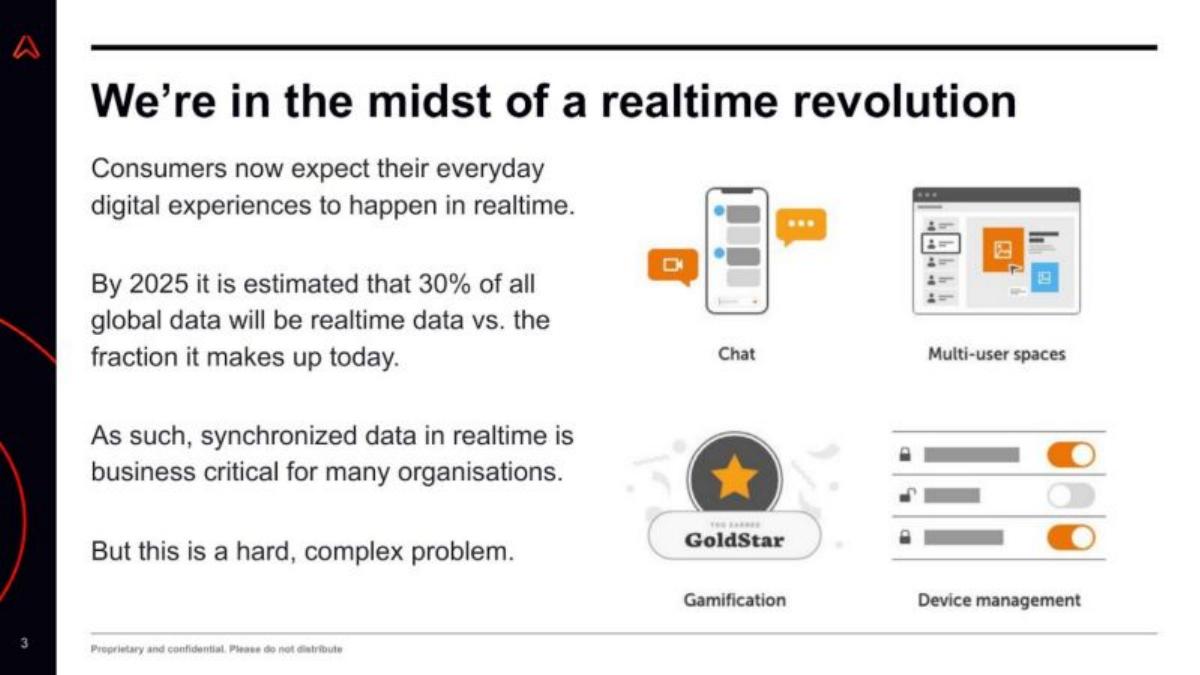
- The deck projects that 30% of all global data will be realtime by 2025, establishing a massive market tailwind (Slide 3).
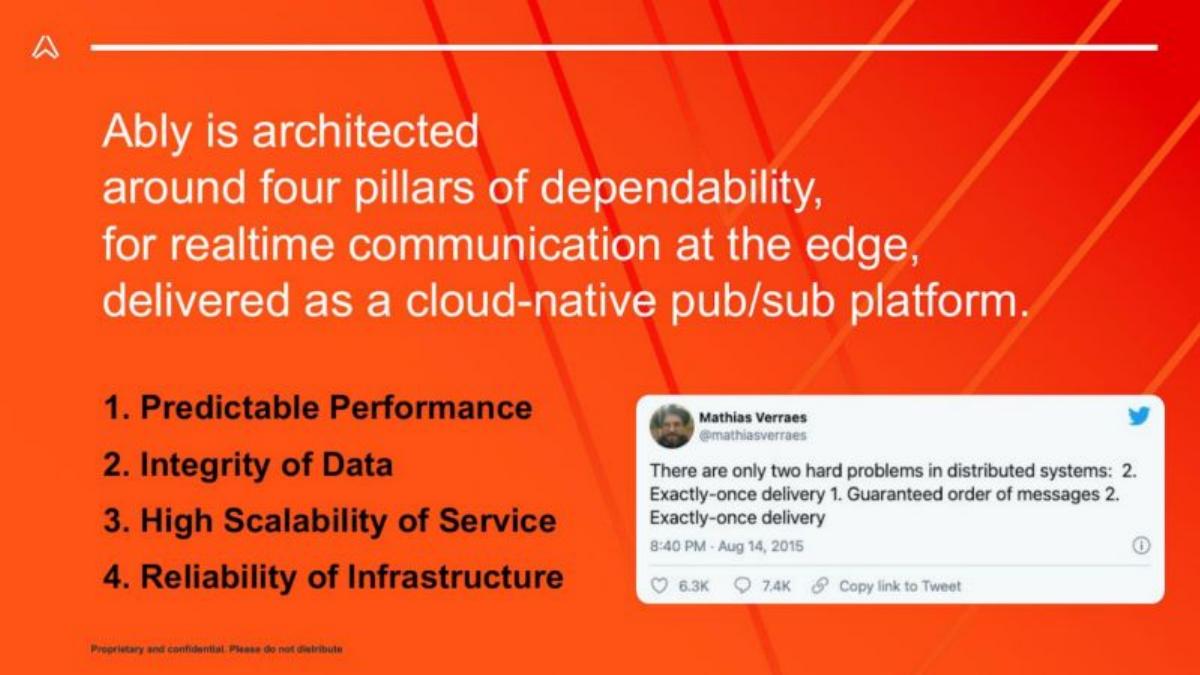
- Ably defines its value proposition through four pillars: Predictable Performance, Integrity of Data, High Scalability, and Reliability (Slide 5).
- The company positions itself as an 'enterprise realtime communication platform' specifically for live experiences like driver tracking and IoT (Slide 7).
- The deck introduces the concept of the 'decade of distribution' to justify the shift toward edge computing and local-first development (Slide 16).
- Ably sets an ambitious long-term goal of powering realtime experiences for a billion people each month (Slide 18).
- Technical credibility is established through detailed architectural diagrams and lists of supported protocols like WebSockets, MQTT, and SSE (Slides 22-23).
- The presentation omits a traditional team slide, financial projections, and a specific use-of-funds breakdown in the provided sequence.
- The deck uses a 'Business update & outlook' framing rather than a standard pitch, reflecting its Series B maturity (Slide 1).
The Narrative of Infrastructure Maturity
Ably’s Series B deck is a departure from the frantic, high-energy pitches of the Seed and Series A stages. By 2021, Ably was no longer proving that realtime data was a 'nice to have' feature; they were arguing that it had become the very foundation of the modern digital economy. The deck, titled Business update & outlook on Slide 1, carries the tone of a market leader briefing its partners rather than a startup begging for a check.
Slides 1-3: Setting the Macro Stage
The presentation opens with a clear temporal marker: '2020 saw our vision rapidly materialise.' On Slide 2, the company makes a bold claim that 'Realtime is no longer an add-on.' This is a classic 'Why Now' slide that leverages the global shift toward digital-first interactions during the pandemic. Slide 3 provides the quantitative weight for this claim, stating that by 2025 it is estimated that 30% of all global data will be realtime data . By citing specific use cases like Chat, Multi-user spaces, Gamification, and Device management, Ably grounds a high-level technical concept in recognizable consumer experiences.
Slides 4-7: Defining the Problem and the Pillars
Slide 4, titled THE PROBLEM SPACE , differentiates Ably from first-generation realtime tools. It argues that while many solutions exist for 'simple low-latency realtime updates,' the next wave of applications requires something more robust. They list four developer needs: Dependability, Scalability, Proximity, and Simplicity. This leads directly into Slide 5, where Ably introduces its four pillars of dependability : Predictable Performance, Integrity of Data, High Scalability of Service, and Reliability of Infrastructure. This slide is notable for including a tweet from 2015 about the 'two hard problems in distributed systems,' which serves as a subtle nod to the technical community and reinforces the difficulty of what Ably has built.
Slide 6 and 7 pivot to business value. Slide 6 claims the platform 'removes the user experience and brand risk' associated with realtime requirements, while Slide 7 explicitly defines Ably as an enterprise realtime communication platform . It lists specific high-stakes applications: driver tracking on maps, IoT device communication, and business-critical chat. This is a crucial transition from 'what we are' to 'what we enable.'
Slides 15-18: The Decade of Distribution
After a transition slide (Slide 15), the deck enters its visionary phase. Slide 16 introduces the decade of distribution . It outlines a shift toward local-first development and data processed at the edge, arguing that a 'centralized single source of truth' is becoming impractical. This is a sophisticated argument that positions Ably as the solution to a fundamental architectural shift in the way the internet works. Slide 17 summarizes this by calling Ably the realtime data fabric . The section concludes on Slide 18 with a massive North Star metric: 'Next stop. Realtime experiences for a billion people each month.'
Slides 20-23: Technical Proof and Appendices
The deck concludes with a series of technical appendices that would likely be used during the Q&A or due diligence phase. Slide 21 provides a detailed breakdown of the Platform offering , including Pub/Sub messaging, Integrations, Push Notifications, and Streaming data sources. Slide 22 shows a complex platform architecture diagram, illustrating how data flows between devices and data centers. Finally, Slide 23 lists the ecosystems we support , including protocols like WebSockets, MQTT, and SSE, as well as third-party integrations like AWS Lambda, Zapier, and RabbitMQ. This level of detail is designed to satisfy the 'how' for a technical investor after the previous slides have sold the 'why.'
What Ably Does Exceptionally Well
1. Market Sizing via Trend Analysis: Instead of a traditional TAM/SAM/SOM slide, Ably uses the '30% of all data will be realtime' stat to imply a market that is not just large, but inevitable. This is often more effective for infrastructure companies where the total addressable market is effectively 'everyone with a server.'
2. Defining the 'Hard' Problem: By referencing the 'two hard problems in distributed systems' (Slide 5), Ably creates a moat. They aren't just selling a API; they are selling a solution to a problem that is notoriously difficult for even the best engineering teams to solve in-house.
3. Use Case Versatility: The deck manages to mention everything from driver tracking to gamification. This demonstrates that their 'data fabric' is horizontal, meaning their growth isn't tied to the success of a single industry.
What is Missing from the Ably Deck
1. Team Slide: In the provided 17 slides, there is no team slide detailing the backgrounds of the founders or key engineering leadership. While the catalogue facts mention Matthew O'Riordan, a Series B investor would typically want to see the 'who' behind the 'what,' especially for a deep-tech company.
2. Competition: There is no direct competitive matrix. While Slide 23 mentions compatibility with Pusher and PubNub, it doesn't explain why Ably wins against them in a head-to-head enterprise bake-off.
3. Financials and Unit Economics: The deck is remarkably light on business metrics. There is no mention of ARR (Annual Recurring Revenue), NRR (Net Revenue Retention), or customer acquisition costs. For a Series B, these are usually mandatory. It is possible these were included in a separate 'Data Room' or a more sensitive version of the deck.
4. The 'Ask': There is no slide stating how much money they are raising or what they intend to do with it. While we know from the catalogue facts that they raised $70M, the deck itself remains focused on the vision and the product rather than the transaction.
Lessons for Founders
Sell the Shift, Not the Tool: Ably doesn't just sell a pub/sub API; they sell the 'decade of distribution.' If you are building infrastructure, you must convince investors that the world is moving in a direction that makes your product a necessity, not a luxury.
Use Appendices for Depth: Keep the main narrative clean and visionary, but include the 'scary' technical diagrams in the back. This allows you to control the pace of the meeting while having the proof ready when a technical partner starts digging.
Own the 'Hard' Parts: If your product solves a problem that is technically difficult, lean into that difficulty. Use it to explain your moat. Ably's focus on 'integrity' and 'dependability' is a direct challenge to cheaper, less reliable competitors.
Frequently asked questions
- How much did Ably raise with this deck?
- According to the catalogue facts, Ably raised $70M in a Series B round in 2021. The deck itself is titled as a 'Business update & outlook' from February 2021, which served as the foundational narrative for this significant capital injection.
- What is Ably's core product according to the slides?
- Ably describes itself as a 'cloud-native pub/sub platform' and an 'enterprise realtime communication platform.' As stated on Slide 7, it is designed to build, deliver, and scale live experiences, removing the need for companies to manage complex internal infrastructure.
- Does the deck include a competitor analysis?
- No, the main deck does not have a dedicated competitor slide. However, Slide 23 mentions that the platform is 'Pusher compatible' and 'PubNub compatible,' which subtly acknowledges the existing market landscape while positioning Ably as a more flexible or advanced alternative.
- What market trends does Ably highlight?
- Ably focuses on the 'realtime revolution' and the 'decade of distribution.' Slide 3 notes that consumers expect digital experiences in realtime, and Slide 16 highlights the shift toward local-first development and data processed at the edge as centralized systems become impractical.
- Who is the target audience for this deck?
- The deck is clearly aimed at sophisticated institutional investors. The inclusion of deep technical appendices (Slides 21-23) covering architecture and protocol support suggests that Ably expects investors to perform rigorous technical due diligence on their infrastructure.