Careerist’s 2023 pitch deck is a textbook example of how to lead with overwhelming traction. Positioned as an 'Ed-Fintech' platform, the company addresses the broken job market by financing, training, and placing junior to mid-level tech talent. The deck highlights a meteoric rise from $0.4M in 2019 to a projected $25M+ in 2023, all while maintaining profitability with a $500K monthly EBITDA. By combining an automated learning marketplace with proprietary job application software and in-house financing (loans and deferred tuition), Careerist has built a high-LTV engine. The deck’s strength li…
Key takeaways
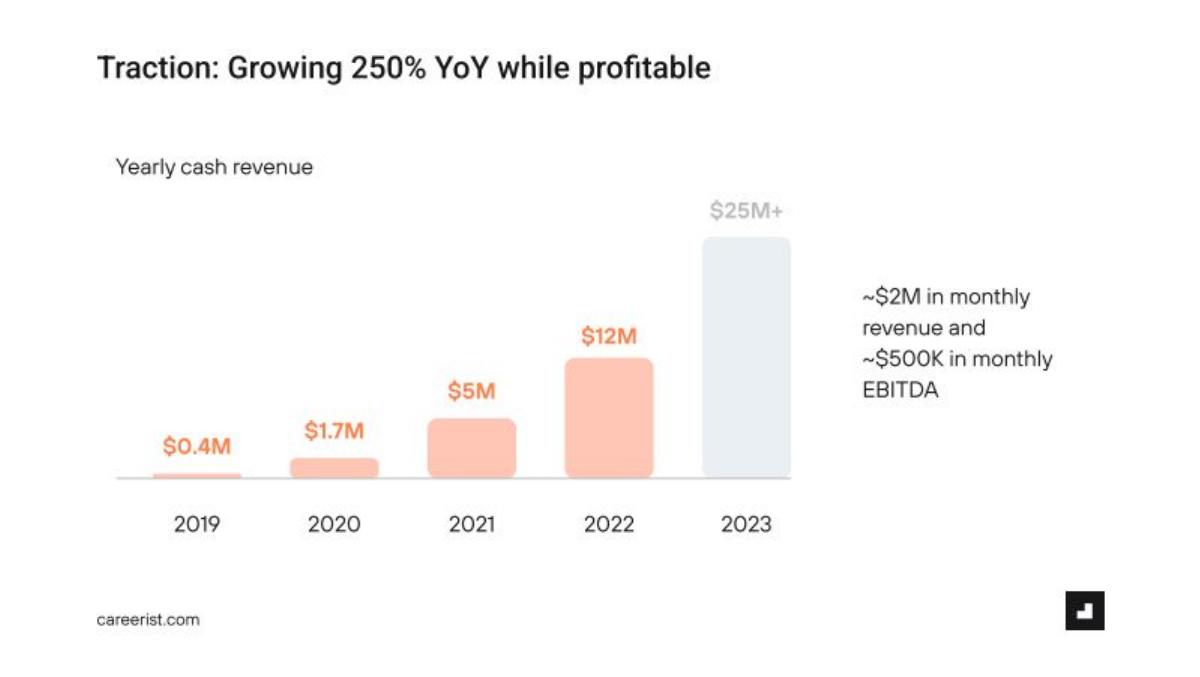
- The company reports 250% Year-over-Year growth while remaining profitable (Slide 5).
- Revenue has scaled from $0.4M in 2019 to a projected $25M+ for 2023 (Slide 5).
- The business model utilizes a dual-revenue stream: students pay up to $12,500 upfront or via deferred plans, and employers pay 10-20% recruiting fees (Slide 7).
- Acquisition is highly efficient, with 35.04% of clients coming from organic traffic and 25.18% from referrals (Slide 8).
- The platform maintains a Net Promoter Score (NPS) of 70+, significantly higher than competitors like Coursera and Udemy (Slide 9).
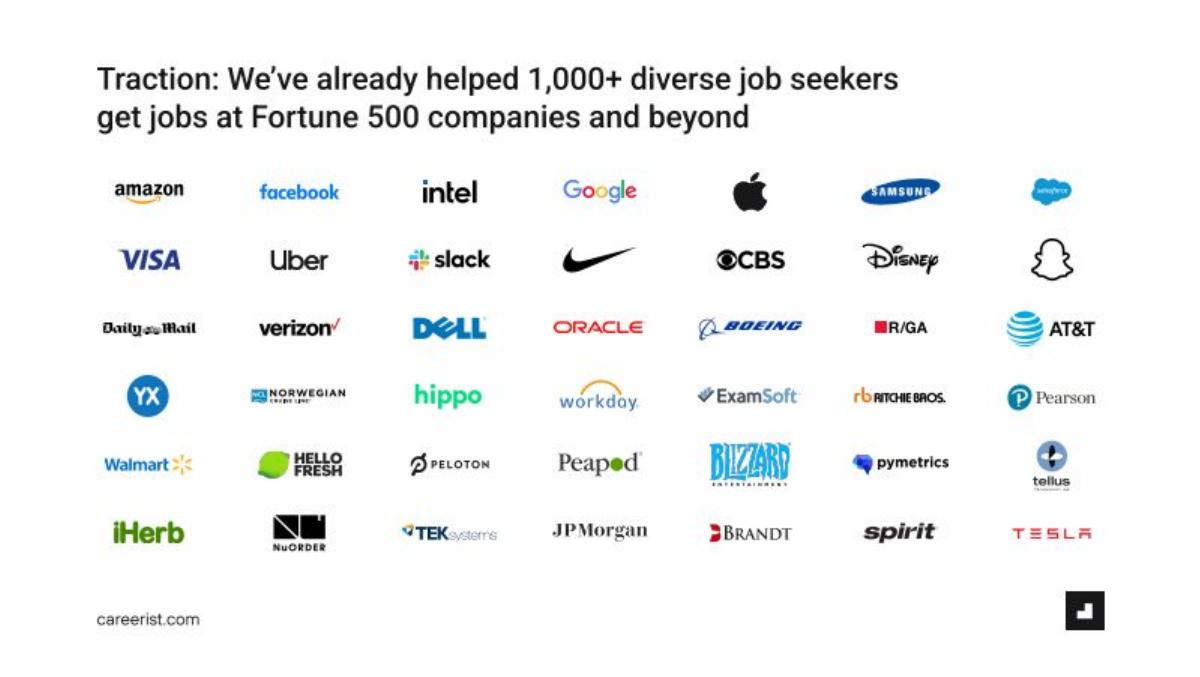
- Placements are verified at major tech hubs including Facebook, Apple, Google, and Netflix (Slide 6).
- The team features serial entrepreneurs who previously built Trucker Path, a popular trucking app with factoring monetization (Slide 11).
- The deck identifies a $10B+ Serviceable Addressable Market (SAM) specifically for junior and mid-level tech job seekers in the US (Slide 10).
Executive Summary: The Power of the Outcome-Based Model
Careerist’s 2023 pitch deck is a masterclass in demonstrating product-market fit through financial performance. While many EdTech companies struggle with low completion rates and high acquisition costs, Careerist has pivoted to an 'Ed-Fintech' model that aligns the company’s success directly with the student's employment outcome. By managing the training, the application process, and the financing, they have created a closed-loop system that investors find highly attractive due to its predictability and high margins.
Slide 1-2: The Ambition and Identity
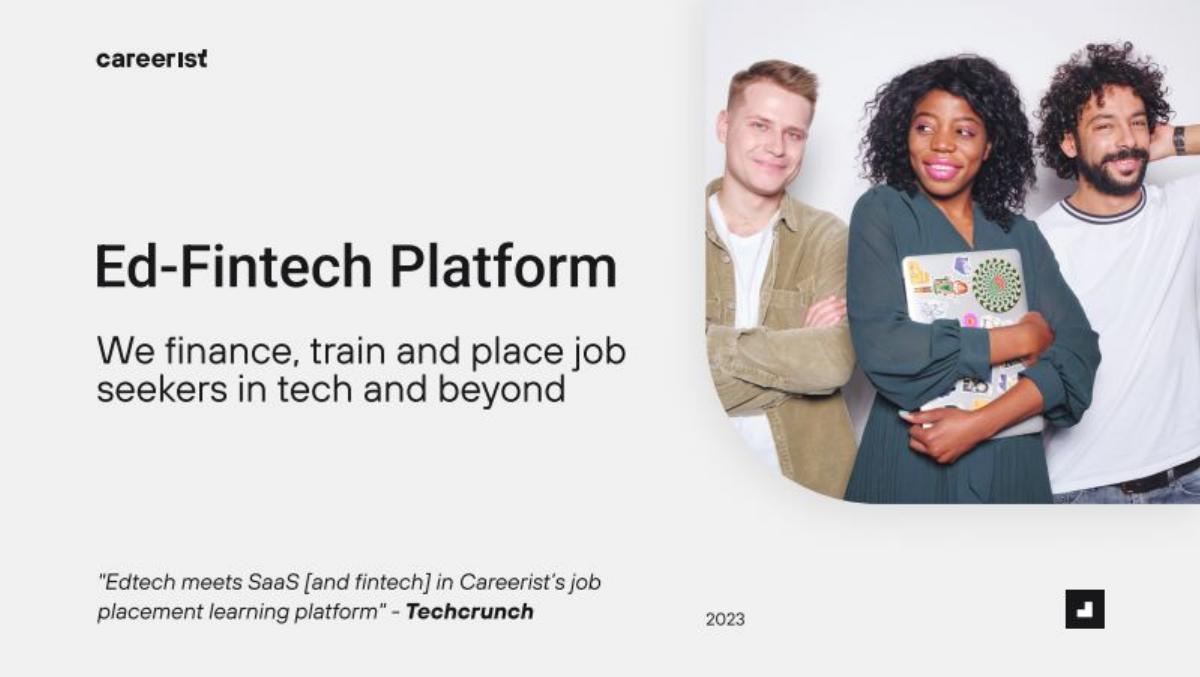
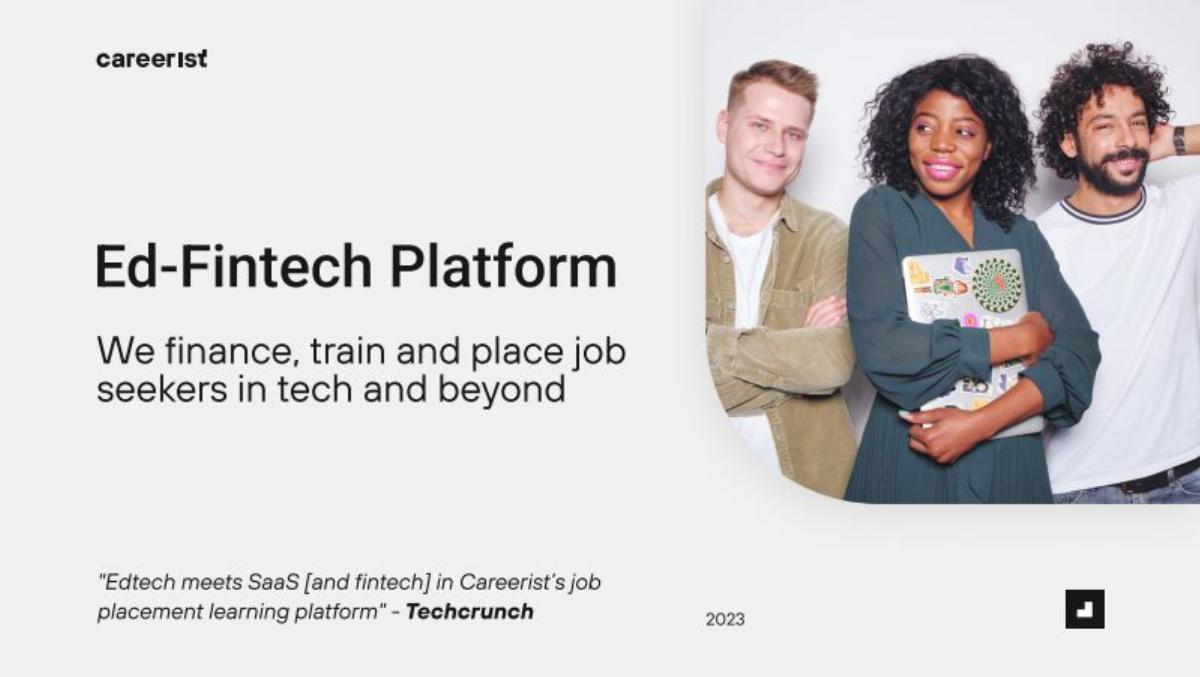
The deck opens with a clear identity: an "Ed-Fintech Platform." This is a strategic choice. EdTech alone often commands lower multiples, but Fintech implies proprietary data, underwriting, and recurring or high-value financial flows. The subtitle on Slide 1, "We finance, train and place job seekers in tech and beyond," sets the stage for a full-funnel solution. Slide 2 reinforces this with a bold 'Ambition' statement: to serve millions of job seekers. This establishes the scale of the vision immediately after the TechCrunch quote on the cover page provides third-party validation.
Slide 3-4: Defining the Broken Market and the Integrated Solution
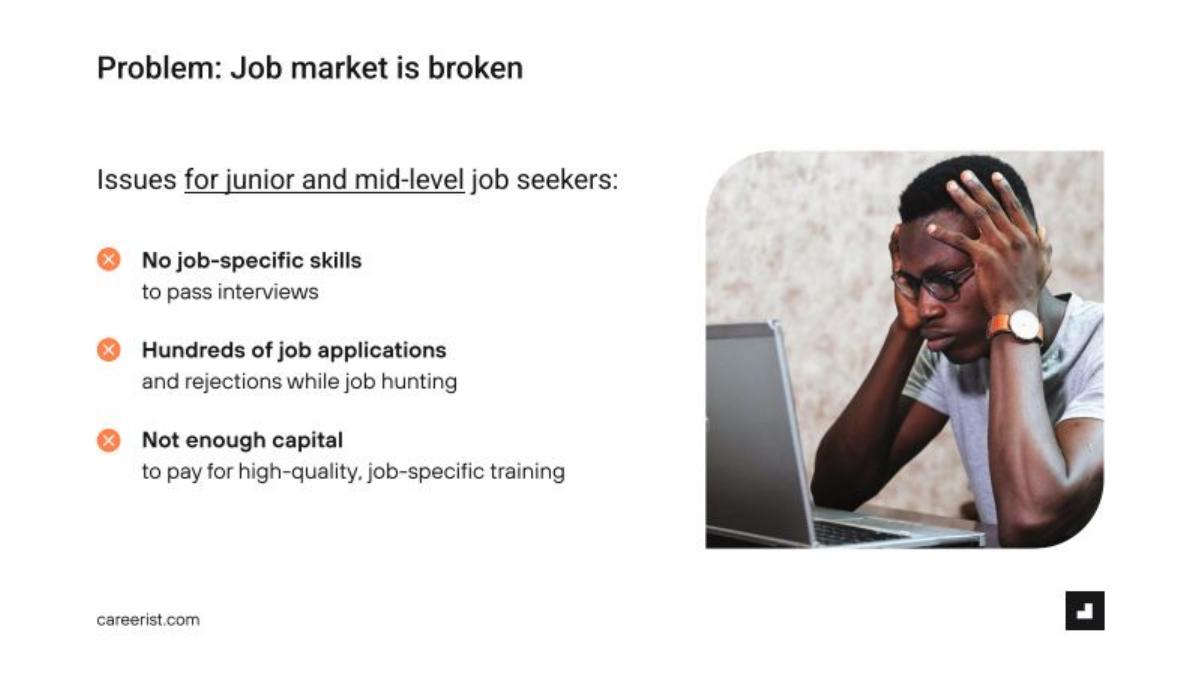
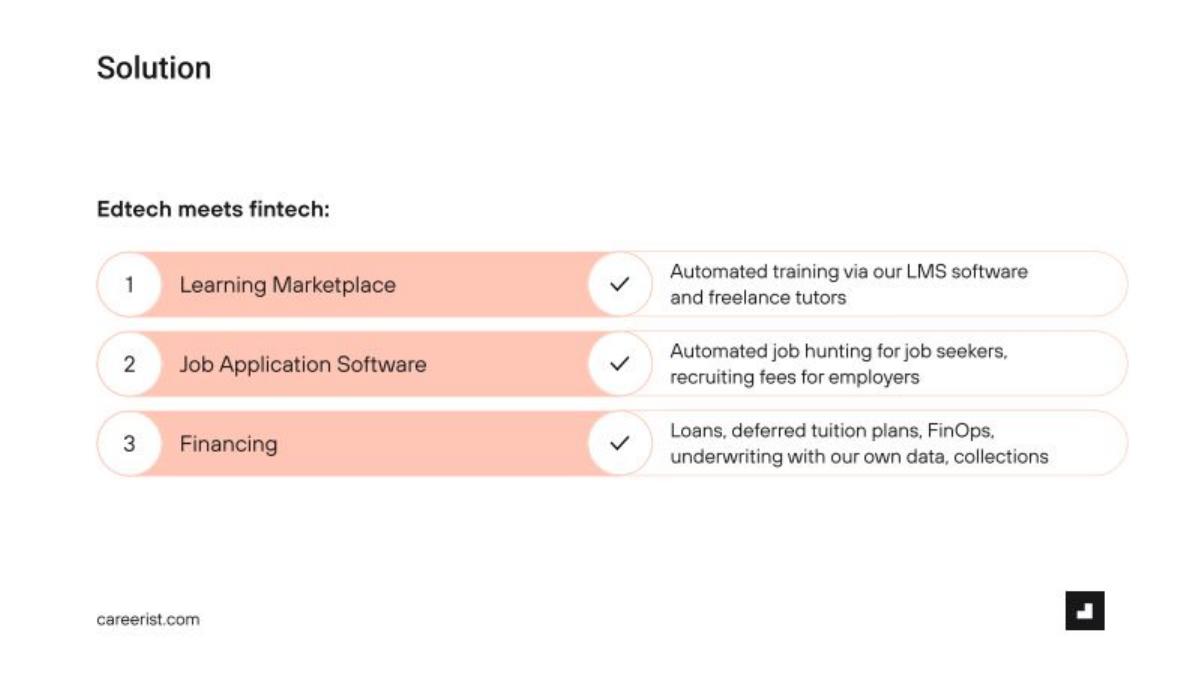
Slide 3 identifies the target demographic: junior and mid-level job seekers. It highlights three specific failures of the current market: lack of skills, the 'black hole' of job applications, and the capital gap. Slide 4 presents the 'Solution' as a three-pronged attack. First, a Learning Marketplace with automated training. Second, Job Application Software that automates the hunt for the seeker (a significant differentiator). Third, a Financing arm that handles loans and deferred tuition. This slide is crucial because it shows Careerist isn't just a school; it's a placement engine with a bank attached.
Slide 5-6: The Traction 'Wall'
Slide 5 is the most important slide in the deck. It shows a clear, upward-sloping bar chart of yearly cash revenue: $0.4M (2019), $1.7M (2020), $5M (2021), $12M (2022), and a projected $25M+ for 2023. The note that they are doing ~$2M in monthly revenue with ~$500K in monthly EBITDA is a powerful signal to investors that this is a sustainable, high-growth business, not a 'burn-at-all-costs' startup. Slide 6 follows up with a logo wall of Fortune 500 companies where 1,000+ graduates have been placed, including Amazon, Google, and Tesla, proving the efficacy of their training.
Slide 7-8: Business Model and Unit Economics
Slide 7 breaks down the revenue streams. The $12,500 upfront price point is high for EdTech but reasonable for career transformation. The addition of 10-20% recruiting fees from employers adds a B2B layer to their B2C core. Slide 8 addresses the 'Achilles heel' of most B2C startups: customer acquisition costs (CAC). By showing that 35.04% of their 1,624 clients in Q4'22 came from organic traffic and 25.18% from referrals, Careerist demonstrates a strong network effect and brand equity that reduces reliance on expensive paid ads (Facebook is only 10.36% of their mix).
Slide 9-10: Customer Satisfaction and Market Size
Slide 9 uses NPS (Net Promoter Score) to distance Careerist from 'MOOCs' (Massive Open Online Courses). An NPS of 70+ is elite, especially when contrasted against the ~2 and ~2.5 scores attributed to Coursera and Udemy. This suggests that the high price point is justified by high student satisfaction. Slide 10 defines the market. They calculate a $100B+ TAM for all US job changers, but more importantly, a $10B+ SAM for junior/mid-level tech seekers. The note that they only need 20,000 clients to reach $100M in revenue makes the path to 'centaur' status (a $100M ARR company) feel achievable.
Slide 11: The Team
The team slide features 10 individuals, led by three founders with deep experience. Ivan Tsybaev (CEO) and Max Gusakov (CTO) have a proven track record of building and scaling Trucker Path. The inclusion of specialists in Finance, Sales, and Marketing, along with a Fintech Advisor from First Republic Bank, reinforces the 'Ed-Fintech' positioning. This is a team built for execution and operational complexity, not just academic curriculum design.
What Careerist Does Well
Traction-First Approach: The deck doesn't wait until slide 10 to show numbers. By slide 5, the investor knows the company is profitable and growing 250% YoY. · Clear Categorization: Calling themselves 'Ed-Fintech' immediately explains why they have high LTV and why they handle their own underwriting. · Acquisition Transparency: Providing a full table of acquisition channels (Slide 8) builds immense trust with analysts who are skeptical of B2C growth. · Outcome Validation: The logo wall of employers (Slide 6) and the high NPS (Slide 9) prove that the product actually works for the end user.
What is Missing from the Deck
The Ask: There is no slide detailing how much capital is being raised or what the specific milestones for the next 18-24 months are. · Unit Economics Deep Dive: While they show revenue and EBITDA, they don't explicitly state the CAC (Customer Acquisition Cost) or the LTV (Lifetime Value) in dollar amounts, only mentioning 'High LTV' on slide 10. · Competitive Landscape: Aside from a brief NPS comparison, there is no traditional 'competitor grid' showing how they stack up against other bootcamps or placement agencies. · Product Screenshots: For a company claiming to have 'Automated Job Application Software,' there are no visuals of the actual platform or user interface.
What Other Founders Should Copy
The 'Path to $100M' Logic: Slide 10’s breakdown of exactly how many customers are needed to reach a major revenue milestone is a great way to make a large TAM feel grounded. · NPS Benchmarking: If your industry has a reputation for poor user experience (like online education), highlighting your NPS against the industry giants is a powerful way to show a superior product. · The 'Ed-Fintech' Pivot: Founders in crowded sectors should look at how Careerist added a financial layer to their business to improve margins and defensibility. If you can finance your own customers, you control the entire value chain.
Frequently asked questions
- What is the primary problem Careerist is solving?
- According to slide 3, Careerist targets the 'broken' job market for junior and mid-level seekers. The three specific pain points identified are a lack of job-specific skills to pass interviews, the exhaustion of sending hundreds of applications without success, and a lack of capital to afford high-quality training.
- How does Careerist differentiate itself from traditional EdTech?
- Careerist positions itself as 'Ed-Fintech' on slide 4. Unlike platforms that only provide content, Careerist integrates automated training (LMS), automated job hunting software for the seeker, and in-house financing options like deferred tuition and underwriting based on their own data.
- Is the company profitable?
- Yes. Slide 5 explicitly states the company is 'growing 250% YoY while profitable.' It further specifies a monthly EBITDA of approximately $500K on monthly revenue of approximately $2M.
- What are the specific costs for students using the platform?
- As detailed on slide 7, students have two main options: an upfront payment of up to $12,500 or a monthly deferred payment plan/loan. This flexibility lowers the barrier to entry for candidates while securing high LTV for the company.
- Who are the founders and what is their track record?
- The leadership team, shown on slide 11, includes Ivan Tsybaev (CEO), Max Gusakov (CTO), and Max Glubochansky (CBO). Tsybaev and Gusakov previously built Trucker Path, which the deck describes as the most popular US trucking app.