The arive pitch deck is a masterclass in brand positioning over technical specification. Operating in the notoriously difficult quick-commerce (Q-Commerce) sector, arive uses its 10 slides to distance itself from 'last mile logistics' and 'food delivery,' instead pitching a 'premium experience' and 'shoppable editorial.' The deck highlights a successful $27M capital raise from top-tier investors like Balderton and GFC, and lists presence in four major German cities. However, the deck is notably light on financial fundamentals, omitting unit economics, CAC/LTV ratios, and a specific 'Ask' for…
Key takeaways
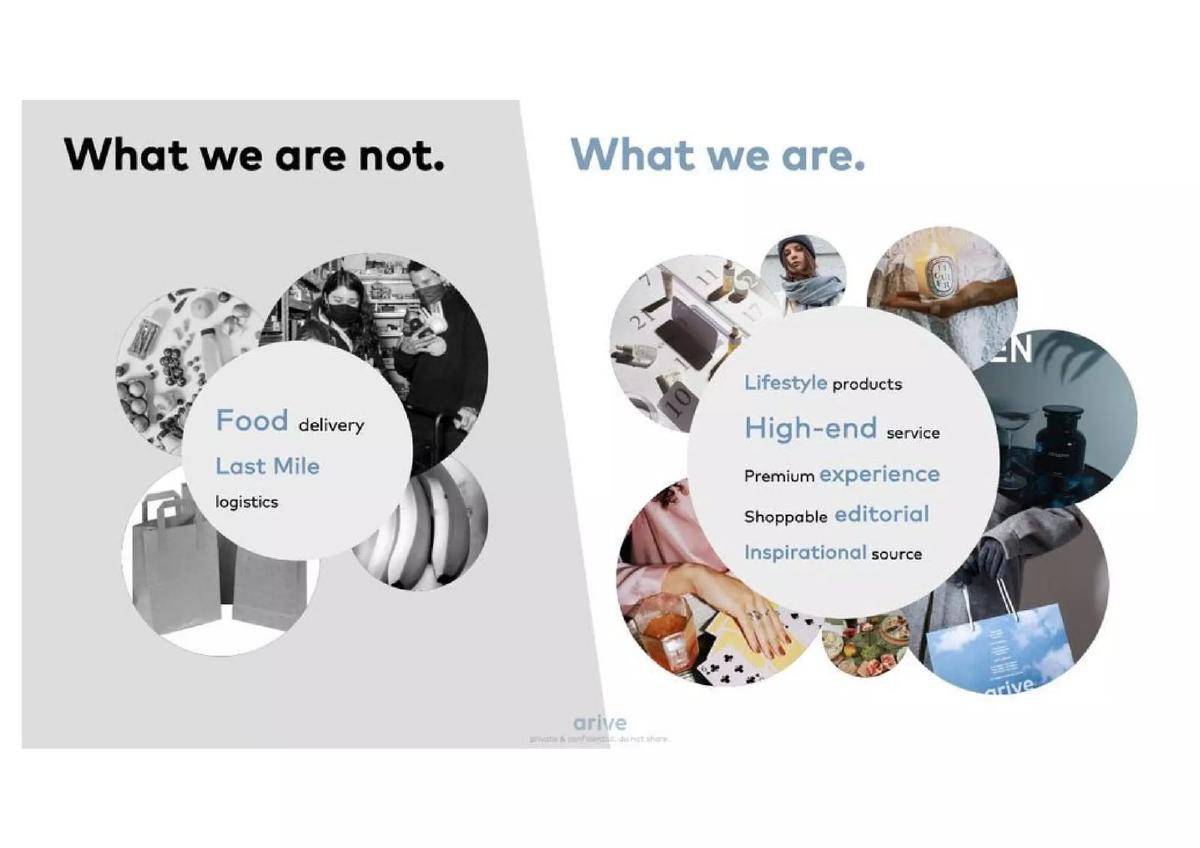
- arive explicitly differentiates itself from standard food delivery and logistics, focusing instead on 'Lifestyle products' and 'High-end service' (Slide 4).
- The company has raised a total of $27M from prominent investors including 468 Capital, La Famiglia, Balderton, GFC, and Burda (Slide 8).
- The platform promises delivery of branded consumer goods in under 30 minutes (Slide 1).
- The startup is currently live in four cities: Munich, Berlin, Hamburg, and Frankfurt (Slide 8).
- The team size is stated as 80+ 'Arivers' with headquarters in Munich and a secondary office in Berlin (Slide 8).
- Future growth plans include expansion into new categories like Pets, Fashion, and Travel, alongside a broader European rollout (Slide 9).
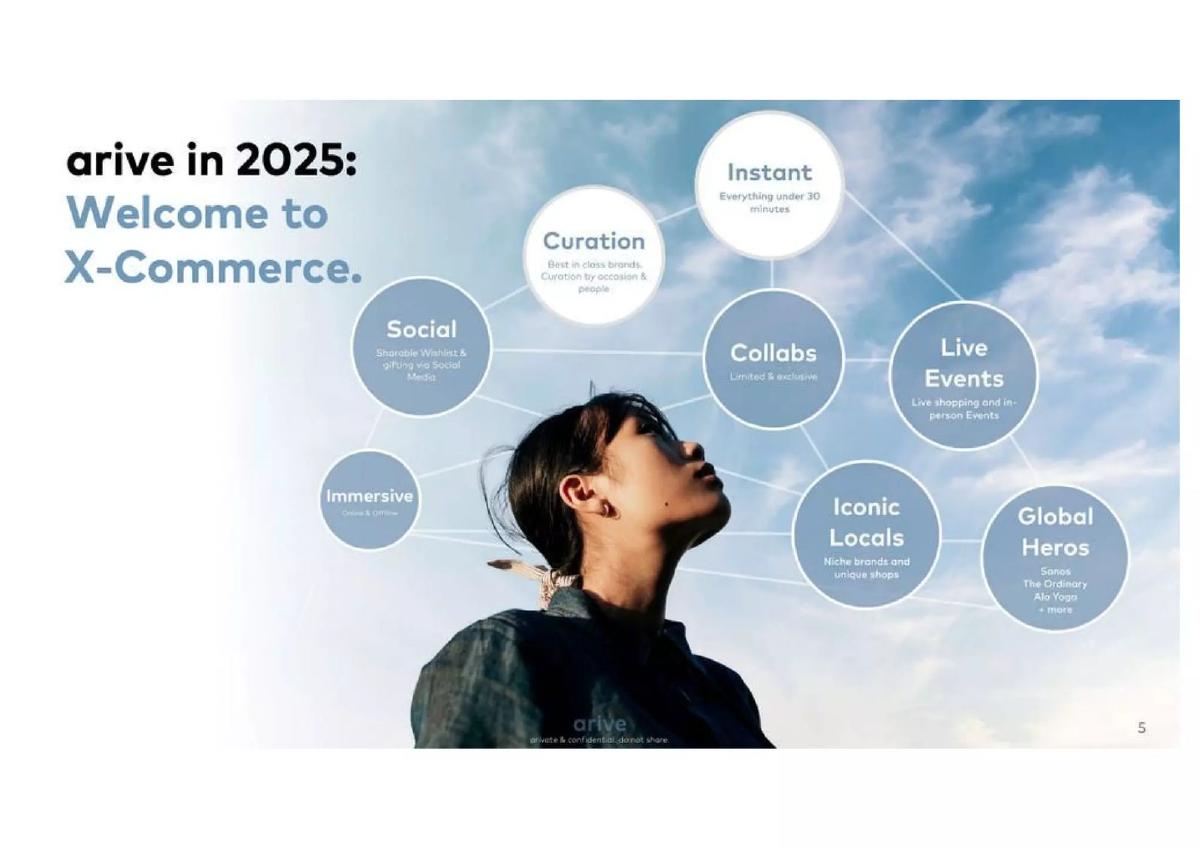
- The deck introduces the concept of 'X-Commerce,' which integrates social features, live shopping, and influencer curation (Slide 5, 6).
- There is a total absence of a 'Team' slide featuring founder backgrounds or an 'Ask' slide detailing the specific funding amount sought in this round.
The Brand-First Approach to Quick Commerce
The arive pitch deck is a 10-slide presentation that prioritizes aesthetic and vision over raw data. In an era where quick-commerce companies were often viewed as commodity logistics plays, arive attempts to carve out a niche as a premium curator. The deck is designed to feel like a lifestyle magazine, using high-quality imagery and minimal text to convey a sense of luxury and ease.
Slide 1: The Hook
The cover slide is minimalist, featuring the arive logo against a blue sky with clouds. The tagline, "BRANDS YOU LOVE IN 30 MINUTES," immediately establishes the two pillars of the business: brand curation and speed. It doesn't mention groceries or essentials, signaling a departure from the standard convenience store model.
Slide 2: The Market Shift
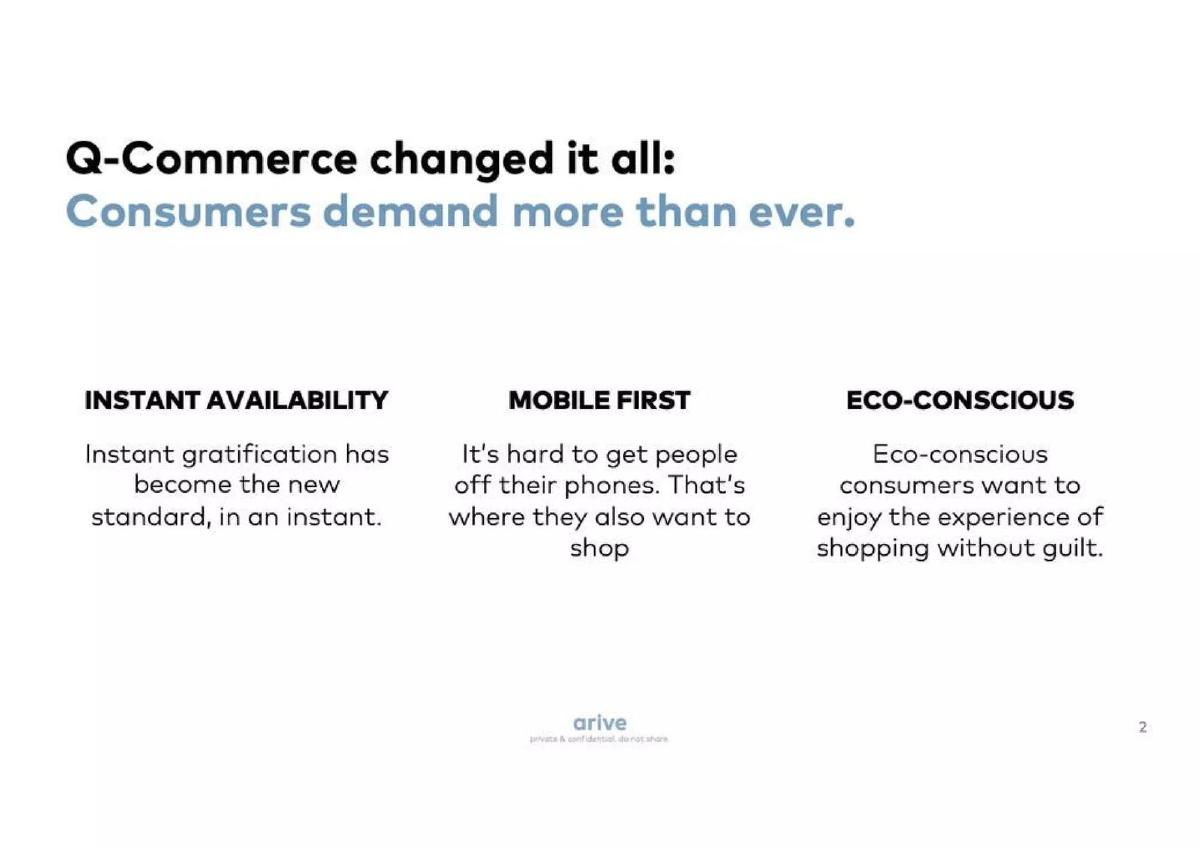
Slide 2 addresses the changing consumer landscape. It claims that "Q-Commerce changed it all" and identifies three core consumer demands: INSTANT AVAILABILITY , MOBILE FIRST , and ECO-CONSCIOUS . This slide sets the stage for why arive exists, suggesting that while the market has shifted toward speed, there is still a gap for a service that meets these demands without sacrificing the "experience" of shopping.
Slide 3: Ambition and Mission
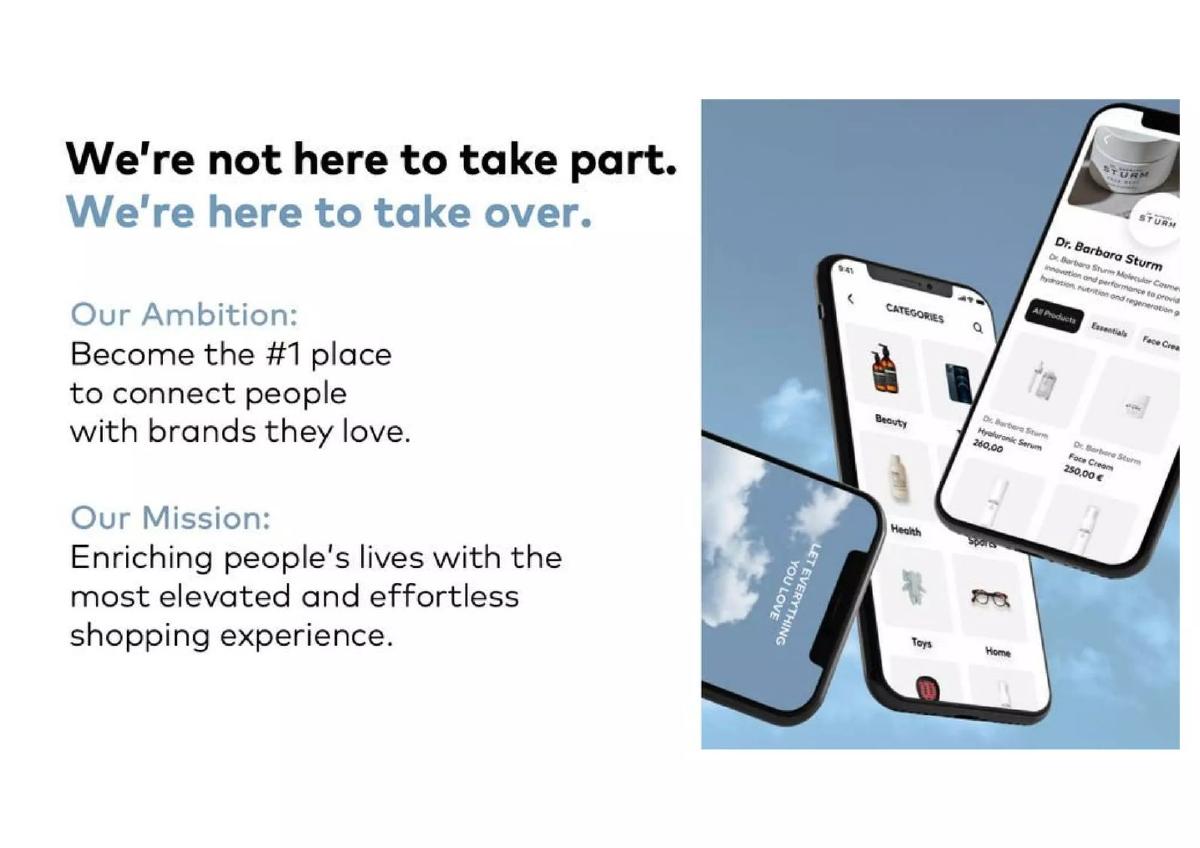
This slide is heavy on rhetoric, stating, "We're not here to take part. We're here to take over." It defines their ambition as becoming the "#1 place to connect people with brands they love" and their mission as "Enriching people's lives with the most elevated and effortless shopping experience." The visual includes app mockups featuring high-end brands like Dr. Barbara Sturm, reinforcing the premium positioning.
Slide 4: Competitive Differentiation
Slide 4 is one of the most important in the deck for positioning. It uses a "What we are not" vs. "What we are" comparison. Under "What we are not," it lists Food delivery and Last Mile logistics , shown in muted greyscale. Under "What we are," it lists Lifestyle products , High-end service , Premium experience , Shoppable editorial , and Inspirational source . This is a deliberate attempt to escape the low-margin, high-competition perception of the logistics industry.
Slide 5: The 2025 Vision (X-Commerce)
Slide 5 introduces the concept of "X-Commerce." It presents a web of interconnected features planned for 2025, including Social (sharable wishlists), Curation , Instant (everything under 30 minutes), Collabs , Live Events , Iconic Locals (niche shops), and Global Heros (listing brands like Sonos, The Ordinary, and Alo Yoga). This slide aims to show that arive is building a platform, not just a delivery service.
Slide 6: The Engaging Platform
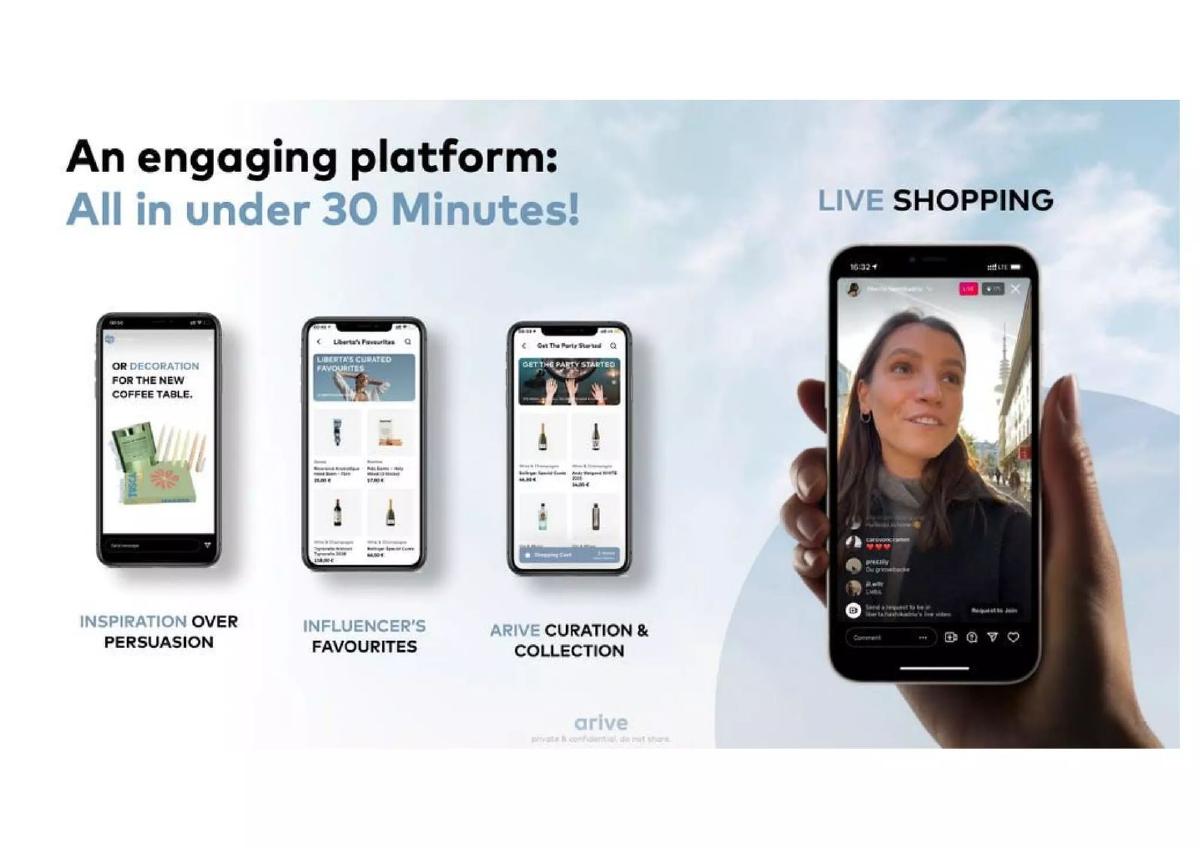
This slide focuses on the user interface and content strategy. It highlights "Inspiration over Persuasion," "Influencer's Favourites," and "arive Curation & Collection." A large smartphone graphic shows a "LIVE SHOPPING" feature, suggesting that arive intends to use video content and personalities to drive sales, much like social media platforms.
Slide 7: Brand Partnerships
Slide 7 argues that "Brands love arive: Because we make them better." It lists three benefits for brands: EMPOWERING BRANDS (allowing them to design their own store on the app), PLUG & PLAY LAST MILE (making fast delivery easy for brands), and ELEVATED DESIRABILITY . This slide is crucial for showing how they solve problems for the supply side of their marketplace.
Slide 8: Traction and Funding
Slide 8 provides the only hard metrics in the deck. It states the company is live in 4 CITIES (Munich, Berlin, Hamburg, Frankfurt). It reveals a TOTAL FUNDING RAISED of $27M from investors including 468 Capital, La Famiglia, Balderton, GFC, and Burda . Finally, it notes a team size of 80+ ARIVERS with offices in Munich and Berlin. This slide serves as the primary proof of execution.
Slide 9: The Roadmap
The "What's next?" slide outlines four growth areas: CONNECTED RETAIL (connecting local stores), IN-APP LIVESHOPPING (merging content and e-commerce), NEW CATEGORIES (Pets, Fashion, Travel), and EUROPEAN EXPANSION . It mentions they are "Currently in talks with partners" for the retail integration, indicating that these features are in the development or negotiation phase.
Slide 10: The Closing Philosophy
The final slide is a poetic manifesto about "chasing" vs. "attracting." It concludes with the phrase "LET EVERYTHING YOU LOVE arive." While it lacks a call to action or contact information, it maintains the brand's aspirational tone to the very end.
What Works in the arive Deck
The primary strength of this deck is its unwavering commitment to brand identity . In a sector where most players look identical—bright colors, stock photos of groceries, and a focus on price—arive looks like a high-fashion brand. This differentiation is essential for attracting premium brand partners who might otherwise be wary of appearing on a "discount" delivery app.
The investor slide (Slide 8) is another high point. Listing Balderton and GFC alongside a $27M figure provides immediate credibility. It tells a potential investor that the "smart money" has already done the initial due diligence and found the model viable. The focus on "Inspiration over Persuasion" is also a clever psychological pivot, suggesting that arive can generate demand rather than just fulfilling it.
What is Missing from the arive Deck
The most glaring omission is the Team Slide . For a Series A stage company, the background of the founders is usually a top-three concern for investors. We don't know if the founders come from a logistics background, a fashion background, or a tech background. This is a significant oversight that forces investors to look elsewhere for the "who" behind the "what."
Furthermore, the deck is devoid of unit economics . There is no mention of Average Order Value (AOV), Customer Acquisition Cost (CAC), or the cost per delivery. In the Q-Commerce space, where profitability is notoriously difficult to achieve, the absence of these numbers is a major red flag. Investors need to see that the "premium" model actually translates into better margins than the grocery-delivery incumbents.
Finally, there is no specific Ask . A pitch deck is a tool to raise money, yet this deck never specifies how much is being raised, what the valuation expectations are, or specifically how the new capital will be allocated beyond the vague goals on the roadmap slide.
What a Founder Should Copy
Founders in crowded markets should copy arive's "What we are not" (Slide 4) strategy. By explicitly defining what you aren't, you prevent investors from pigeonholing you into a category with low multiples or poor reputations. If you are building a "premium" version of a common service, you must visually and verbally distance yourself from the "common" version early in the deck.
The visual consistency is also worth emulating. Every slide feels like it belongs to the same story. The use of high-fidelity app mockups (Slide 3 and 6) makes the product feel real and polished, even if some features (like Live Shopping) are still on the roadmap. This builds confidence in the team's ability to execute on the "experience" they are promising.
Conclusion
The arive deck is a bold bet on the idea that brand and curation can win in a market dominated by logistics and scale. While it succeeds in creating a compelling vision of "X-Commerce," its lack of financial transparency and team details makes it a high-level teaser rather than a complete investment case. It is a deck designed to get a meeting based on vibes and existing investor pedigree, rather than one designed to close a deal on the merits of the business model alone.
Frequently asked questions
- What is the core value proposition of arive?
- arive positions itself as a premium delivery layer for high-end lifestyle brands. Unlike grocery-focused Q-Commerce players, arive focuses on 'brands you love' delivered in 30 minutes. The deck emphasizes 'Inspiration over Persuasion' and 'Elevated Desirability,' suggesting they target a more affluent demographic looking for beauty, fitness, and household products rather than just milk and eggs.
- Which investors have backed arive according to the deck?
- Slide 8 lists a strong roster of venture capital firms. These include 468 Capital, La Famiglia, Balderton Capital, Global Founders Capital (GFC), and Burda. This lineup indicates significant institutional confidence in the team's ability to execute in the high-burn Q-Commerce sector, having already secured $27M in total funding prior to the completion of this deck.
- What are the biggest omissions in this pitch deck?
- The deck lacks three critical components: a Team slide, a Financials slide, and a specific Ask. There is no mention of the founders' track records, no data on gross margins or burn rate, and no indication of how much capital they are currently raising or at what valuation. It functions more as a brand vision document than a comprehensive investment memorandum.
- How does arive plan to expand its product offering?
- According to Slide 9, the company intends to move beyond its initial categories into Pets, Fashion, and Travel. They also plan to implement 'Connected Retail,' which involves showing products from local physical retail stores within the arive app. This suggests a shift toward a marketplace model supported by their existing 30-minute logistics infrastructure.
- What is 'X-Commerce' as defined by the deck?
- On Slide 5, arive introduces 'X-Commerce' as their 2025 vision. It is a multi-faceted ecosystem that combines 'Instant' delivery with 'Social' features (wishlists/gifting), 'Curation' (best-in-class brands), 'Collabs' (limited editions), 'Live Events' (in-person and digital), and 'Immersive' online/offline experiences. It represents a move toward becoming a media-commerce hybrid.