Arctic Star Exploration's pitch deck is a specialized document for the junior mining sector, focusing heavily on geological validation and asset potential rather than software-style scalability. The deck centers on the Timantii Project in Finland, citing a discovery of 111 diamonds in a 48.65kg sample. It leans on third-party credibility, including a 43-101 technical report by KIVI Geoscience Inc. and media coverage from July 2017. While the deck provides a granular $2 million exploration budget, it lacks a formal team slide, financial history, or a clear exit strategy for investors. The pres…
Key takeaways
- The company is publicly traded across three exchanges: TSX (ADD.V), FRA (A182.F), and OTC (ASDZF) as shown on Slide 1.
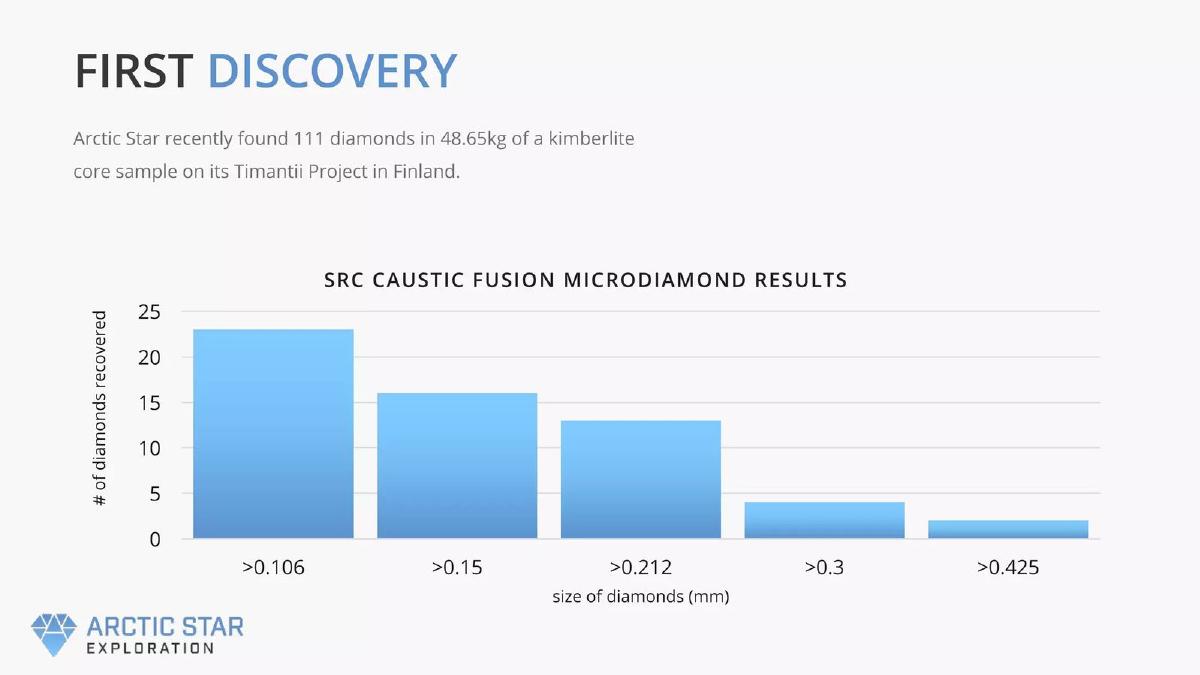
- The core value proposition is the Timantii Project in Finland, where 111 diamonds were recovered from a 48.65kg kimberlite core sample (Slide 3).
- Geological validity is anchored by a NI 43-101 technical report authored by Kevin R. Kivi, P.Geo., with an effective date of June 20, 2017 (Slide 4).
- The deck utilizes external media validation from July 2017 to frame the project as a 'new diamond frontier' (Slide 5).
- A detailed $2,000,000 exploration budget is presented, with 'Core drilling' representing the largest single expense at $900,000 (Slide 6).
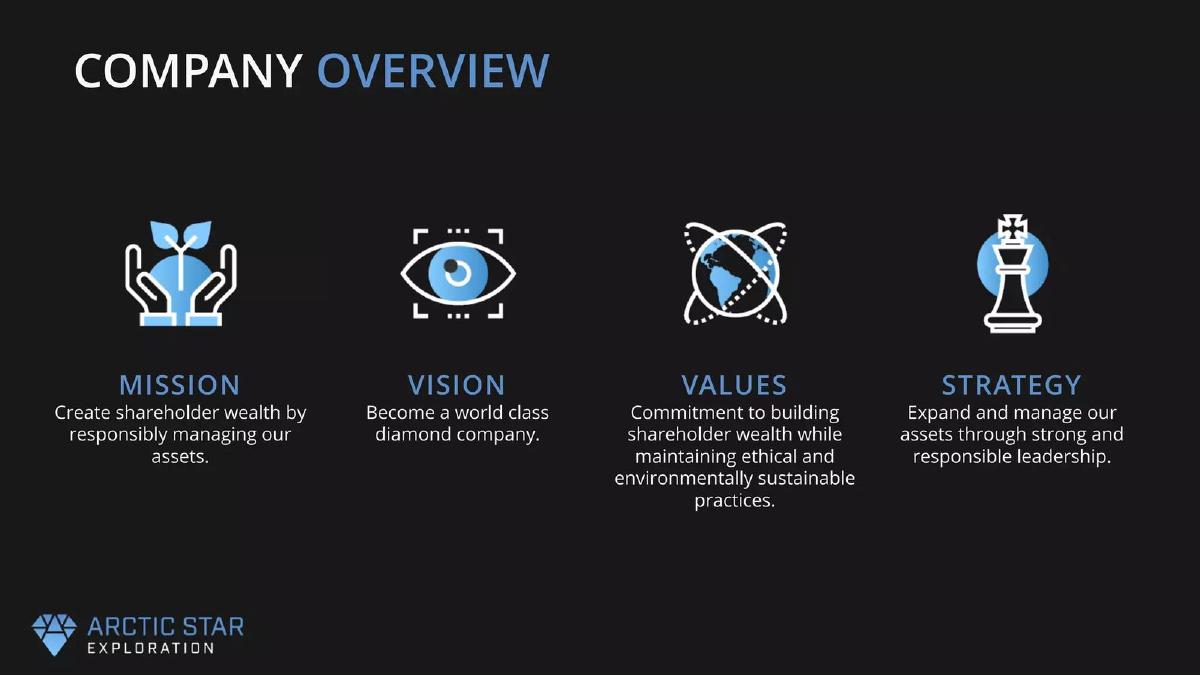
- The mission is strictly defined as creating shareholder wealth through responsible asset management (Slide 2).
- Technical results are quantified through SRC Caustic Fusion microdiamond results, showing a distribution of diamond sizes from >0.106mm to >0.425mm (Slide 3).
- The deck omits a dedicated team slide, though it references 'two diamond legends' in a press quote on Slide 5.
Executive Summary: The Junior Miner's Technical Case
Arctic Star Exploration’s pitch deck is a highly specialized document tailored for the natural resources sector. Unlike tech startups that pitch user growth and recurring revenue, Arctic Star pitches geological probability and asset potential. The deck is dated by its references to July 2017 media coverage and a June 2017 technical report. It serves as a bridge between raw exploration data and investor interest, focusing almost exclusively on the Timantii Project in Finland. For a junior mining company, the 'product' is the land and what lies beneath it, and this deck treats the geological report as its primary validation metric.
Slide 1: Title and Public Listing
The title slide is minimalist, featuring a large diamond graphic and the company logo. Crucially, it lists the company’s trading symbols: TSX: ADD.V , FRA: A182.F , and OTC: ASDZF . This immediately signals to the reader that this is a public entity subject to regulatory oversight and that liquidity exists for the shares. The use of a high-quality diamond image sets the sector context immediately without requiring a subtitle.
Slide 2: Company Overview
This slide outlines the Mission, Vision, Values, and Strategy. The language is standard corporate fare: 'Create shareholder wealth,' 'Become a world class diamond company,' and 'Ethical and environmentally sustainable practices.' The strategy is defined as expanding and managing assets through 'strong and responsible leadership.' While these are high-level platitudes, they are necessary in the mining sector to signal compliance with ESG (Environmental, Social, and Governance) standards, which are critical for permitting and institutional investment.
Slide 3: First Discovery and Technical Data
Slide 3 is the 'traction' slide of the mining world. It reports that Arctic Star found 111 diamonds in 48.65kg of a kimberlite core sample at the Timantii Project in Finland. The slide includes a bar chart titled 'SRC Caustic Fusion Microdiamond Results.' The chart breaks down the recovery by size:
0.106 mm: ~23 diamonds · >0.15 mm: ~16 diamonds · >0.212 mm: ~13 diamonds · >0.3 mm: ~4 diamonds · >0.425 mm: ~2 diamonds
This data is intended to prove that the kimberlite is diamondiferous (contains diamonds). In exploration, the presence of microdiamonds is a key indicator of the potential for larger, macro-sized commercial diamonds.
Slide 4: The Geological Report
To provide third-party verification of the claims on Slide 3, Slide 4 introduces the 'Geological Report.' It cites a 43-101 technical report authored by Kevin R. Kivi, P.Geo., of KIVI Geoscience Inc. The National Instrument 43-101 is a strict Canadian coding standard for mineral projects. By showing the cover of the report and stating an effective date of June 20, 2017 , the company is providing the 'due diligence' package that sophisticated mining investors require to trust the discovery data.
Slide 5: Potential Opportunities and Media Validation
This slide shifts from technical data to market sentiment. It features three headlines from July 2017:
'Two diamond legends reunite for next big discovery' (Baystreet.ca) · 'Another Grib diamond mine in Finland?' (Rockstone Research) · 'Arctic Star sees new diamond frontier in Finland' (Resource Clips)
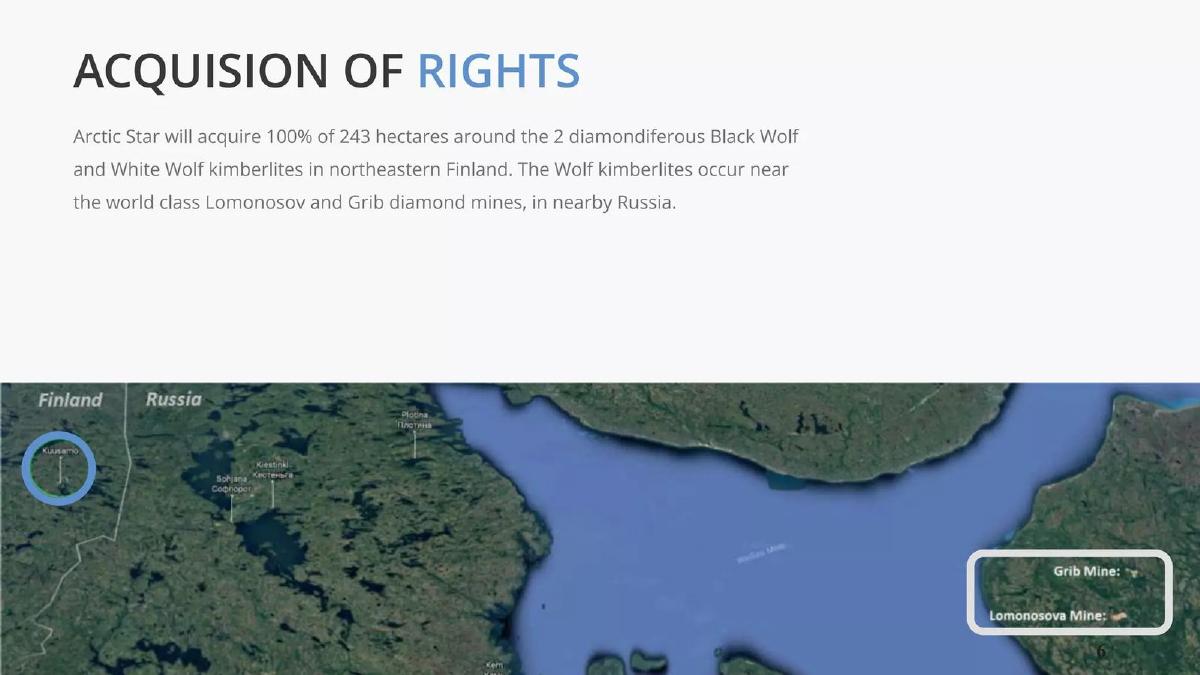
The reference to 'Two diamond legends' is a common tactic in junior mining, where the track record of the geologists or promoters (often referred to as 'close-ology' or 'jockeying') is as important as the land itself. The comparison to the 'Grib diamond mine' provides a frame of reference for the potential scale of the project.
Slide 6: Proposed Exploration Budget
The final slide in this set provides a transparent breakdown of how a $2,000,000 budget would be spent. The use of a donut chart clearly illustrates the priority of funds:
Core drilling: $900,000 (45% of budget) · Winter till sampling: $720,000 (36% of budget) · Ground geophysical surveys: $120,000 · Log, sample, & analyse core storage: $100,000 · Petrology & KIM chemistry: $54,000 · Trenching & sampling: $50,000 · Community dialogue: $30,000 · Land tenure fees & deposits: $26,000
This level of detail is excellent for building investor trust. It shows that the majority of the capital is going 'into the ground' (drilling and sampling) rather than into administrative overhead.
What Works in This Deck
Technical Credibility: The inclusion of the 43-101 report and the specific microdiamond counts (111 diamonds) moves the pitch from speculative to evidence-based. In mining, data is the only currency that matters before production begins.
Budget Transparency: Many decks fail to explain exactly how they will use the funds. Arctic Star provides a line-item budget that totals exactly $2M, showing they have a concrete operational plan for the next phase of exploration.
Geographic Focus: By focusing entirely on the Timantii Project in Finland, the deck avoids the 'distracted explorer' trap where companies list ten different properties in ten different countries. This focus suggests a high conviction in this specific asset.
What Is Missing
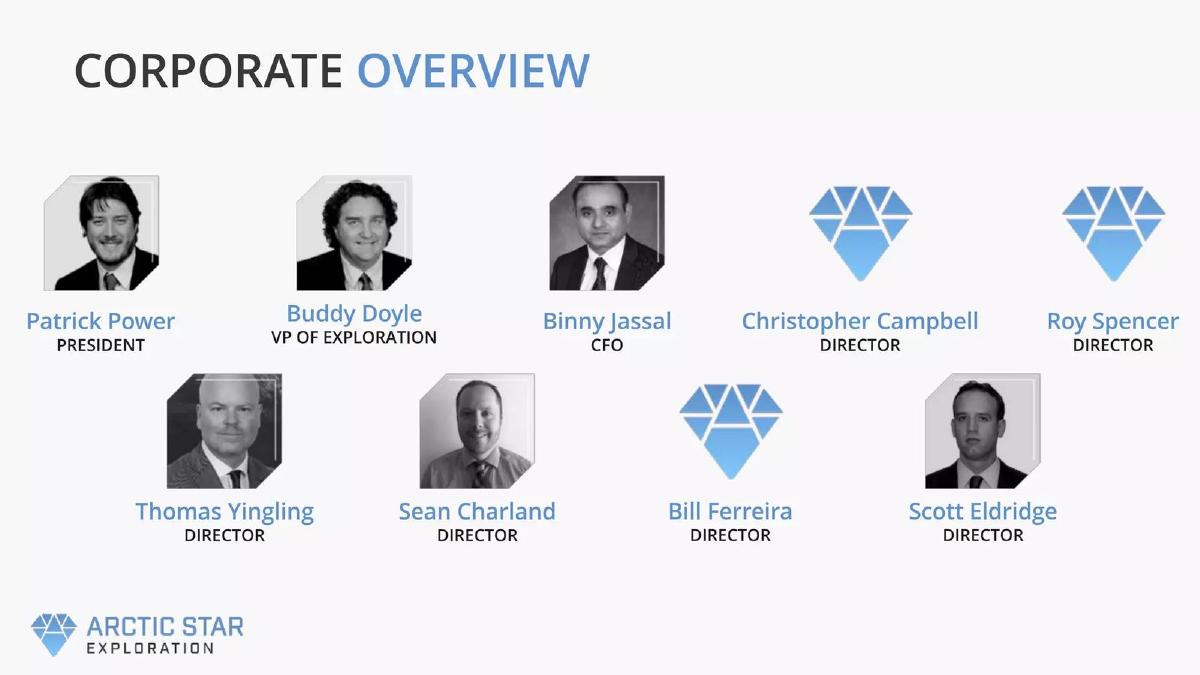
The Team Slide: While the media quotes mention 'diamond legends,' the deck itself does not name the management team or the board of directors. In junior mining, the reputation of the CEO and Lead Geologist is paramount. Investors need to know who is managing their $2 million.
Capital Structure: As a public company, the deck should ideally include a slide on the share structure (shares outstanding, warrants, options, and insider ownership). This helps investors understand potential dilution.
Timeline: The budget is clear, but the schedule is not. A Gantt chart or timeline showing when the 'Winter till sampling' or 'Core drilling' will commence and when results are expected would provide a necessary sense of urgency.
Founder's Guide: What to Copy
Use Regulatory Standards: If your industry has a 'gold standard' for reporting (like NI 43-101 in mining or Phase II trials in Biotech), lead with it. It instantly separates professional outfits from amateurs.
Quantify the 'Small' Wins: Arctic Star didn't wait for a giant diamond to pitch; they used the recovery of 111 microdiamonds to prove the concept. Founders should look for 'micro-metrics' that prove their 'macro-thesis' is viable.
The 'Use of Funds' Donut: Copy the format of Slide 6. It is a clean, visually effective way to show that you are spending money on the things that actually create value (in this case, drilling) rather than just 'marketing' or 'operations.'
Frequently asked questions
- What is the primary project discussed in this deck?
- The primary focus is the Timantii Project located in Finland. The deck highlights a 'First Discovery' on Slide 3, where the company recovered 111 diamonds from a relatively small 48.65kg kimberlite core sample. This project is framed as a potential peer to other major diamond mines, such as the Grib mine, as suggested by the media quotes on Slide 5.
- How does the company validate its geological findings?
- Arctic Star relies on two main forms of technical validation. First, it presents a bar chart of 'SRC Caustic Fusion' results on Slide 3 to show the size distribution of recovered microdiamonds. Second, Slide 4 highlights a formal National Instrument 43-101 technical report authored by Kevin R. Kivi of KIVI Geoscience Inc., which confirms the diamond-bearing nature of the Wolf kimberlites.
- What is the total requested budget and how will it be spent?
- Slide 6 outlines a 'Proposed Exploration Budget' totaling exactly $2,000,000. The largest allocations are for Core drilling ($900,000) and Winter till sampling ($720,000). Other costs include Ground geophysical surveys ($120,000), Petrology ($54,000), and smaller amounts for land fees, community dialogue, and core storage.
- Is Arctic Star Exploration a private startup?
- No. As indicated on the title slide (Slide 1), Arctic Star is a publicly traded company. It lists its tickers for the TSX Venture Exchange (ADD.V), the Frankfurt Stock Exchange (A182.F), and the OTC markets (ASDZF). This deck functions more as an investor relations presentation for a secondary offering or private placement rather than a seed-stage venture pitch.
- What is missing from this pitch deck compared to standard templates?
- The deck lacks several standard components, most notably a dedicated Team slide featuring bios and photos of the leadership. It also lacks a 'Problem/Solution' framework, as the 'problem' in mining is implied (the need for new mineral resources). There is no mention of current cash position, capital structure, or a specific timeline for the proposed exploration activities.