ARC Document Solutions (formerly American Reprographics Company) uses this 2015 investor overview to signal a fundamental shift in its business model. The deck targets the Architecture, Engineering, and Construction (AEC) industry, proposing a move from high-cost physical printing to cloud-based 'Construction Document & Information Management' (CDIM). The narrative is built on the premise that traditional document management is the third-largest office expense, and that digital transformation can unlock significant margin expansion. With 34% of net sales already coming from recurring Managed…
Key takeaways
- The company identifies document-related costs as the third largest office expense after people and locations (Slide 7).
- ARC claims that printing project documents typically costs twice as much as managing them digitally (Slide 7).
- The core technology offering is branded as SKYSITE, a cloud-based tool for construction document distribution (Slide 10).
- Annual recurring revenue (ARR) accounted for 34% of net sales via Managed Print Services at the time of the deck (Slide 16).
- The company highlights a significant financial asset in the form of approximately $85 million in Net Operating Losses (NOLs) to minimize cash taxes (Slide 17).
- Free Cash Flow grew 40% year-over-year, rising from $29.1 million in 2013 to $40.7 million in 2014 (Slide 17).
- The deck explicitly states the stock is undervalued due to a 'lack of awareness of ARC’s transformation' (Slide 16).
- Gross margins showed a steady upward trend, reaching 34.5% in Q1 2015 compared to 32.4% in Q1 2013 (Slide 17).
Introduction: The Legacy Pivot
The ARC Document Solutions investor overview is a quintessential example of a legacy industrial services company attempting to rebrand as a technology-driven platform. The deck, current as of March 31, 2015, focuses on the transition from traditional reprographics (printing) to cloud-based document management for the AEC (Architecture, Engineering, and Construction) sector. The narrative arc moves from the pain points of physical paper to the efficiency of the cloud, backed by solid, if not explosive, financial performance.
Slide 1: Title and Branding
The cover slide establishes the corporate identity: ARC Document Solutions. The subtitle, "Investor Overview," and the date stamp of March 31, 2015, indicate this is a quarterly update intended for the public markets or institutional investors. The visual theme is corporate blue with abstract curves, suggesting a professional, stable environment.
Slide 4: The Thesis of Transformation
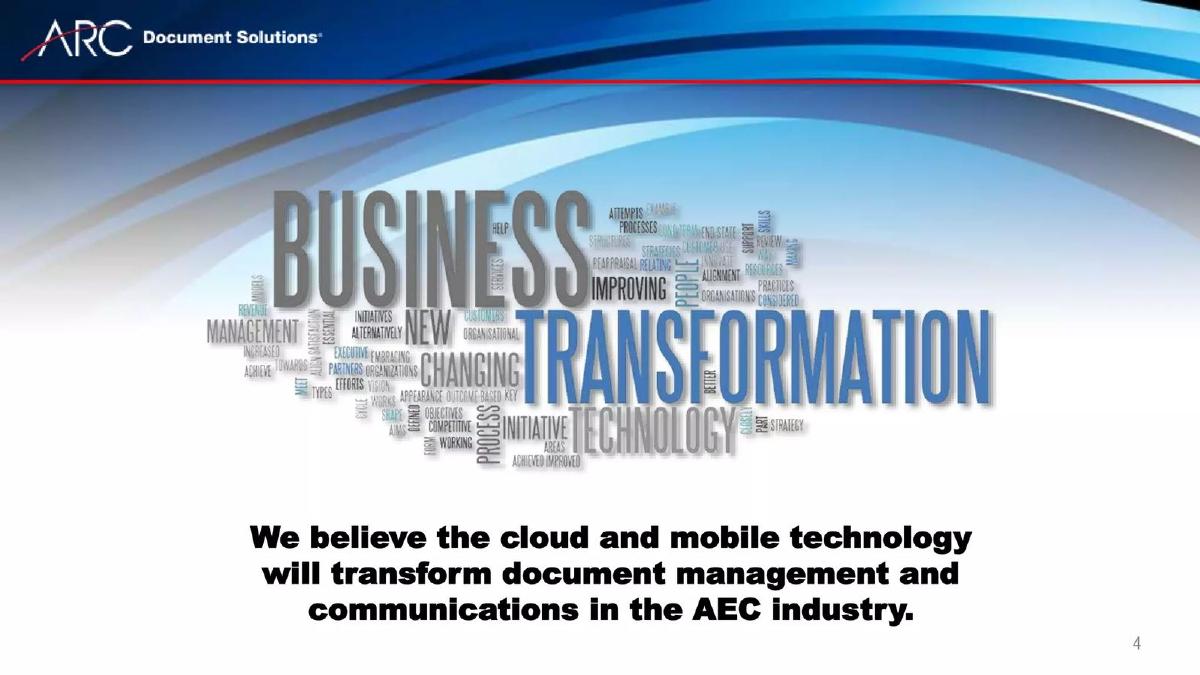
Slide 4 serves as the vision statement. Using a word cloud featuring terms like "Business Transformation," "Technology," and "Changing," the company explicitly states its belief: "the cloud and mobile technology will transform document management and communications in the AEC industry." This slide is designed to shift the investor's perception of ARC from a "print shop" to a "tech enabler."
Slide 7: Quantifying the Problem
This is one of the most effective slides in the deck because it uses specific, hard-hitting metrics to justify the business model. ARC claims that for most customers:
Average annual print cost per person is $2,500 to $3,500. · Document-related costs are the third largest office expense. · Printing costs twice as much as digital management. · Organization errors cause delays of days or weeks. · Storage boxes are left untouched for 16 years.
Analysis: By framing the status quo as wasteful and inefficient, ARC creates a vacuum that only their digital solutions can fill.
Slide 10: The CDIM Solution
Slide 10 introduces "CDIM" (Construction Document & Information Management). It defines CDIM as a suite of cloud-based tools to manage and distribute construction documents. The slide identifies "SKYSITE" as the primary technology. It also lists supporting services like BIM (Building Information Modeling) and file conversion, alongside hardware such as SmartScreens and tablets. This slide bridges the gap between software and the physical job site.
Slide 13: The Unified Digital Hub
This slide uses a visual metaphor to show the convergence of three service lines: CDIM, MPS (Managed Print Services), and AIM (Archive and Information Management). All three are shown being "sucked" into a tablet screen. The messaging is clear: ARC provides a "single location where all documents, and all information... are available anytime, anywhere, on any device."
Slide 16: The Investment Opportunity
Slide 16 summarizes the bull case for the stock. Key points include:
Transformation to a business with a bigger addressable market. · Annual recurring revenue (ARR) representing 34% of net sales via MPS. · A management team of "entrepreneurial veterans." · An explicit claim that the "Stock is undervalued" due to a lack of market awareness regarding the company's transformation.
Analysis: The mention of 34% recurring revenue is a critical signal to investors who value predictable cash flows over transactional print orders.
Slide 17: Financial Leverage and Performance
This is the data-heavy slide. It provides three years of quarterly data (Q1 '13 to Q1 '15) across three metrics: Revenue, Gross Margin, and Adjusted EBITDA. Notable figures include:
Gross Margin improvement from 32.4% in Q1 '13 to 34.5% in Q1 '15. · A 40% YOY growth in Free Cash Flow ($29.1mm to $40.7mm). · The mention of $85mm in NOLs (Net Operating Losses), which is a significant tax asset that protects cash flow.
Analysis: The charts show a company that is successfully "leveraging fixed costs" to improve margins even when revenue is relatively flat (fluctuating between $100mm and $109mm per quarter).
Slide 22: Closing and Contact
The deck concludes with a standard thank you and contact information for David Stickney, VP of Corporate Communications & IR. This reinforces that the deck is a tool for Investor Relations rather than a venture capital pitch.
What ARC Document Solutions Does Well
The deck excels at identifying a specific, high-friction problem within a niche industry (AEC). By quantifying the cost of paper—specifically the $3,500 per person print cost—they make the ROI of their digital transition feel inevitable. They also do a masterful job of highlighting their "hidden" financial assets, such as the $85 million in NOLs, which makes the company more attractive to value investors who care about cash flow efficiency.
What is Missing from the Deck
Despite being an "Investor Overview," the provided slides lack a few critical components:
Competitive Landscape: There is no mention of other cloud-based construction software (like Procore or Autodesk), which were significant competitors in 2015. · Churn Metrics: While they tout 34% recurring revenue, they do not provide retention or churn rates for their MPS or SKYSITE customers. · Detailed Team Slide: While they mention a "management team of experienced veterans," the specific bios and track records of the leadership are not included in this selection. · Market Size (TAM): They claim a "bigger addressable market" but do not provide a dollar figure for the total opportunity in AEC digital transformation.
Founder's Playbook: What to Copy
Use Comparative Cost Metrics: If you are disrupting a legacy process, use Slide 7 as a template. Don't just say you are "better"; say the old way costs $3,500 per person and that 90% of the physical output is never used. Hard numbers on the inefficiency of the status quo are incredibly persuasive.
Highlight Tax and Cash Flow Efficiencies: If your company has unique financial advantages like NOLs or high depreciation that shields cash, call it out. Investors, especially in the later stages, aren't just buying a product; they are buying a cash flow stream. ARC’s focus on Free Cash Flow growth (40%) is a strong closing argument.
Visual Convergence: Slide 13 is a great way to show how disparate product lines come together into a single user experience. If your product suite feels fragmented, use a "unified hub" visual to show how it all fits into the customer's pocket or tablet.
Frequently asked questions
- What is the primary industry ARC Document Solutions serves?
- ARC specifically targets the AEC (Architecture, Engineering, and Construction) industry. Their solutions are designed to manage the high volume of technical documents, blueprints, and project information required in large-scale construction projects, moving these workflows from physical paper to cloud-based mobile environments.
- How does ARC justify the need for digital transformation?
- The deck uses aggressive cost-saving metrics: annual print costs of $2,500 to $3,500 per person, and the claim that physical printing is twice as expensive as digital management. They also note that document organization errors can delay project schedules by weeks and that most physical storage boxes remain untouched for 16 years.
- What are the three main service pillars mentioned in the deck?
- The deck highlights CDIM (Construction Document & Information Management), MPS (Managed Print Services), and AIM (Archive and Information Management). These three pillars are presented as a unified ecosystem that allows documents to be available 'anytime, anywhere, on any device' via a central tablet interface.
- What financial metrics does the company emphasize to investors?
- The company focuses on 'Financial Leverage,' specifically highlighting revenue stability, gross margin growth, and Adjusted EBITDA. A key highlight is the $85 million in NOLs, which allows the company to convert a higher percentage of EBITDA into Free Cash Flow by avoiding cash taxes.
- What is the 'SKYSITE' product mentioned in the slides?
- SKYSITE is identified as ARC's 'Primary Technology.' It is a cloud-based suite of tools and services used to manage and distribute construction documents. It acts as the digital hub that connects their supporting services like hyperlinking and BIM with hardware like SmartScreens and tablets.