Lazy Creatures presents a highly specific, micro-scale fundraising effort focused on the loungewear market. The deck identifies a gap between high-end designers like Olivia von Halle and mass-market retailers like Old Navy, aiming to serve millennials who want stylish yet comfortable home attire. With a business model centered on monthly 'curated editions' and price points ranging from $36 to $108, the company leverages social proof from Kickstarter backers to validate demand. However, the deck is notably lean on financial projections, manufacturing logistics, and team background. The ask is…
Key takeaways
- The company is seeking a very specific micro-investment of $30,200 to reach product-market fit within six months (Slide 10).
- The problem is framed through personal anecdote and Reddit screenshots from the 'female fashion advice' community to demonstrate market demand (Slide 2).
- Social proof is provided via screenshots of Kickstarter backer comments and Instagram posts, indicating an existing customer base (Slide 4).
- The competitive landscape identifies a gap between 'mature' luxury brands and 'plain' mass-market loungewear extensions (Slide 6).
- The business model relies on monthly curated editions of 5-6 styles rather than a permanent large inventory (Slide 8).
- Pricing is set between $36 and $108 per garment, with shipping costs integrated into operational expenses (Slide 8).
- The use of funds is heavily weighted toward 'Overhead' at 45% ($13,500), which is high for a seed-stage product company (Slide 10).
- The deck lacks a dedicated team slide, financial history, or specific manufacturing details in the provided six slides.
Lazy Creatures Pitch Deck Analysis
Lazy Creatures enters the direct-to-consumer (DTC) apparel space with a focus on the 'athleisure' adjacent category of loungewear. The deck is structured as a narrative of personal discovery followed by community validation. It is a 'micro-deck' for a 'micro-raise,' targeting a specific dollar amount that suggests an angel or friends-and-family round rather than institutional venture capital.
Slide 1: Title Slide
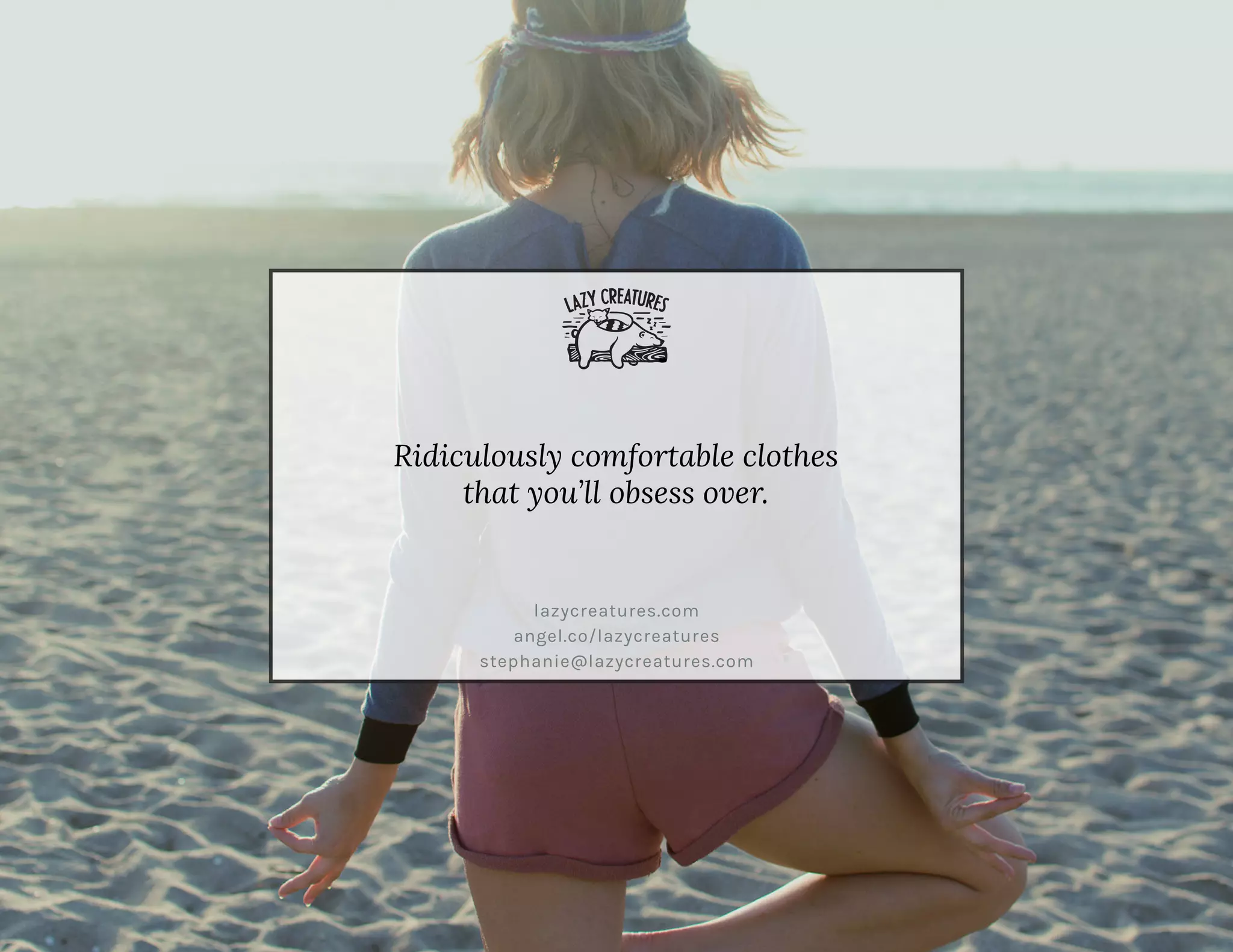
The title slide establishes the brand identity immediately. The logo features a stylized, sleeping animal (likely a sloth or bear) on a log, reinforcing the 'Lazy Creatures' name. The value proposition is stated simply: 'Ridiculously comfortable clothes that you’ll obsess over.' Contact information for 'Stephanie' and links to AngelList and the company website are included, signaling transparency and an existing digital footprint.
Slide 2: The Problem
Slide 2 uses a 'personal problem that many shared' framework. It dates the origin of the idea to 2011, providing a timeline of three years before finding online validation. The slide includes screenshots from Reddit’s 'female fashion advice' subreddit, showing users complaining about wearing 'old, ugly clothes' at home and the 'double standard' of dressing well for work but poorly for lounging. The slide concludes that most people are stuck between 'ratty old T-shirts' or 'activewear,' identifying a lack of affordable, cute loungewear.
Slide 4: Social Proof
Skipping to Slide 4, the company presents 'Social Proof' through Kickstarter backer comments. This is a critical slide for early-stage DTC brands as it proves that a) the product exists, b) people are willing to pay for it, and c) the quality meets expectations. Comments mention the softness of the fabric and the 'coral color.' Notably, one comment mentions a concern about a missing 'market bag,' which shows the founder is willing to include honest, unedited feedback, though it also hints at early fulfillment complexities.
Slide 6: Competitive Landscape
This slide categorizes competitors into two groups. The first group includes 'Traditional loungewear designers' like Olivia von Halle, Araks, Soma, and Cosabella, which are described as costly and tailored to a 'mature market.' The second group includes 'Major brands' like Old Navy, Anthropologie, Uniqlo, and Gap, which are criticized for having 'plain garments' that only serve the home. Lazy Creatures positions itself in the middle: chic, stylish, and comfortable for millennials, with the implication of a more accessible price point than luxury designers.
Slide 8: Business Model
The business model slide highlights a 'Quality > Quantity' philosophy. The 'Curated Editions' strategy involves monthly launches of 5-6 styles. This is a common tactic for modern DTC brands to maintain engagement and create a sense of scarcity/freshness. The 'Pricing Model' section lists garments between $36 and $108. A key operational detail is mentioned here: 'shipping costs built into operational expenses,' suggesting a 'free shipping' consumer-facing model which is standard for the industry but requires tight margin management.
Slide 10: Investment
The final provided slide is the 'Investment' ask. The figure is remarkably precise: $30,200. The stated goal is to reach product-market fit within six months. The breakdown is as follows:
Overhead (45% / $13,500): This is the largest category, which is unusual for such a small raise unless it covers the founder's basic salary or rent for a small studio/warehouse. · Product Development (22% / $6,700): Likely covering samples and initial production runs for the monthly editions. · Marketing & Advertising (20% / $6,000): A relatively small budget for a DTC brand, suggesting a reliance on organic growth or very high-efficiency spend. · Web Development (13% / $4,000): Likely for e-commerce site optimization.
What Works in This Deck
Authentic Problem Identification: By using actual Reddit threads, the founder proves that the 'problem' isn't just a personal whim but a documented consumer pain point. This is more effective than generic market charts for a niche lifestyle brand.
Clear Positioning: The competitive landscape slide does an excellent job of showing exactly where the brand sits. It doesn't claim to have no competitors; instead, it explains why existing options fail the target demographic (millennials).
Low Barrier to Entry: The small ask makes this an easy 'yes' for a group of angel investors. It shows the founder is focused on the immediate next milestone (product-market fit) rather than asking for millions before the model is proven.
What Is Missing
The Team: There is no slide detailing the founder's background. In apparel, experience in sourcing, design, or supply chain management is vital. Investors need to know if 'Stephanie' can actually manage production at scale.
Unit Economics: While the retail prices are listed ($36-$108), the deck does not disclose the Cost of Goods Sold (COGS). Without knowing the margins, it is impossible to tell if the $30,200 will actually lead to a sustainable business or just fund one more production cycle.
Manufacturing and Supply Chain: There is no mention of where the clothes are made or how the supply chain is managed. For a brand touting 'quality,' the source of the materials and the ethical standards of the factories are increasingly important to the target millennial demographic.
Growth Strategy: Beyond 'Marketing & Advertising,' there is no detail on how the brand will acquire customers. Will they use influencers, SEO, or paid social? A $6,000 budget disappears quickly in the world of Facebook and Instagram ads.
Founder's Takeaway
The Lazy Creatures deck is a textbook example of a 'Phase 1' pitch. It successfully uses social proof and community feedback to validate a niche. However, to move beyond a hobbyist or micro-business level, the founder would need to provide much deeper financial clarity. If you are copying this style, ensure your 'Social Proof' is as strong as theirs, but don't neglect the 'Team' slide—investors at this stage are buying into the person as much as the product. The precision of the $30,200 ask is a double-edged sword; it shows you know your costs, but it can also look like you haven't accounted for the inevitable 'unknown unknowns' that plague apparel startups.
Frequently asked questions
- What is the specific market gap Lazy Creatures aims to fill?
- According to Slide 6, the company targets a 'niche market of millennials' who find traditional loungewear designers too expensive or aesthetically tailored to a mature market, and find mass-market brands like Gap or Uniqlo too plain or limited to home-only use. They aim to provide 'chic and stylish' options that can be dressed up or down.
- How does the company plan to release new products?
- Slide 8 outlines a 'Curated Editions' model where products are launched monthly. Each edition contains 5 to 6 styles. This approach emphasizes quality over quantity and includes styling advice to show customers how to wear the items for different occasions, potentially reducing inventory risk compared to traditional seasonal cycles.
- What is the current stage of the company based on the deck?
- The company is in the post-Kickstarter, pre-product-market fit stage. Slide 4 shows comments from Kickstarter backers, confirming that at least one production run has occurred and items have been shipped. Slide 10 explicitly states the goal of the current $30,200 raise is to 'reach product/market fit in 6mo.'
- How is the requested investment of $30,200 allocated?
- Slide 10 breaks down the investment into four categories: 45% ($13,500) for Overhead, 22% ($6,700) for Product Development, 20% ($6,000) for Marketing & Advertising, and 13% ($4,000) for Web Development. The high allocation to overhead suggests the founder may be looking to cover basic living or warehouse expenses during the six-month push.
- What critical information is missing from this pitch deck?
- The deck omits several standard investor requirements, including a team slide (though a founder named Stephanie is mentioned in comments), unit economics (CAC/LTV), a detailed manufacturing/supply chain plan, and long-term financial projections. There is also no mention of the total addressable market (TAM) size in the provided slides.