The 2017 SpaceX Series H deck, used to raise $100M, serves as a technical manifesto for the Big Falcon Rocket (BFR) and the company's long-term Mars ambitions. Rather than focusing on traditional SaaS metrics or market size, the deck leverages SpaceX's historical launch cadence—growing from 2 launches in 2012 to a projected 30 in 2018—to build credibility for its next phase. The core of the presentation is the BFR, a fully reusable vehicle designed to deliver 150 tons to Low Earth Orbit, dwarfing the Saturn V's 135-ton capacity. By detailing the 'Value of Refilling' and specific Mars mission…
Key takeaways
- SpaceX demonstrated a significant scaling of operations, increasing from 2 launches in 2012 to 15 as of October 2017 (Slide 4).
- The BFR architecture targets a 150-ton payload capacity to Low Earth Orbit with full reusability, compared to the Falcon Heavy's 30-ton partial reuse (Slide 5).
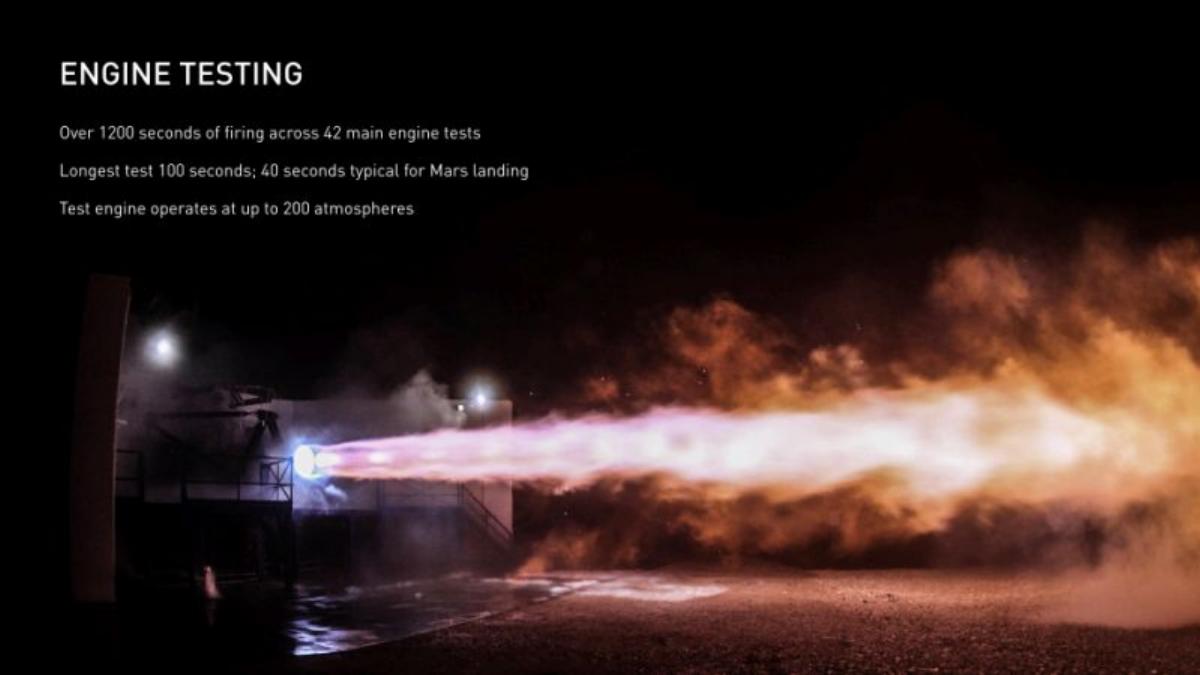
- Engine testing for the Mars landing typical profile requires 40 seconds, while SpaceX had achieved tests up to 100 seconds (Slide 3).
- The BFR ship is designed with a pressurized volume of 825 cubic meters, which the deck notes is greater than an A380 main deck (Slide 7).
- Orbital refilling is the critical enabler for deep space missions, allowing a ship to regain full Delta-V capability after reaching Earth orbit (Slides 10-11).
- The company set specific milestones for Mars: at least 2 cargo missions in 2022 and 2 crew/cargo missions in 2024 (Slide 16).
- The Raptor engine operates at a chamber pressure of 250 bar with a throttle range of 20% to 100% thrust (Slide 8).
- SpaceX positions the BFR as a multi-purpose vehicle capable of ISS docking, Moon Base Alpha support, and Earth-to-Earth transport (Slides 13, 14, 20).
The Vision of a Multiplanet Species
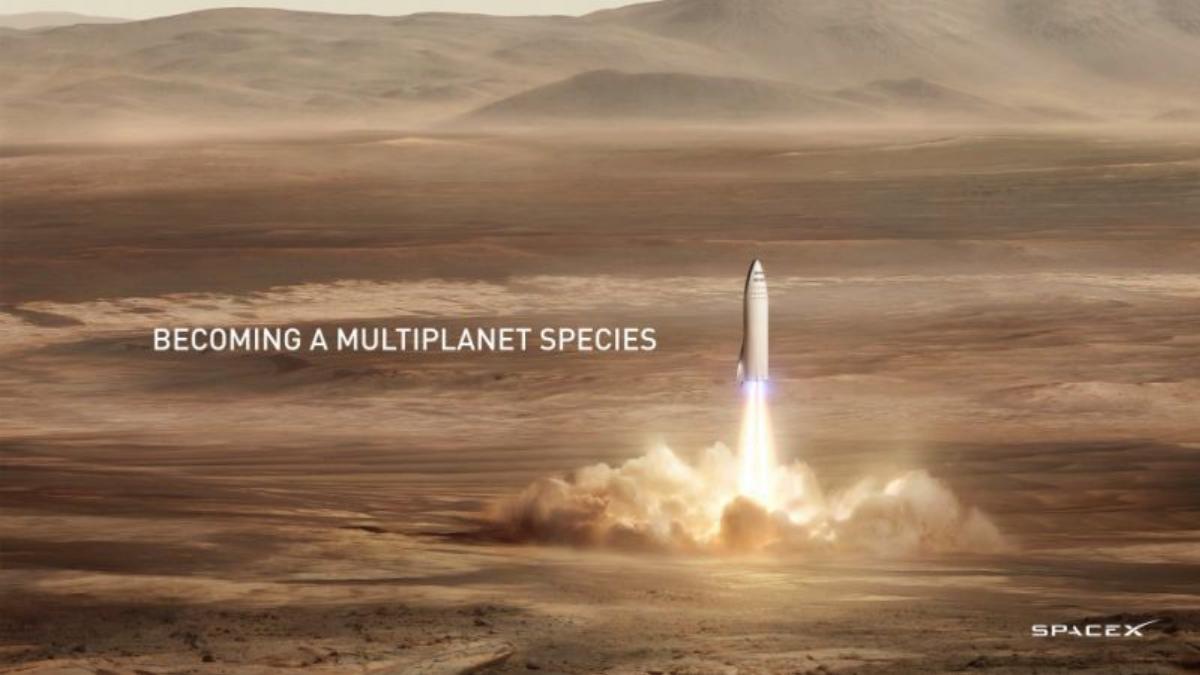
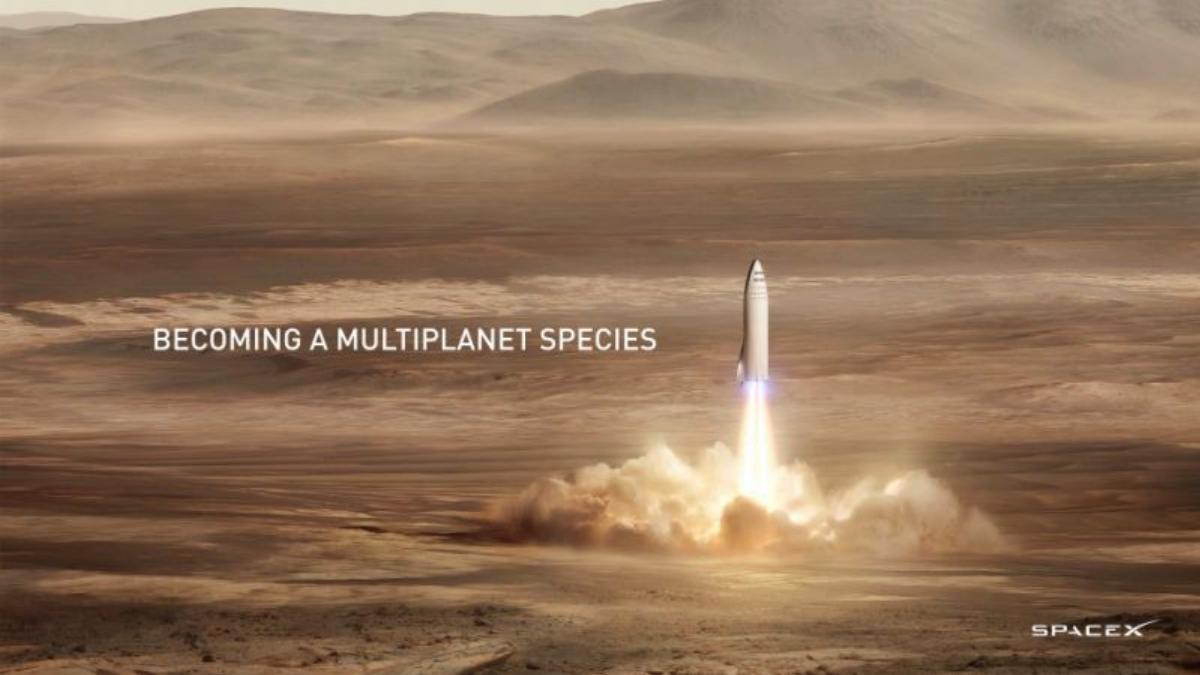
The SpaceX Series H pitch deck from 2017 is not a typical startup presentation. It does not open with a problem statement about market inefficiencies or a slide about a billion-dollar TAM (Total Addressable Market). Instead, it opens with a high-resolution render of a rocket landing on a dusty, red horizon under the title "BECOMING A MULTIPLANET SPECIES" (Slide 1). This sets the tone for the entire document: this is a technical roadmap for a civilizational shift, funded by a B2B launch business.
Establishing Credibility Through Progress
Before diving into the futuristic BFR (Big Falcon Rocket) architecture, SpaceX spends the first few slides grounding the investor in reality. Slide 2, titled simply "PROGRESS," acts as a divider between the vision and the proof. Slide 3 provides hard data on "ENGINE TESTING," noting over 1,200 seconds of firing across 42 main engine tests. It specifically highlights that while a typical Mars landing requires 40 seconds of firing, they have already achieved a 100-second test. This is a classic engineering de-risking tactic: prove the component works under conditions more strenuous than the actual mission requires.
Slide 4, "LAUNCH RATE," is perhaps the most important business slide in the deck. It shows a bar chart of successful launches by year: 2 in 2012, 3 in 2013, 6 in 2014, 7 in 2015, 8 in 2016, and 15 as of October 15, 2017. The projection for 2018 is 30 launches. This 15x growth in launch cadence over five years provides the necessary evidence that SpaceX is no longer a research project, but a high-output manufacturing and operations company.
The BFR Architecture: Scaling Reusability
The core of the deck (Slides 5 through 9) introduces the BFR. Slide 5, "VEHICLE COMPARISON," uses a payload mass chart to show the leap in capability. While the Falcon 1 was expendable and the Falcon 9 and Falcon Heavy (FH) offered "PARTIAL REUSE," the BFR is labeled "FULL REUSE." The payload capacity jumps from FH's ~30 tons to BFR's 150 tons. A silhouette of a human next to the rockets provides a sense of scale, showing the BFR standing at 106 meters tall with a 9-meter diameter.
Slides 6 and 7 break down the ship's specifications. The ship has a dry mass of 85t and a propellant mass of 1,100t. The "MARS TRANSIT CONFIGURATION" (Slide 7) is particularly detailed, boasting 825 cubic meters of pressurized volume—noting this is "Greater than an A380 main deck." The inclusion of 40 cabins and a "solar storm shelter" transitions the narrative from cargo delivery to human habitation.
The Raptor Engine and Launch Capability
Slide 8 focuses on the "RAPTOR ENGINES," the propulsion units for the BFR. It lists technical specs: a chamber pressure of 250 bar and a throttle range of 20% to 100%. The ship uses two sea-level engines (1,700 kN thrust each) and four vacuum engines (1,900 kN thrust each). By providing specific Isp (Specific Impulse) values—330s to 375s—SpaceX is speaking directly to technical due diligence teams.
Slide 9, "ROCKET CAPABILITY," places the BFR in a historical context. It compares the payload to Low Earth Orbit (LEO) across various global rockets. The BFR's 150-ton capacity is shown to surpass the Saturn V (135 tons), which was the previous benchmark for heavy lift. This slide effectively argues that SpaceX is not just competing with current market players like Ariane 5 or Delta IV Heavy, but is surpassing the greatest achievements of the Apollo era.
Orbital Refilling: The Mission Enabler
Slides 10 and 11 address the most significant hurdle in deep space travel: fuel. Under the heading "VALUE OF REFILLING," SpaceX uses graphs to show how Delta-V (velocity change) decreases as payload mass increases. Slide 11 demonstrates that by using "TWO TANKERS" to refill the ship in Earth orbit, the BFR can maintain its 150-ton payload capacity for missions beyond LEO. This architecture allows the ship to leave Earth's gravity well with full tanks, a requirement for reaching Mars with significant cargo.
Multi-Mission Versatility
After establishing the Mars architecture, the deck pivots to show the BFR's immediate commercial utility. Slide 12, "BFR CAPABILITIES," leads into renders of the ship docking with the "INTERNATIONAL SPACE STATION" (Slide 13) and supporting "MOON BASE ALPHA" (Slide 14). This is a subtle but vital point for investors: the same hardware developed for Mars can be monetized in the existing LEO and lunar markets. The Moon Base Alpha slide shows the BFR using a crane to offload cargo, suggesting a role in lunar infrastructure development.
The Mars Roadmap
The final section of the deck outlines the path to colonization. Slide 15, "MARS TRANSPORTATION ARCHITECTURE," is a complex diagram showing the six-step process from Earth launch to Mars ascent and return. It introduces the concept of "ISRU" (In-Situ Resource Utilization), where the ship is refilled on Mars using local H2O and CO2 to produce CH4 (methane) and O2 (oxygen) for the return trip.
Slide 16, "INITIAL MARS MISSION GOALS," provides a concrete timeline. For 2022, the goal is to land at least 2 cargo ships to confirm water resources and place power infrastructure. For 2024, the goal is 2 crew ships and 2 cargo ships to set up a propellant production plant. Slides 17, 18, and 19 show the evolution of a Mars base from a few landed ships to a sprawling, illuminated city. The final slide (Slide 20) is a call to action to "WATCH EARTH TO EARTH FILM," hinting at the BFR's potential to disrupt long-haul terrestrial travel by flying passengers between cities in under 30 minutes.
What Makes This Deck Effective?
The SpaceX deck succeeds because it treats a fantastical goal with the sobriety of an engineering report. By the time the investor reaches the slides of a Mars city, they have already been briefed on engine chamber pressures, payload mass ratios, and historical launch successes. The deck builds a logical ladder: if we can launch 30 times a year (Slide 4), and if the Raptor engine works (Slide 8), and if we can refill in orbit (Slide 11), then a Mars base (Slide 18) is a matter of execution, not magic.
Furthermore, the visual quality is exceptional. The use of high-contrast renders against black backgrounds keeps the focus on the hardware. The data is presented clearly, with minimal text, allowing the scale of the rockets and the beauty of the destinations to do the heavy lifting.
What Is Missing From the Deck?
As a fundraising analyst, the omissions in this deck are striking. There is a total absence of traditional business metrics. Specifically, the deck lacks:
Financial Projections: There are no slides showing expected revenue from BFR launches, the cost to build a single BFR, or the projected ROI for a Mars mission. · Unit Economics: While reusability is mentioned, the deck does not quantify the cost savings per kilogram compared to the Falcon 9. · Competition: There is no mention of Blue Origin, ULA, or national space agencies as competitors. SpaceX positions itself as being in a class of its own. · Team: There is no slide detailing the experience of the engineering team or leadership. In a Series H, it is assumed the investors already know Elon Musk and his top lieutenants. · The Ask: The deck does not state how much money is being raised or how the funds will be allocated between BFR development and Falcon 9 operations.
These omissions suggest that SpaceX was raising from a position of extreme strength, where the technical roadmap was the only information the investors required to commit capital.
Founder Takeaways: What to Copy
Founders in deep tech or hardware can learn several lessons from this deck:
Lead with Proof: SpaceX didn't start with Mars; they started with their 2012-2017 launch record. Always anchor your future claims in past performance. · Use Comparative Scale: The use of a human silhouette and the comparison to the A380 and Saturn V makes abstract numbers (825 cubic meters, 150 tons) immediately relatable. · Solve the 'How' Before the 'What': Before showing the Mars city, SpaceX explained the orbital refilling and ISRU fuel production. They addressed the biggest technical skeptics first. · Visual Consistency: The deck feels like a single, cohesive story because of its consistent color palette and high-quality imagery. It looks like it belongs to a company that values precision.
In summary, the SpaceX Series H deck is less of a pitch and more of a mission briefing. It assumes the investor is already sold on the 'why' and uses 20 slides to explain the 'how' through the lens of relentless engineering progress.
Frequently asked questions
- What is the primary business case presented in the deck?
- The deck focuses on the transition from the Falcon 9 and Falcon Heavy to the BFR (Big Falcon Rocket). The business case is built on the economies of scale provided by full reusability and orbital refilling. By increasing payload capacity to 150 tons while making the entire system reusable, SpaceX aims to radically lower the cost per ton to orbit, enabling both commercial Earth-orbit missions and interplanetary colonization.
- How does SpaceX use historical data to justify future claims?
- Slide 4 is pivotal, showing a clear upward trajectory in launch frequency. By proving they could scale from 2 launches in 2012 to 15 in mid-2017, they establish 'Progress' (Slide 2) as a core competency. This historical reliability serves as the foundation for the more speculative engineering claims regarding the BFR and Mars missions.
- What are the technical specifications for the Mars transit vehicle?
- The BFR ship is detailed as having a 48m length, 9m body diameter, and an 85t dry mass. For Mars transit, it is configured with 40 cabins, large common areas, a galley, and a solar storm shelter. It utilizes a combination of two sea-level Raptor engines and four vacuum Raptor engines to achieve the necessary thrust and efficiency for different flight phases.
- What is the 'Value of Refilling' mentioned in the deck?
- Orbital refilling is presented as the solution to the 'tyranny of the rocket equation.' Slides 10 and 11 show that a single launch to Earth orbit leaves a ship with limited Delta-V for deep space. By sending 'tanker' versions of the BFR to refill the ship in orbit, the payload capacity to Mars is maintained at the full 150 tons, rather than being depleted by the fuel required to leave Earth's gravity.
- Does the deck include financial projections or a team slide?
- No. The 20 slides provided focus exclusively on engineering, mission architecture, and historical launch volume. There are no slides detailing revenue, burn rate, profit margins, or the executive team. This suggests the Series H round was likely predicated on technical milestones and the vision of the founder rather than traditional financial metrics.