SpatzAI is a real-time micro-conflict manager designed to address unfair feedback as it happens, rather than relying on retrospective surveys or HR interventions. The deck introduces a proprietary 4-level conflict hierarchy—Ripple, Spat, Dispute, and Conflict—each requiring specific levels of accountability ranging from verbal acknowledgment to formal apologies. By capturing this behavioral data, the company aims to train Large Language Models (LLMs) in objectivity and bias detection. The business model follows a standard SaaS freemium structure with a $4/user/month Pro tier. While the deck p…
Key takeaways
- The product centers on a 'Spatz Team 3-Step Chat App' designed to facilitate real-time objections to unfair feedback (Slide 2).
- Conflict is categorized into four distinct levels: Ripple, Spat, Dispute, and Conflict, with corresponding accountability requirements (Slide 4).
- The platform aims to generate behavioral data to train LLMs in objectivity, bias detection, and fair reasoning (Slide 4).
- Positioning is defined by resolving conflicts 'before HR needs to,' moving away from top-down hierarchies to peer-led resolution (Slide 6).
- Revenue is structured through a freemium model, including a $4 per user per month Pro tier and future white-label licensing (Slide 8).
- Founder Desmond Sherlock brings over 40 years of experience in behavior systems and insurance models, including building Tripcover and Bonzah (Slide 10).
- The development team is distributed across India and Vietnam, utilizing a tech stack that includes Firebase, AWS, and Slack (Slide 10).
- The deck omits a specific funding ask, current user traction, and a detailed Go-To-Market strategy (Slides 1-10).
Executive Summary: Digitizing Workplace Harmony
SpatzAI enters the crowded HR-tech and productivity space with a highly specific value proposition: the resolution of 'micro-conflicts.' The deck, dated August 2025, positions the company as a 'real-time micro-conflict manager.' Unlike traditional employee engagement tools that rely on periodic surveys or retrospective incident reports, SpatzAI attempts to institutionalize a protocol for immediate, peer-led resolution. The deck is structured to move from the philosophical need for psychological safety to a technical framework for conflict escalation, concluding with a team overview and a standard SaaS revenue model.
Slide 1: Title and Vision
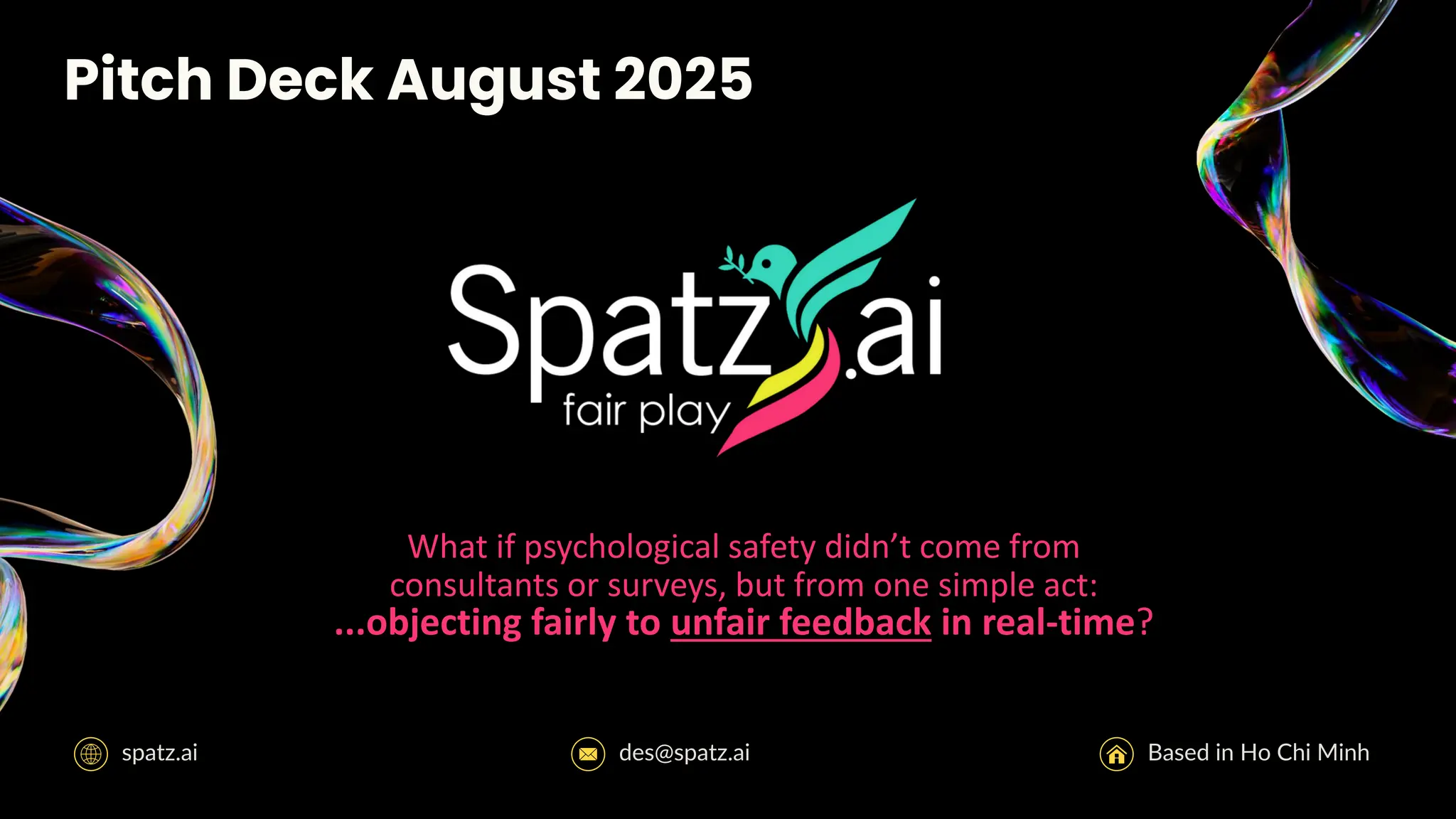
The cover slide introduces the company name, SpatzAI, with the tagline 'fair play.' It immediately establishes the core problem-solving angle with a rhetorical question: 'What if psychological safety didn't come from consultants or surveys, but from one simple act: objecting fairly to unfair feedback in real-time?' The slide also notes the company's base in Ho Chi Minh City and provides a contact email for the founder. The visual theme uses dark backgrounds with colorful, fluid shapes, which is maintained throughout the presentation.
Slide 2: The Solution
Slide 2 defines the product as a 'real-time micro-conflict manager.' It lists four primary components of the SpatzAI ecosystem: Spatz Team Charter Agreement , Spatz Team 3-Step Chat App , Spatz Team & AI Review Platform , and Spatz AI Team LLM Data . The stated goal is to build trust and psychological safety 'on the fly' by addressing issues as they happen, rather than waiting for external fixes. This slide is critical because it moves the concept from a vague 'culture tool' to a specific set of software deliverables.
Slide 4: The Spatz AI Objective LLM Data
This is the most detailed slide in the deck, outlining the proprietary conflict hierarchy. It categorizes conflict into four levels:
0. Ripple: Requires a verbal caution and verbal acknowledgment. · 1. Spat: Requires a caution via the chat app and acknowledgment on the app. · 2. Dispute: Requires an objection via the chat app and a simple apology. · 3. Conflict: Triggers a 'Stop' phase, involving a team review and a formal 'acceptable apology' on the app.
Beyond the protocol, the slide explains the data play. By tagging these conflicts, SpatzAI measures 'time to resolution' and generates behavioral data to train LLMs in objectivity and bias detection. This suggests the company views itself as a data company as much as a software-as-a-service provider.
Slide 6: Value Proposition & Positioning
Slide 6 attempts to differentiate SpatzAI from existing HR tools. It claims to be the 'first system that resolves conflict before HR needs to.' The positioning focuses on three unique value points: real-time response to manager friction, built-in behavioral accountability, and a peer-led design that bypasses traditional top-down hierarchies. This is a bold claim, as it suggests the software can replace or significantly augment traditional management roles in conflict mediation.
Slide 8: Business / Revenue Model
The revenue model is a standard SaaS freemium approach. The 'Pro tier' is priced at $4/user/month , which is competitive within the productivity tool market. The 'Enterprise tier' includes analytics and HR integrations, though specific pricing for this tier is not disclosed. The slide also lists 'Future revenue' sources, including white-label licensing, psychosocial compliance packages, and a data analytics subscription for anonymized micro-conflict insights. This indicates a long-term strategy to monetize the aggregate data generated by the platform.
Slide 10: Team Presentation
The team slide focuses heavily on the founder, Desmond Sherlock . His bio highlights 40+ years of experience in behavior systems and a background as an industrial designer. He is credited with building Tripcover and Bonzah, and leading the Quitober social health campaign. The slide also mentions a development team based in India and Vietnam with expertise in Firebase, AWS, and Slack. Notably, the slide mentions 'ongoing recruitment' for behavioral science experts, suggesting the team is still in a growth or formation phase regarding its subject matter expertise.
What Works in This Deck
The SpatzAI deck succeeds in defining a very specific niche. Many HR-tech decks are vague about how they actually improve culture; SpatzAI provides a concrete, four-level protocol that investors can visualize. The 'Conflict Level' table on Slide 4 is the strongest asset in the deck, as it transforms a soft skill (conflict resolution) into a hard, measurable process. Furthermore, the inclusion of a specific price point ($4/user/month) and a clear tech stack (Firebase/AWS/Slack) gives the impression of a product that is ready for, or already in, development.
What Is Missing
While the conceptual framework is strong, the deck is missing several pillars of a standard venture capital pitch:
Traction: There is no mention of current users, pilot programs, or waitlist numbers. Without this, it is impossible to gauge market fit. · The Ask: The deck does not state how much money is being raised, the valuation, or the intended use of funds. · Market Size (TAM/SAM/SOM): There is no analysis of the total addressable market for conflict resolution tools. · Competitor Analysis: While Slide 6 mentions 'existing tools,' it does not name them or provide a feature-by-feature comparison against incumbents like Lattice, CultureAmp, or even Slack's own native features. · Financial Projections: There are no charts showing expected revenue growth or burn rate over the next 18-24 months.
Founder Advice: Strengthening the Pitch
To move from a conceptual presentation to a fundable investment deck, the founders should focus on proving the protocol works. A slide dedicated to a case study or pilot program results—showing a reduction in 'time to resolution' or an increase in 'psychological safety scores'—would be highly persuasive. Additionally, the 'LLM Data' angle is a significant claim; the deck would benefit from explaining how the data is anonymized and how the AI actually assists in the 'Stop' phase of a conflict. Finally, adding a clear financial ask and a roadmap of milestones would transform this from a product overview into a business proposition.
Frequently asked questions
- What is the core conflict resolution mechanism in SpatzAI?
- The core mechanism is a structured escalation protocol. It starts with a 'Ripple' (verbal caution), moves to a 'Spat' (chat app caution), then a 'Dispute' (chat app objection), and finally a 'Conflict' (stop phase). Each level requires a specific response, such as a verbal acknowledgment for a Ripple or an 'acceptable apology' for a Conflict, ensuring that friction is addressed immediately and documented.
- How does SpatzAI plan to use AI beyond simple automation?
- According to Slide 4, SpatzAI intends to use the behavioral data generated by its users to train Large Language Models (LLMs). The goal is to create models that excel in objectivity, bias detection, and fair reasoning. By tagging and categorizing micro-conflicts, they are building a proprietary dataset of human conflict resolution patterns.
- What is the pricing strategy for the platform?
- SpatzAI utilizes a freemium SaaS model. There is a free tier for small teams, a Pro tier priced at $4 per user per month, and an Enterprise tier that includes advanced analytics and HR integrations. Future revenue streams are projected to come from white-label licensing and data analytics subscriptions for micro-conflict insights.
- Who is leading the development of SpatzAI?
- The company is led by Desmond Sherlock, an industrial designer with 40 years of experience in behavior systems. He has a track record in the insurance sector (Tripcover, Bonzah) and social health (Quitober). The technical execution is handled by a development team based in India and Vietnam, specializing in Firebase, AWS, and Slack integrations.
- What critical information is missing from this pitch deck?
- The deck lacks several standard components required for a full investment evaluation. There are no slides showing current traction (user numbers or revenue), no competitive analysis against existing HR tech or feedback tools, no financial projections, and most notably, no 'Ask' slide detailing how much capital is being raised and how it will be spent.