Beatstoc's confidential June 2018 investor deck raises $5 million for a platform selling 'PoP's' — Pieces of Popularity — to fans through 'Initial Fan Offerings'. The mechanism slide is genuinely well built, and half the raise is correctly aimed at artist acquisition. But three months after launching a beta, the deck contains no users, no named artists and no unit economics, and 86-90% of a $421 million year-three projection comes from the one revenue line it never explains. For an instrument that plainly raises securities questions in 2018, there is no regulatory slide at all.
Key takeaways
- Beatstoc's June 2018 confidential deck seeks $5 million on top of $5 million it says was already secured, split 50% artist acquisition, 25% Phase 2 platform development, 25% go-to-market content production.
- The product sells 'PoP's' (Pieces of Popularity) to fans through an 'Initial Fan Offering', renewable annually like season tickets, creating what the deck calls a new royalty for the artist.
- The deck says beta testing launched in March 2018 but reports no users, no artists, no PoP's sold and no revenue from those three months.
- Projected revenue runs $31.9 million in 2018, $152.2 million in 2019 and $421.2 million in 2020, with net income moving from a $1.07 million loss to $49.2 million.
- Initial Fan Offerings account for roughly 86-90% of every projected year's revenue, and the deck states no assumptions for artists onboarded, PoP price, conversion or renewal.
- Beatstoc Live gets a full slide of imagery but is projected at $42,500 of 2018 revenue, under 0.4% of the model.
- There is no market sizing, no competition slide and no mention of Patreon, Bandcamp, royalty marketplaces or fan tokens, all of which existed in 2018.
- Selling a popularity-linked royalty in 2018 is a securities question, and the deck contains no exemption, counsel opinion or regulatory slide anywhere in its 14 pages.
What this deck actually is
This is a confidential investor deck from Beatstoc, Inc., dated June 2018, fourteen pages long, distributed under a full legal disclaimer that asks recipients to return it on request. It is not a product deck, not a credentials deck and not a recreation — it is the document the company sent to accredited investors while raising a $5 million round on top of $5 million it says it had already secured.
The idea underneath it is genuinely interesting, and it is the reason this deck is worth reading in 2026 rather than filing under crypto-era curiosities. Beatstoc proposed selling "PoP's" — Pieces of Popularity — to fans through an "IFO", an Initial Fan Offering. An artist offers a limited number of PoP's; fans buy them; the artist gets a new royalty stream tied to their popularity; the fan gets exclusive content, streaming, live events and, in the deck's own framing, participation in "the popularity experiences of artists". PoP's renew annually, like season tickets.
Strip the vocabulary away and this is a fan-financed revenue-share security launched in the same year the SEC was issuing subpoenas across the ICO market. That single fact should dominate the deck. It appears nowhere in it. What the fourteen slides contain instead is a philosophy section, a team page, a wine-and-living-room fantasy about Beatstoc Live, one financial table projecting $421 million of revenue in year three, and a request for money.
Slide-by-slide walkthrough
Slide 1 — Title
"Beatstoc, Inc. Confidential June, 2018." No tagline, no one-line description, no logo lockup carrying meaning. The cover of an investor deck is the cheapest positioning real estate a founder will ever own, and this one spends it on a date stamp and a confidentiality label. An investor who opens this file on a phone between meetings has learned nothing by the time they swipe.
Slide 2 — Overview and key highlights
The strongest writing in the deck arrives immediately: "New Relationship. New Royalty. New Reality." Below it, the mechanism in two sentences — Beatstoc is "an exclusive experience platform that sells pieces of artists' Popularity (PoP's) to their most loyal fans", with PoP's acting as season tickets renewable every year.
Then the highlights box, which is where the deck starts to leak credibility: platform "currently in final stage of development"; "Beta testing, launched in March, 2018"; "$5 million in capital secured to date"; "LOI's signed with artists"; "Strong and experienced management team". Four of those five are unfalsifiable. Beta launched in March 2018 and this deck is dated June 2018 — three months of beta and not one number from it. How many fans, how many artists, how many PoP's sold, what the renewal behaviour looked like, what the average order value was. Nothing. "LOI's signed with artists" without a count or a single name is the weakest possible version of the single most important proof point this business needed.
Slide 3 — An Industry Out Of Rhythm
A wall of prose that walks from cassettes to CDs to downloads to streaming and lands on the accurate observation that streaming yields "very little, if any, income" for artists while stripping the direct engagement fans used to get from physical media. The argument is correct and well known. What is missing is the number that would make it a problem worth funding: no per-stream payout figures, no artist income distribution, no count of artists below a living wage, no size of the fan-to-artist direct spend market. Roughly 180 words of prose where three data points would have been stronger.
Slide 4 — Rewriting The Narrative
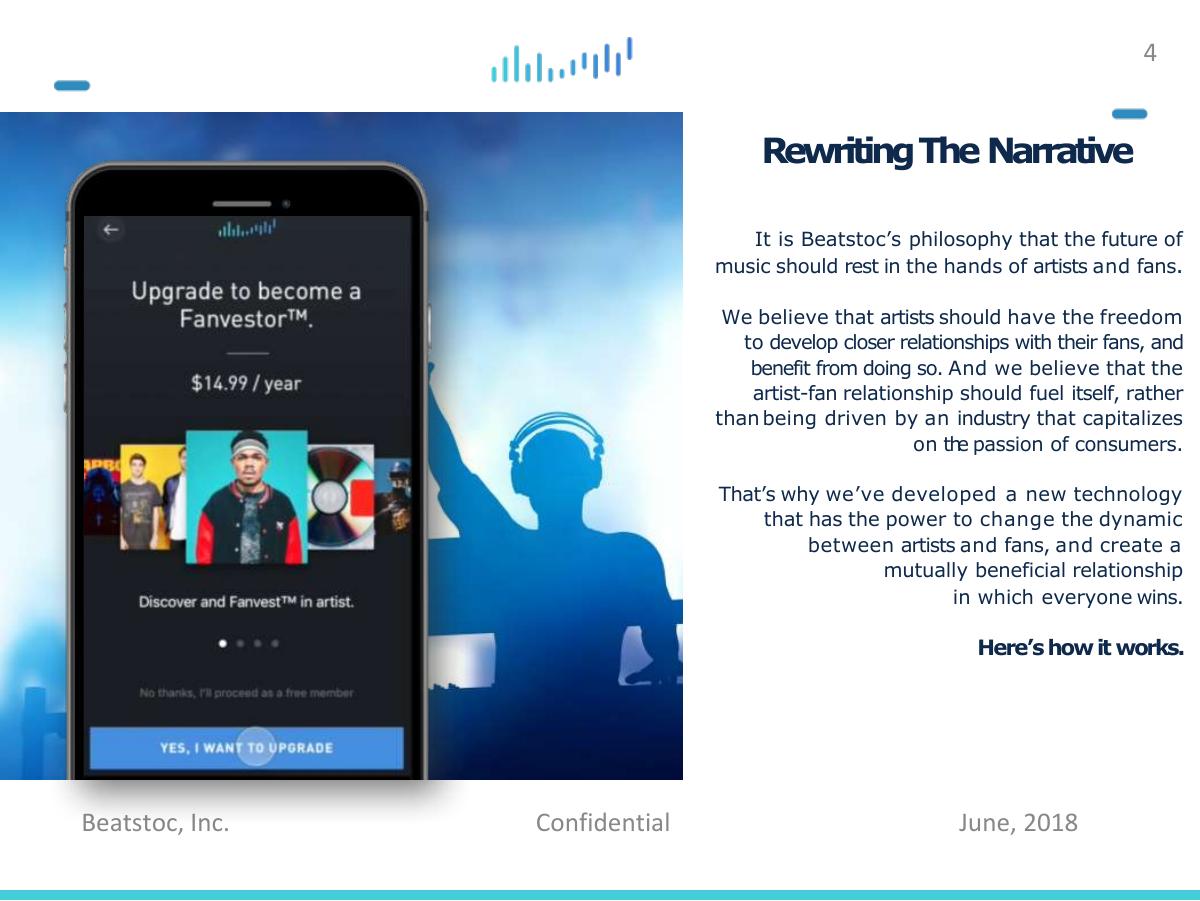
An entire slide of philosophy, right-aligned over a background image: the future of music should rest in the hands of artists and fans, the artist-fan relationship should fuel itself rather than being driven by an industry that capitalises on the passion of consumers. It closes with "Here's how it works." This is a manifesto slide in position four of fourteen. In a deck this short, that is seven percent of the total surface spent restating slide 3's sentiment in warmer language.
Slide 5 — How it works, for artists and for fans
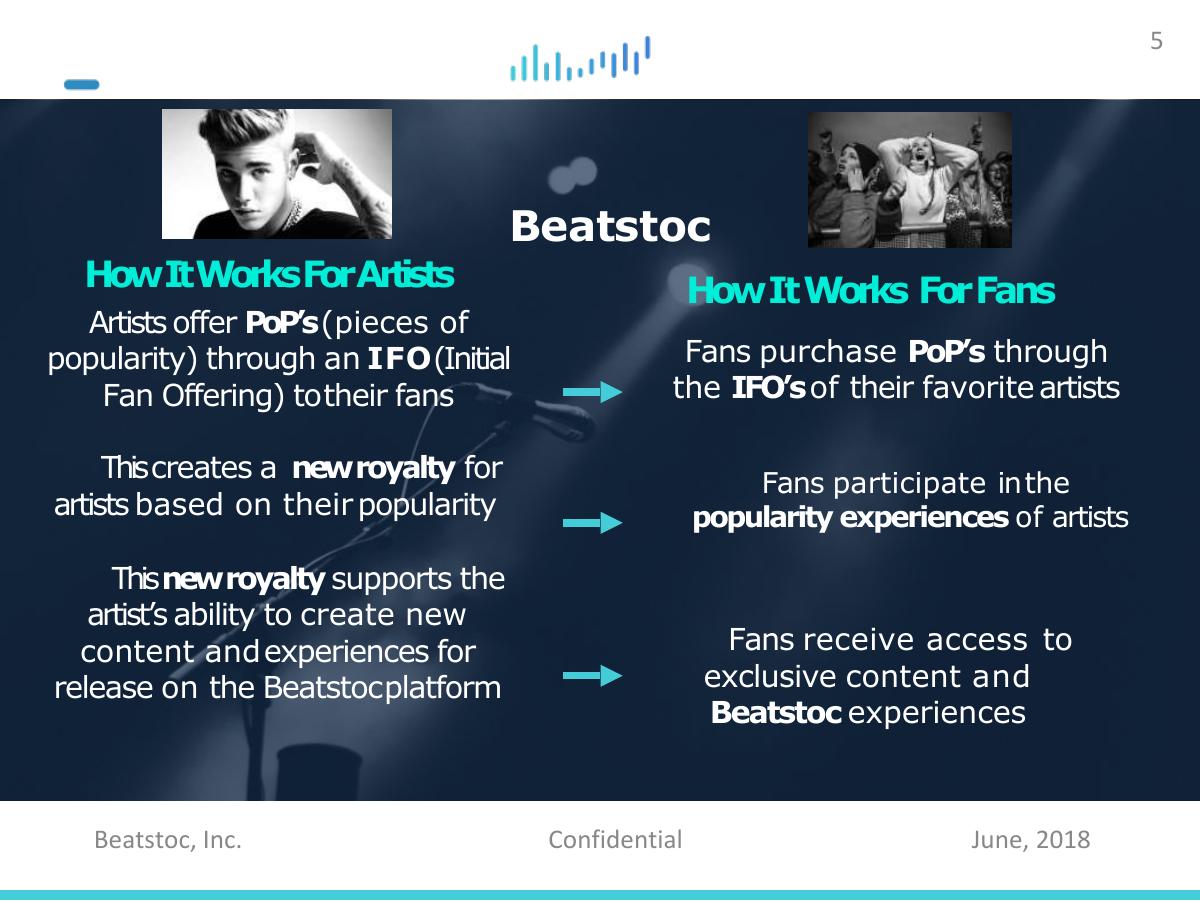
The mechanism slide, and structurally the best-designed page in the file: two parallel three-step columns. Artists offer PoP's through an IFO to their fans; this creates a new royalty based on their popularity; that royalty funds new content and experiences on the platform. Fans purchase PoP's through the IFOs of their favourite artists; fans participate in the popularity experiences of artists; fans receive access to exclusive content and Beatstoc experiences.
The symmetry is elegant, and it is also where the deck quietly avoids its own hardest question. "Participate in the popularity experiences" is doing enormous work. Does a PoP pay out? Is the fan's return economic or experiential? If it is economic, this is a security and the deck needs a regulatory slide. If it is purely experiential, then "royalty" and "Initial Fan Offering" are the wrong words and the pitch is a premium annual membership with a token-flavoured name. The deck never resolves the ambiguity, and every serious investor question about this company starts there.
Slide 6 — Why Fans Will Love Beatstoc
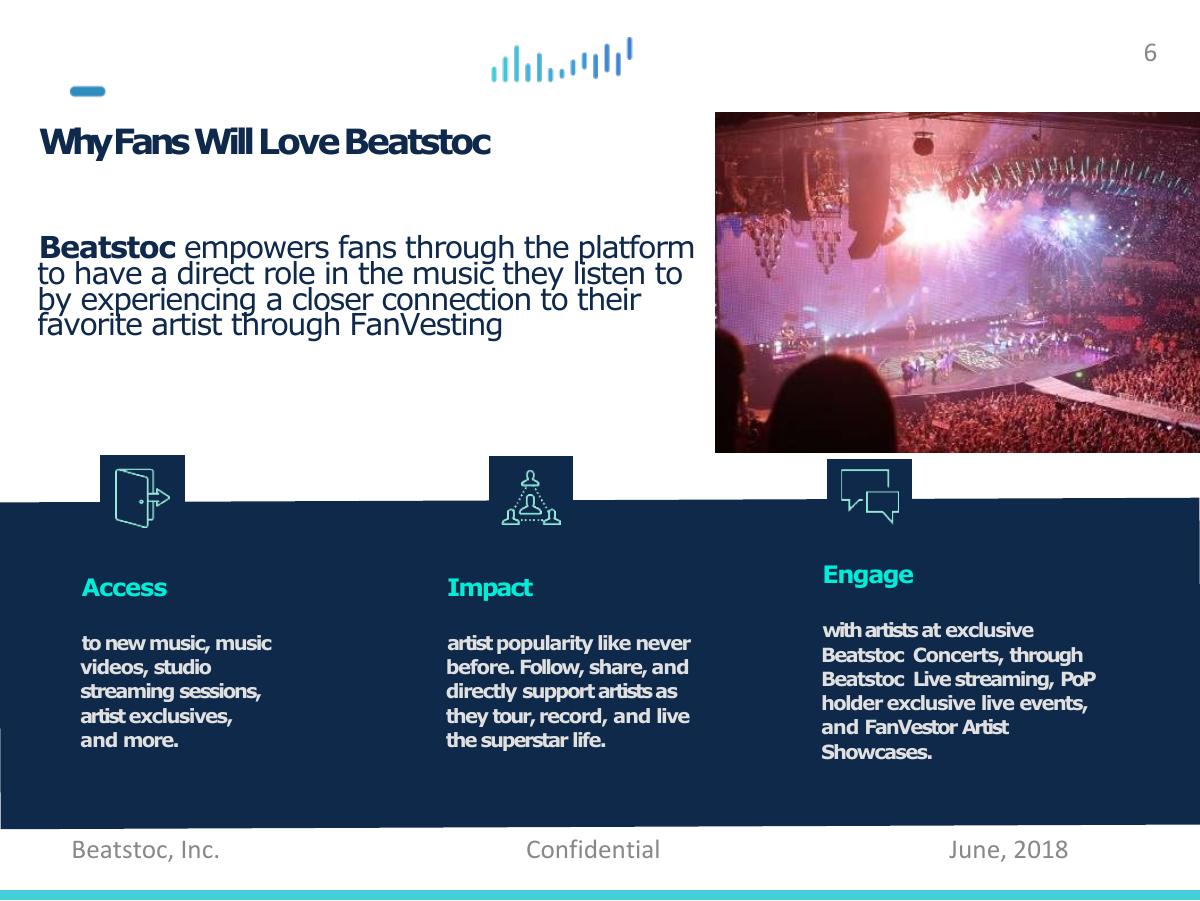
Three columns — Access, Impact, Engage — under the coined verb "FanVesting". Access covers new music, videos, studio streaming sessions and artist exclusives. Impact is "artist popularity like never before. Follow, share, and directly support artists as they tour, record, and live the superstar life." Engage lists Beatstoc Concerts, Beatstoc Live streaming, PoP-holder exclusive live events and FanVestor Artist Showcases.
"FanVesting" and "FanVestor" are investment words. They appear on the fan-benefit slide with no disclosure attached. Note also that the deck introduces at least six product surfaces here — Concerts, Live, exclusive events, showcases, studio streaming, artist exclusives — for a company that describes itself as still in final-stage development on slide 2.
Slide 7 — Why Artists Love Beatstoc
Sixty words, centred, on an otherwise empty page: a new way to monetise popularity, invest in the fan base, and benefit from the freedom to keep creating; the more content an artist provides, the closer the connection and the more successful they will be on the platform. Note the tense — "Why Artists Love Beatstoc", present tense, in a deck that never names an artist who does. Marketplaces live or die on supply acquisition, and 50% of the funds requested on slide 12 go to acquiring artists. This slide should have carried the artist economics: what an artist earns per PoP, what the platform takes, what a mid-tier artist's annual income from Beatstoc looks like at a stated fan count. It carries a paragraph of encouragement instead.
Slide 8 — The Beatstoc Management Team (bios)
Three long bios. Gene Jackson, CEO and founder, described through "structuring businesses that connect passion with purpose, and success with legacy", with the note that "this entrepreneurship runs in Gene's family, as his is one of the two families that started the Salvation Army." Mick Sweeney, COO and co-founder, is the most concrete profile in the deck: Verizon from 1998 to 2016, launching apps and products, opening over 150 small business points of distribution. Ryan Jackson, CMO and co-founder, with "a vast knowledge of the music industry and contacts with the most popular artists".
The heredity claim is the tell. An investor reading a deck about selling fan-financed royalty instruments does not care which families founded the Salvation Army in 1865; they care whether this team has shipped a regulated consumer financial product or signed a major-label artist before. The Verizon distribution record is real operating experience and gets one clause. The music-industry claim — the one that determines whether artist acquisition works — is stated as "contacts with the most popular artists" and is never evidenced.
Slide 9 — The Beatstoc Team (photo grid)
Fourteen headshots across three rows: CEO, COO, CMO, a VP of Technology, legal counsel, a VP of Product, two people at the Beatstoc Foundation, another Beatstoc Technology Group role, and five Artist Relationship Managers split by genre — Pop, Rock, Rap/Hip Hop, Hip Hop/R&B and Latin. It is a fourteen-person org chart for a company still in final-stage development, and it includes a foundation and two named subsidiaries, Beatstoc Artist Management Inc. and Beatstoc Technology Group Inc.
Two things an investor takes from this page. First, the genre-specialist ARM structure is a real signal — someone thought hard about how artist supply actually gets sourced. Second, this is a large payroll and a three-entity corporate structure carried before revenue, which reframes the $5 million ask: a meaningful share of it is keeping the existing organisation alive, not building the product.
Slide 10 — Beatstoc Live
"Imagine watching a sold out show from the comfort of your own living room with friends and a glass of wine... Beatstoc Live makes that possible." A full slide of second-person imagery for a livestreaming feature. In June 2018 this was a crowded space — Amazon, Live Nation, YouTube and Verizon-era go90 were all in it — and the deck neither acknowledges that nor explains what makes streaming a concert to PoP holders different from streaming it to everyone. The wine glass is memorable. It is also the only thing on the slide.
Slide 11 — Beatstoc Financial Summary
The one dense slide, and the one that would end the meeting. A three-year P&L projects total revenue of $31.88 million in 2018, $152.21 million in 2019 and $421.19 million in 2020. Net income moves from a $1.07 million loss to $15.95 million to $49.24 million.
The composition is the problem. Initial Fan Offerings supply $27.4 million of 2018 revenue, $129.3 million of 2019 and $377.1 million of 2020 — roughly 86% to 90% of the entire model. Everything the deck spent thirteen slides on emotionally — subscriptions, music sales, Beatstoc Live, fan experiences — collectively contributes about 10%. Beatstoc Live, the feature that got its own full slide, is projected at $42,500 in 2018 and $1.57 million in 2020, under 0.4% of revenue.
Then the derivation. $27.4 million of IFO revenue in a partial 2018, from a platform that entered beta in March of that year with no disclosed users and no named artists. There is no assumption row anywhere: no artists onboarded per month, no average PoP price, no PoP's sold per artist, no fan conversion rate, no renewal rate. The model also flows PoP proceeds into an Artist Compensation line ($10.3 million in 2018), a Development Fund, a Beatstoc Foundation allocation and a Reserve Fund, which means gross profit sits at 20%, 21% and 18% of revenue in the three years. That structure is coherent and honest in shape. It just sits on a top-line number with no visible input assumptions and a 1,222% growth rate between 2018 and 2020.
Slide 12 — The ask and use of funds
"Beatstoc is currently seeking a total of $5 million in additional financing to achieve key company growth initiatives." Use of funds: 25% Phase 2 platform development, 25% go-to-market artist content production, 50% acquisition of artists. Note the footer date on this slide reads March 2018 while every other slide reads June 2018 — a slide lifted from an earlier version and never updated.
The allocation itself is the most investable thing in the deck: putting half the raise into supply acquisition is the correct instinct for a two-sided marketplace, and it is consistent with the genre-ARM structure on slide 9. What is missing is everything around it. No instrument, no valuation, no pre-money, no runway, no milestones the $5 million buys, no explanation of what the previously secured $5 million was spent on. A use-of-funds pie without a milestone attached tells an investor how you will spend the money, not what you will have proven when it is gone.
Slide 13 — Why invest
Three columns. "The Legwork is Complete" — initial product development done, onboarding beta users, signing artists. "Team Strength" — decades of experience founding and operating successful ventures. "Scalability" — the core technology and business model has "wide-ranging applicability across numerous market verticals, including sports, media, and film".
Each is a claim the deck has already failed to substantiate, restated with more confidence. "The legwork is complete" contradicts slide 2's "final stage of development" and slide 12's request for a quarter of the raise to fund Phase 2 platform development. And the vertical-expansion claim — sports, media, film — is offered by a company that has not yet demonstrated the model works once, in music.
Slide 14 — Thank you and disclaimer
A thank-you paragraph, then roughly 400 words of legal boilerplate: confidential, not all-inclusive, may not be photocopied, should be returned on request, estimates and projections prepared by management involve significant elements of subjective judgment. The disclaimer is longer than any substantive slide in the deck except the financial table. It also confirms this document was circulated to "a select number of qualified parties" — an accredited-investor distribution, which makes the total absence of a securities-treatment slide for the PoP instrument itself more conspicuous, not less.
What this deck does better than most startup pitch decks
The core idea is one sentence and it lands. "Sells pieces of artists' popularity to their most loyal fans" is a proposition anyone can repeat after one reading. Most decks cannot survive that test. · The two-sided mechanism is drawn as two symmetric columns. Slide 5 shows the artist flow and the fan flow side by side in three steps each. Marketplace founders routinely explain one side and leave the reader to infer the other. · Supply acquisition gets half the raise. Allocating 50% of $5 million to acquiring artists shows the team understood which side of the marketplace is hard to buy. · The ARM structure is a real go-to-market design. Five artist relationship managers split by genre is an operating answer, not a slogan, and it is more specific than most seed-stage GTM slides. · The financial model routes money to the artist explicitly. Artist Compensation, Development Fund and Reserve Fund line items mean the deck is honest that Beatstoc keeps roughly a fifth of revenue as gross profit, rather than hiding a take rate. · The language is consistent. PoP, IFO, FanVesting, FanVestor and Beatstoc Live are used the same way on every slide. Vocabulary discipline is rarer than it sounds.
Where this deck would fail in an investor meeting
No traction, three months after beta launch. Not one user, artist, PoP or dollar from the March 2018 beta appears anywhere in fourteen slides. · No regulatory slide for what is plainly a securities question. Selling instruments that create a royalty tied to popularity, in June 2018, with the words "Initial Fan Offering" on the page, and no mention of Reg A+, Reg CF, Reg D, a no-action position or counsel's view. · 86–90% of projected revenue comes from the one line item never explained. IFO revenue carries the entire model and has zero stated assumptions behind it. · $421 million of revenue by year three from a pre-revenue platform. Without an assumption table, this reads as a number chosen backwards from a desired valuation. · No market sizing at all. Fourteen slides and not one TAM, SAM, addressable-fan-count or artist-count figure. · No competition slide. Patreon, Bandcamp, Kickstarter, Vezt, SongVest, Royalty Exchange and the fan-token category all existed in 2018. None are named. · The fan's return is left ambiguous. "Participate in popularity experiences" is not an answer to "what does a PoP holder actually get if the artist blows up?" · No unit economics. No PoP price, no artist payout share, no fan acquisition cost, no renewal rate — for a business whose entire thesis is annual renewal. · Two slides of philosophy before the mechanism. Slides 3 and 4 make the same emotional argument twice. · Internal contradictions. "The legwork is complete" versus "final stage of development" versus 25% of the raise for Phase 2 development; a March footer on a June deck. · Fourteen people, a foundation and two subsidiaries before revenue. The org chart implies a burn rate the deck never states. · No deal terms. No instrument, valuation, minimum cheque, use of the prior $5 million, or milestone this round buys.
2018 token-era deck vs. what the same idea needs today
Naming "Initial Fan Offering", "PoP's", "FanVesting" Plain naming of the instrument, or explicitly a membership
Regulatory posture Absent Named exemption, counsel, transfer restrictions, on slide 3 or 4
Traction "Beta testing, launched March 2018" Cohort chart: fans per artist, PoP price, renewal rate at month 12
Artist proof "LOI's signed with artists" Named artists, follower counts, signed revenue-share terms
Financials $421M in year three, no assumptions Bottom-up: artists onboarded × fans converted × price × renewal
Competition None named Patreon, Bandcamp, fan tokens, royalty marketplaces, positioned
Team framing Family lineage and "vast contacts" Artist deals closed, regulated products shipped
Ask "$5 million in additional financing" Instrument, valuation, 18-month milestone the round buys
How you would rebuild this deck in twelve slides
Cover with the sentence. "Beatstoc — fans buy a share of an artist's popularity. Raising $5M." Everything the reader needs in one line. · Problem, in three numbers. Per-stream payout, share of artists earning below a living wage, average annual superfan spend that never reaches the artist. Delete slides 3 and 4's prose entirely. · The mechanism. Keep slide 5 unchanged. It is the best page in the deck. · What a PoP is, legally. One slide, early: the instrument, the exemption, counsel, what the holder does and does not receive. In this business it is a trust-builder, not a footnote. · Beta results. Three months of real data — fans, artists, PoP's sold, average order value, repeat behaviour. If those numbers are embarrassing, show them anyway; the absence is louder. · Artist economics. A worked example: an artist with 100,000 followers sells N PoP's at $X, earns $Y in year one, Beatstoc keeps Z%. · Fan economics. The mirror worked example, including the renewal decision at month twelve. · Market. Artists in the addressable tier, superfans per artist, spend per superfan, built bottom-up. · Competition. Patreon, Bandcamp, royalty marketplaces and fan tokens on one axis grid, with the one thing PoP's do that none of them do. · Model. The slide 11 table, plus a visible assumption block. Cut the projection to two years if year three cannot be defended. · Team. The photo grid, captioned with what each person has shipped or signed. Delete the family-lineage sentence. · Ask. $5M, instrument, valuation, the 50/25/25 split, and the three milestones the money buys.
The transferable lesson
Beatstoc's deck fails in a way that has nothing to do with music or tokens. It spends its first seven slides persuading the reader that the problem is real and the mission is good — which the reader already accepted after slide 2 — and then, when it finally reaches the slides where belief is either earned or lost, it has nothing to put on them. No beta numbers three months after launching a beta. No named artist in a company whose survival depends on named artists. No assumptions behind a number that grows 1,222% in twenty-four months. No regulatory position on an instrument the deck itself calls an offering.
The pattern generalises: decks do not usually fail because the idea is bad, they fail because conviction is spent in the wrong places. Emotional slides are cheap to write and cheap to read, so they multiply. Evidence slides are expensive, so they get postponed to the appendix that never gets built. An investor reading your deck is doing one thing — looking for the slide where a claim becomes checkable. If they reach slide 11 and the first checkable number in the document is a $421 million projection with no inputs, the meeting is already over.
Read your own deck the way an investor does: find every sentence that could be replaced by a number, and count how many of them you have actually replaced. That count, not the design, is what determines whether the next meeting happens.
Frequently asked questions
- What was Beatstoc?
- Beatstoc, Inc. was a music technology company that pitched investors in June 2018 on a platform where fans buy 'PoP's' — Pieces of Popularity — in their favourite artists through an 'Initial Fan Offering'. PoP's acted as annually renewable season tickets giving holders exclusive content, streaming, concerts and live events, while creating a new popularity-based royalty stream for the artist.
- How much was Beatstoc raising in its 2018 deck?
- Five million dollars in additional financing, on top of $5 million the deck says was already secured. Use of funds was split 50% to acquisition of artists, 25% to Phase 2 platform development and 25% to go-to-market artist content production. The deck states no instrument, no valuation, no minimum cheque size and no milestone the round is meant to reach.
- How many slides are in the Beatstoc pitch deck?
- Fourteen. One cover, one overview, two slides of industry framing and philosophy, one mechanism slide, two benefit slides, two team slides, one Beatstoc Live slide, one financial summary, one use-of-funds slide, one why-invest slide and a thank-you page carrying roughly 400 words of legal disclaimer.
- What is the strongest slide in the Beatstoc deck?
- Slide 5, the mechanism. It lays the artist flow and the fan flow side by side in three symmetric steps each: artists offer PoP's through an IFO, which creates a new popularity royalty, which funds new content; fans buy PoP's, participate in the artist's popularity, and receive exclusive content and experiences. Most marketplace decks explain only one side.
- Why is the Beatstoc financial projection a problem?
- It projects $421 million of revenue by 2020 from a platform that entered beta in March 2018 with no disclosed users, and 86 to 90% of that revenue comes from Initial Fan Offerings — the one line item the deck never derives. There is no assumption row for artists onboarded, PoP price, fans converted per artist or renewal rate, so the number cannot be checked.
- What should founders take from this teardown?
- Emotional slides are cheap and multiply; evidence slides are expensive and get postponed. Beatstoc spends seven slides persuading the reader of a problem they accepted on slide 2, then arrives at the slides where belief is earned with nothing checkable on them. Count how many sentences in your own deck could be replaced by a number, and how many you actually replaced.