Bear & Breakfast presents a compelling 'hook' in its pitch deck: a management adventure game where the player is a bear. The deck excels at establishing a unique visual identity and a clear four-step gameplay loop—Build, Manage, Explore, Repeat—which is critical for the simulation genre. However, the version of the deck analyzed is heavily sanitized for public viewing. It contains placeholder zeros for all budget items, including Art, Programming, and Marketing, and lists the release target as 'REDACTED.' While this makes it an excellent template for visual structure, it lacks the hard data n…
Key takeaways
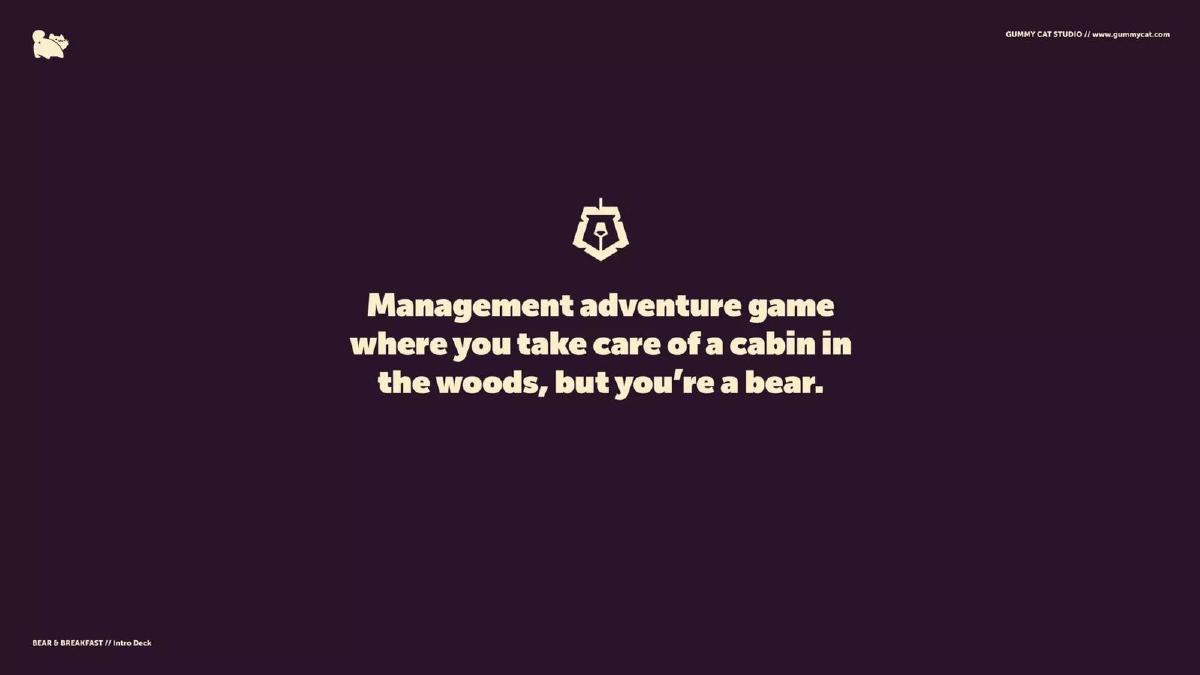
- The deck leads with a strong, concise 'X meets Y' style hook: a management game where you are a bear (Slide 2).
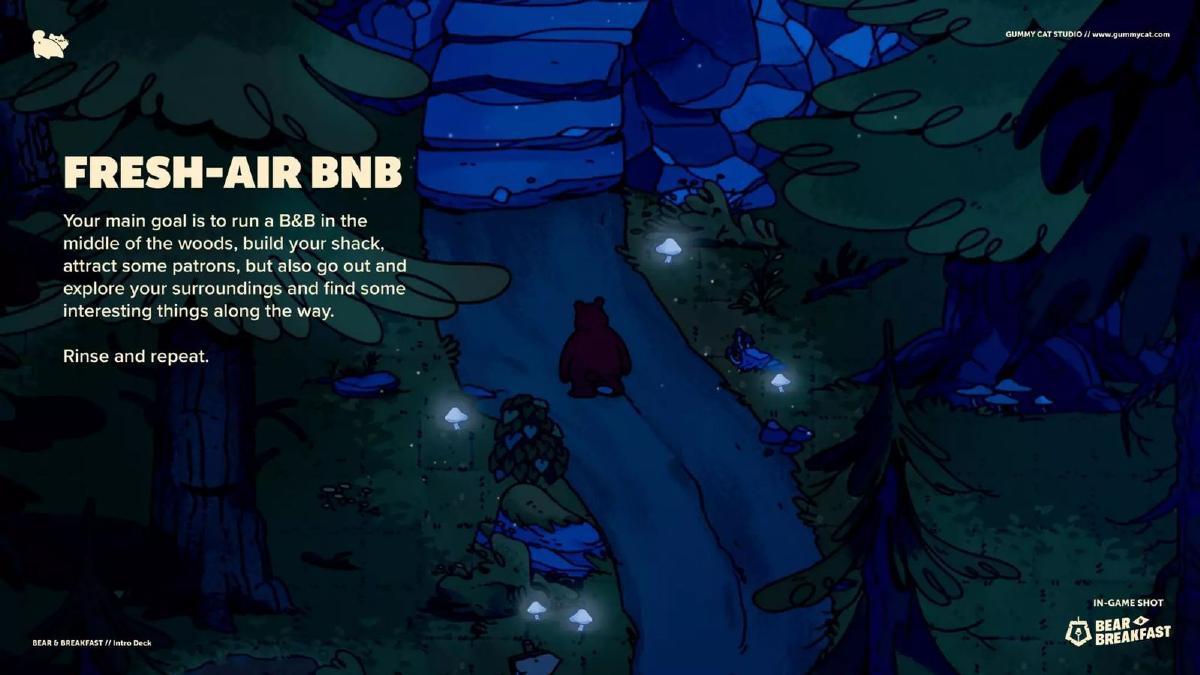
- A clear four-stage gameplay loop is defined as Build, Manage, Explore, and Repeat (Slide 5).
- The project was in the 'Pre-production, Unannounced' stage at the time of this deck's creation (Slide 8).
- The concept originated in 2018, born from a frustration with a lack of narrative simulation titles (Slide 4).
- All financial figures are placeholders, with the estimated budget total listed as '$000,000' (Slide 6).
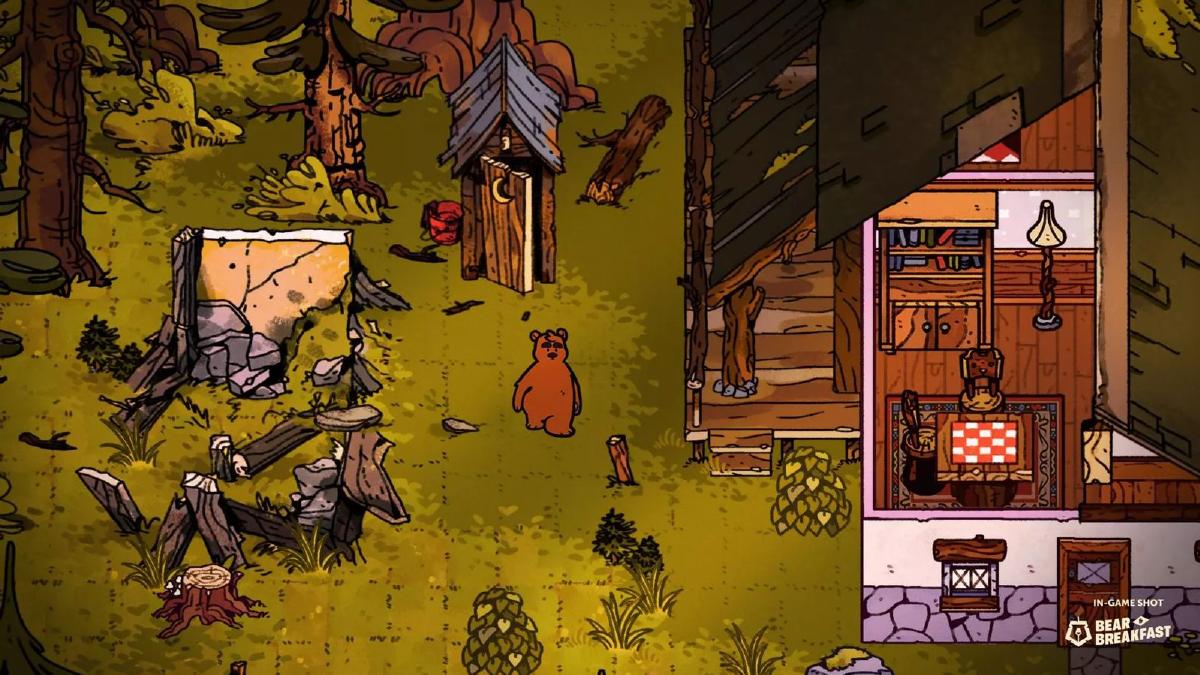
- The deck includes an 'In-Game Shot' to prove technical progress and visual style beyond just concept art (Slide 3).
- The development timeline is left as 'XX months,' indicating this version was likely used for general portfolio sharing rather than a live investor meeting (Slide 6).
- The game identifies its setting as 'Timberfall,' emphasizing world-building and character stories (Slide 7).
Introduction and Visual Identity
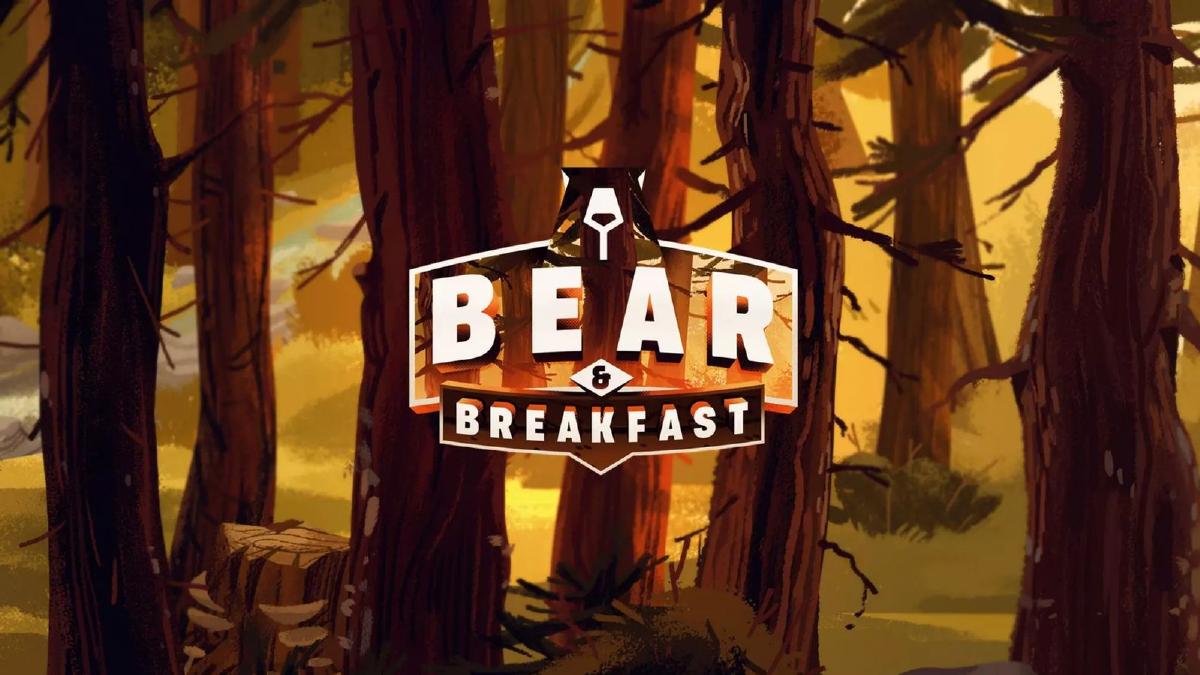
The Bear & Breakfast pitch deck is a masterclass in establishing a specific 'vibe' before ever showing a spreadsheet. From the title slide, the studio, Gummy Cat, establishes a professional yet whimsical brand. The use of high-quality, hand-drawn illustrations immediately signals the production value of the game. For indie developers, art is often the first thing an investor or publisher evaluates, and this deck uses it as a primary communication tool.
Slide 1: Title Slide
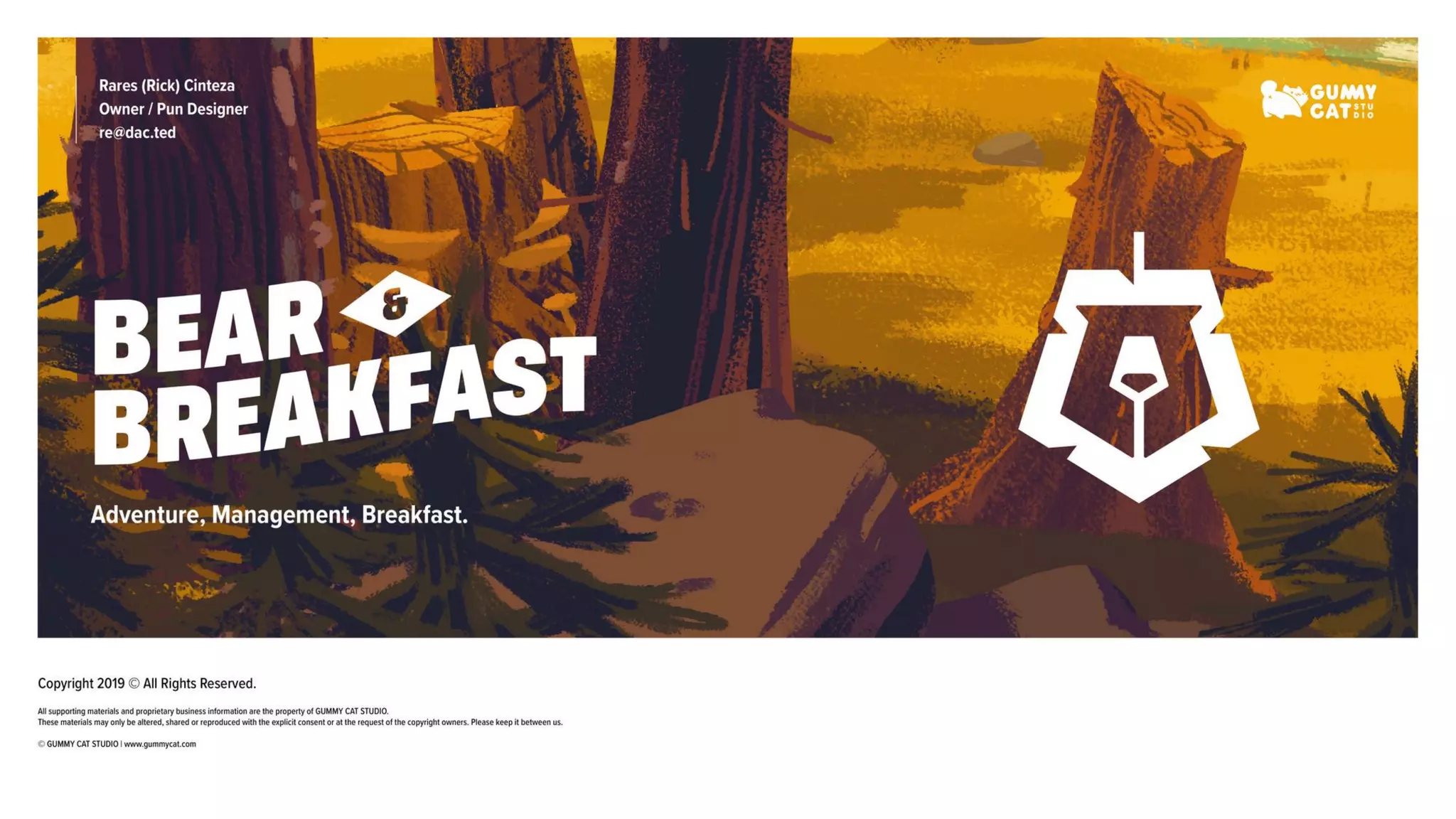
The opening slide features the game's logo and a tagline: "Adventure, Management, Breakfast." It identifies Rares (Rick) Cinteza as the Owner and, notably, the "Pun Designer." This is a strategic choice; it tells the reader that the writing and humor are core pillars of the product. The copyright date is listed as 2019, providing a temporal anchor for the project's development cycle.
Slide 2: The Hook
Slide 2 is a minimalist 'high-concept' slide. It contains a single sentence: "Management adventure game where you take care of a cabin in the woods, but you’re a bear." This is an excellent example of a pitch hook. It defines the genre (Management adventure) and the unique twist (you're a bear) in under 20 words. It answers the "What is this?" question immediately, allowing the rest of the deck to focus on the "How?"
Slide 3: In-Game Proof of Concept
Rather than relying solely on concept art, slide 3 provides an "In-Game Shot." This is crucial for building trust. It shows a bear character standing near a rusted truck with a dialogue bubble that reads, "I dunno.. I don't trust joggers. They're always the first to find dead bodies.." This single slide accomplishes three things: it proves the game engine can render the art style, it demonstrates the isometric perspective, and it showcases the dark, quirky humor mentioned in the intro.
Slide 4: The Origin Story
The "Concept" slide explains the 'Why.' It notes the project was sketched in 2018 and was "born out of love for systematic management games" and a "deep frustration over the lack of compelling narrative simulation titles." By identifying a gap in the market—narrative-heavy simulation—the founders justify the game's existence to a potential investor. It frames the game not just as a fun idea, but as a solution to a market deficiency.
Slide 5: The Gameplay Loop
Slide 5, titled "Player Experience," breaks the game down into four repeatable actions: Build (your cabin), Manage (guests and cash), Explore (surroundings), and Repeat (take home goods). This is the most important slide for a game pitch. It explains the mechanics clearly. The use of custom character illustrations for each step keeps the reader engaged with the art style while they digest the mechanical information.
Slide 6: The Missing Budget
Slide 6 is titled "Estimated Budget," but it is entirely non-functional in this version of the deck. Every field is populated with zeros: Art ($00,000), Programming ($00,000), and so on. The timeline is listed as "XX months." While this is frustrating for an analyst, it serves as a reminder that founders often scrub their decks before uploading them to public repositories like SlideShare. In a real pitch, this slide would be the pivot point where the conversation shifts from 'creative' to 'business.'
Slide 7: World Building
The "Exploration" slide introduces "Timberfall," the game's setting. It emphasizes that exploration leads to learning about "characters and their stories." This reinforces the earlier claim that the game is a "narrative simulation." The illustration shows the bear character at a dilapidated bus stop, further cementing the game's aesthetic of 'cozy decay.'
Slide 8: The Recap
The final slide in this set summarizes the project's status. The game is defined as a "Sim / Management Adventure," the status is "Pre-production, Unannounced," and the release target is "REDACTED." This slide acts as a summary for a busy reader, though the lack of a specific timeline or release target limits its utility as a standalone business document.
What Works in This Deck
Tone Consistency: The deck never breaks character. From the "Pun Designer" title to the dialogue in the screenshots, the humor is consistent. This gives investors confidence that the final product will have a cohesive voice.
Visual Communication: The deck uses very little text. It relies on high-quality illustrations to explain the world and the gameplay. In the gaming industry, where the visual product is the end goal, this is the correct approach.
Clear Genre Definition: The founders don't try to reinvent the wheel. They clearly state they are making a management sim, then explain their specific twist on it. This makes it easy for a publisher to understand where this fits in their portfolio.
What Is Missing
Financial Data: As noted, the budget and timeline are entirely redacted. A real pitch requires a clear breakdown of burn rate, total capital required, and a projected ROI or sales target based on comparable titles (e.g., Stardew Valley or Graveyard Keeper).
Team Slide: The provided slides do not include a team biography section. In indie gaming, the pedigree of the developers (previous titles worked on, technical expertise) is often as important as the game concept itself.
Market Analysis: There is no mention of the target audience, platform strategy (PC, Switch, Console), or how the game plans to compete with existing titles in the 'cozy sim' genre.
Founder's Playbook
Founders should copy the Gameplay Loop structure from slide 5. Breaking a complex game down into four simple verbs is the best way to explain mechanics to non-gamers or busy executives. Additionally, the Hook on slide 2 is a perfect example of how to distill a complex project into a single, memorable sentence. However, founders must ensure their Budget slide (slide 6) is backed by a detailed spreadsheet that accounts for the high cost of the quality art displayed throughout the deck.
Frequently asked questions
- What is the core gameplay loop of Bear & Breakfast?
- According to slide 5, the gameplay loop consists of four distinct phases: Build (customizing the cabin), Manage (handling guests and cash), Explore (finding rewards in the surroundings), and Repeat (taking home goods to start the cycle again). This structure is typical for the management simulation genre but is clearly articulated here to show how narrative and mechanics intertwine.
- How much funding was Gummy Cat Studio seeking in this deck?
- The specific funding ask is not disclosed in this version of the deck. Slide 6, titled 'Estimated Budget,' uses placeholder zeros ($00,000) for every line item, including development and marketing. The 'Est Budget Total' is also listed as '$000,000.' This suggests the deck was scrubbed of sensitive financial data before being shared publicly.
- What is the 'hook' of the game as presented to investors?
- The hook is a subversion of the standard management sim: 'Management adventure game where you take care of a cabin in the woods, but you’re a bear' (Slide 2). This immediately sets the tone for the game's humor and unique selling point, separating it from more serious or human-centric simulators.
- What stage of development was the game in during this pitch?
- Slide 8, the 'Recap' slide, states that the game was in 'Pre-production' and was 'Unannounced.' However, slide 3 features an 'In-Game Shot,' suggesting that a functional prototype or vertical slice existed to demonstrate the art style and dialogue system before the formal production phase began.
- Who is the primary contact for the project?
- The title slide (Slide 1) identifies Rares (Rick) Cinteza as the 'Owner / Pun Designer.' This unconventional job title reinforces the deck's emphasis on humor and narrative, which slide 4 claims was a driving force behind the game's creation.