The Beatstoc pitch deck from June 2018 presents a platform designed to bypass traditional streaming economics by letting fans invest directly in an artist's popularity. By selling 'Pieces of Popularity' (PoPs) via 'Initial Fan Offerings' (IFOs), the company aimed to create a new royalty stream for creators while giving fans exclusive access. The deck is notable for its extremely aggressive financial modeling, projecting total revenue to grow from $31.8M in 2018 to $421.1M by 2020. While the team slide showcases a broad range of industry-specific roles, including genre-focused 'ARM' leads, the…
Key takeaways
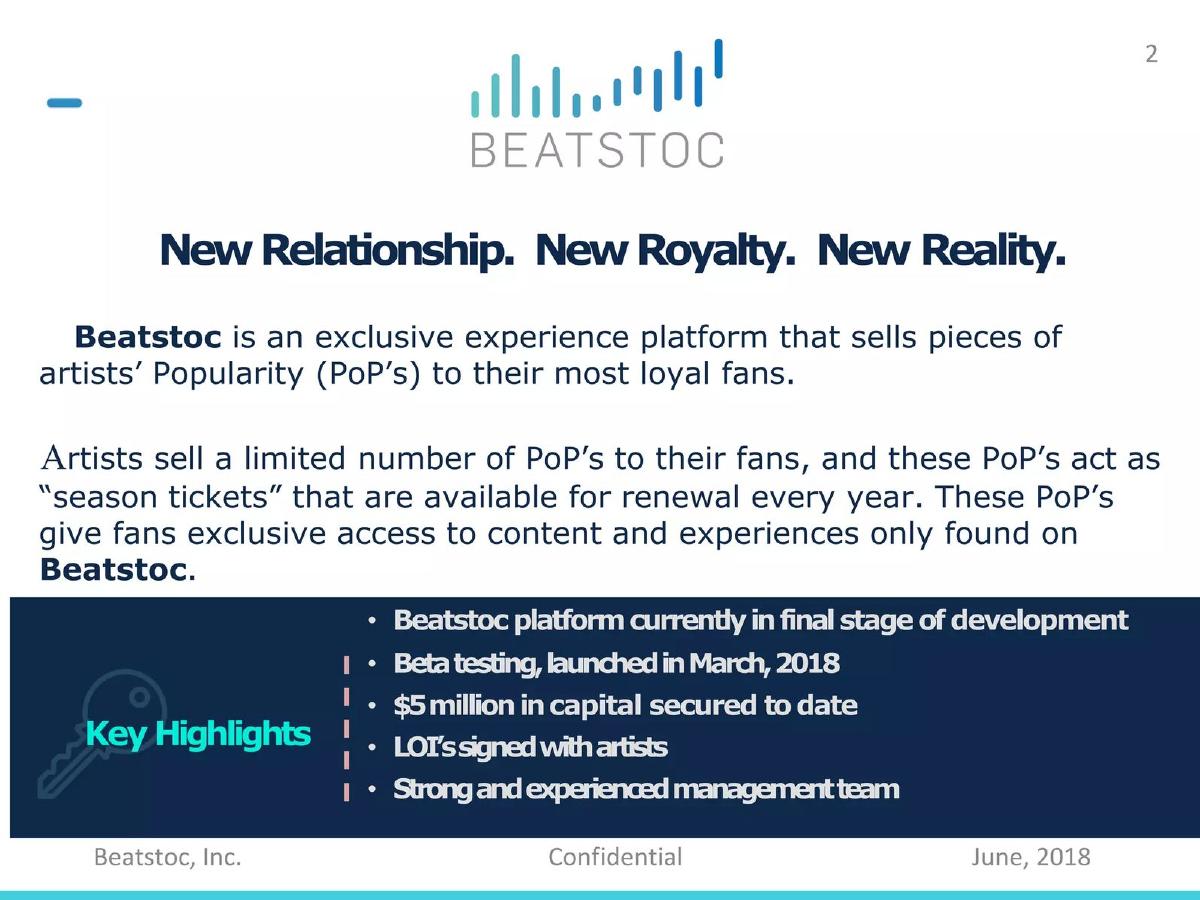
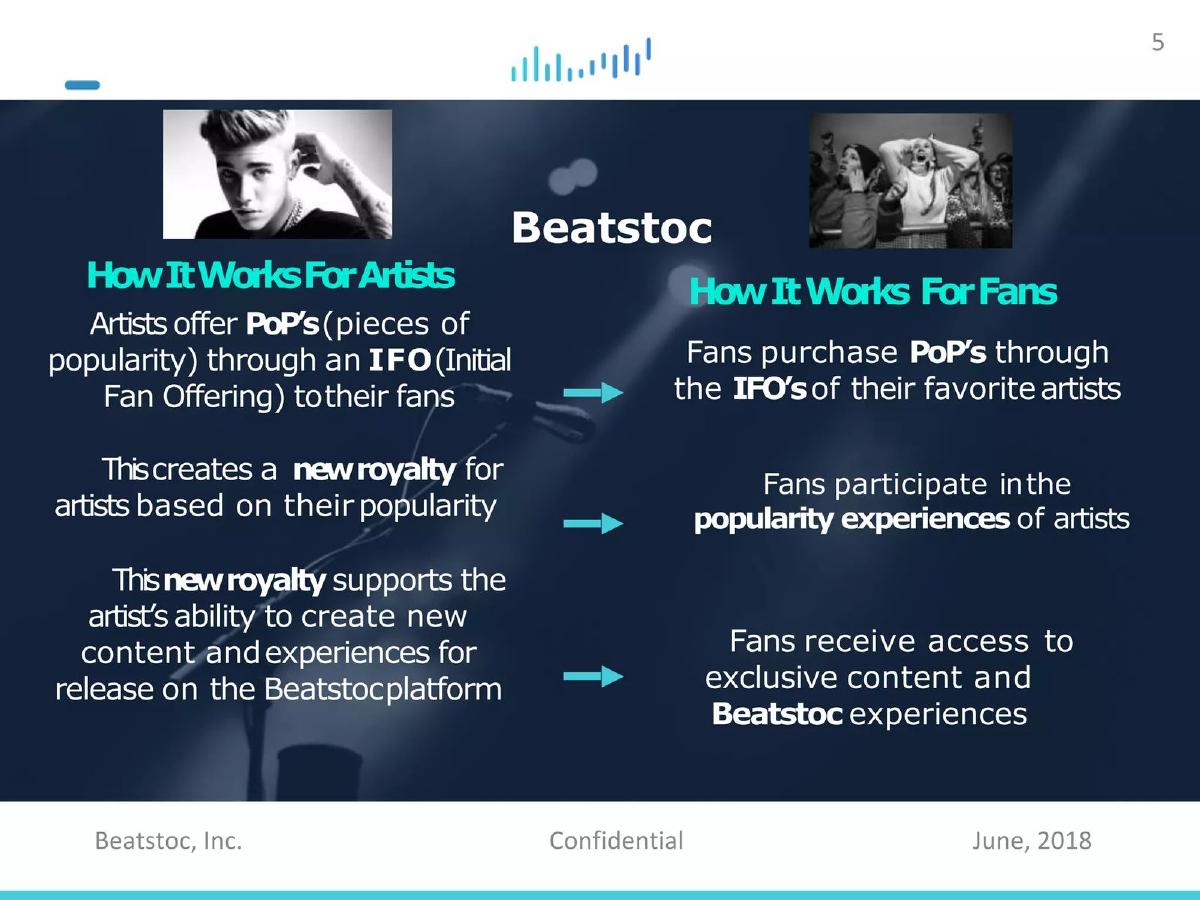
- The business model relies on 'Initial Fan Offerings' (IFOs) where fans buy 'Pieces of Popularity' (PoPs) to fund artists (Slide 5).
- Beatstoc identifies the 'downside' of streaming as low artist income and a lack of direct fan engagement (Slide 3).
- Financial projections are exceptionally optimistic, forecasting a move from a $1,074,944 net loss in 2018 to a $49,244,137 net profit by 2020 (Slide 11).
- The primary revenue driver is IFOs, projected to reach $377,056,000 by 2020 (Slide 11).
- The team structure includes specialized 'ARM' (Artist Relations Management) roles for Pop, Rock, Rap/Hip Hop, and Latin genres (Slide 9).
- The deck claims the 'legwork is complete,' stating they are already onboarding beta users and signing artists as of June 2018 (Slide 13).
- There is no slide detailing the specific amount of capital being raised or the valuation sought.
- The deck suggests horizontal scalability into sports, media, and film, though no strategy for these verticals is provided (Slide 13).
Executive Summary: The Financialization of Fandom
The Beatstoc pitch deck, dated June 2018, represents a specific era of the 'creator economy' where startups sought to apply financial market mechanics to artistic output. By introducing terms like 'Initial Fan Offering' (IFO) and 'Pieces of Popularity' (PoPs), Beatstoc attempted to position itself as a stock market for music. While the deck is visually clean and follows a logical flow, it suffers from the classic pitfall of early-stage ventures: projections that appear disconnected from the reality of market adoption and regulatory hurdles.
Slide 1: Title Slide
The deck opens with a minimalist title slide featuring the Beatstoc logo—a stylized blue frequency wave—and the company name in a clean, sans-serif grey font. The footer identifies the entity as 'Beatstoc, Inc.,' marks the document as 'Confidential,' and dates it 'June, 2018.' It is a standard, professional entry point that establishes the brand identity immediately.
Slide 3: The Problem – An Industry Out of Rhythm
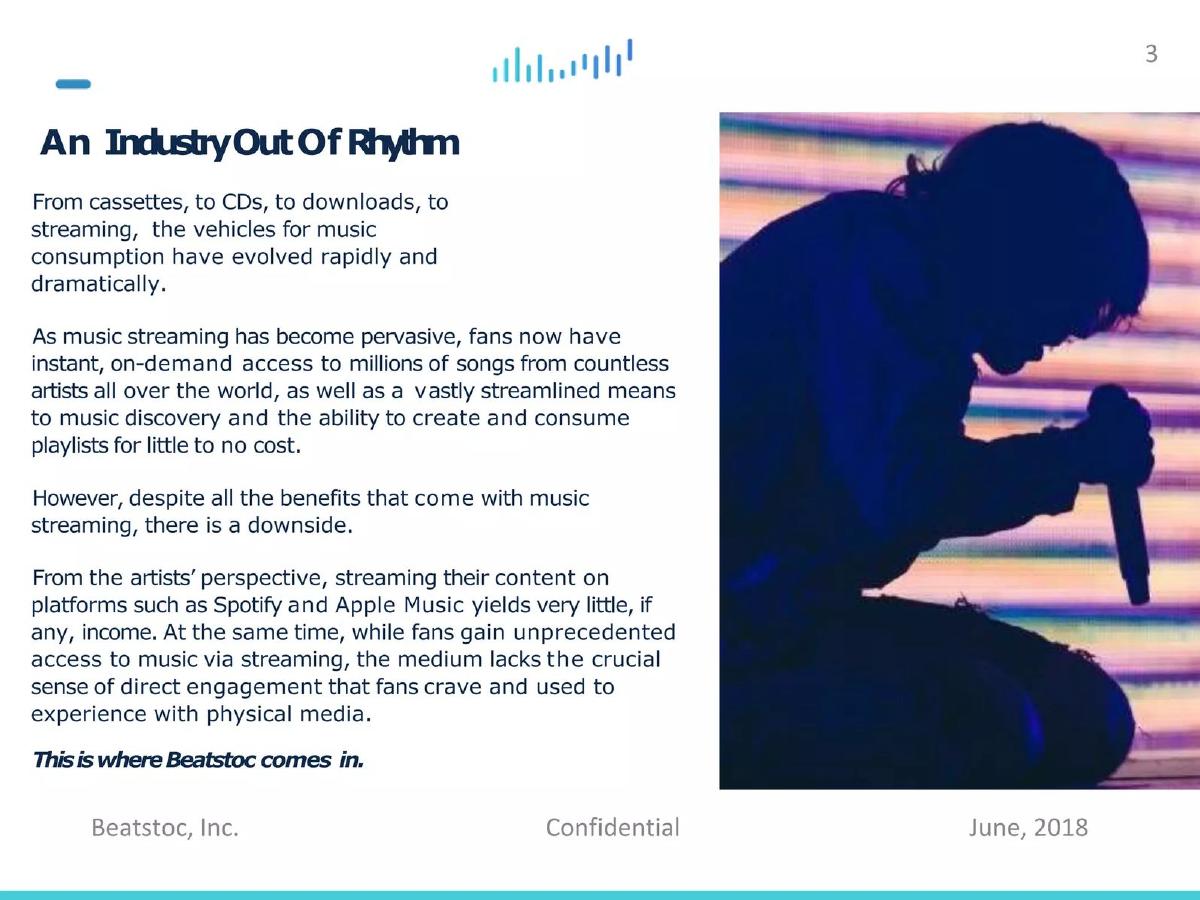
Beatstoc frames the problem through the evolution of music consumption. The slide notes that while streaming (Spotify, Apple Music) offers 'instant, on-demand access,' it has two major flaws. First, it yields 'very little, if any, income' for artists. Second, it lacks the 'direct engagement' fans felt with physical media. This sets the stage for a solution that promises both better monetization for creators and deeper connection for consumers. The imagery of a dejected artist underscores the emotional weight of the 'starving artist' narrative in the streaming age.
Slide 5: The Solution – How It Works
This slide introduces the core mechanics of the platform. It is split into two columns: 'How It Works For Artists' and 'How It Works For Fans.' Artists offer 'PoP’s (pieces of popularity)' through an 'IFO (Initial Fan Offering).' This is described as a 'new royalty' that supports the artist's ability to create content. Fans purchase these PoPs to gain 'exclusive content' and 'Beatstoc experiences.' The slide uses arrows to show a reciprocal relationship, but it remains vague on what a 'Piece of Popularity' actually represents legally or financially. Is it a share of future earnings, or a glorified fan club membership? The deck leaves this unanswered.
Slide 7: The Value Proposition – Why Artists Love Beatstoc
This slide reinforces the artist-centric nature of the platform. It claims Beatstoc provides an opportunity to 'monetize their popularity' and 'invest in their fan base.' The text suggests a virtuous cycle: more content leads to a closer connection, which leads to more success on the platform. It is a high-level emotional pitch intended to show that the platform aligns with artist interests, though it lacks data or testimonials from the 'signed artists' mentioned later in the deck.
Slide 9: The Team – A Broad Roster
The team slide is crowded, featuring 13 individuals. The leadership consists of Gene Jackson (CEO), Mick Sweeney (COO), and Ryan Jackson (CMO). Notably, the team includes a 'Legal Counsel' (Simran Singh), which is a necessity for a company dealing with 'offerings' and 'royalties.' The bottom row is dedicated to 'ARM' (Artist Relations Management) leads for specific genres: Pop, Rock, Rap/Hip Hop, and Latin. This suggests the company’s go-to-market strategy was heavily reliant on genre-specific influencers and talent scouts.
Slide 11: Financial Summary – Aggressive Projections
Slide 11 is the most data-dense and controversial slide in the deck. It presents a three-year financial forecast (2018-2020). In 2018, the company projects $31,881,111 in total revenue with a net loss of $1,074,944. By 2020, they project revenue to skyrocket to $421,193,500 with a net income of $49,244,137. The vast majority of this revenue ($377M) is expected to come from 'Initial Fan Offerings.' These figures are incredibly high for a company that, according to Slide 13, was still in the beta onboarding phase in mid-2018. The 'Gross Profit %' is projected to hover between 18% and 21%.
Slide 13: The Conclusion – Why Now?
The final slide in this set summarizes the company's readiness. It claims 'The Legwork is Complete,' noting they have moved past initial development and are signing artists. It highlights 'Team Strength' and 'Scalability,' suggesting the model could work for sports, media, and film. This slide serves as the 'closing argument,' though it notably lacks a specific 'Ask' slide (e.g., 'We are seeking $X million for Y% equity') in this 7-slide selection.
What Works in the Beatstoc Deck
Clear Terminology: By co-opting familiar financial terms like 'IFO' (a play on IPO), the founders make a complex concept immediately understandable to investors. They aren't just selling digital goods; they are creating a 'market.'
Industry Alignment: The problem slide (Slide 3) accurately identifies the two biggest complaints in the music industry: low streaming payouts and the loss of the artist-fan connection. By positioning themselves as the solution to both, they create a compelling narrative.
Specialized Team: The inclusion of genre-specific ARM leads (Slide 9) shows that the company understands music is not a monolith. Having dedicated leads for Latin or Hip Hop suggests a localized, culture-first approach to artist acquisition.
What is Missing from the Beatstoc Deck
The 'Ask': None of the provided slides state how much money the company is looking to raise or how they intend to use the funds. Without an 'Ask' slide, the deck is a presentation, not a pitch.
Regulatory Clarity: Selling 'Pieces of Popularity' and 'Initial Fan Offerings' sounds remarkably like selling securities. In 2018, the SEC was beginning to crack down on ICOs (Initial Coin Offerings). The deck offers no explanation of how they bypass or comply with these regulations beyond having a lawyer on the team slide.
Unit Economics: While the financial summary (Slide 11) shows massive top-line numbers, it doesn't explain the unit economics. How much does it cost to acquire a fan? What is the average spend per IFO? Without these metrics, the $421M revenue figure looks like a 'plug' number rather than a calculated forecast.
Competitive Landscape: The deck ignores existing competitors. In 2018, platforms like Patreon, Kickstarter, and even early blockchain music projects were already operating in this space. Failing to acknowledge the competition makes the founders look less informed about the market.
Founder's Guide: What to Copy and What to Avoid
Copy the Problem Framing: Slide 3 is an excellent example of how to frame a market shift. It uses a simple timeline (Cassettes -> CDs -> Downloads -> Streaming) to show why the current state is unsustainable. This 'inevitability' narrative is very persuasive for investors.
Avoid 'Hockey Stick' Hubris: The projections on Slide 11 are a major red flag. Projecting a jump from $0 to $421M in three years—especially when the product is still in beta—often leads to a loss of credibility. It is better to present a 'Base Case' and a 'Growth Case' backed by realistic user acquisition costs.
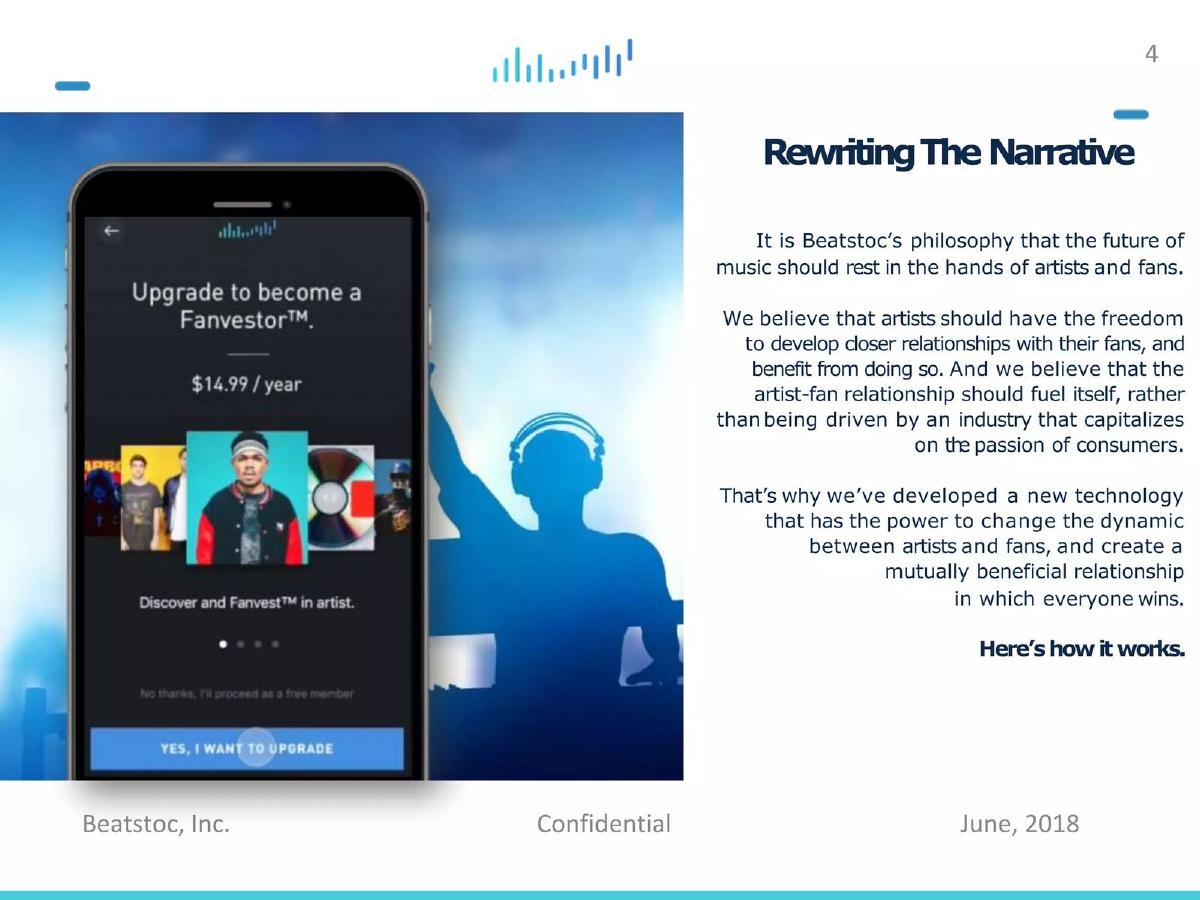
Detail the Product: The deck is very 'high level.' It tells us what the platform does but never shows us. Founders should include at least one or two UI/UX mockups to prove the product is more than just a concept. Beatstoc claims the 'legwork is complete' but provides no visual evidence of the platform's interface.
Be Specific About the 'New Royalty': If your business model relies on a novel financial instrument, you must explain it. Investors need to know if they are backing a tech company, a fintech company, or a legal gamble. Beatstoc's vagueness regarding 'PoPs' is its greatest weakness.
Frequently asked questions
- What exactly are 'Pieces of Popularity' (PoPs)?
- According to Slide 5, PoPs are 'pieces of popularity' that fans purchase through an Initial Fan Offering (IFO). The deck describes this as a 'new royalty' for artists based on their popularity. However, the deck does not explain the legal or financial structure of these PoPs—whether they are securities, digital collectibles, or contractual rights to future earnings.
- How does Beatstoc plan to make money?
- The financial summary on Slide 11 lists several revenue streams: FanVestor Subscriptions, Initial Fan Offerings, Music Sales, Beatstoc Live, Advertising Revenue, and Fan Experiences. The IFOs are by far the largest projected revenue source, accounting for over 89% of the total projected revenue of $421.1M in 2020.
- Is the product live according to the deck?
- Slide 13 states that the 'initial product development phase' is complete. At the time of the June 2018 deck, the company claimed to be in the process of onboarding beta users and signing artists. It does not provide specific numbers for how many artists or users were active at that moment.
- Who is on the leadership team?
- The team is led by Gene Jackson (CEO), Mick Sweeney (COO), and Ryan Jackson (CMO). The roster on Slide 9 is quite large, featuring a VP of Technology, Legal Counsel, and various 'ARM' leads for different musical genres, suggesting a heavy emphasis on industry networking and artist acquisition.
- What are the biggest risks visible in this deck?
- The most prominent risk is the 'hockey stick' financial projection on Slide 11, which assumes a 1,220% increase in revenue over 24 months. Additionally, the concept of an 'Initial Fan Offering' carries significant regulatory risk regarding securities laws, which the deck mentions only via the presence of a 'Legal Counsel' on the team slide.