Affini-T's Series B pitch deck, presented at the 40th Annual J.P. Morgan Healthcare Conference in January 2022, details their strategy for engineering T cells to treat hard-to-treat solid tumors by targeting oncogenic driver mutations. The company emphasizes its 'Right Targets. Right Cells. Right Place.' approach, particularly focusing on KRAS mutations. The deck showcases the scientific pedigree of its co-founders from Fred Hutch and the experience of its C-suite, supported by seed investors like VIDA Ventures and Leaps by Bayer. Key slides illustrate their discovery platform, the fundamenta…
Key takeaways
- The deck positions Affini-T as a company 'Unlocking the power of T cells against oncogenic driver mutations' for solid tumors (Slide 1).
- Affini-T's core strategy is summarized as 'Right Targets. Right Cells. Right Place.' to deliver transformative therapies (Slide 3).
- The company specifically targets KRAS, noting its prevalence and the lack of approved therapies for certain mutations like G12V and G12D (Slide 7).
- Co-founders Phil Greenberg, Aude Chapuis, and Tom Schmitt are highlighted for their prolific experience in T cell clinical programs, stemming from Fred Hutch (Slide 9).
- The C-suite, including Jak Knowles (CEO) and Kathy Yi (COO/CFO), brings experience from companies like Sanofi, Novartis, and Takeda (Slide 11).
- Affini-T's discovery platform involves prioritizing targets, discovering high-affinity TCRs, engineering patient T cells, and infusing the therapeutic (Slide 13).
- Data is presented to show that CD4 T cells can orchestrate durable anti-tumor responses and that CD4/CD8 coordinated responses enhance anti-tumor activity (Slides 15, 17).
- The company outlines a multi-generational pipeline, differentiating between 'First-Generation' and 'Next-Generation' technologies (Slide 21).
Affini-T Pitch Deck Teardown: Engineering T Cells for Solid Tumors
This teardown provides a detailed analysis of Affini-T's Series B pitch deck, presented at the 40th Annual J.P. Morgan Healthcare Conference in January 2022. Affini-T, a healthcare company focused on T-cell therapies, successfully raised $175M in its Series B round. The deck showcases their scientific approach to engineering T cells to target oncogenic driver mutations in solid tumors. We will examine each slide provided, highlighting what works well, identifying any omissions, and discussing key takeaways for other founders.
Slide 1: Title Slide
The title slide features the Affini-T logo prominently on a black background, accompanied by two purple, molecular-looking structures. The tagline, 'Unlocking the power of T cells against oncogenic driver mutations,' clearly states the company's mission. Below this, it notes '40th Annual J.P. Morgan Healthcare Conference' and 'January 2022', indicating the context and timing of the presentation. This slide effectively introduces the company and its core focus in a visually engaging manner, immediately signaling a deep scientific and medical orientation.
Slide 3: Vision and Mission
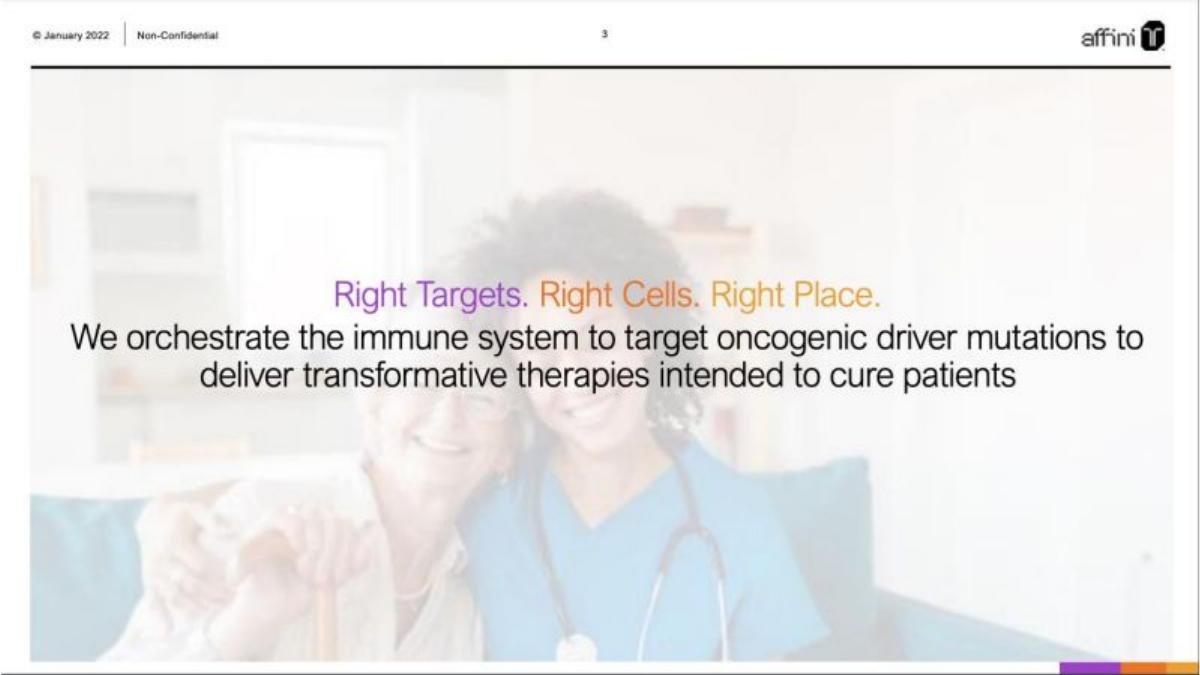
Slide 3, titled 'Right Targets. Right Cells. Right Place.', presents Affini-T's strategic mantra. The text states, 'We orchestrate the immune system to target oncogenic driver mutations to deliver transformative therapies intended to cure patients.' This slide uses a faded background image of a healthcare professional with a patient, which adds a human element to the scientific mission. The phrase 'intended to cure patients' is a strong, aspirational statement that underscores the company's ultimate goal. This slide serves as a concise and memorable articulation of their value proposition.
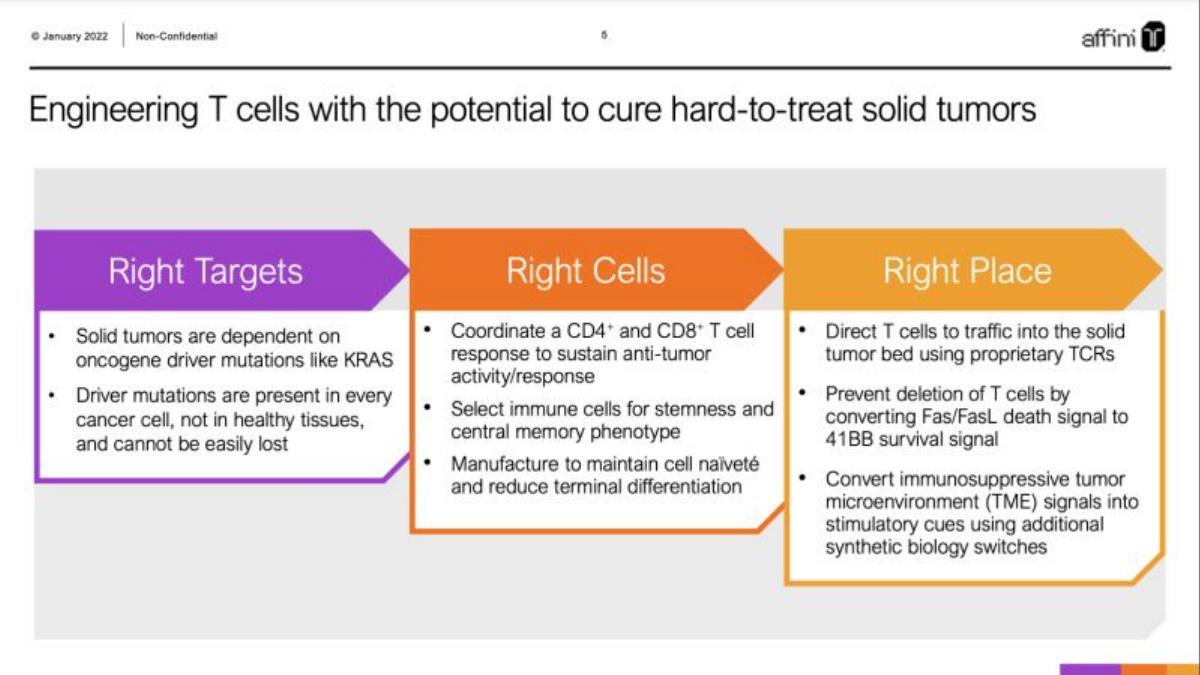
Slide 5: Engineering T Cells Strategy
This slide, titled 'Engineering T cells with the potential to cure hard-to-treat solid tumors,' elaborates on the 'Right Targets. Right Cells. Right Place.' framework introduced on Slide 3. It breaks down each component into bullet points:
Right Targets: Solid tumors dependent on oncogene driver mutations like KRAS; Driver mutations present in every cancer cell, not in healthy tissues, and cannot be easily lost. · Right Cells: Coordinate CD4+ and CD8+ T cell response to sustain anti-tumor activity/response; Select immune cells for stemness and central memory phenotype; Manufacture to maintain cell naiveté and reduce terminal differentiation. · Right Place: Direct T cells to traffic into the solid tumor bed using proprietary TCRs; Prevent deletion of T cells by converting Fas/FasL death signal to 41BB survival signal; Convert immunosuppressive tumor microenvironment (TME) signals into stimulatory cues using additional synthetic biology switches.
This slide provides a high-level overview of the scientific and engineering challenges Affini-T aims to solve, demonstrating a comprehensive approach to T-cell therapy development.
Slide 7: Market Opportunity - KRAS
Titled 'Attacking KRAS: the most prevalent oncogenic driver mutation in solid tumors,' this slide presents data supporting the market need for Affini-T's focus. It features two main graphics:
Relative frequency of G12 mutations: A pie chart showing the breakdown of Kirsten Rat Sarcoma (KRAS) G12 mutations, with Cysteine (C), Valine (V), and Aspartic acid (D) highlighted as having 'No approved therapies.' · Incidence of G12V and G12D in certain adenocarcinomas: Gauges illustrating the incidence and estimated patient numbers for KRAS G12V and G12D in Pancreatic (28% / ~74K and 35% / ~92K respectively), Colorectal (9% / ~98K and 12% / ~128K respectively), and Lung (7% / ~40K and 5% / ~30K respectively) cancers.
The slide effectively uses data to underscore the prevalence of KRAS mutations and the significant unmet medical need, particularly for G12V and G12D variants, which lack approved therapies. This provides a strong rationale for their target selection.
Slide 9: Co-Founders and Scientific Pedigree
This slide, 'Fred Hutch co-founders among the most prolific in the industry for generating T cell clinical programs,' highlights the scientific leadership. It features headshots of Phil Greenberg, MD, Aude Chapuis, MD, and Tom Schmitt, PhD. The text states they have 'Advanced over a dozen T cell therapeutic candidates.' Below their names, logos of institutions and companies like W, Juno Therapeutics, NIH, National Cancer Institute, Fred Hutch, and bluebird bio are displayed, along with 'Undisclosed industry partners.' On the right, two publications are cited: 'T cell receptor gene therapy targeting WT1 prevents acute myeloid leukemia relapse post-transplant' from Nature Medicine and 'T Cells Engineered against a Native Antigen Can Surmount Immunologic and Physical Barriers to Treat Pancreatic Ductal Adenocarcinoma' from Cancer Cell. This slide effectively establishes credibility and expertise through the founders' track record and affiliations.
Slide 11: Management Team and Seed Investors
Titled 'Experienced management poised to advance multiple T cell therapies,' this slide introduces the C-Suite and seed investors. It features headshots and titles for:
Jak Knowles, MD, CEO (logos: CytoSen, Century, Piexonics, Bayer) · Loïc Vincent, PhD, CSO (logos: Sanofi, Takeda, Adaptate) · Kim Nguyen, PhD, CTO (logos: Precision, Vitafont, Terumo) · Kathy Yi, MBA, COO/CFO (logos: Cerevel, Sangamo, Novartis)
Below the C-Suite, 'Seed Investors' are listed with their logos: VIDA Ventures, Leaps by Bayer, Humboldt, Agent Capital, and Alexandria. This slide demonstrates that the company has assembled a leadership team with relevant industry experience and has secured backing from reputable early-stage investors, signaling confidence from the investment community.
Slide 13: Discovery Platform
This slide, 'Affini-T’s discovery platform has identified multiple TCR clinical candidates,' illustrates the company's systematic approach to developing T-cell receptor (TCR) therapies. It outlines a four-step process:
Prioritize: Streamline top targets to prosecute, focusing on Solid tumors with high unmet need, Oncogenic driver mutants, Public epitopes, and Common HLAs (e.g., A11, A2, A3) as 'Candidate targets.' · Discover: Isolate high affinity TCRs from panel of healthy donors, leading to 'TCRs with de-risked safety profile that have cleared thymic selection.' This step mentions a 'Robust and proven TCR discovery platform' from Fred Hutch. · Engineer: Lentiviral engineering of patient T cells, leveraging 'coordinated CD4/CD8 T cell response for improved efficacy and durability.' · Treat: Infuse engineered T cell therapeutic.
The visual flow from left to right clearly explains the journey from target identification to patient treatment, making a complex process understandable.
Slide 15: Fundamental Immunology - CD4 T Cells
Titled 'Fundamental immunology: CD4 T cells can orchestrate durable anti-tumor responses,' this slide provides scientific background. It presents three diagrams illustrating the roles of CD4 T cells:
CD4 Helper: Promotes CD8 T cell function, proliferation and survival. · CD4 Effector: Direct and indirect killing of tumor cells. · CD4 Activator: Drives B cell maturation and antibody production.
These diagrams, while detailed, are typical for a scientific presentation and serve to educate the audience on the underlying biological mechanisms that Affini-T leverages. This slide demonstrates the scientific depth of the company's approach.
Slide 17: CD4/CD8 Coordinated Response Data
This slide, 'CD4/CD8 coordinated T cell response induces deep and durable anti-tumor activity,' presents experimental data. It shows two graphs comparing 'CD4 T Cells' and 'CD4 and CD8 T Cells' in their effect on 'Red object area µm²/well' (a measure of tumor size) over time (hours) in a PANC-1 cell line. Both graphs show a decrease in tumor area with the addition of T cells and co-receptors compared to 'Tumor Only.' Key takeaways are highlighted:
'Addition of co-receptor to CD4 T cells creates additional effector function for tumor killing.' · 'CD4 T cells synergize with CD8 T cells to enhance anti-tumor activity.'
This slide provides crucial preclinical evidence supporting the efficacy of their engineered T-cell approach, particularly emphasizing the synergistic effect of CD4 and CD8 T cells.
Slide 19: Differentiated Pipeline Title Slide
This is an interstitial slide, simply stating 'Differentiated Pipeline of TCR T Cell Therapies' on a black background with the Affini-T logo and the same molecular structures as the title slide. It acts as a section divider, signaling a transition to discussing the company's product pipeline.
Slide 21: First-Generation and Next-Generation Technologies
Titled 'Affini-T technologies positioned to advance a robust pipeline of immune innovation,' this slide outlines the company's technological evolution. It divides their approach into two categories:
First-Generation: Coordinated CD4/CD8 response; Fas-41BB durability receptor; Switch receptors (e.g., inhibitory receptors, cytokine receptors); Boost MHC expression; Disrupt endogenous TCR. · Next-Generation: CD28 costimulatory chimeric receptors (e.g., PD-1); Cytokines to increase immune response; Enzymes to break down fibrotic tissue; Epigenetic modification; Immune adjuvants; Chemokine receptors to improve trafficking.
This slide demonstrates a forward-looking strategy, showcasing not only their current capabilities but also their plans for future innovation and expansion of their therapeutic platform.
Slide 23: Multi-Generational Pipeline and Value Creation
This slide, 'Multi-generational pipeline will create meaningful value,' presents a timeline of value creation. It shows milestones across three stages:
Seed (2021): Advanced multiple KRAS candidates; Established manufacturing process; Developed gene editing strategy; Facilities contracted; Build out pipeline, platform, and team. · Series A and B (2022): KRAS: FIH safety for G12V + G12D; Clinical read-out for MCC and KRAS; p53 and PIK3CA clinical candidates; Automated TCR discovery engine; Non-viral manufacturing and next-gen synthetic biology strategies; Non-dilutive partnerships. · Beyond (2023+): KRAS, P53 and MCC: Clinical POC; Multi-center registrational study with in-house clinical supply; Robust multi-program pipeline; Allogeneic and in situ platform expansion; cGMP facility completion.
This slide provides a clear roadmap of the company's development, linking specific achievements and future goals to different funding stages and a timeline. It effectively communicates the potential for significant value creation over time.
Slide 25: Call to Action / Best Pitch Deck Promotion
This final slide is a promotional slide for 'bestpitchdeck.com,' inviting users to 'Browse the best pitch deck examples.' It features logos of various companies like Uber, Airbnb, and Dropbox, and encourages engagement via social media. This slide is not part of Affini-T's core pitch but rather an artifact of the deck's source, bestpitchdeck.com.
What Works Well
Affini-T's pitch deck excels in several key areas, particularly given its highly scientific and technical nature. Firstly, the deck establishes a strong scientific foundation from the outset. The title slide (Slide 1) immediately positions the company at the cutting edge of T-cell therapy for solid tumors. This is reinforced by the 'Right Targets. Right Cells. Right Place.' mantra (Slide 3), which simplifies a complex strategy into an easily digestible framework. The subsequent breakdown of this framework on Slide 5 provides sufficient detail for a scientifically literate audience without becoming overly dense.
The emphasis on the unmet medical need is another strength. Slide 7, dedicated to 'Attacking KRAS,' effectively uses data to highlight the prevalence of specific KRAS mutations and the current lack of approved therapies. The visual representation with pie charts and gauges makes the market opportunity clear and compelling, demonstrating a targeted approach to a significant problem in oncology.
Credibility is robustly built through the team slides. Slide 9 showcases the co-founders from Fred Hutch, emphasizing their extensive experience and track record in T-cell clinical programs. Citing specific scientific publications further solidifies their expertise. This is complemented by Slide 11, which introduces an experienced C-suite with backgrounds from major pharmaceutical and biotech companies, alongside a list of reputable seed investors. This combination of scientific and operational leadership, backed by early investment, instills confidence.
The deck also does an excellent job of explaining its discovery platform (Slide 13) and the underlying immunology (Slide 15) in a structured manner. The four-step process from 'Prioritize' to 'Treat' on Slide 13 is clear and logical, outlining the company's systematic approach. The inclusion of preclinical data on Slide 17, demonstrating the synergistic effect of CD4 and CD8 T cells, provides crucial validation for their scientific hypothesis and therapeutic strategy. This data-driven approach is essential for a biotech pitch.
Finally, the forward-looking vision is well-articulated. Slide 21 differentiates between 'First-Generation' and 'Next-Generation' technologies, showing a clear roadmap for platform evolution. This is further elaborated on Slide 23 with a 'Multi-generational pipeline' and a value creation timeline that projects milestones from the Seed stage through Series A and B, and 'Beyond' 2023. This demonstrates strategic planning and a long-term vision for growth and impact, which is attractive to investors looking for sustained value.
What Is Missing
Despite its strengths, the Affini-T pitch deck, based on the provided slides, exhibits several notable omissions typical for a public conference presentation rather than a private investor meeting. The most significant absence is a clear 'Ask' slide. There is no explicit statement of the funding amount being sought, the use of funds, or the valuation. While the catalogue listing indicates a Series B round raising $175M, this information is not present within the deck itself. For a private investor pitch, this would be a critical missing component, as investors need to understand the capital requirements and how their investment contributes to the company's milestones.
Secondly, there is no dedicated 'Problem' slide that explicitly outlines the challenges Affini-T aims to solve before presenting their solution. While Slide 7 touches on the unmet need for KRAS mutations, a more direct problem statement would set the stage more effectively, particularly for a less scientifically informed audience. The deck dives directly into the solution and its scientific underpinnings without first clearly articulating the pain points in the current treatment landscape for solid tumors.
Financial projections are also entirely absent. There are no revenue forecasts, burn rates, or detailed financial models. While a Series B biotech pitch might not delve into granular unit economics, high-level financial milestones or a projection of market share and revenue potential would typically be included to demonstrate the commercial viability and scale of the opportunity. The 'Value creation' slide (Slide 23) outlines scientific and operational milestones but lacks any corresponding financial implications or valuations.
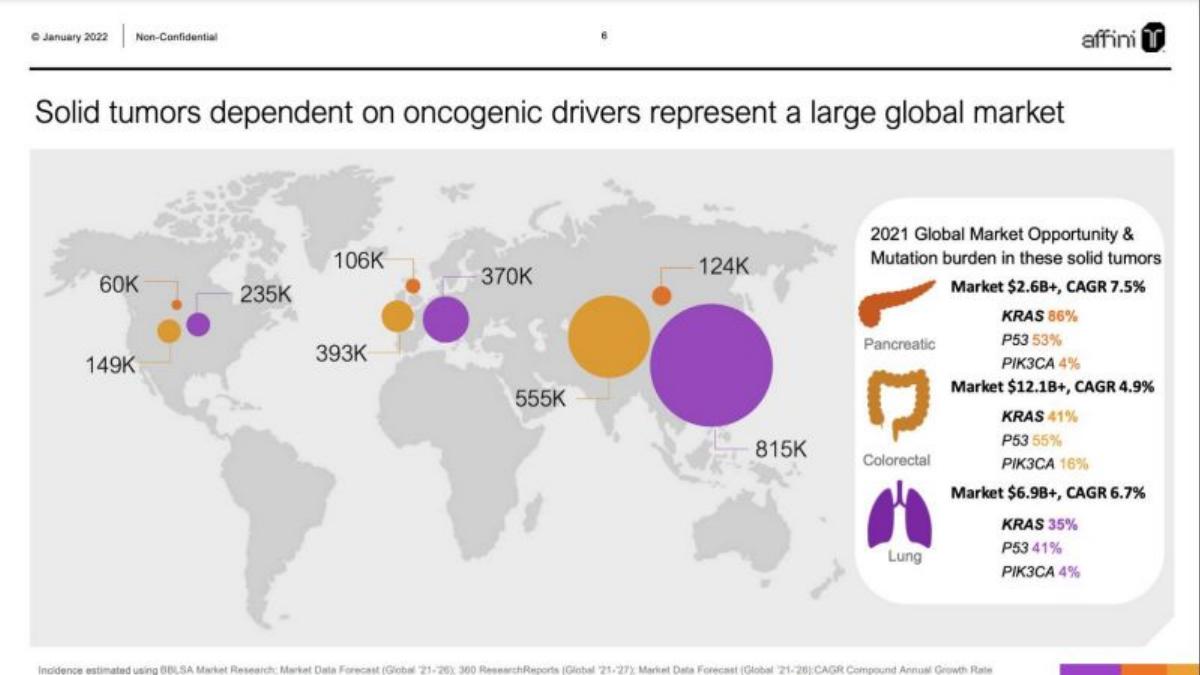
Furthermore, a comprehensive 'Market Size' slide beyond the incidence numbers for KRAS (Slide 7) is missing. While the KRAS data is valuable, a broader view of the total addressable market for solid tumors, or even specific subsets, would provide investors with a clearer understanding of the overall commercial potential. This would typically include market segmentation, growth rates, and competitive landscape analysis.
While the team slides are strong in scientific and operational expertise, a 'Board of Directors' or 'Advisory Board' slide is not included. For a Series B company, the composition of the board and the influence of key advisors can be a significant indicator of governance and strategic guidance, which investors often scrutinize.
Finally, while the deck mentions 'proprietary TCRs' (Slide 5) and a 'robust and proven TCR discovery platform' (Slide 13), a dedicated 'Intellectual Property' slide detailing their patent portfolio, competitive advantages, and barriers to entry is not present. In the highly competitive biotech space, IP is paramount, and investors would typically expect a clear articulation of how the company protects its innovations.
What a Founder Should Copy
Founders, especially those in deep tech or biotech, can learn valuable lessons from Affini-T's pitch deck. The first element to emulate is the clear and concise articulation of a complex scientific mission. The tagline 'Unlocking the power of T cells against oncogenic driver mutations' (Slide 1) and the strategic mantra 'Right Targets. Right Cells. Right Place.' (Slide 3) are excellent examples of simplifying intricate science into memorable, impactful statements. This approach helps investors quickly grasp the core value proposition without getting lost in excessive jargon.
Secondly, the strategic use of data to highlight unmet needs is highly effective. Slide 7, focusing on KRAS mutations, demonstrates how to present specific market data (incidence rates, lack of approved therapies) to justify the chosen therapeutic focus. Founders should identify their most compelling market data points and present them clearly, ideally with visuals that make the scale of the problem undeniable.
The emphasis on team credibility is another strong point. The detailed co-founder slide (Slide 9) showcasing their prolific track record, institutional affiliations (Fred Hutch), and scientific publications is crucial for biotech. Similarly, the C-suite slide (Slide 11) with logos of past companies demonstrates relevant industry experience. Founders should meticulously document their team's credentials, highlighting specific achievements and relevant experience that directly support the company's mission. For early-stage companies, leveraging the reputation of advisors or scientific founders is particularly important.
The structured explanation of the discovery platform (Slide 13) is also a valuable model. Breaking down a multi-step process into clear, sequential stages with concise descriptions helps investors understand the operational workflow and scientific rigor. Founders should strive to illustrate their core process or technology in a step-by-step manner, making it accessible even to those without specialized domain knowledge.
Furthermore, the inclusion of preclinical data (Slide 17) to validate key scientific hypotheses is essential for biotech. Presenting clear, interpretable graphs with concise explanations of the findings helps build confidence in the technology's potential. Founders should select their most compelling data and present it in a way that directly supports their claims about efficacy or mechanism of action.
Finally, the forward-looking pipeline and value creation timeline (Slides 21 and 23) are excellent for demonstrating long-term vision and strategic planning. Differentiating between current and future technological generations, and mapping out milestones against a timeline, shows investors a clear path to sustained growth and value generation. Founders should develop a similar roadmap, outlining key scientific, operational, and commercial milestones that align with their funding strategy and long-term objectives.
Deck Facts
company: Affini-T · sector: Healthcare · stage: Series B · year: 2022 · slides: 25 (13 provided) · decktype: Investor Pitch Deck · outcome: $175M raised · hq: Not specified in provided slides or catalogue facts
Frequently asked questions
- What is Affini-T's core therapeutic approach?
- Affini-T's core approach is to engineer T cells to target oncogenic driver mutations in solid tumors. They aim to orchestrate the immune system using 'Right Targets. Right Cells. Right Place.' principles to deliver transformative, curative therapies for patients, as stated on Slide 3.
- Which specific mutations does Affini-T focus on?
- The deck explicitly states a focus on 'Attacking KRAS: the most prevalent oncogenic driver mutation in solid tumors' (Slide 7). It highlights KRAS G12V and G12D mutations, noting the absence of approved therapies for these in certain adenocarcinomas.
- Who are the key scientific leaders behind Affini-T?
- The key scientific leaders are the Fred Hutch co-founders: Phil Greenberg, MD, Aude Chapuis, MD, and Tom Schmitt, PhD (Slide 9). They are described as being 'among the most prolific in the industry for generating T cell clinical programs'.
- What is the company's long-term pipeline strategy?
- Affini-T's long-term strategy involves a 'Multi-generational pipeline' to create meaningful value (Slide 23). This includes 'First-Generation' technologies like coordinated CD4/CD8 response and 'Next-Generation' advancements such as CD28 costimulatory chimeric receptors and epigenetic modification (Slide 21).
- What stage of funding was this deck used for?
- According to the catalogue facts, this deck was used for a Series B round, during which Affini-T raised $175M. The deck itself references 'Series A and B' in its value creation timeline on Slide 23.