Beatdapp's 12-slide seed deck from 2018 is a masterclass in 'problem-first' storytelling. The company identifies a specific, multi-billion dollar pain point—the discrepancy between streaming play counts and royalty payouts—and offers a high-throughput technical solution. By highlighting a 15% reporting error rate and the looming threat of billion-dollar lawsuits (citing Spotify's $1.6B settlement), the deck creates immediate urgency. While the technical explanation of the 'dapp' or blockchain element is light, the strength of the team and an exceptionally high-profile advisory board, includin…
Key takeaways
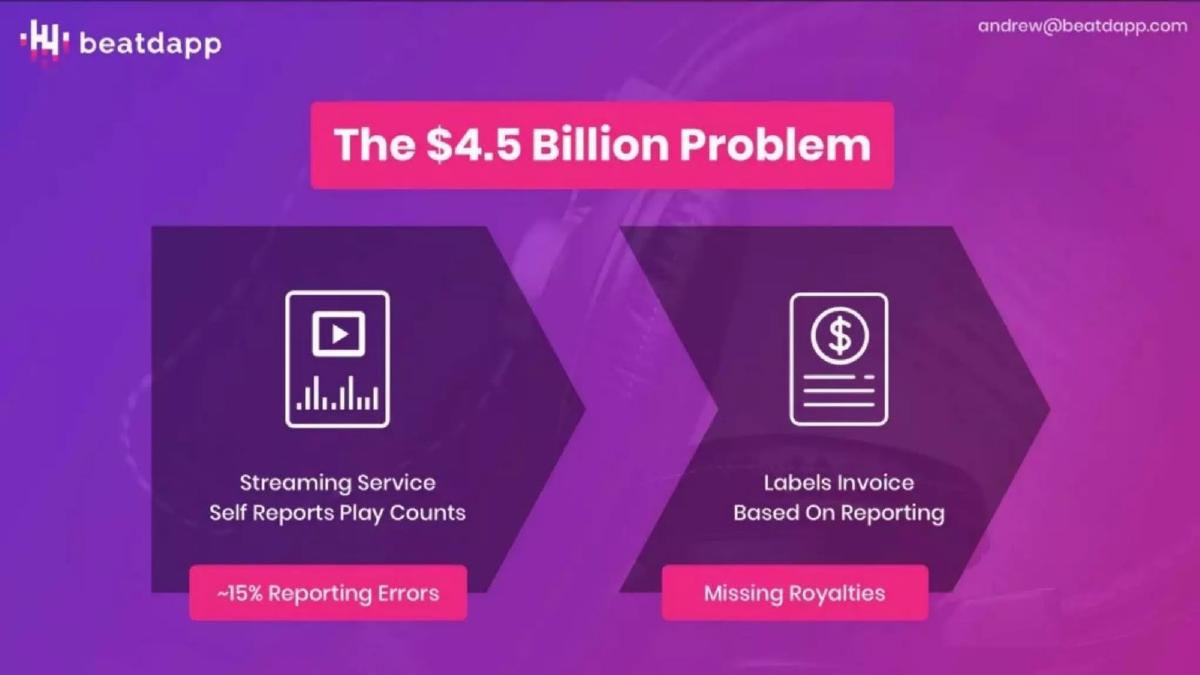
- The deck identifies a specific $4.5 billion annual loss in the music industry due to reporting errors (Slide 2).
- It creates urgency by citing a $1.6 billion publishing lawsuit settlement involving Spotify (Slide 4).
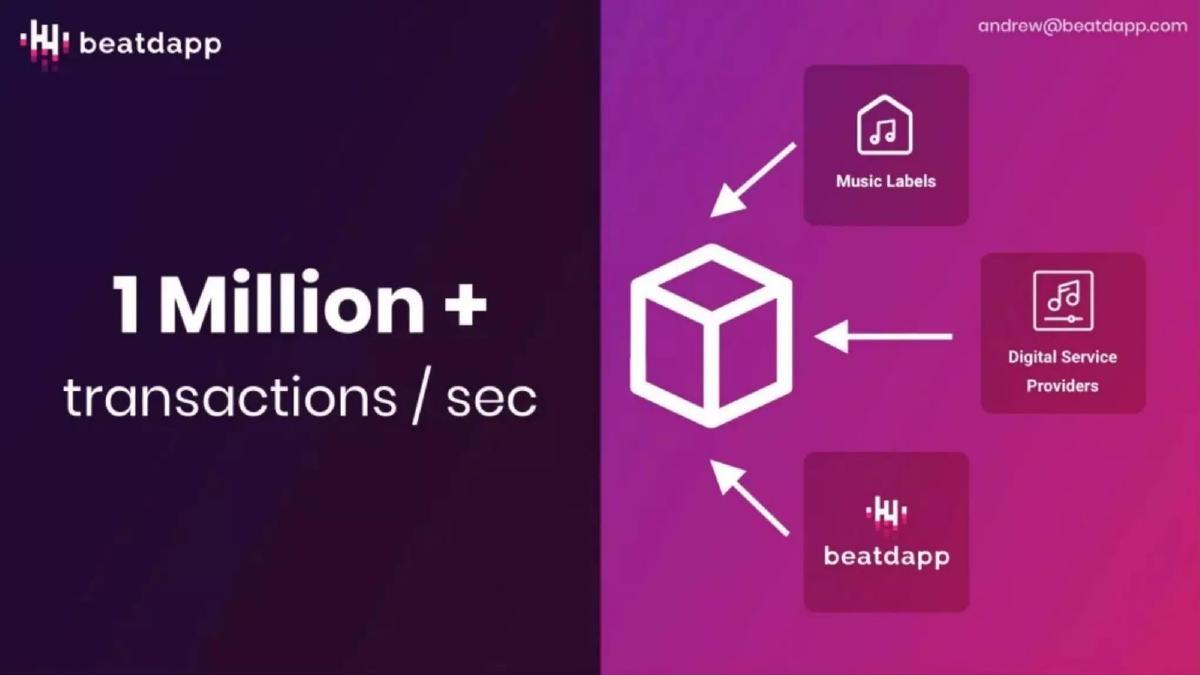
- Beatdapp claims a technical capacity of over 1 million transactions per second to handle global streaming volume (Slide 6).
- The company demonstrates commercial traction with a stated $25M sales pipeline featuring major labels like Warner Music and eOne (Slide 7).
- Market timing is supported by a Goldman Sachs forecast of a $30B market by 2030 with a 10.6% CAGR (Slide 8).
- The advisory board includes the 22nd Prime Minister of Canada and the former Chief Counsel of Universal Music Group (Slide 11).
- The deck omits a specific 'Ask' slide detailing how the $2.4M would be spent.
- There is no detailed breakdown of the business model or per-transaction pricing structure.
The Problem-Centric Pitch: Beatdapp's $2.4M Seed Strategy
Beatdapp’s 2018 seed deck is a focused, 12-slide presentation that prioritizes the scale of the problem over the complexity of the solution. In an era where 'blockchain' was often a buzzword looking for a problem, Beatdapp identified a multi-billion dollar accounting failure in the music industry and positioned itself as the objective auditor. By using a 'PWC for music' analogy, they simplified a complex technical proposition into a clear value add: recovering lost revenue and preventing lawsuits.
Slides 1-4: Establishing the $4.5 Billion Pain Point
The deck opens with a bold claim on Slide 1 : 'Solving a $4.5B problem for the music industry.' This immediately sets the stakes. Slide 2 breaks down the mechanics of this problem. It explains that streaming services self-report play counts, but these reports contain approximately 15% reporting errors, leading to 'Missing Royalties.' This is the core thesis of the company.
Slide 3 contextualizes the difficulty of tracking these plays by noting there are over 600 streaming platforms globally. It displays logos for major players like Spotify, YouTube, Tidal, and Peloton, alongside international giants like QQ Music and Gaana. This illustrates that the fragmentation of the market makes manual auditing impossible.
To move the problem from 'annoying' to 'existential,' Slide 4 highlights 'Multi-billion dollar headline litigation risk.' It features a Rolling Stone headline: 'Spotify Settles Its $1.6 Billion Publishing Lawsuit.' This slide is crucial because it shows that the 15% error rate isn't just lost revenue for labels; it is a massive legal liability for the platforms (DSPs) themselves. This establishes a dual-sided market need.
Slides 5-7: The Solution and Commercial Traction
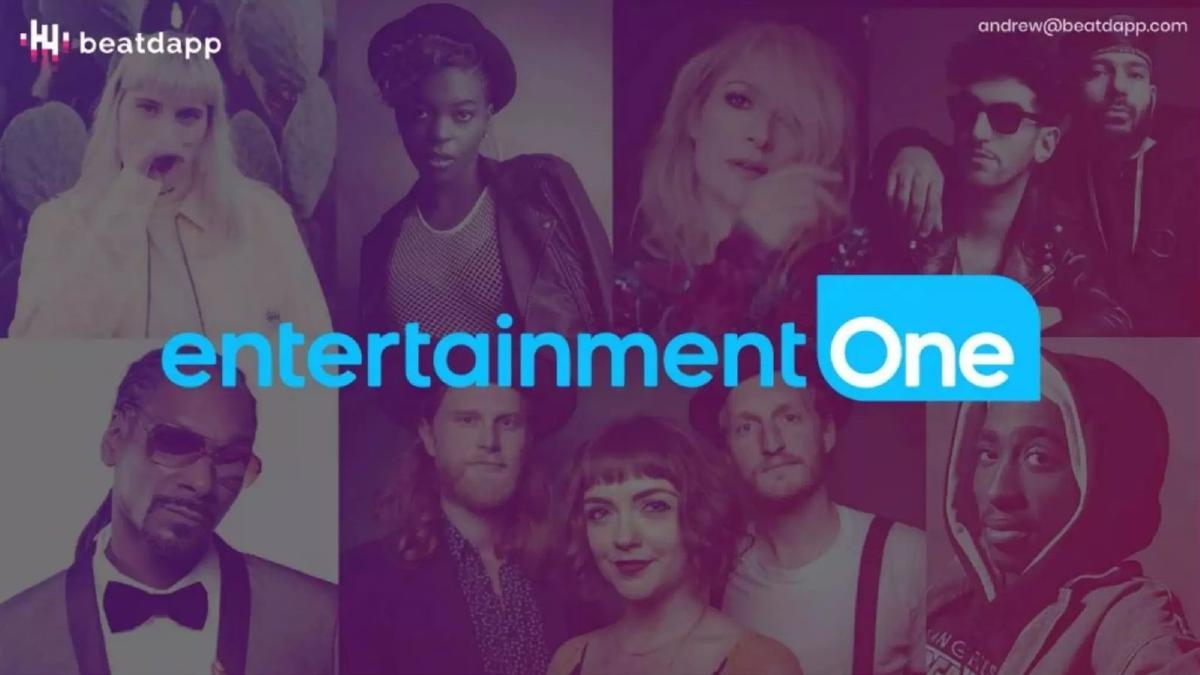
Slide 5 serves as a transition, showing a collage of artists under the 'entertainment One' (eOne) brand, likely signaling an early partner or a representative rights holder. Slide 6 introduces the technical capability of the platform. It claims the system can handle '1 Million + transactions / sec.' The diagram shows a central node receiving data from Music Labels and Digital Service Providers, with Beatdapp acting as the verification layer. This is the only slide that hints at the 'dapp' (decentralized app) nature of the business, though it focuses on throughput rather than decentralization.
Slide 7 is the 'Traction' slide, though it is framed as a '$25M Pipeline.' It lists heavy hitters in the music space: Warner Music, TuneCore, The Orchard, T-Series, and Saregama. For a seed-stage company, showing a pipeline of this caliber validates that the problem identified in the first four slides is one that the industry's largest incumbents are willing to pay to solve.
Slides 8-9: Market Opportunity and Growth
Slide 8 uses external validation to size the market. Citing a Goldman Sachs 'Stairway to Heaven' report, it projects a '$30B [market] by 2030' with a '+10.6% YOY CAGR.' This tells investors that even if Beatdapp only captures a small percentage of the audit/verification fee, the underlying volume is massive and growing.
Slide 9 provides a geographical breakdown of royalties, noting 1% in North America and 3% internationally. This is a somewhat vague slide—it isn't clear if these percentages represent the error rates, the market share, or the target commission. However, it reinforces the global nature of the streaming royalty problem.
Slides 10-12: The Team and the 'Why Now'
The 'Team' on Slide 10 features Andrew Batey (CEO), Morgan Hayduk (COO), and Pouria Assadipour (CTO). Their backgrounds include EasyMarkit, Spinlister, Telus, and the LA Clippers. While the founders have solid operational experience, Slide 11 is the 'heavy hitter' slide. The 'Our Advisors' section includes Stephen J. Harper, the 22nd Prime Minister of Canada. Having a former G7 world leader as an advisor is an extraordinary signal of credibility for a seed-stage startup. The board also includes the former Chief Counsel of Universal Music Group (Sarah Scott) and the former Canadian Consul General to Los Angeles (James Villeneuve), providing deep legal and diplomatic ties to the music industry's hubs.
The deck concludes on Slide 12 by restating the three most important numbers: '$30B by 2030,' '15% reporting error,' and '$4.5B annual loss.' It ends with a simple contact email, leaving the investors with the scale of the opportunity fresh in their minds.
What Works in This Deck
The Urgency of the Problem: By leading with a $4.5B loss and a $1.6B lawsuit, the deck makes the solution feel mandatory rather than optional. · The Advisory Board: In a complex industry like music rights, having the former Chief Counsel of UMG and a former Prime Minister provides a level of 'institutional trust' that is very hard to replicate. · The Pipeline: Listing Warner Music and T-Series in a $25M pipeline for a seed round is a very strong indicator of product-market fit. · Simplicity: The deck avoids getting bogged down in the technical 'how' of blockchain/Dapp technology and focuses entirely on the business value of 'verification.'
What is Missing
The Business Model: There is no mention of how Beatdapp actually makes money. Is it a SaaS fee? A percentage of recovered royalties? A per-transaction fee? This is a significant omission for a seed deck. · The Ask: The deck does not state how much money they are raising or what the milestones for the next 18 months will be. (We know from catalogue facts they raised $2.4M, but it isn't on the slides). · Competition: There is no competitive landscape slide. Investors would want to know how Beatdapp differs from traditional auditors or other blockchain-based rights management startups. · Product Visuals: There are no screenshots or mockups of the actual dashboard or reporting tool.
What a Founder Should Copy
The 'Anchor' Metric: Find the one number that defines the industry's failure (in this case, the 15% error rate) and repeat it. It becomes the 'hook' for the entire pitch. · The Headline Strategy: Using a real-world news headline (the Spotify lawsuit) to prove that the problem you are solving is currently causing pain for the biggest players in the market. · The 'Pipeline' Slide: If you don't have revenue yet, a pipeline slide with recognizable logos is the next best thing. It proves that people are at least taking your calls. · External Data Sources: Using a Goldman Sachs report to size your market adds a layer of professionalism and objectivity that 'founder-calculated' TAM slides often lack.
Frequently asked questions
- What problem is Beatdapp trying to solve?
- Beatdapp addresses the 'missing royalties' issue in the music streaming industry. According to slide 2, streaming services self-report play counts with an estimated 15% reporting error rate. This leads to a $4.5 billion annual loss for rights holders. By providing an independent, real-time authentication and verification system, Beatdapp aims to eliminate these discrepancies and reduce litigation risk for Digital Service Providers (DSPs).
- How does the technology work according to the deck?
- The deck is relatively high-level regarding the underlying architecture, but slide 6 illustrates a central verification hub that connects Music Labels, DSPs, and Beatdapp. The key technical claim is the ability to process over 1 million transactions per second, which is necessary to track global streaming data in real-time across the 600+ platforms mentioned on slide 3.
- Who are the key people involved in Beatdapp?
- The leadership team consists of Andrew Batey (CEO), Morgan Hayduk (COO), and Pouria Assadipour (CTO), with backgrounds at companies like EasyMarkit, Telus, and the LA Clippers (Slide 10). However, the advisory board is the standout feature, including Stephen J. Harper (22nd PM of Canada) and Sarah Scott (former Chief Counsel at Universal Music Group), providing significant industry and regulatory weight (Slide 11).
- What is the market size for this solution?
- Beatdapp cites a Goldman Sachs report on slide 8, projecting the music streaming market to reach $30 billion by 2030. They highlight a 10.6% year-over-year compound annual growth rate (CAGR). On slide 9, they further break down the opportunity by royalty volume, noting that 1% of annual royalties are in North America while 3% are international.
- Is there evidence of product-market fit in the deck?
- While the deck doesn't show a product demo, it demonstrates significant market interest through a $25 million pipeline (Slide 7). This pipeline includes major industry players such as Warner Music, TuneCore, The Orchard, and T-Series. This list of potential customers suggests that the 'reporting error' problem is a recognized pain point for the world's largest music rights holders.