Beeketing’s 2014 seed deck is a textbook example of how to leverage early traction to overcome a crowded market. In just 10 slides, the team demonstrates they aren't just building a product, but a growth engine. The deck highlights a consistent 30% to 50% month-over-month MRR growth over nine months, reaching $24,000 by December 2015 (Slide 5). Instead of long-winded feature lists, they use a competitive matrix to position themselves as the only 'Easy to Use' and 'Automated' solution for SMBs (Slide 7). The inclusion of their #1 and #2 rankings on the Shopify App Store (Slide 4) provides imme…
Key takeaways
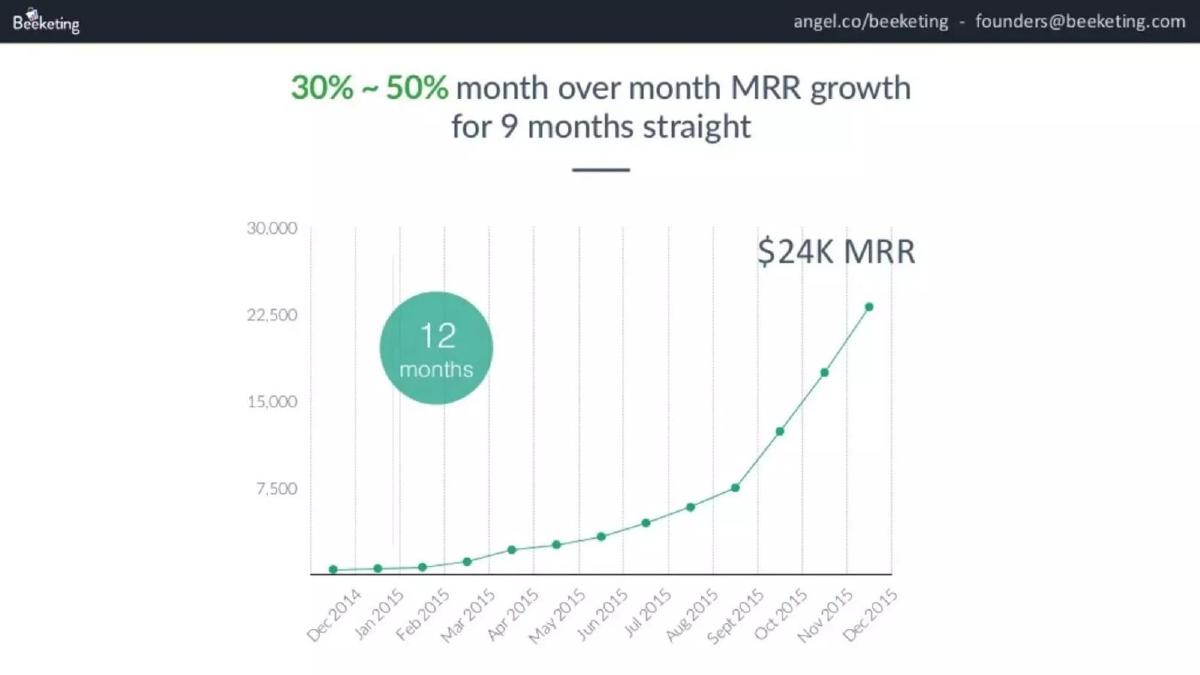
- The company achieved a consistent 30% to 50% month-over-month MRR growth for nine consecutive months (Slide 5).
- Beeketing reached $24,000 in Monthly Recurring Revenue by December 2015 (Slide 5).
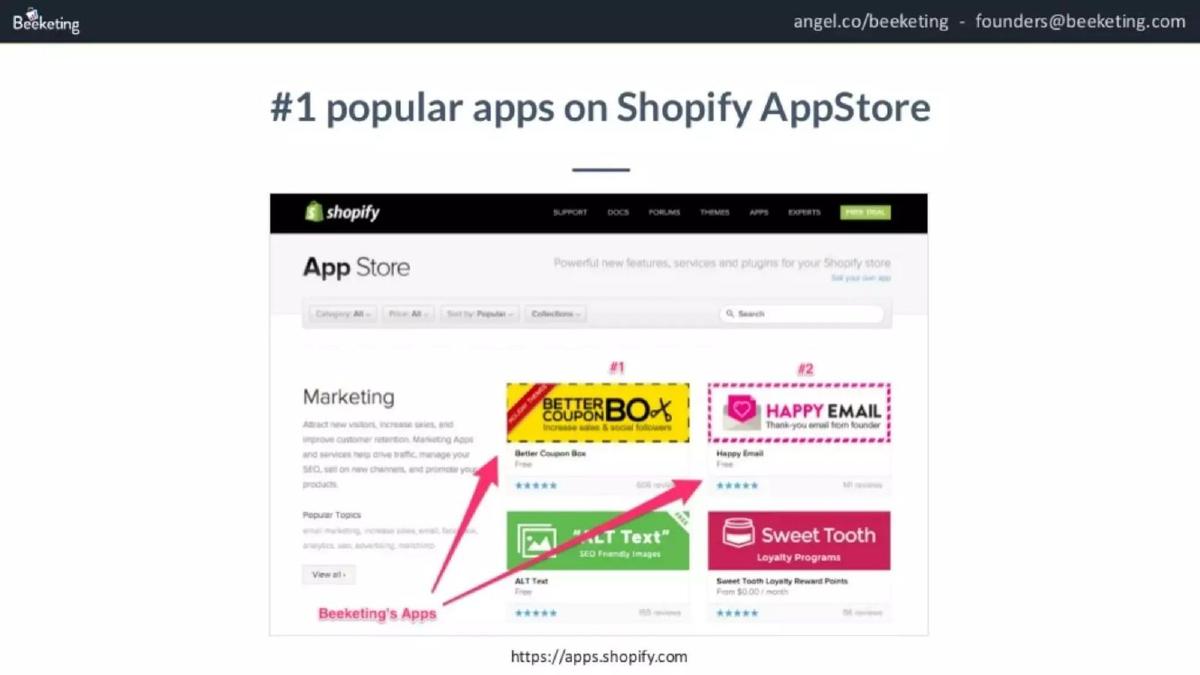
- The platform held the #1 and #2 spots for popular apps on the Shopify AppStore with 'Better Coupon Box' and 'Happy Email' (Slide 4).
- The total addressable market is defined as 2 million SMB online stores spending $6,000 per year, totaling a $12 billion market (Slide 8).
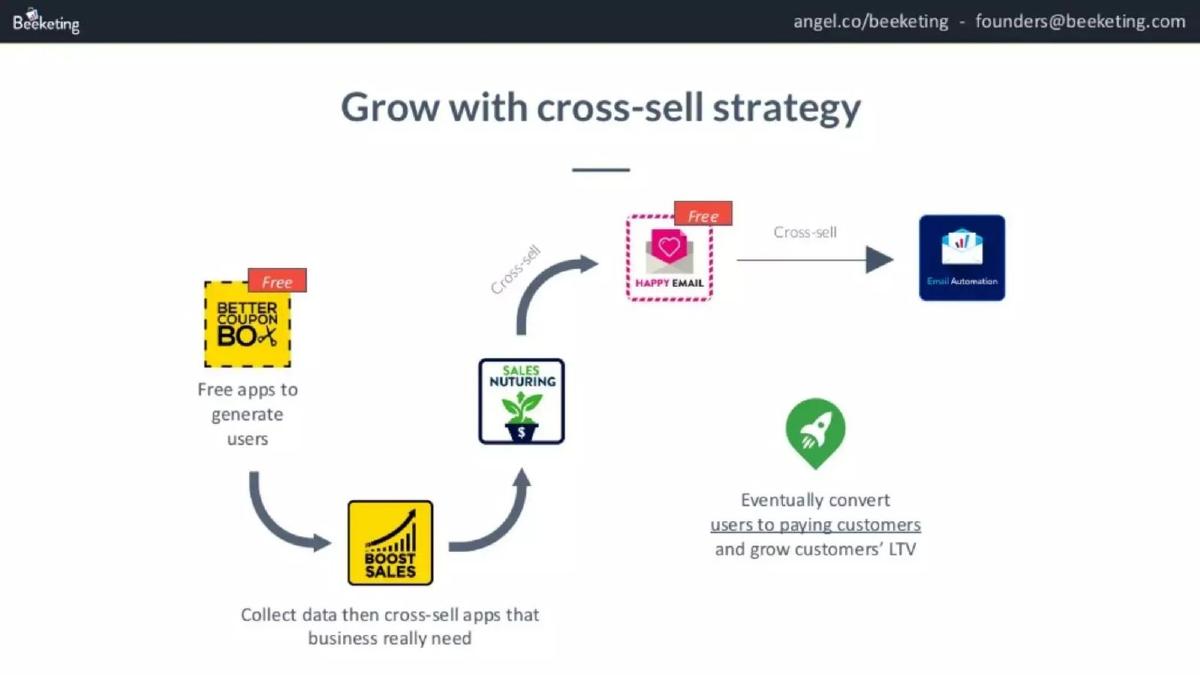
- The product strategy relies on a 'cross-sell' funnel, moving users from free apps to paid 'Sales Nurturing' and 'Email Automation' tools (Slide 6).
- The founding team includes a Forbes 30 Under 30 recipient and members with previous exits in the SaaS e-commerce space (Slide 9).
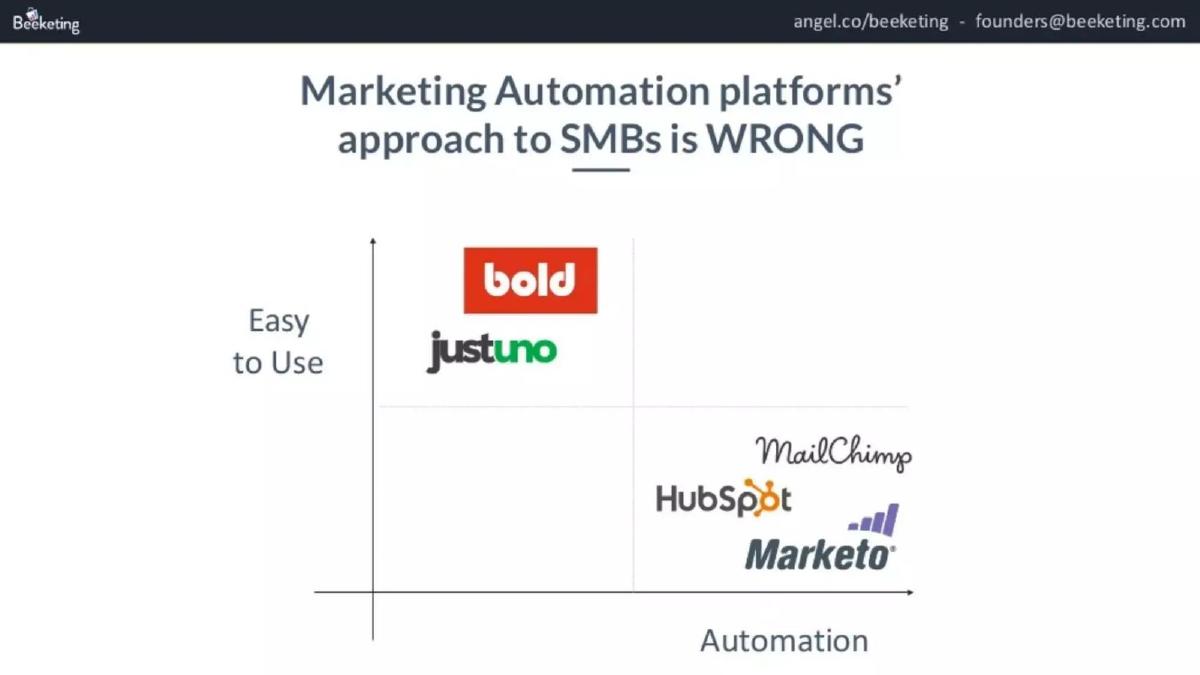
- The deck positions competitors like HubSpot and Marketo as high-automation but low ease-of-use for the SMB segment (Slide 2).
- The presentation completely omits a specific funding 'Ask' or a breakdown of how the $225,000 would be spent (Slide 10).
Introduction: The Power of the Traction-Led Pitch
The Beeketing pitch deck from 2014 is a lean, 10-slide document that serves as a masterclass in letting numbers do the talking. At the seed stage, many founders get bogged down in the 'vision' or the technical minutiae of their build. Beeketing took the opposite approach. By the time they were pitching this deck, they already had a $24,000 MRR and a dominant position in the Shopify ecosystem. This teardown explores how they used that momentum to secure a $225,000 seed round.
Slide 1: Title and Contact
The cover slide is minimalist, featuring the Beeketing logo and the tagline 'Marketing Automation for E-commerce.' It includes the name of the founder and CEO, Quan MT, and a direct email address. Notably, it also includes a link to their AngelList profile in the header, signaling that they are actively in fundraising mode and providing a path for immediate due diligence.
Slide 2: The Market Gap
Slide 2 sets the stage by identifying a flaw in the current market. Using a standard 2x2 matrix, the founders plot 'Easy to Use' against 'Automation.' They place established giants like MailChimp, HubSpot, and Marketo in the high-automation but low-ease-of-use category. Conversely, they place Bold and Justuno in the easy-to-use but low-automation category. This creates a logical 'white space' in the top-right quadrant for a solution that is both automated and simple.
Slide 3: Visualizing the Problem
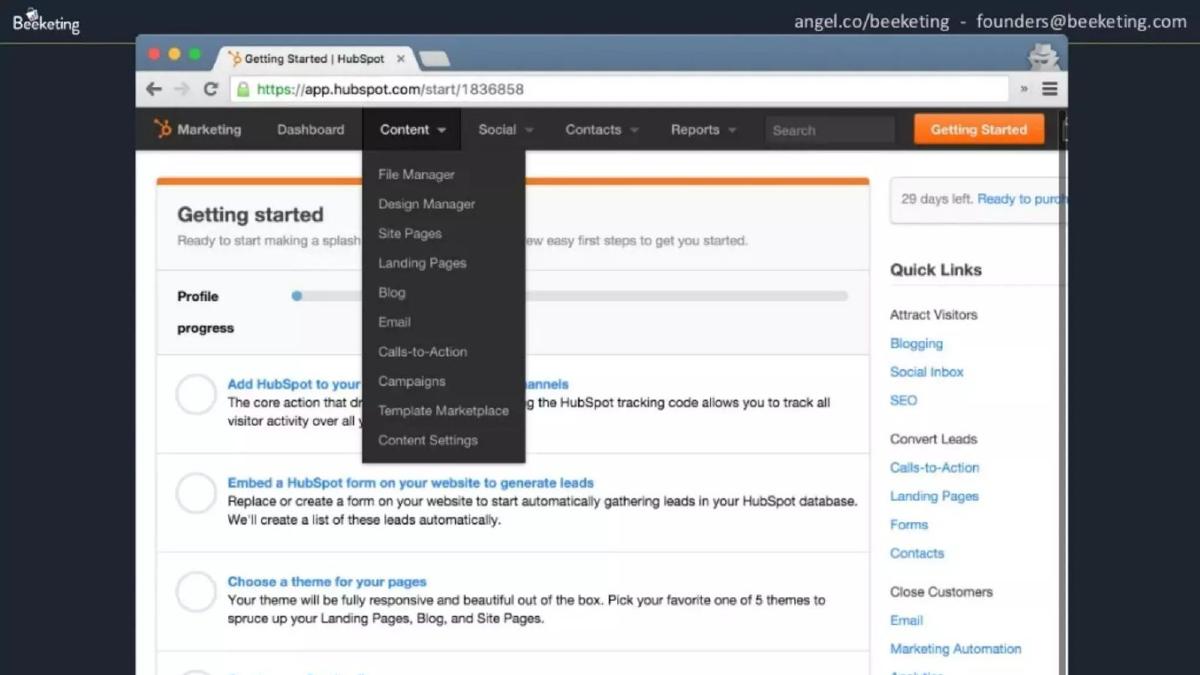
Slide 3 is a screenshot of the HubSpot 'Getting Started' dashboard. It serves as a visual proof point for the claim made on the previous slide. The interface is cluttered with menus for File Manager, Design Manager, Landing Pages, and more. For a small business owner, this represents a steep learning curve and a significant time investment. By showing this, Beeketing reinforces the idea that existing solutions are too complex for their target demographic.
Slide 4: Social Proof and Ecosystem Dominance
This is arguably the most important slide in the deck for a seed-stage investor. It shows a screenshot of the Shopify App Store where two of Beeketing's products, 'Better Coupon Box' and 'Happy Email,' occupy the #1 and #2 spots in the Marketing category. This proves three things: they understand the distribution channel, they can build products that users actually want, and they have already achieved scale within a major ecosystem.
Slide 5: The Traction Curve
"30% ~ 50% month over month MRR growth for 9 months straight"
If Slide 4 proved they could get users, Slide 5 proves they can make money. The chart shows a classic 'hockey stick' growth curve starting in December 2014 and ending in December 2015 with $24K MRR . The text highlights the consistency of this growth. For an investor, a 9-month track record of 30-50% MoM growth is a strong indicator of a scalable business model.
Slide 6: The Business Model (Cross-Sell Strategy)
Slide 6 explains how they turn free users into revenue. The 'cross-sell strategy' starts with free apps to generate a user base. Once the data is collected, the platform suggests apps that the business 'really needs,' such as 'Sales Nurturing' or 'Email Automation.' The goal, as stated on the slide, is to 'Eventually convert users to paying customers and grow customers' LTV.'
Slide 7: The Solution Positioning
This slide returns to the 2x2 matrix from Slide 2, but now Beeketing is placed firmly in the top-right quadrant. By adding their logo and the icons of their various apps into that 'Easy to Use' and 'Automated' space, they visually complete the argument started at the beginning of the deck. They are the solution to the problem of complexity in the SMB market.
Slide 8: Market Size
Beeketing defines its Total Addressable Market (TAM) as 2 Million small and medium online stores. They estimate these stores spend $6,000 per year on online marketing, leading to a $12 Billion market . They also include logos for Shopify, Magento, Bigcommerce, and Volusion, indicating that while they started on Shopify, their ambitions (and the market) extend to all major e-commerce platforms.
Slide 9: The Founding Team
The team slide focuses on relevant experience and accolades. CEO Quan MT is highlighted as a 'Forbes 30 under 30' recipient with a previous exit at age 18. CMO Alice Ha is credited with growing a previous SaaS project from 0 to 90,000 users in one year. CTO Dzung Da is noted for building a messenger system for over 1,000 social networks. This slide builds confidence that the team has the technical and marketing chops to execute the plan.
Slide 10: Conclusion and Traction Summary
The final slide repeats the most impressive metrics: $24K MRR , 30% ~ 50% MoM MRR growth , and #1 on Shopify AppStore . It provides contact information again. Notably, there is no 'Ask' here. There is no mention of how much they are raising or what the valuation is. This suggests the deck was used as a teaser or that the terms were being negotiated separately.
What Works in This Deck
Traction is the Hero: The deck doesn't lead with a 'vision' of the future; it leads with the reality of the present. The $24k MRR and the #1 App Store ranking are the strongest possible arguments for a seed round. · Clear Competitive Positioning: The 2x2 matrix is a standard trope, but here it is backed up by a screenshot of a competitor's complex UI. This makes the 'Easy to Use' claim feel earned rather than just a marketing buzzword. · The Funnel Logic: Slide 6 clearly explains the 'how' of their revenue. Showing the transition from free apps to paid automation tools makes the business model easy to understand.
What is Missing from This Deck
The Ask: There is no slide detailing the funding goal. Investors need to know if the company is looking for $200k or $2M, and what milestones that money will buy. · Unit Economics: While MRR growth is shown, there is no mention of Customer Acquisition Cost (CAC) or Churn. In the crowded e-commerce app space, retention is just as important as acquisition. · Product Roadmap: The deck shows what they have built, but it doesn't clearly articulate what comes next. Is the goal to stay an 'app suite' or to become a standalone platform?
What a Founder Should Copy
The 'Proof' Slide: If you have a top ranking in an app store or a high rating on a review site, put the screenshot in the deck. It is much more powerful than a bullet point. · The Traction/Contact Footer: Keeping the contact info and a link to a data room (or AngelList) on every slide (as seen in the header/footer here) makes it easy for an investor to move to the next step. · Minimalist Design: This deck uses very little text. It relies on charts, logos, and screenshots. This ensures the investor focuses on the data rather than getting lost in paragraphs of prose.
Frequently asked questions
- What was Beeketing's primary growth metric in this deck?
- Beeketing focused heavily on Monthly Recurring Revenue (MRR) growth. Slide 5 shows a clear upward trajectory from near-zero in late 2014 to $24,000 in December 2015. They specifically highlighted a 30% to 50% month-over-month growth rate sustained for nine months, which is a powerful signal for seed-stage investors looking for product-market fit.
- How did Beeketing differentiate itself from major players like HubSpot?
- They used a 2x2 matrix on Slide 2 and Slide 7 to argue that enterprise-grade tools like HubSpot, Marketo, and MailChimp are too complex for SMBs. They positioned Beeketing in the top-right quadrant, claiming to offer high levels of automation while remaining 'Easy to Use,' a gap they identified in the existing market.
- What is the 'cross-sell strategy' mentioned in the deck?
- Slide 6 outlines a freemium acquisition model. They offer free apps like 'Better Coupon Box' to generate a large user base and collect data. They then cross-sell these users into paid services like 'Sales Nurturing' and 'Email Automation' to increase the Lifetime Value (LTV) of the customer.
- Who were the key members of the founding team?
- The team consisted of Quan MT (CEO), Alice Ha (CMO), and Dzung Da (CTO). According to Slide 9, Quan MT was a Forbes 30 Under 30 honoree with a previous exit, Alice Ha had grown a previous SaaS project to 90,000 users, and Dzung Da had experience building messenger systems for over 1,000 social networks.
- What is missing from this pitch deck?
- The deck is notably missing an 'Ask' slide, which typically details the amount of money being raised and the milestones it will fund. It also lacks a detailed breakdown of unit economics (CAC/LTV ratios) and a roadmap for future product development beyond the existing app suite.