Bellhop’s September 2013 pitch deck captures a specific moment in the evolution of the sharing economy, positioning itself as the 'bellboy' for the Airbnb era. The deck identifies a clear market gap: while platforms like Airbnb were booming, homeowners lacked the professional infrastructure to manage guests at scale. Bellhop proposed a hybrid solution combining an online rental agent service with a marketplace for local service providers like cleaners and check-in agents. While the deck succeeds in establishing market demand by riding the coattails of Airbnb’s early growth, it suffers from si…
Key takeaways
- The deck leans heavily on Airbnb's early success, citing that 40,000 people rented through the platform in a single night (Slide 2).
- Bellhop positions itself as a dual-sided solution: an online rental agent service and a local services marketplace (Slide 3).
- The company identifies a specific need for 'offline' services including housekeeping, check-in/check-out, and room service (Slide 4).
- A significant portion of the value prop relies on hardware and IoT, specifically door locks and electricity control (Slide 5).
- The deck claims to offer 'expert optimization' and syncing across hundreds of rental portals and agencies (Slide 3).
- Bellhop attempts to monetize guest services beyond the stay, including room service and transfers (Slide 4).
- The deck omits critical investor information such as the founding team, business model, and the amount of capital being raised.
- The presentation uses a dated 'bellboy' mascot to humanize a service that is primarily digital and logistics-heavy (Slide 4).
Bellhop Pitch Deck Analysis
The Bellhop pitch deck from September 2013 is a classic example of a 'service layer' startup. It was created during the gold rush of the sharing economy, specifically targeting the inefficiencies created by the rapid rise of Airbnb and its competitors. The deck is brief, totaling 11 slides (with 6 provided for this analysis), and focuses heavily on the 'what' and 'why' while almost entirely ignoring the 'who' and 'how much.'
Slide 1: Title and Vision
The cover slide introduces the company with the tagline: "Turn your home into a hotel with Bellhop." The branding uses a red, script-heavy logo that evokes a vintage hospitality feel, contrasted with a modern, minimalist layout. The footer provides a timestamp of September 2013 and contact information, establishing the deck as a product of the early-2010s tech ecosystem. The vision is clear and immediate: professionalizing the amateur rental market.
Slide 2: Background and Market Validation
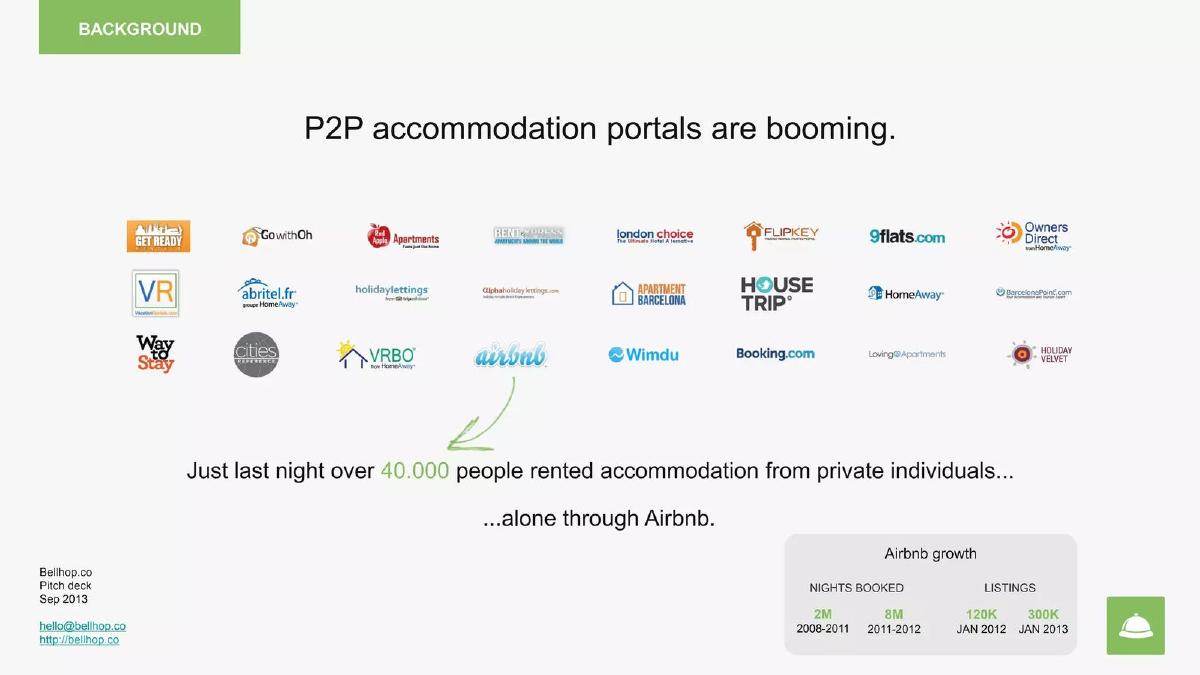
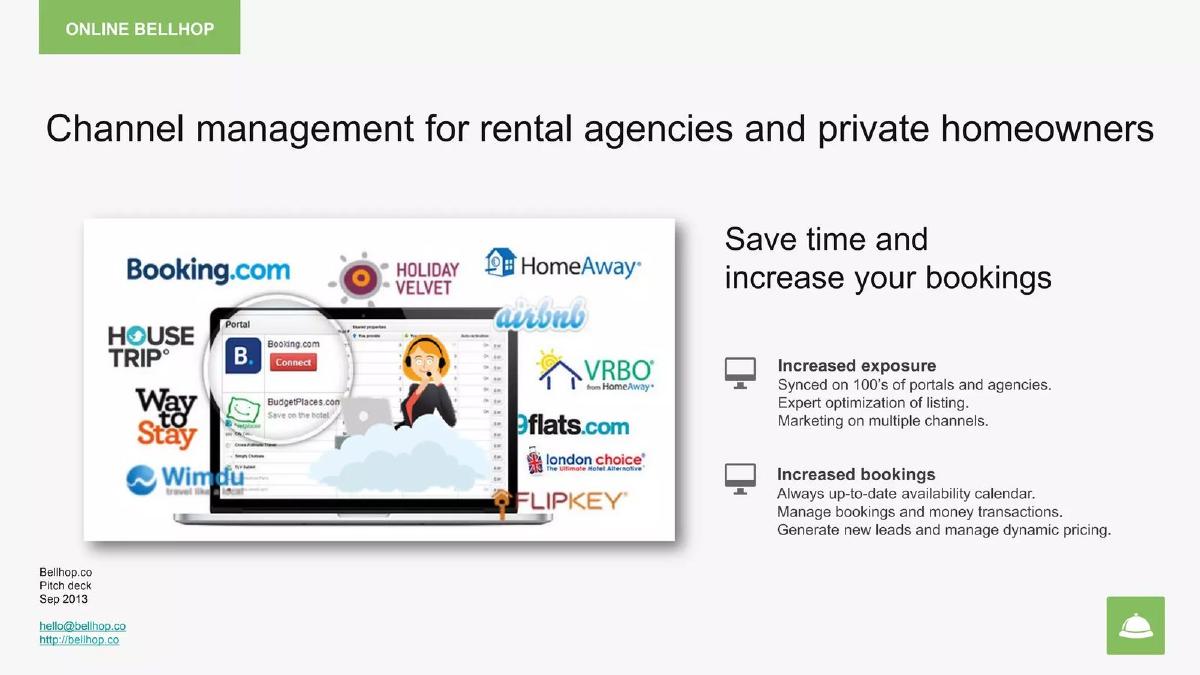
Slide 2, titled "BACKGROUND," uses a 'logos slide' approach to demonstrate market saturation. It features over 20 logos of P2P accommodation portals, including Airbnb, VRBO, HomeAway, and Booking.com . The central claim is that "P2P accommodation portals are booming."
To ground this in data, the slide notes that "Just last night over 40,000 people rented accommodation from private individuals... alone through Airbnb." It also includes a small table showing Airbnb's growth: 2M nights booked between 2008-2011 jumping to 8M in 2011-2012 , and listings growing from 120K in Jan 2012 to 300K in Jan 2013 . This slide effectively uses a third party's success to validate the existence of a massive, underserved user base.
Slide 3: The Solution - Digital and Physical
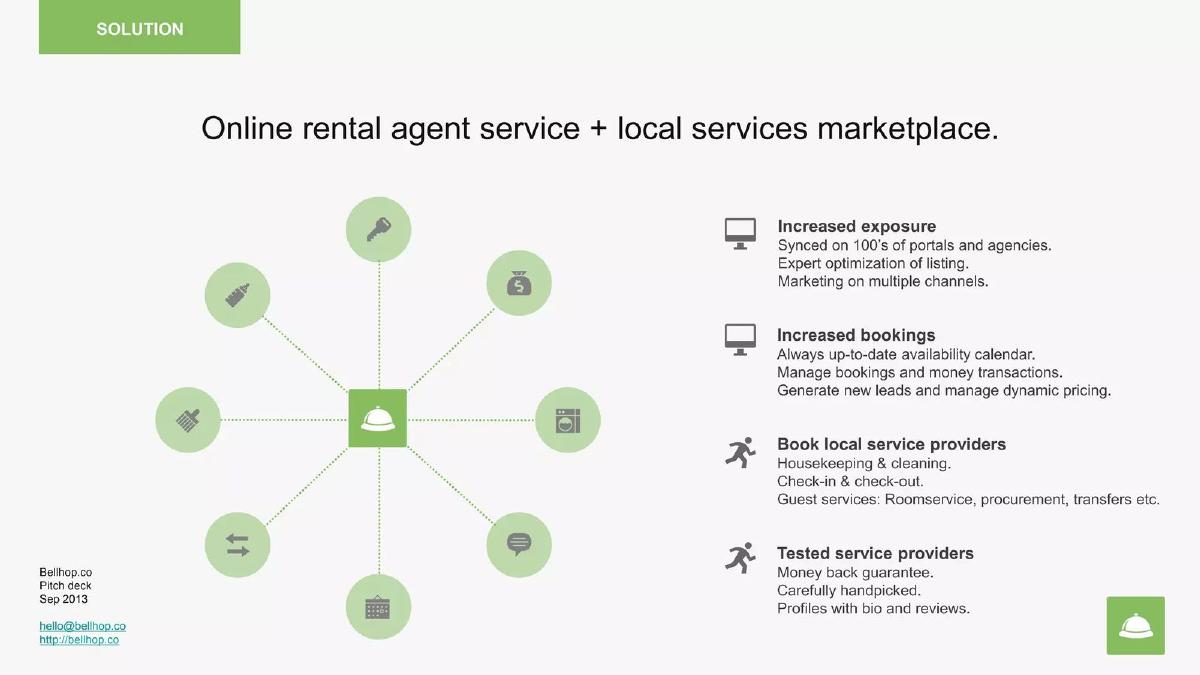
The "SOLUTION" slide defines Bellhop as an "Online rental agent service + local services marketplace." A central hub graphic shows the Bellhop logo connected to various icons representing keys, money, laundry, and communication. The slide breaks the solution into four pillars:
Increased exposure: Syncing on hundreds of portals and expert listing optimization. · Increased bookings: Calendar management, transaction handling, and dynamic pricing. · Book local service providers: Housekeeping, check-in/out, and guest services like room service. · Tested service providers: A curated marketplace with a money-back guarantee and reviewed profiles.
This slide attempts to solve both the digital problem (getting booked) and the operational problem (cleaning and guest management).
Slide 4: Offline Bellhop - The Human Element
Slide 4, titled "OFFLINE BELLHOP," introduces a cartoon bellboy mascot. The headline is "Bellboy service for rental agencies and private homeowners." This slide reiterates the physical services mentioned previously but emphasizes the emotional benefit: "Save time and avoid the hassles."
By listing 'procurement' and 'transfers' under guest services, Bellhop signals an intent to capture more of the travel value chain beyond just the stay. The mention of 'rental agencies' as a target customer suggests the founders recognized that professional managers, not just individuals, were struggling with the logistics of distributed inventory.
Slide 5: Home Automation and Upselling
The "Home Automation" slide introduces a hardware component to the business. It focuses on "Upselling Doorlock and Room Service." The slide highlights four tech-enabled features:
Door Lock: Eliminating key handling. · Full Control: Managing electricity usage via a smartphone. · Instant WiFi: Connecting guests via Facebook login. · Room Service: Ordering food in the local language through a tablet or laptop.
A footnote mentions that this is "Powered by openXO," which is stated to be "managing 5500 Hotels." This slide is ambitious but introduces significant questions about installation, maintenance, and capital expenditure that the rest of the deck does not answer.
Slide 6: Closing Branding
The final slide provided is a repeat of the title branding, serving as a visual bookend. In a standard pitch, this would usually be the 'Q&A' or 'Contact' slide, though here it contains no new information.
What Works in This Deck
Market Timing: In 2013, the 'Airbnb for X' and 'Services for Airbnb' models were highly attractive to investors. By using Airbnb's actual growth numbers, Bellhop makes a compelling case that the 'host' is a new type of small business owner in need of tools.
Clear Value Proposition: The distinction between the 'Online Agent' and the 'Local Marketplace' is a smart way to show how the company can scale. Software scales globally; services scale locally. By offering both, they position themselves as a comprehensive utility for the host.
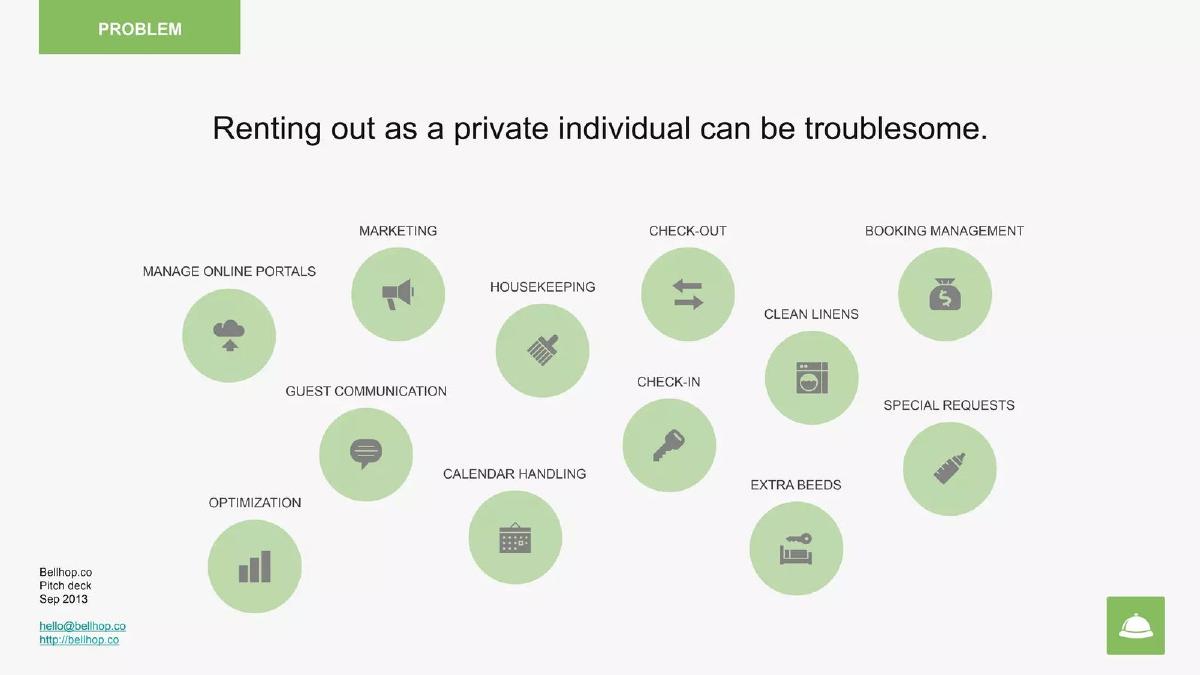
Focus on Friction: The deck correctly identifies 'key handling' and 'cleaning' as the two biggest pain points in short-term rentals. Addressing these specifically shows a good understanding of the customer's daily life.
What is Missing
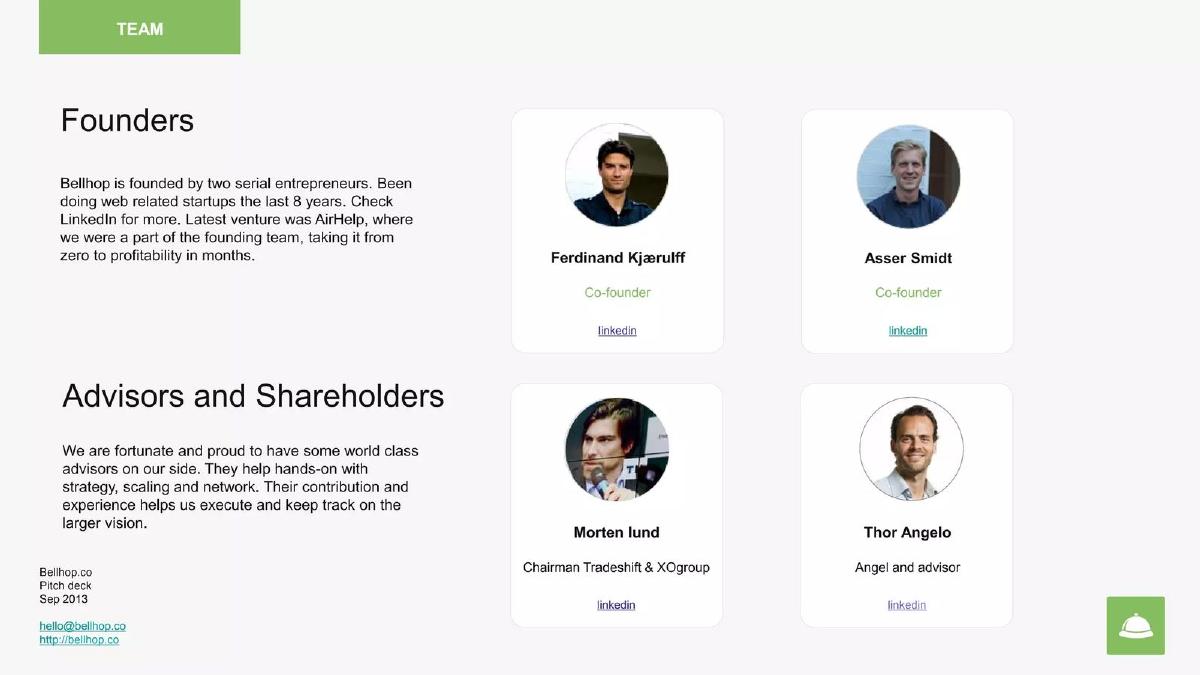
The Team: There is no team slide in the provided sequence. For a service-heavy business that requires logistics and local marketplace management, the founders' background in operations or hospitality is critical information for an investor.
Business Model: As noted in the FAQ, the deck never explains how Bellhop generates revenue. Do they take a percentage of the rental income? Do they charge a fee for the cleaning service? Without this, it is a product pitch, not a business pitch.
Unit Economics: The inclusion of home automation (Slide 5) suggests a high cost of customer acquisition or at least a high initial setup cost. The deck provides no information on how these hardware costs are covered or what the payback period looks like.
The Ask: There is no slide detailing how much money is being raised, what the milestones are, or how the capital will be deployed. This leaves the investor without a clear call to action.
Founder Takeaways
Use 'Coattail Validation': If you are building in the orbit of a giant (like Airbnb or Amazon), use their growth metrics to prove your market exists. Bellhop does this perfectly on Slide 2.
Balance Digital and Physical: If your startup has an offline component, be clear about how those two worlds interact. Bellhop’s Slide 3 graphic is a good template for showing a central software hub managing various physical tasks.
Be Wary of 'Feature Creep' in Decks: The home automation slide feels like a different business than the 'local services marketplace.' Founders should be careful not to present too many disparate business models (SaaS, Marketplace, and IoT) in a single short deck, as it can make the execution strategy look unfocused.
Don't Forget the Basics: No matter how good the idea is, a deck without a team slide and a financial ask is incomplete. Investors invest in people and their ability to turn capital into more capital; this deck only shows a vision for a service.
Frequently asked questions
- What is the core problem Bellhop is trying to solve?
- Bellhop addresses the friction in the peer-to-peer rental market. While platforms like Airbnb made it easy to list a home, homeowners still faced the 'hassles' of professional management. Slide 4 explicitly mentions saving time on housekeeping, check-ins, and guest services. The deck suggests that private individuals lack the tools to act like professional hotels, and Bellhop provides that missing infrastructure.
- How does Bellhop plan to differentiate itself from simple listing sites?
- Unlike Airbnb or VRBO, which are primarily discovery portals, Bellhop positions itself as a management layer. Slide 3 describes their 'Online rental agent service' which includes dynamic pricing, lead management, and cross-portal syncing. Furthermore, they integrate physical services and home automation (Slide 5), moving beyond the digital transaction into the physical operation of the rental property.
- What role does technology play in the Bellhop pitch?
- Technology is presented as both a management tool and a guest amenity. Slide 5 details 'Home Automation' features like smart door locks to eliminate key handling, electricity usage control, and instant WiFi via Facebook login. They also mention a partnership or integration with 'openXO' to manage these systems, suggesting a heavy reliance on IoT to streamline operations.
- Is there a clear business model presented in the deck?
- No. The deck describes the services offered—such as housekeeping, room service, and rental optimization—but it never explains how Bellhop makes money. There is no mention of commission rates, subscription fees for the software, or markups on the local service marketplace. This is a significant omission for a professional fundraising document.
- Who is the intended target audience for Bellhop?
- The deck identifies two primary customer segments on Slide 4: 'rental agencies' and 'private homeowners.' By targeting agencies, Bellhop suggests a B2B play where they act as a sub-contractor for professional managers, while their 'private homeowner' focus targets the growing individual host market popularized by the logos shown on Slide 2.