Gaming Startup Go-to-Market Slide Examples: 9 Real Pitch
How gaming and esports startups explain how they will win players: sponsored tournaments, publisher pipelines, celebrity reach.
Gaming Startup Go-to-Market Slide: Show the Community, the Partner and the Cost per Player
Games and esports products live or die on whether players show up and stay. A gaming startup's go-to-market slide therefore has to answer a narrower question than most: where will the first thousand, then the first hundred thousand, players come from, and what will each one cost? This guide uses nine go-to-market slides from gaming, esports and game-adjacent startups, from a sponsored college tournament with a dated schedule and prize pool to a cost table whose own rows do not add up and a profit forecast that the slide never supports.
TL;DR
Name the community or partner that brings players, give dates and figures for it, and separate reach from results. Brag House shows a dated college tournament (6 to 27 July 2021) with Coca-Cola and McDonald's as partners, 10 universities and a $10,000 prize. Fayceoff names a pipeline of 250+ game companies and a partner with 100 million unique users. Kryptomon lists its channels and "+100K current community members". Kings Entertainment gives celebrity follower counts, from 245k to 18.4 million, but no campaign result. Warlands prices a distribution team for 1,000 daily players at €340,620 a month, then forecasts €3.5 million monthly net with nothing to support it.
Nine gaming go-to-market slides
Strongest first, warning examples last. Each example quotes the slide and notes what an investor can and cannot learn from it.
Brag House go to market slide — slide 15
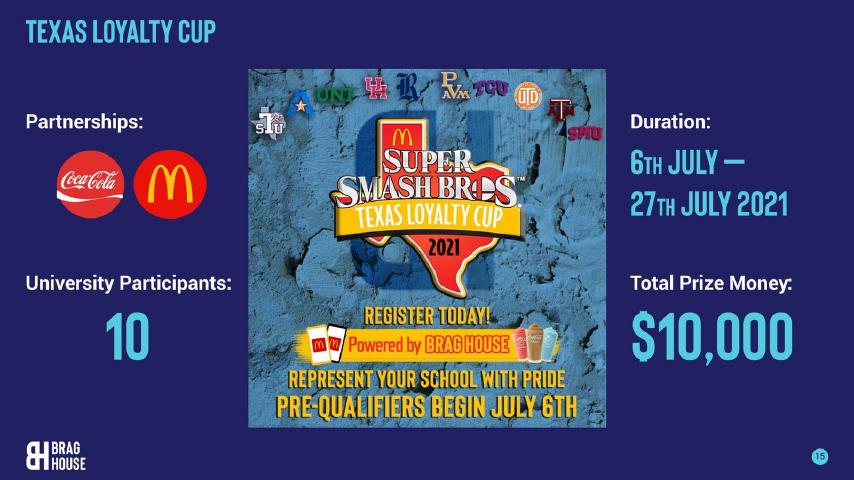
Social platform for college gamers. Slide titled "Texas Loyalty Cup".
Brag House deck, slide 15. Exact stored slide matched to this analysis.
Our analysis: A dated, sized and sponsored event that brings players in groups.
Evidence and limitation: Company event details; no registration or viewing figures.
What a founder can adapt: Add registrations, viewers and new accounts from the event.
Supporting analysis
What the deck claims: "Partnerships:" Coca-Cola and McDonald's logos. "University Participants: 10". "Duration: 6th July – 27th July 2021". "Total Prize Money: $10,000". Poster: "Super Smash Bros. Texas Loyalty Cup 2021 … Register today! Powered by Brag House … Pre-qualifiers begin July 6th".
Presentation choice: Investors can see exactly what the company ran and who paid for it.
When it does not fit: An event slide with no outcome line.
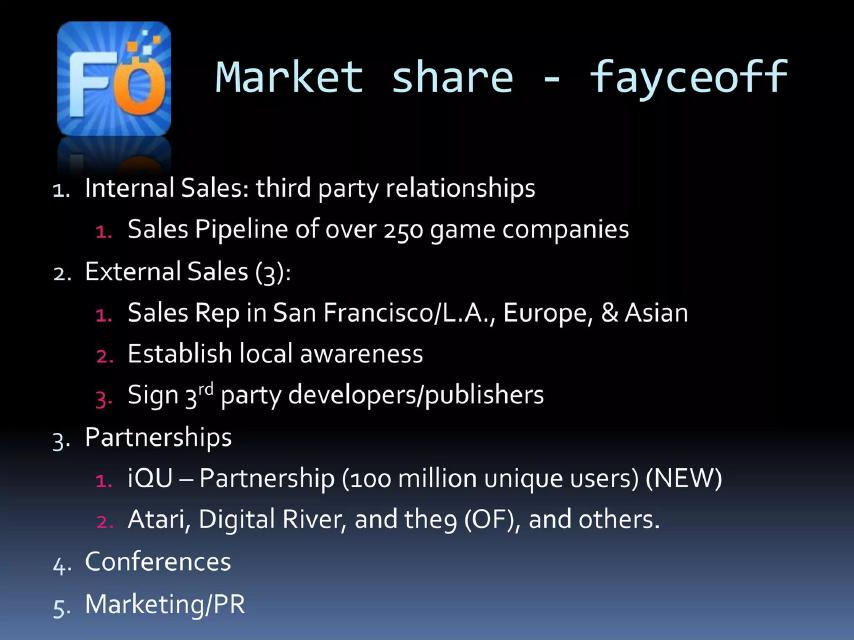
Game technology sold to game companies. Slide titled "Market share – fayceoff".
Fayceoff deck, slide 7. Exact stored slide matched to this analysis.
Our analysis: A named pipeline and named partners for a business sold to game makers.
Evidence and limitation: Company claims; pipeline status and partnership terms not stated.
What a founder can adapt: Say how many of the 250 are signed and what the iQU partnership provides.
Supporting analysis
What the deck claims: "1. Internal Sales: third party relationships – Sales Pipeline of over 250 game companies. 2. External Sales (3): Sales Rep in San Francisco/L.A., Europe, & Asian; Establish local awareness; Sign 3rd party developers/publishers. 3. Partnerships: iQU – Partnership (100 million unique users) (NEW); Atari, Digital River, and the9 (OF), and others. 4. Conferences. 5. Marketing/PR."
Presentation choice: A count of target companies is more testable than a market size.
When it does not fit: Presenting a partner's user count as your own reach.
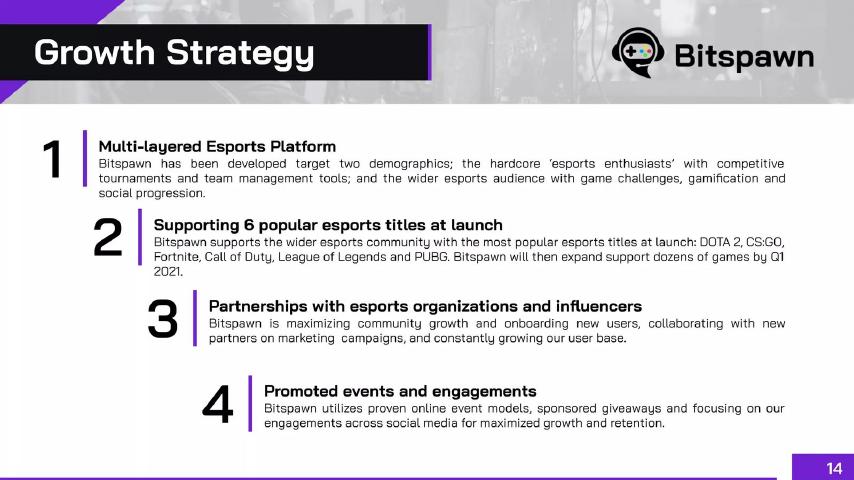
Esports tournament and team platform. Slide titled "Growth Strategy".
Bitspawn deck, slide 14. Exact stored slide matched to this analysis.
Our analysis: Concrete game titles, generic channels.
Evidence and limitation: Company plan; partners unnamed, no figures beyond the title count.
What a founder can adapt: Name the esports organizations and give players won per channel.
Supporting analysis
What the deck claims: "1 Multi-layered Esports Platform … 2 Supporting 6 popular esports titles at launch – DOTA 2, CS:GO, Fortnite, Call of Duty, League of Legends and PUBG … 3 Partnerships with esports organizations and influencers … 4 Promoted events and engagements – … sponsored giveaways and focusing on our engagements across social media".
Presentation choice: Supported titles tell investors which player communities the company targets.
When it does not fit: Unnamed "partnerships with influencers".
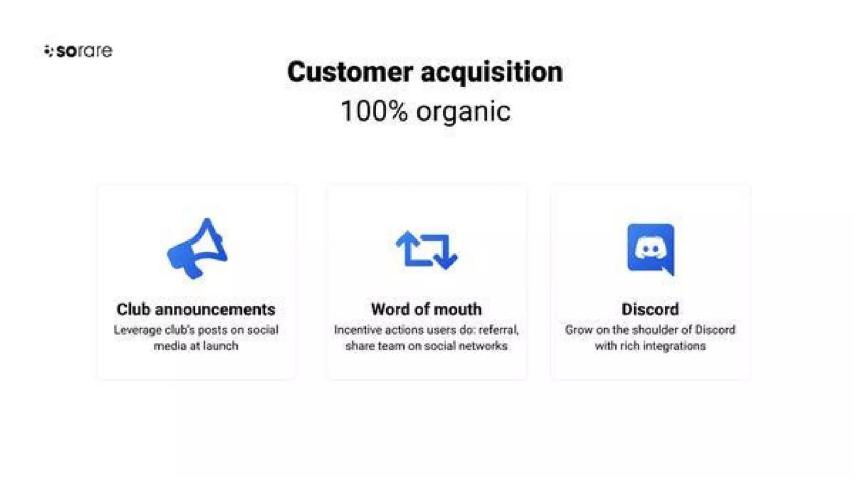
Fantasy football game with digital player cards. Slide titled "Customer acquisition".
Sorare deck, slide 12. Exact stored slide matched to this analysis.
Our analysis: Three concrete channels built on partners' and players' audiences.
Evidence and limitation: Company claim; no figures on the slide.
What a founder can adapt: Show users and cost per channel to prove the organic claim.
Supporting analysis
What the deck claims: "100% organic". "Club announcements: Leverage club's posts on social media at launch". "Word of mouth: Incentive actions users do: referral, share team on social networks". "Discord: Grow on the shoulder of Discord with rich integrations".
Presentation choice: Club partners and referrals are low-cost channels that suit a game.
When it does not fit: A "100% organic" claim with no number behind it.
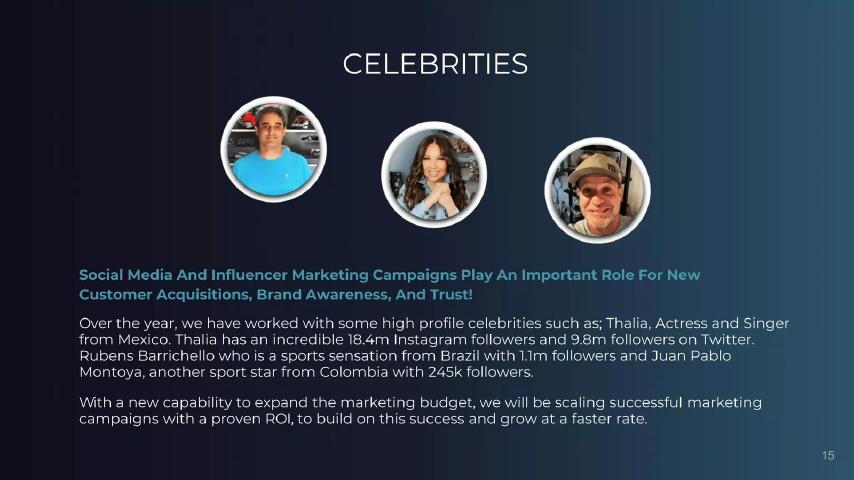
Online gaming and betting company. Slide titled "Celebrities".
Kings Entertainment deck, slide 15. Exact stored slide matched to this analysis.
Our analysis: Named celebrities with audience sizes, but no outcome.
Evidence and limitation: Follower counts of third parties; no campaign results.
What a founder can adapt: Add sign-ups, deposits and cost per campaign to back up "proven ROI".
Supporting analysis
What the deck claims: "Social Media And Influencer Marketing Campaigns Play An Important Role For New Customer Acquisitions, Brand Awareness, And Trust!" "… Thalia … has an incredible 18.4m Instagram followers and 9.8m followers on Twitter. Rubens Barrichello … with 1.1m followers and Juan Pablo Montoya … with 245k followers." "… we will be scaling successful marketing campaigns with a proven ROI …".
Presentation choice: Reach is specific and checkable, which is better than a generic influencer claim.
When it does not fit: Claiming a proven return without showing it.
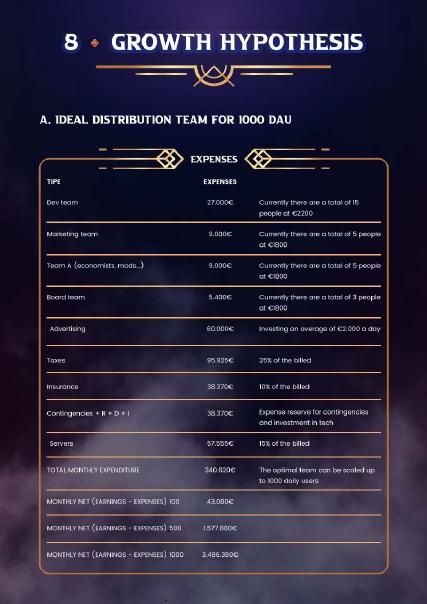
Blockchain strategy game. Slide titled "Growth Hypothesis – A. Ideal distribution team for 1000 DAU". Warning example on arithmetic and forecasts.
Warlands deck, slide 17. Exact stored slide matched to this analysis.
Our analysis: A detailed cost table that adds up, with one wrong row and an unsupported profit line.
Evidence and limitation: Company plan; we recalculated the table.
What a founder can adapt: Fix the development row (15 x €2,200 = €33,000) and show revenue per player behind the net figures.
Supporting analysis
What the deck claims: Expenses: "Dev team 27.000€ – Currently there are a total of 15 people at €2200"; "Marketing team 9.000€"; "Team A (economists, mods…) 9.000€"; "Board team 5.400€"; "Advertising 60.000€ – Investing on an average of €2.000 a day"; "Taxes 95.925€ – 25% of the billed"; "Insurance 38.370€ – 10% of the billed"; "Contingencies + R + D + I 38.370€"; "Servers 57.555€ – 15% of the billed"; "Total monthly expenditure 340.620€". "Monthly net (earnings – expenses) 100: 43.080€; 500: 1.577.880€; 1000: 3.496.380€".
Presentation choice: Costs per daily player are exactly what investors want, so errors stand out.
When it does not fit: Profit forecasts with no revenue assumption shown.
GMBL deck, slide 15. Exact stored slide matched to this analysis.
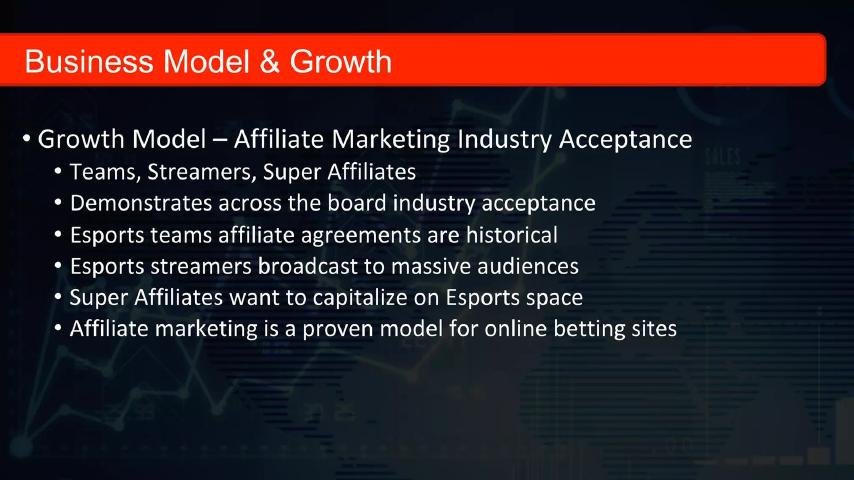
Our analysis: A channel named, with nothing to test.
Evidence and limitation: Company claims; no figures or named affiliates.
What a founder can adapt: Name the affiliates signed, their audience and the commission paid.
Supporting analysis
What the deck claims: "Growth Model – Affiliate Marketing Industry Acceptance: Teams, Streamers, Super Affiliates; Demonstrates across the board industry acceptance; Esports teams affiliate agreements are historical; Esports streamers broadcast to massive audiences; Super Affiliates want to capitalize on Esports space; Affiliate marketing is a proven model for online betting sites".
Presentation choice: Affiliates can be a strong channel, but only named deals and terms show it.
When it does not fit: "Massive audiences" with no number.
Whether each slide names a channel or partner, gives a figure, and shows results.
Example
Channel or partner
Figures given
Results shown
Brag House
Sponsored college tournament
Dates, 10 universities, $10,000
No
Fayceoff
Publisher pipeline, iQU
250+ companies, 100M partner users
No
Kryptomon
Seven social channels, named partners
100K+ community
Community size only
Bitspawn
Esports titles and influencers
6 titles
No
Sorare
Clubs, referrals, Discord
None
Claimed "100% organic"
Kings Entertainment
Celebrities
Follower counts
No
Warlands
Advertising and team
€340,620 a month
Forecast only
GMBL
Affiliates
None
No
Game Face Gaming
Facebook
None
No
Key Takeaways
Say where the first players come from.
Date events and give their size.
Follower counts are reach, not results.
Check that cost tables add up.
Tie any profit forecast to player numbers you can defend.
Build your gaming go-to-market slide
Answer these before you design the slide.
First players. Which community, publisher, platform or creator brings your first players?
Channels. For each channel, what does one active player cost and how many has it brought so far?
Activity. How many of your community members play daily or weekly?
Forecast. What revenue per player supports any profit forecast, and is it labelled as a forecast?
Copyable framework: Our first players come from [community or partner]. [Channel]: [cost] per active player, [number] so far. [Number] daily active players of [community size]. Forecast: [target players] at [revenue per player].
Illustrative example 1 — written by us
Before: We will grow through influencers, partnerships and massive esports audiences.
After: Our first players come from 4 college esports clubs. Sponsored cups: $3.10 per active player, 1,400 players since March. Twitch creators: $5.80 per active player, 600 players. 2,100 daily active players out of a 9,000-member Discord. Forecast: 10,000 daily players by Q4 at $0.90 revenue per player per month.
What improved: Our illustrative rewrite; all figures are invented for the example. It names the source of players, costs each channel, shows activity and labels the forecast.
What this guide adds
The general go-to-market guide covers any startup. Gaming differs in three ways. Players gather in communities that already exist, on Discord, Twitch and in esports clubs, so the plan is often about entering a community rather than buying ads. Distribution can come from a publisher, platform or partner who already holds the audience. And the business usually depends on daily active players, so investors want a cost per player and a believable path from hundreds to thousands of daily users. This guide shows how gaming startups present those three points, and where they go wrong.
How we read each slide
We read each stored slide image and quote the text on it. Kryptomon, Warlands and Kings Entertainment were read at full size because their text is small; Brag House, Fayceoff, Bitspawn, Sorare, GMBL and Game Face Gaming were legible at low resolution. We recalculated the Warlands cost table. We have not checked any company's partners, community size or results, and we make no claim that any slide affected a fundraising outcome.
Events with dates, partners and a prize
Brag House's slide is a single event, the Texas Loyalty Cup, and it gives investors almost everything they need to judge it. It is dated, "6th July to 27th July 2021". It names partners, Coca-Cola and McDonald's. It gives a size, 10 university participants, and a total prize of $10,000. The poster on the slide shows the format, a Super Smash Bros. tournament with pre-qualifiers.
What it does not show is the result: how many students registered, how many watched, and how many became users of the platform. An event slide becomes much stronger when it ends with one line of outcome, such as registrations, viewers and new accounts per dollar of prize money.
Distribution partners who already hold the players
Fayceoff splits its plan into internal sales, external sales and partnerships. The figures are in the details: a "Sales Pipeline of over 250 game companies", sales representatives in San Francisco and Los Angeles, Europe and Asia, and a "Partnership" with iQU described as reaching "100 million unique users", alongside Atari, Digital River and the9. For a company that sells to game makers, a named pipeline of 250 companies is a far more testable claim than a market size.
Two questions remain. A pipeline is not a customer list, so the slide should say how many of the 250 are signed or paying. And a partner's 100 million users are the partner's audience, not Fayceoff's; the slide should say what the partnership actually gives, such as placement, revenue share or integration.
Bitspawn takes a lighter version of the same approach: support for 6 popular esports titles at launch (DOTA 2, CS:GO, Fortnite, Call of Duty, League of Legends and PUBG), partnerships with esports organizations and influencers, and sponsored giveaways. The titles are concrete; the partners are not named and there are no figures for what each channel has produced.
Community channels and the size of the community
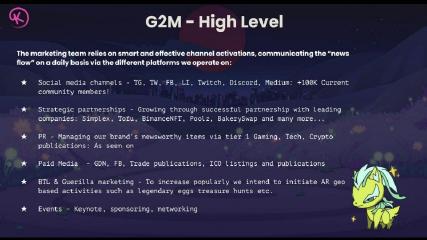
Kryptomon, a blockchain game, lists six channels: social media (Telegram, Twitter, Facebook, LinkedIn, Twitch, Discord and Medium, with "+100K Current community members!"), strategic partnerships with Simplex, Tofu, BinanceNFT, Poolz and BakerySwap, PR in gaming, tech and crypto publications, paid media, guerrilla marketing such as augmented-reality treasure hunts, and events. The community figure is the most useful number on the slide because games depend on early players who recruit others.
It would be stronger with a split by channel and a sign of activity. One hundred thousand members across seven platforms could mean a lively Discord or a large count of passive followers; daily active members, or the share who have played the game, would tell investors which.
Sorare's slide takes the opposite approach: "Customer acquisition: 100% organic", through club announcements on social media at launch, word of mouth with incentives for referrals and sharing teams, and growth on Discord with rich integrations. It names three channels and makes a bold claim, but gives no figure on the slide itself. If all growth is organic, the cost per user and the number of users brought by each channel are the proof, and both belong on the slide.
Celebrity reach is not a result
Kings Entertainment, an online gaming and betting company, devotes its slide to celebrities it has worked with: Thalia, "an incredible 18.4m Instagram followers and 9.8m followers on Twitter", Rubens Barrichello "with 1.1m followers" and Juan Pablo Montoya "with 245k followers". It then says the company will scale "successful marketing campaigns with a proven ROI".
The follower counts are specific and checkable, but they measure the celebrity's audience, not what the campaign did. The slide gives no sign-ups, deposits, cost or return. When a slide claims "proven ROI", investors will look for the return; leaving it out turns the strongest claim on the slide into the weakest.
Cost tables must add up, and forecasts must be earned
Warlands, a blockchain strategy game, gives the most detailed cost picture in this set: an "Ideal distribution team for 1000 DAU" with monthly expenses for the development team (€27,000), marketing team (€9,000), a team of economists and moderators (€9,000), board (€5,400), advertising (€60,000, "Investing on an average of €2.000 a day"), taxes (€95,925, "25% of the billed"), insurance (€38,370), contingencies (€38,370) and servers (€57,555). The total is €340,620 a month.
We recalculated the table. The rows add up to €340,620, and the tax, insurance and server lines are consistent with billing of €383,700 a month. Advertising of €2,000 a day matches €60,000 for 30 days. Two problems remain. The development team is described as "15 people at €2200", which is €33,000, not the €27,000 shown. And the slide ends with "Monthly net" of €43,080 at 100 daily users, €1,577,880 at 500 and €3,496,380 at 1,000. That is roughly €3,500 of net profit per daily player per month, with no revenue per player, conversion rate or price shown to support it.
A cost table invites checking, which is good. But one wrong row and an unsupported profit line give an investor reason to doubt the rest. Show revenue per daily player, label the profit as a forecast and make every row match its own description.
Lists of tactics without figures
GMBL's "Business Model & Growth" slide describes its growth model as "Affiliate Marketing Industry Acceptance" and lists teams, streamers and super affiliates, with claims such as "Esports streamers broadcast to massive audiences" and "Affiliate marketing is a proven model for online betting sites". It names no affiliate, audience size, commission or result.
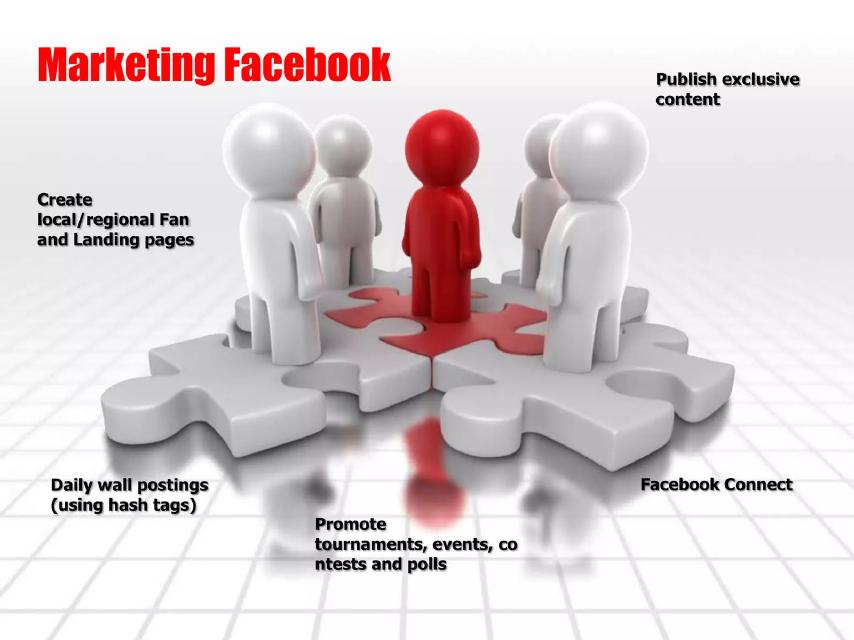
Game Face Gaming's "Marketing Facebook" slide arranges five tactics around a puzzle graphic: create local and regional fan and landing pages, publish exclusive content, daily wall postings using hashtags, promote tournaments, events, contests and polls, and Facebook Connect. These are reasonable tactics but there is nothing to test: no audience, budget, cost per player or outcome.
What to put on a gaming go-to-market slide
Start with one sentence on where your first players come from: a community, a publisher, a platform, a tournament circuit or a creator. List each channel with a date, a size and a result, as Brag House almost does. If a partner holds the audience, say what the partnership gives you, not just how big the partner is. Report community size with an activity measure such as daily active members. If you show costs, check every row; if you show profit, show the revenue per player that produces it and label it as a forecast. Replace claims like "proven ROI" or "massive audiences" with the number that proves them.
Common mistakes
Reach shown as results. Follower counts are not players won.
Partner's users as your own. Say what the partnership gives you.
Undated events. Give dates, size and outcome.
Rows that do not add up. Check every row against its description.
Unsupported profit. Show revenue per player behind any forecast.
Claims without numbers. Replace "proven ROI" with the return.
Diagnostic checklist
Source of first players named.
Each channel has a cost and a result.
Community size with an activity measure.
Events dated and sized.
Cost table checked.
Forecasts labelled with their assumptions.
Frequently asked questions
What should a gaming startup's go-to-market slide show?
Where your first players come from, what each channel costs and how many active players it has produced. Brag House shows a dated, sponsored tournament with 10 universities and a $10,000 prize.
Do celebrity or influencer follower counts help?
Only as context. Kings Entertainment lists followers from 245k to 18.4 million but no sign-ups or return, so investors cannot judge the campaigns.
How should I show community size?
Give the total and an activity measure. Kryptomon's "+100K current community members" across seven platforms would be stronger with daily active members or the share who play.
Should I include a cost table for my distribution plan?
Yes, if every row is checked. Warlands' table adds up to €340,620 a month, but one row does not match its own description and the profit forecast has no revenue assumption.
How we chose these examples
Corpus: published pitch deck teardowns on StartupFundraising.com. Founder-uploaded private decks are excluded.
Selection (2026-10-01): we searched extracted slide text for go-to-market, marketing, customer acquisition, distribution, partnership and growth strategy slides in decks from gaming, esports and game-adjacent companies. We dropped slides already used in other guides and a slide from a fintech deck, then kept 9 slides from 9 companies.
Review: stored slide images were read on 2026-10-01 against company, deck and slide number; Kryptomon, Warlands and Kings Entertainment were read at full size, the rest at low resolution (editorial model review). We recalculated the Warlands cost table. No person has yet completed an editorial review of this page. We did not verify any company's partners, community size or results.