Influencer Marketing in a Pitch Deck: 10 Real Examples
How founders present influencer marketing on a go-to-market slide: cost, reach, sales and share of customers. Ten real slides from private startups compared.
How to Present Influencer Marketing on Your Pitch Deck
Twelve slides from ten real pitch decks show how founders present influencers as a way to win customers. The strongest give what was spent, what was posted and what was sold. The weakest name influencers as a tactic with no cost, no result and no sign of whether the plan has been tried.
TL;DR
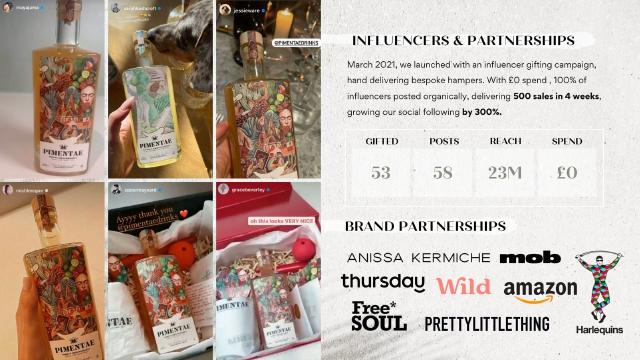
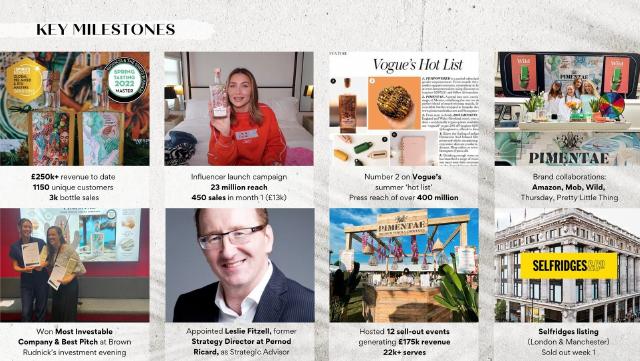
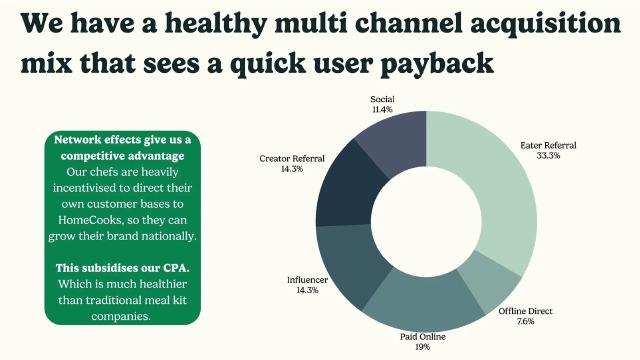
Present influencer marketing as a tested channel with numbers, not as a promise. Give four facts: how many people posted, what it cost, how many people saw it, and what it led to in sales or sign-ups. Pimentae, a tequila cocktail brand, reports 53 people gifted, 58 posts, 23M reach, £0 spend and "500 sales in 4 weeks"; its milestones slide gives 450 sales in month 1, so the figures need reconciling. HomeCooks, a meal marketplace, shows influencers as 14.3% of customer acquisition alongside five other channels. Marianna Naturals budgets $25,000 a month for influencer advertising. Sliver and Yaga name influencers as a tactic with no cost or result. Fyre Festival is a warning: reach in the hundreds of millions said nothing about whether the festival could be delivered.
Influencer marketing slides from real pitch decks
Each example shows the exact stored slide above its analysis and links to the full teardown. Stage and year are given only where the deck or public records state them. Figures are the company's own claims.
Pimentae deck, slide 12. Exact stored slide matched to this analysis.Pimentae deck, slide 10. Exact stored slide matched to this analysis.
Our analysis: Cost, posts, reach and sales on one page.
Evidence and limitation: Different numbers for the same campaign on different slides.
What a founder can adapt: Use one sales figure with a defined period, and add revenue.
Supporting analysis
What the deck claims: March 2021 gifting launch: 53 gifted, 58 posts, 23M reach, £0 spend, "500 sales in 4 weeks", social following +300%. Milestones slide: 450 sales in month 1 (£13k).
Presentation choice: Cost, posts, reach and sales on one page.
When it does not fit: Different numbers for the same campaign on different slides.
Marianna Naturals deck, slide 38. Exact stored slide matched to this analysis.Marianna Naturals deck, slide 36. Exact stored slide matched to this analysis.
Our analysis: Treats influencers as a sales partner and an ad cost.
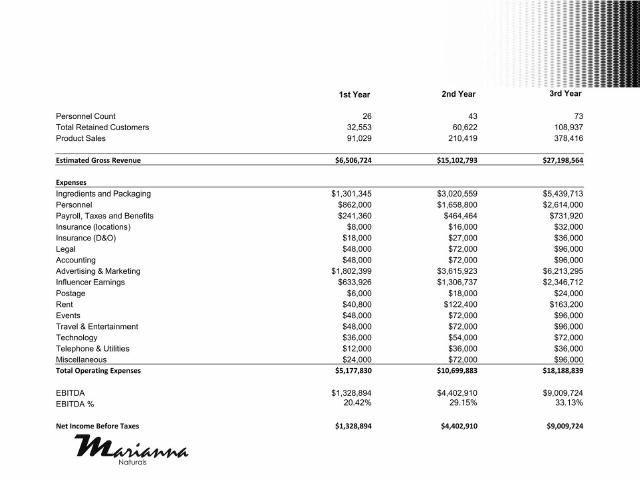
Evidence and limitation: A 20% assumption beside a 9.7% forecast.
What a founder can adapt: Make the assumption and the model agree.
Supporting analysis
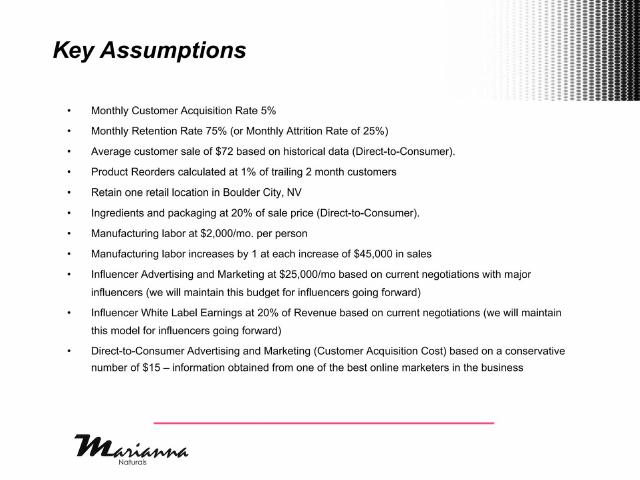
What the deck claims: Assumptions: influencer advertising $25,000/month; influencer white-label earnings 20% of revenue. P&L year 1: white-label $633,926 on revenue $6,506,724 (about 9.7%); advertising and marketing $1,802,399.
Presentation choice: Treats influencers as a sales partner and an ad cost.
When it does not fit: A 20% assumption beside a 9.7% forecast.
What each slide tells you about influencer marketing
Only one slide gives cost, reach and sales together.
Example
Cost
Reach
Result
Actual or plan
Pimentae
£0
23M
Sales (two figures)
Actual
HomeCooks
No
No
Share of customers
Actual
MediHere
No
No
Share of patients
Unclear
WineSimple
Target
No
No
Plan
Bunch
No
Followers
No
Unclear
Marianna Naturals
$25k/month
No
Forecast
Plan
Vruum
No
No
Return ratio
Unclear
Sliver
No
No
No
Plan
Yaga
No
No
No
Plan
Fyre Festival
No
300M+
No
Actual
Key Takeaways
Report cost, posts, reach and sales together.
Show influencers as a share of all customer acquisition.
Label figures as actual or planned.
Make the numbers agree across slides.
Reach is not demand; show what people did.
Test your influencer line before you send it
Answer each in one line.
Who. How many people posted, and how big were their audiences?
Cost. What did it cost in cash and product?
Result. How many sales or sign-ups followed, and over what period?
Share. What share of all customers came from influencers?
Status. Is each figure actual or planned?
Copyable framework: In [month year] we [gifted/paid] [n] creators, who made [n] posts. Cost: [amount]. Result: [n] sales in [period], [share]% of new customers that month
Illustrative example 1 — written by us
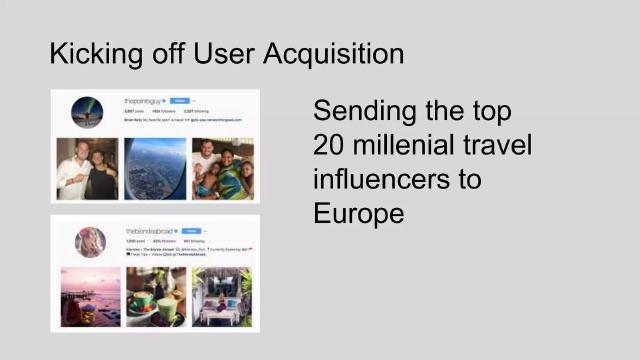
Before: Sending the top 20 millennial travel influencers to Europe.
After: In [month year] we will send 20 travel creators to Europe at a cost of [amount]; success is [n] bookings within [period]
What improved: Our illustrative rewrite, not Sliver's text. Bracketed parts are placeholders, not company facts.
What this guide covers
Influencer marketing means paying, gifting or partnering with people who have a following on social media so that they show your product to their audience. For consumer startups it can be one of the cheapest ways to win early customers. For investors, the question is whether it works for this company, at what cost, and whether it can keep working as spending grows.
Our go-to-market slide guide covers channels generally, and the customer acquisition guide covers costs across channels. Neither looks closely at influencers. We searched the extracted text of the deck library for influencer, removed companies whose product is an influencer platform (where influencers are the customer, not a channel) and listed companies, and read each remaining candidate from images of the original deck pages. We kept twelve slides from ten private companies. We left out one strong slide because it already appears in another guide, and dropped a three-sided influencer marketplace under the platform rule.
The examples fall into four groups: launch campaigns with results, influencers inside a channel mix, influencer budgets and plans, and one cautionary deck.
Report a campaign with cost, reach and sales
Pimentae's launch slide is the clearest example in the library. In March 2021 the founders hand-delivered gift hampers to people with a following rather than paying them. The slide gives four tiles: Gifted 53, Posts 58, Reach 23M and Spend £0. It adds "500 sales in 4 weeks" and a 300% rise in the brand's own social following. Every number an investor would ask for is on one page, and the zero spend shows the founders can get attention without a budget.
There is one problem. Pimentae's milestones slide, two pages earlier, describes the same campaign as "23 million reach, 450 sales in month 1 (£13k)". Five hundred sales in four weeks and 450 sales in month one may be measured over slightly different periods, but an investor who notices will ask which is right. Use one figure, define the period, and repeat it the same way everywhere. The £13k revenue figure is useful and belongs on the campaign slide too, because it lets the reader work out the value of each sale.
Reach of 23M is also the softest number on the slide. Reach usually means the total followers of everyone who posted, not people who saw the post. Sales are the number that matters; reach should support them, not replace them.
Show influencers as one channel in a mix
HomeCooks, a marketplace where independent chefs sell home-cooked meals, shows where its customers come from in a single chart: eater referral 33.3%, paid online 19%, influencer 14.3%, creator referral 14.3%, social 11.4% and offline direct 7.6%. Placing influencers inside the full mix answers a question investors always have: is the company dependent on one channel? Here influencers bring about one customer in seven, which is meaningful but not risky. The slide does not give the cost per customer for each channel, which is the next thing an investor will ask.
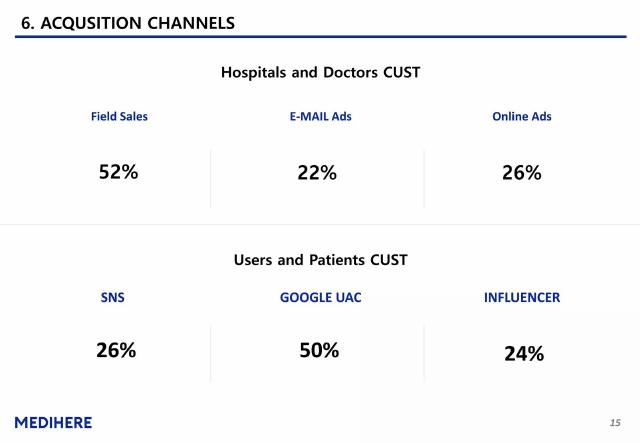
MediHere, a telehealth and clinic company, splits patient acquisition into Google app campaigns 50%, social networks 26% and influencers 24%, and doctor acquisition into field sales, email and online ads. Showing two sides of a marketplace separately is helpful. But the slide does not say whether these shares are results or a plan, and the tidy round numbers suggest a plan. Label it either way.
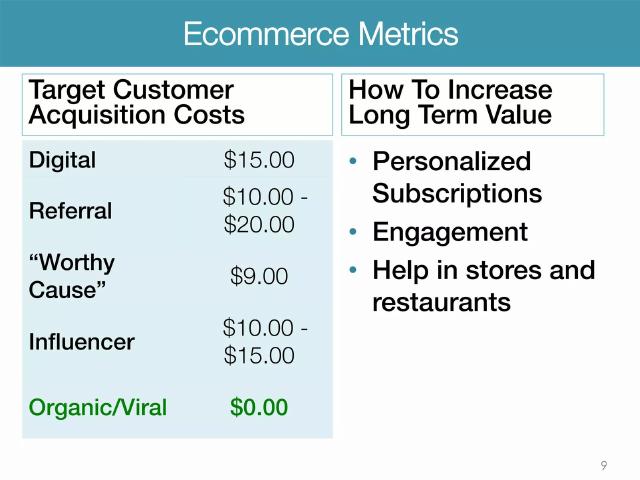
WineSimple, an online wine store, lists a target customer acquisition cost for each channel: influencers $10 to $15, digital $15, referral $10 to $20, a charity partnership $9 and organic $0. A per-channel cost is exactly the right measure. The word target matters, though: these are goals, and the slide needs at least one actual cost from a test to be convincing. WineSimple later closed, in 2016.
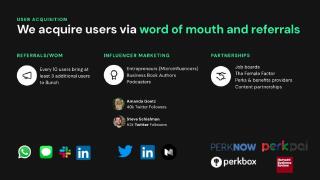
Bunch, a party app for mobile games, shows micro-influencers, with example accounts of around 40,000 followers, next to its referral loop, where every ten users bring at least three more. Pairing influencers with referrals is sensible: influencers start the first wave, and referrals keep it going. The slide would be stronger with how many users came from the influencer posts.
Budgets and plans: say what is assumed
Marianna Naturals, a skincare brand, puts influencer marketing in its financial assumptions: $25,000 a month for influencer advertising, described as based on current negotiations, and a white-label line where influencers sell products under their own names, assumed at 20% of revenue. The profit and loss slide then shows year-one influencer white-label earnings of $633,926 on revenue of $6,506,724. That is about 9.7%, not 20%. Either the assumption or the model is out of date. Assumptions and forecasts must match; an investor who checks one line will check the rest.
The useful idea in the Marianna deck is treating influencers as a sales partner as well as an advertising cost. A product line sold under an influencer's name turns marketing spend into revenue. If you do this, show the split between the two clearly.
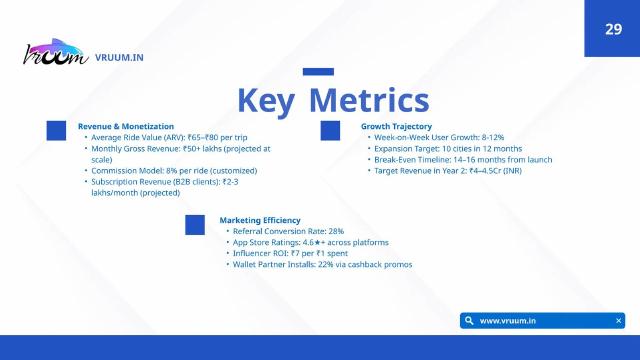
Vruum, a ride-hailing app in Delhi, claims an influencer return of ₹7 for every ₹1 spent, on a slide where the other figures are labelled as projections. The return is not labelled, so a reader cannot tell whether it was measured. A return figure is only worth showing if it comes from a real campaign, with the spend and the result next to it.
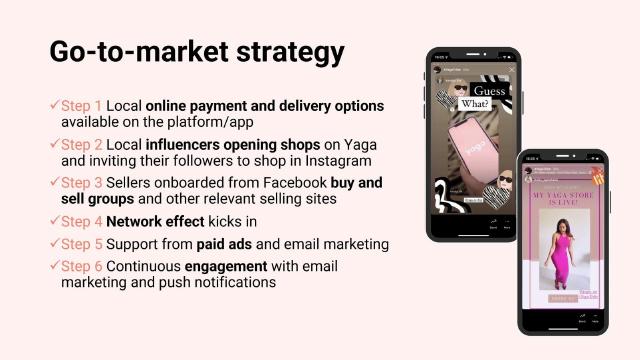
Sliver plans to send "the top 20 millennial travel influencers to Europe", and Yaga, a second-hand fashion marketplace, has local influencers open shops on the app and invite their followers. Both are sensible ideas. Neither gives a cost, a timeline or a result. As plan slides they are fine at the very earliest stage, but they should say what will count as success: for example, sign-ups per influencer shop within 30 days.
How to measure an influencer test before you pitch
If influencers are part of your plan, run a small test before you raise and put the result on the slide. Give each creator a unique discount code or tracked link so that every sale can be traced back to a post. Record what you gave away, including the retail value of free product and any fee, so the true cost is visible. Count sales and sign-ups over a fixed period, such as the four weeks after the first post, and compare them with a normal four weeks without posts. Then divide the total cost by the number of new customers to get a cost per customer you can set beside your other channels.
Two further checks make the result more believable. First, show whether customers who arrived through influencers came back and bought again; a channel that brings one-off buyers is worth less than one that brings repeat customers. Second, say how the plan changes as spending grows. Gifting fifty hampers is cheap; paying a hundred creators every month is not, and the cost per customer usually rises as you move beyond the people who already like the product. A single honest line on the slide, such as this hypothetical one, "first test: £0 spend, 450 sales; next: paid posts at a target cost of £8 per customer", tells an investor far more than a large reach figure.
The cautionary example: reach without delivery
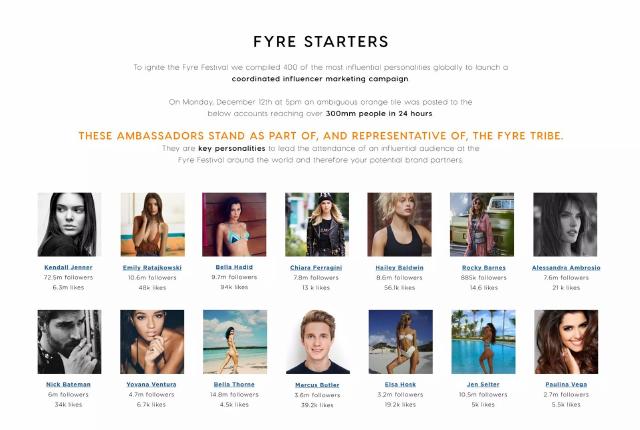
Fyre Festival's marketing slide describes 400 personalities posting the same orange tile on December 12 and reaching "over 300mm people in 24 hours". As a launch, it was famous. As evidence for investors, it showed only that people had seen a post. The festival collapsed, and its founder was later convicted of fraud. The lesson for any deck is that reach is not demand and is certainly not delivery. Pair any influencer reach figure with what people did next, and make sure the business can serve them.
Common mistakes
Reach as the result. Show sales or sign-ups.
No cost. Include cash and product given away.
Unlabelled figures. Mark actual or planned.
Numbers that disagree. Use one figure across slides.
One channel only. Show the full mix.
Diagnostic checklist
Number of creators and posts.
Total cost.
Sales or sign-ups, with the period.
Share of all new customers.
Actual or planned, labelled.
Frequently asked questions
How we chose these examples
Corpus: published pitch deck teardowns on StartupFundraising.com. Founder-uploaded private decks are excluded.
Selection (2026-10-01): we searched extracted slide text for influencer, excluded companies whose product is an influencer platform or marketplace, listed companies and market-size-only mentions, and read each remaining candidate from images made from the original deck files. A Hervé slide was left out because it already appears in another guide; Flow Water was excluded because its parent company was listed; Forklyft was excluded under the platform rule; two slides were too thin to analyse.
Eligibility: each company was private when its deck was made. Pimentae, HomeCooks, MediHere, Yaga and Bunch were checked against public funding records; WineSimple's closure in 2016 and Fyre Festival's collapse are public record. Marianna Naturals, Vruum and Sliver rest on their own decks, with no sign of a listing.
Slide numbers are PDF page numbers.
Overlap check: no guide covers influencer marketing; none of these slides appears in another guide.
Review: all twelve slide images were inspected on 2026-10-01 and matched to company, deck and slide number (AI editorial model review). No person has yet completed an editorial review of this page. The worksheet uses placeholders, not company data.
Figures are the companies' own claims; we did not verify underlying data. We make no claim that any slide caused a fundraising outcome.