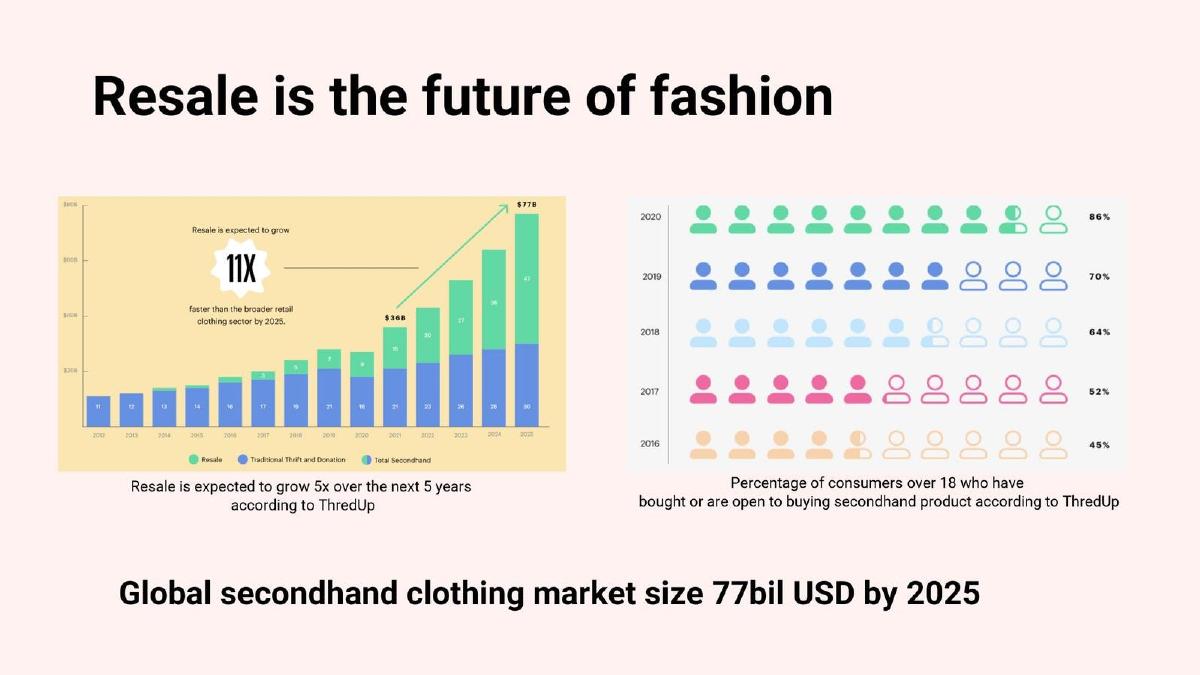
Yaga’s 11-slide pitch deck focuses on the massive opportunity for secondhand fashion in emerging markets like Africa. By addressing the primary friction point in these regions—fear of scams—through an integrated escrow model, Yaga positions itself as a secure alternative to informal social media selling. The deck highlights a strong social growth loop where 'Millennial sellers' act as acquisition engines by sharing listings on their own social networks. While the deck effectively communicates the value proposition and the 'Network Effect' mechanism, it notably lacks specific financial metrics…
Key takeaways
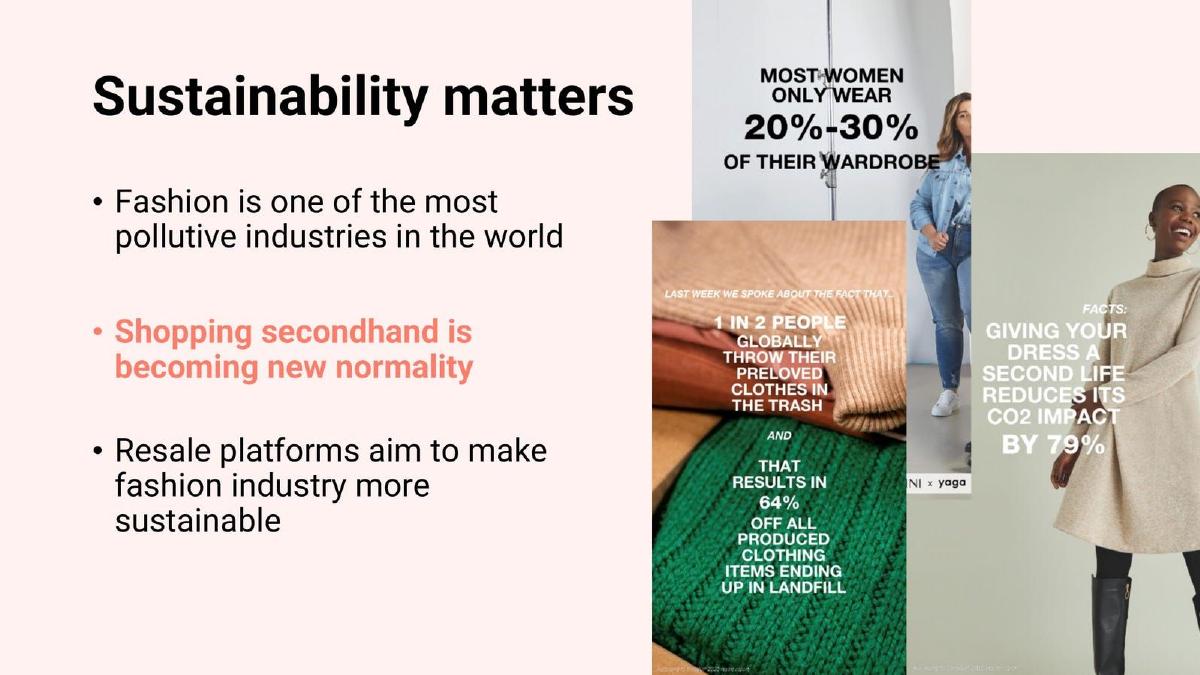
- Yaga identifies fashion as one of the most pollutive industries, noting that giving a dress a second life reduces its CO2 impact by 79% (Slide 2).
- The platform specifically targets 'emerging and fringe markets,' a niche often underserved by global giants like Vinted or Poshmark (Slide 3).
- The core product solution is a 'Trust & Safety' framework that utilizes an escrow model to hold funds until the buyer confirms receipt (Slide 4).
- Yaga leverages a five-step social growth loop where sellers share listings to attract new users, creating a self-sustaining network effect (Slide 5).
- The deck highlights that most women only wear 20%-30% of their wardrobe, representing significant untapped inventory (Slide 2).
- The company operates across multiple domains including South Africa (.co.za), Estonia (.ee), Kenya (.co.ke), and India (shopyaga.in) as shown on Slide 6.
- The deck omits a dedicated team slide, financial projections, and current traction metrics like GMV or active user counts.
- According to publisher reports, Yaga raised $2.2M in 2024 to scale its operations in Africa and other emerging markets.
Yaga Pitch Deck Teardown
Yaga is a social e-commerce marketplace that has successfully carved out a niche in the secondhand fashion space by looking where others aren't: emerging markets. While the resale boom is well-documented in the US and Europe, Yaga focuses on regions like Africa and India, where trust is the primary currency. This 11-slide deck, which supported a $2.2M Seed round in 2024, prioritizes the 'why' and the 'how' over raw metrics.
Slide 1: Title Slide
The opening slide sets a visual tone that is consistent with a consumer fashion app. It features high-quality lifestyle photography and a clear value proposition: "marketplace for new & preloved fashion." By showing the app interface on a smartphone, Yaga immediately establishes itself as a mobile-first platform, which is critical for their target emerging markets where mobile penetration often outpaces desktop usage.
Slide 2: The Sustainability Thesis
Slide 2, titled "Sustainability matters," provides the ethical and environmental justification for the business. It uses a collage of social-media-style imagery to present three key arguments: fashion is highly pollutive, secondhand is becoming the "new normality," and resale platforms increase industry sustainability. Crucially, it cites a specific metric: "Giving your dress a second life reduces its CO2 impact by 79%." It also highlights the inefficiency of current consumption, stating that most women only wear 20%-30% of their wardrobe. This slide frames Yaga not just as a business, but as a solution to a global waste problem.
Slide 3: Market Positioning
Slide 3 delivers the company's "elevator pitch" in one sentence: "Yaga is an app for selling and buying secondhand fashion in emerging and fringe markets." This is perhaps the most important slide in the deck because it defines their moat. They aren't trying to beat Vinted in France; they are building the infrastructure for regions that are often overlooked by Western tech companies. The visual shows a user's profile ("Ms Paula Bee" in Western Cape), grounding the abstract concept of "emerging markets" in a real-world use case.
Slide 4: Solving the Trust Gap
In many emerging markets, peer-to-peer (P2P) commerce is hampered by a lack of trust. Slide 4, "Trust & Safety," addresses this head-on. The slide identifies the "fear of getting scammed" as the biggest problem in online shopping. Yaga’s solution is an Escrow model . The slide outlines a 5-step process where the money is deposited into a Yaga account and only released to the seller after the buyer confirms receipt. This transforms Yaga from a simple listing site into a financial intermediary, which is a significant value-add in high-risk markets.
Slide 5: The Growth Engine (Network Effect)
Slide 5 illustrates the company's viral loop. It maps out a cycle where a "Millennial seller" opens a shop, adds products, and shares those products on social media. This sharing attracts new users (buyers and sellers), who then start their own shops. By labeling this as a "Network effect," Yaga signals to investors that their customer acquisition cost (CAC) should theoretically decrease over time as the community grows. It positions the sellers as the primary marketing channel, which is a highly scalable model.
Slide 6: Contact and Geographic Footprint
The final slide in the provided sequence serves as a contact page but also reveals the company's current reach. By listing domains for yaga.co.za (South Africa), yaga.ee (Estonia), yaga.co.ke (Kenya), and shopyaga.in (India) , the deck proves that the model is already being localized across three continents. This provides a hint of traction and geographic diversity that was otherwise missing from the narrative slides.
What Works in the Yaga Deck
Clear Problem/Solution Fit: The deck identifies a specific, localized problem (lack of trust in emerging market P2P sales) and offers a specific technical solution (escrow payments). This is much more compelling than a generic "we are the Vinted of Africa" pitch.
Visual Consistency: The deck looks and feels like the product it is selling. The use of soft pinks, high-fashion photography, and clean app mockups suggests a team that understands their target demographic (Millennials and Gen Z).
Focus on the Loop: The "Network Effect" slide is a classic venture capital requirement. By showing how the platform grows organically through social sharing, Yaga demonstrates a path to scale that doesn't rely solely on expensive performance marketing.
What is Missing from the Yaga Deck
Hard Traction Metrics: The most glaring omission in these slides is the lack of data. There is no mention of Gross Merchandise Value (GMV), number of active users, number of listings, or revenue. For a Seed round, investors typically want to see that the "Network Effect" described on Slide 5 is actually functioning in the real world.
Competitive Landscape: The deck does not mention competitors. While they are in "fringe markets," they still compete with informal platforms like WhatsApp, Facebook Marketplace, and local incumbents. A slide explaining why Yaga wins against these alternatives would have strengthened the case.
The Team: The provided slides do not include a team slide. In early-stage fundraising, the pedigree and experience of the founders are often as important as the idea itself. Investors need to know why this specific team is capable of navigating the complex logistics and regulatory environments of countries like Kenya and India.
Unit Economics: While the escrow model is explained, the take rate (the percentage Yaga keeps from each transaction) is not mentioned. Without knowing the margins, it is difficult to assess the long-term profitability of the business.
Founder Takeaways
Solve for Trust First: If you are building in emerging markets, your biggest competitor isn't another startup; it's the user's fear of being cheated. Building trust mechanisms (like escrow) into the core product is a powerful differentiator. · Leverage Your Users as Marketers: Yaga’s growth loop relies on sellers wanting to earn money. By making it easy for them to share their shop on social media, the company turns every user into a brand ambassador. · Niche Down Geographically: Instead of trying to compete in saturated Western markets, Yaga focused on the "fringe." This allows them to become the dominant player in regions that global giants haven't yet optimized for. · Keep the Narrative Simple: The deck doesn't get bogged down in technical jargon. It focuses on sustainability, trust, and growth—three pillars that are easy for any investor to understand and get behind.
Frequently asked questions
- What is Yaga's primary competitive advantage in emerging markets?
- Yaga’s primary advantage is its 'Trust & Safety' infrastructure. Slide 4 explains that the biggest problem in online shopping in their target regions is the fear of being scammed. By implementing an escrow model where money is only released to the seller after the buyer clicks 'Item received,' Yaga solves a fundamental barrier to entry that informal platforms like Facebook Marketplace or Instagram do not address.
- How does Yaga acquire new users without high marketing spend?
- Yaga relies on a 'Network Effect' detailed on Slide 5. The process starts with a 'Millennial seller' opening a shop and adding products. When the seller shares these listings on their own social media channels to earn money, those shared listings naturally attract new buyers and sellers to the Yaga platform, creating a low-cost acquisition loop.
- What is the environmental impact of the business model according to the deck?
- Sustainability is a core pillar of Yaga's pitch. Slide 2 states that giving a dress a second life reduces its CO2 impact by 79%. It also notes that 1 in 2 people globally throw preloved clothes in the trash, resulting in 64% of all produced clothing items ending up in landfills. Yaga positions resale as the 'new normality' to combat these statistics.
- Which geographic regions does Yaga focus on?
- While the company is headquartered in Europe, the deck explicitly states on Slide 3 that it is an app for 'emerging and fringe markets.' The contact slide (Slide 6) lists domains for South Africa (.za), Kenya (.ke), and India (.in), confirming a heavy focus on the Global South and developing economies.
- What key information is missing from the Yaga pitch deck?
- The deck is surprisingly light on hard data. It lacks a slide for Traction (GMV, revenue, user growth), a Team slide (founder backgrounds), and a specific 'Ask' slide detailing how the $2.2M will be spent. While the vision and mechanics are clear, the lack of unit economics and competitive analysis are notable omissions for a Seed round.