XPANCEO's pitch deck is a masterclass in high-stakes deep-tech storytelling, securing $40M in Seed funding to develop a smart contact lens. The deck successfully navigates the 'science fiction' barrier by anchoring its vision in published research and a clear hardware roadmap. It positions the product not just as a medical device, but as the next major computing platform following the smartphone. While the deck lacks current revenue or a specific funding 'ask' slide, it compensates with ambitious financial projections, including a 74% profit margin and a $750B potential TAM. The narrative foc…
Key takeaways
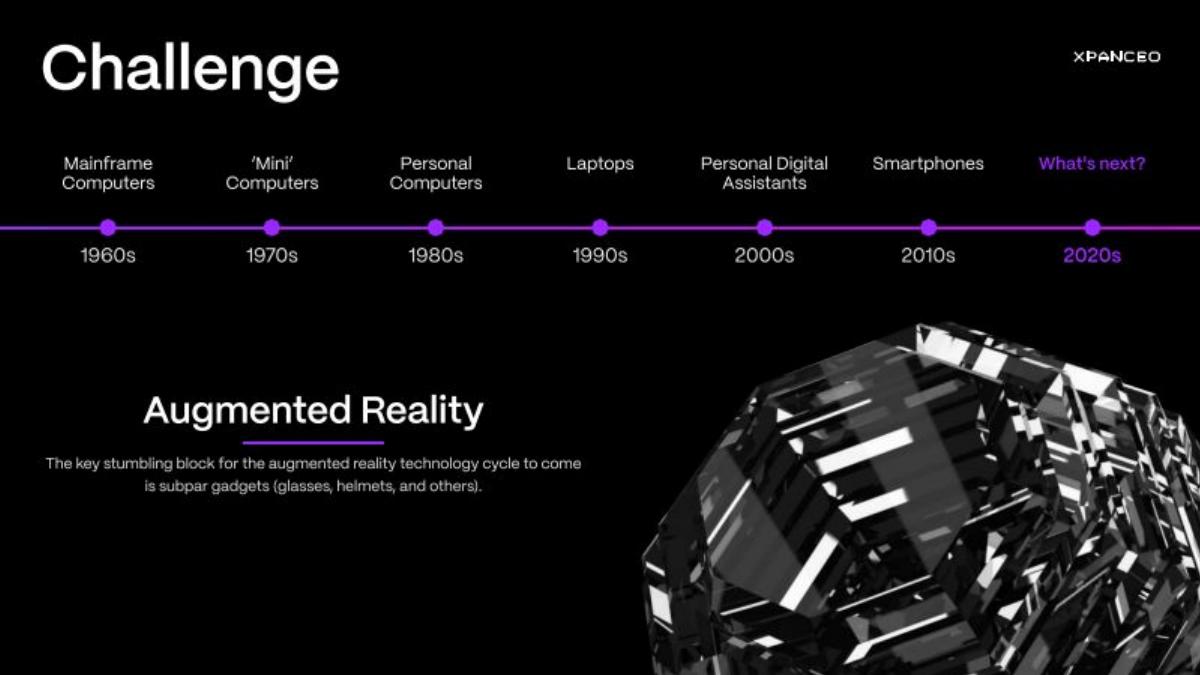
- The company frames its product as the logical successor to the smartphone in a computing timeline starting in the 1960s (Slide 1).
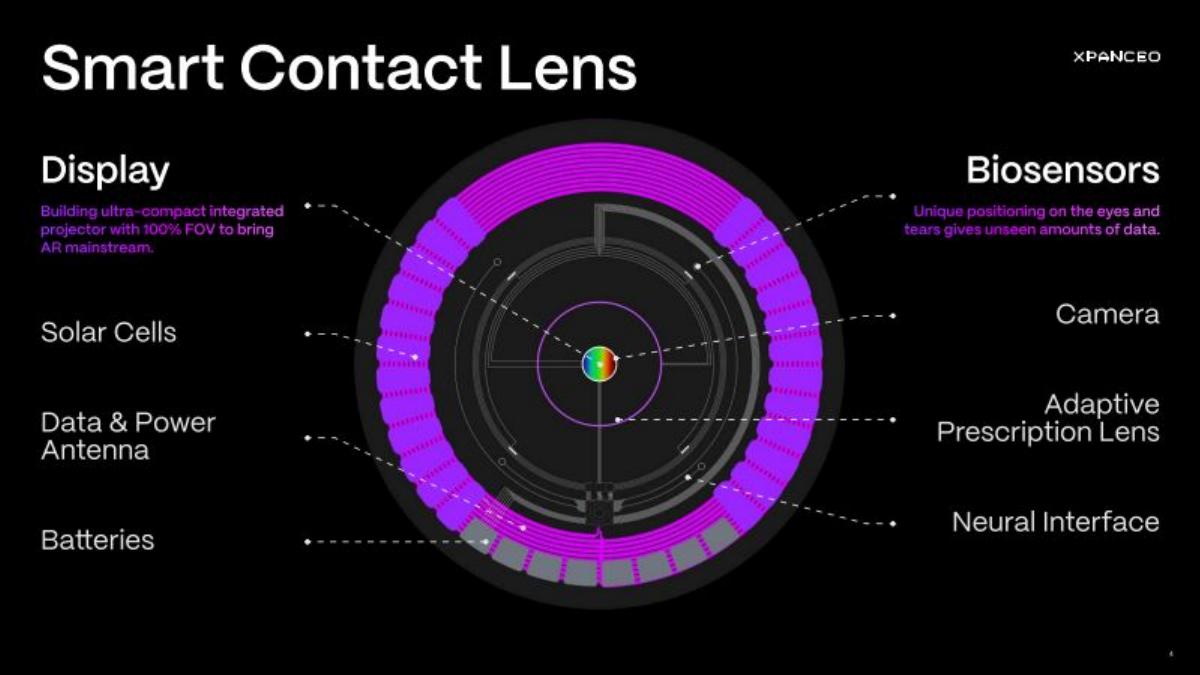
- The hardware design integrates eight distinct components including solar cells, neural interfaces, and biosensors into a single lens (Slide 3).
- XPANCEO projects reaching 10 million users by 2033, with a critical 'crossover' to non-contact lens wearers occurring in 2031 (Slide 8).
- The business model relies on a $1,500 MSRP supported by $1,800/year in projected AR advertising revenue per user (Slide 11).
- Unit economics claim a 74% profit margin, driven by using 400x less material than a smartphone (Slide 11).
- Scientific credibility is established by citing publications in Nature Communications, Nano Letters, and PNAS (Slide 15).
- The team slide highlights that 80% of staff are scientists/engineers and the founder has 3 successful exits totaling $5B (Slide 17).
- The product roadmap outlines a six-stage evolution from a basic holographic display to a full 'Smart Contact Lens' (Slide 18).
The Visionary Leap: XPANCEO's $40M Seed Deck
XPANCEO is attempting one of the most ambitious hardware plays in recent memory: replacing the smartphone with a smart contact lens. Their 19-slide deck, which secured a $40M Seed round in 2024, is a study in how to present high-risk, high-reward deep technology to venture capitalists. The narrative moves from historical inevitability to scientific validation, concluding with aggressive financial projections that attempt to quantify the value of an entirely new computing category.
Slides 1-2: The Challenge and the Vision
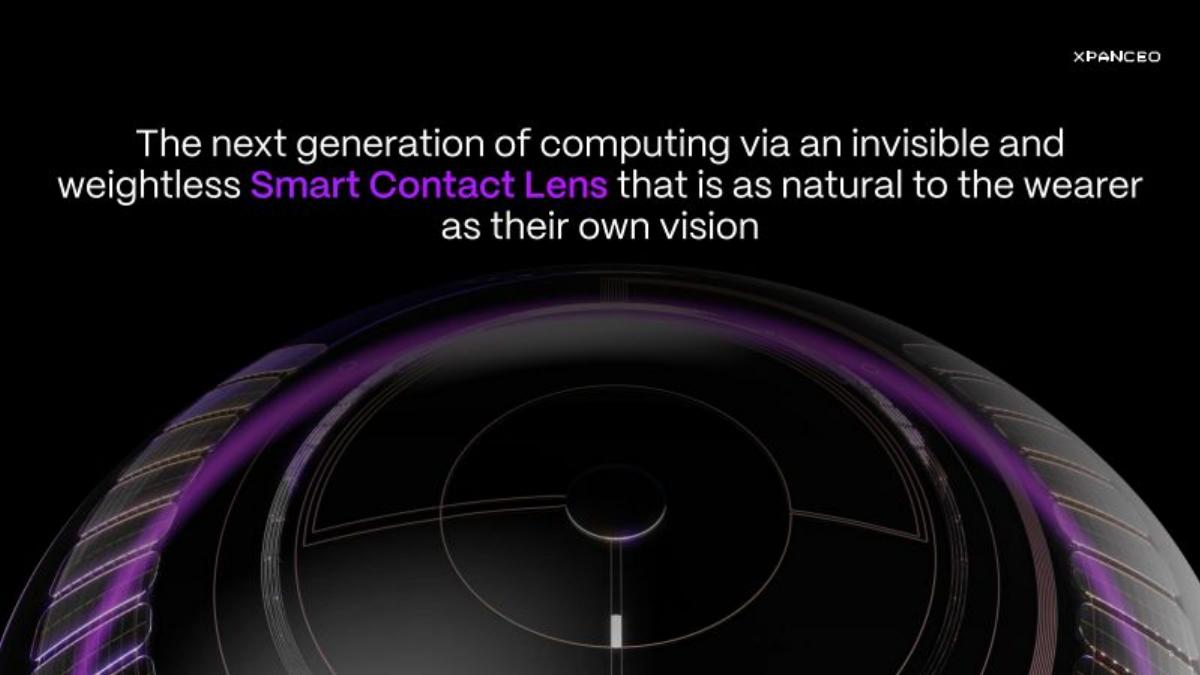
The deck opens with a Challenge slide (Slide 1) that places the viewer on a timeline of computing history. By listing Mainframes (1960s), PCs (1980s), and Smartphones (2010s), XPANCEO frames their product as the inevitable 'What's next?' for the 2020s. They identify the current 'stumbling block' for Augmented Reality as 'subpar gadgets' like glasses and helmets. Slide 2 introduces the solution: an 'invisible and weightless Smart Contact Lens' that is 'as natural to the wearer as their own vision.'
Slides 3-5: Product Anatomy and Value Proposition
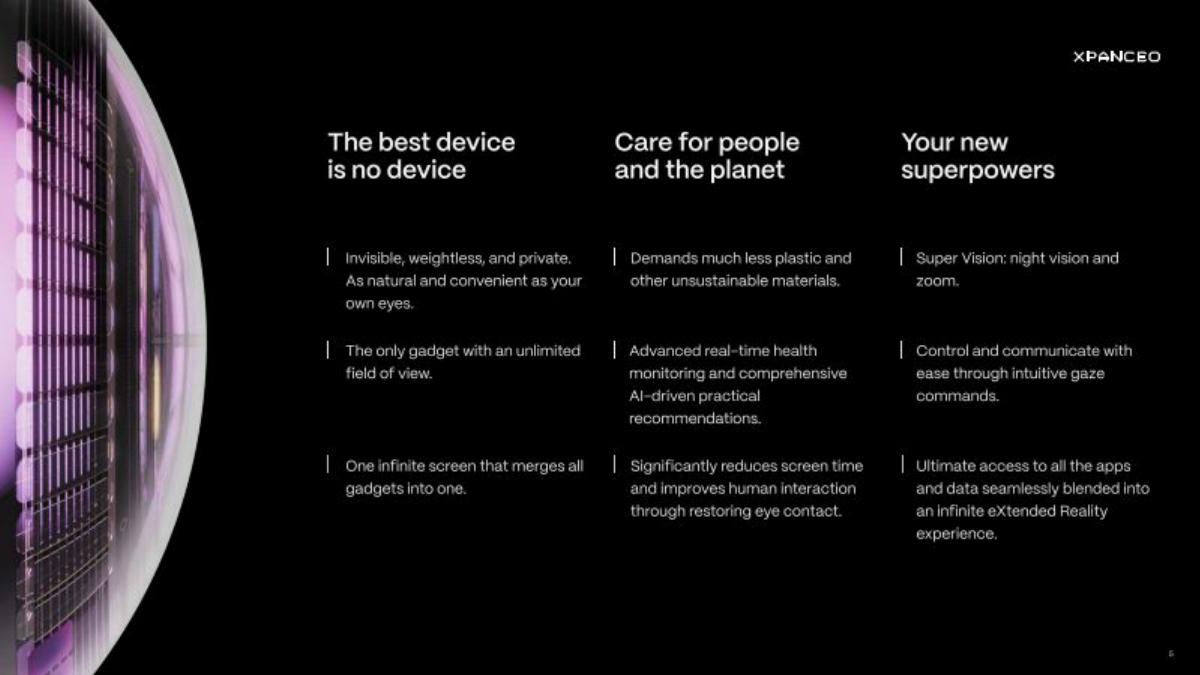
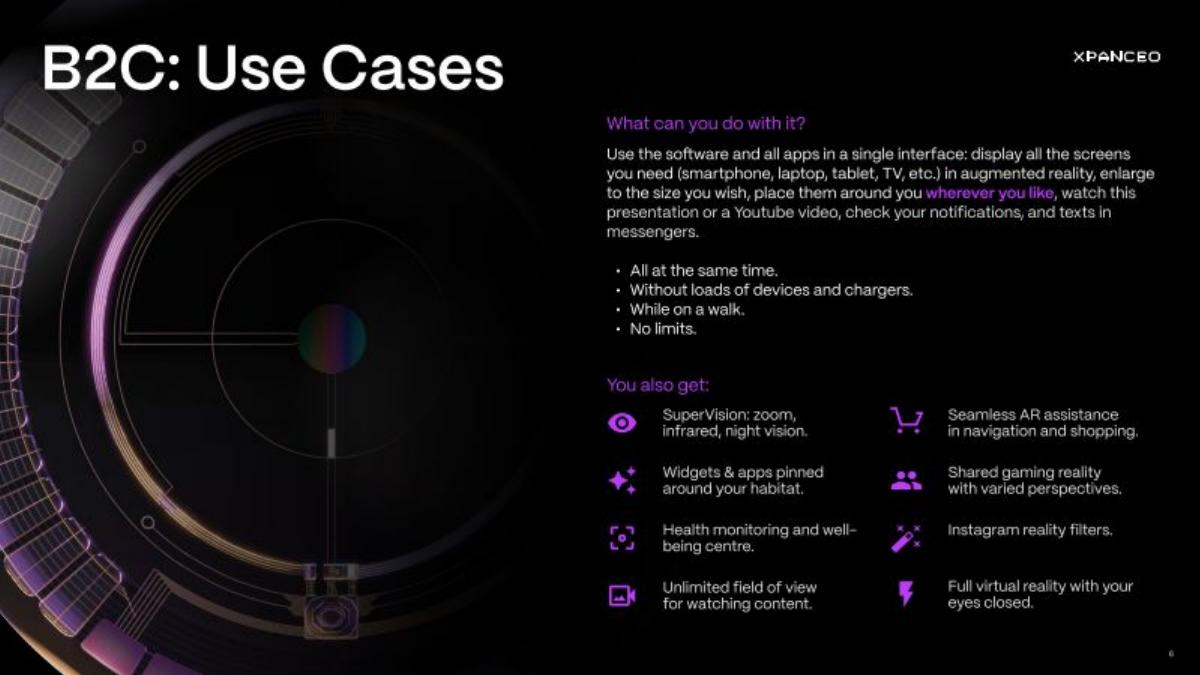
Slide 3 provides a technical breakdown of the lens. It identifies eight key components: Display (ultra-compact projector), Solar Cells , Data & Power Antenna , Batteries , Biosensors , Camera , Adaptive Prescription Lens , and a Neural Interface . This slide is critical for shifting the conversation from science fiction to engineering reality. Slide 4 categorizes the benefits into three pillars: 'The best device is no device' (invisibility), 'Care for people and the planet' (less plastic), and 'Your new superpowers' (night vision and zoom). Slide 5 expands on B2C use cases, suggesting the lens can replace all screens—laptops, TVs, and smartphones—while providing 'full virtual reality with your eyes closed.'
Slides 6-7: Market Expansion and B2B Potential
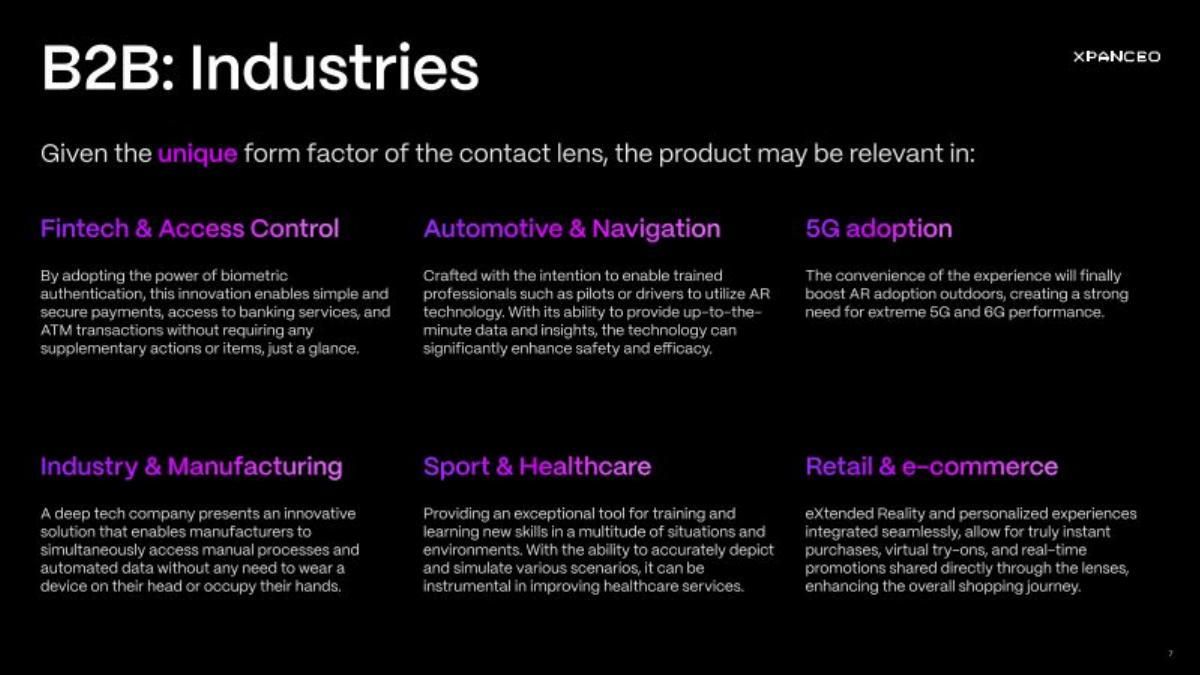
XPANCEO does not limit itself to consumer entertainment. Slide 6 outlines B2B applications across Fintech (biometric payments), Automotive (pilot/driver AR), 5G adoption, Manufacturing, Healthcare, and Retail. This broad stroke approach is intended to show the massive horizontal utility of the platform. Slide 7 introduces a 10-year user growth forecast, starting with 15k users in 2026 and scaling to 10 million by 2033. The chart notes a 'crossover to non-users of contact lenses' in 2031, which is a pivotal assumption for their long-term scale.
Slides 8-10: Market Size and Economic Model
Slide 8 quantifies the existing contact lens market, citing 49 million users in the USA and over 250 million worldwide. Slide 9 pivots to the Augmented Reality market, projecting a $750B TAM for a combined market of medical, well-being, and holographic applications. Slide 10 introduces the revenue model, which includes device sales, advertising, and app commissions. The deck claims the device will have '400x less materials than a smartphone' and '10x less manufacturing costs,' leading to a projected 74% Profit Margin (Slide 11).
Slides 11-12: Unit Economics and Competition
The financial narrative in Slide 11 is particularly aggressive. It sets a $1,500 MSRP and forecasts $1,800/year in ad revenue per user. This would result in a 'x3,4 Revenue on cost.' Slide 12 addresses the competitive landscape, mentioning Mojo Vision (which raised $204M before pivoting), InWith Corp, Innovega Inc., and SmartLens. Crucially, it includes a 'Why not AR glasses' section, listing drawbacks like 'bulky,' 'uncool,' and 'distracting others.'
Slides 13-16: Scientific Validation and R&D
The second half of the deck focuses on proving they can actually build this. Slide 14 highlights 20+ patent-pending technologies across optics, AI, and neural interfacing. Slide 15 is the 'credibility slide,' citing specific research papers published in Nature Communications , Nano Letters , and the National Academy of Sciences (PNAS) . Slide 16 claims XPANCEO operates one of the 'Top 5 optics laboratories in the world, according to BCG,' focusing on refractive index change and ultra-thin electronics.
Slides 17-19: Team, Roadmap, and Contact
Slide 17 introduces the leadership. Founder Roman Axelrod is credited with 3 successful exits totaling $5B, while Co-founder Valentyn Volkov, Ph.D. , is described as an expert in nanophotonics with 200+ published papers. Slide 18 provides a six-step roadmap, starting with a lens with an embedded holographic display and ending with the full 'Smart Contact Lens' featuring seamless XR and solar cells. The deck concludes on Slide 19 with a call to 'Partner with us!' and a QR code.
What Works in This Deck
Platform Positioning: By framing the lens as the next step in a 60-year computing evolution, XPANCEO makes the product feel like an inevitability rather than a niche gadget. · Scientific Anchoring: Citing high-impact journals like Nature Communications (Slide 15) is essential for a $40M Seed round. It moves the conversation from 'if' to 'how.' · Clear Differentiation: The direct comparison to AR glasses (Slide 12) addresses the most common investor objection regarding the current state of the AR market. · Ambitious Unit Economics: The argument that a lens uses 400x less material than a phone (Slide 11) is a compelling way to justify high margins in a hardware business.
What Is Missing from This Deck
The Ask: The deck does not explicitly state how much they are raising or how the funds will be allocated. While the catalogue listing confirms a $40M raise, the deck itself omits a 'Use of Funds' slide. · Regulatory Path: For a device that sits on the eye and monitors glucose/IOP, there is no mention of FDA or EMA regulatory timelines, which are typically major hurdles for healthcare hardware. · Current Traction: There are no photos of actual prototypes or results from early bench testing. The imagery is primarily high-end 3D renders. · Battery Life Reality: While 'Solar Cells' and 'Batteries' are mentioned (Slide 3), the deck lacks specific data on expected battery life, a common failure point for wearable tech.
Founder's Guide: What to Copy
The 'Timeline of Progress' Slide: Using a historical timeline (Slide 1) to show why your product is the logical next step is a powerful way to build narrative momentum. · Component Breakdown: If you are building complex hardware, a 'transparent' view of the components (Slide 3) helps investors visualize the engineering challenge. · Revenue Layering: Don't just show a hardware price. Show how the hardware enables recurring revenue streams like ads and app stores (Slide 11). · Academic Validation: If your team has Ph.D.s or patents, don't just list them—cite the specific journals and paper titles to provide third-party verification of your tech stack.
Frequently asked questions
- How does XPANCEO justify its $40M Seed round without a commercial product?
- XPANCEO justifies the large capital requirement through the complexity of its 'deep tech' stack, which includes advanced optics, photonics, and neural interfacing. The deck emphasizes that they operate one of the top 5 optics laboratories globally according to BCG (Slide 16) and hold over 20 patent-pending technologies (Slide 14). This level of R&D infrastructure and intellectual property serves as the primary valuation driver in lieu of immediate revenue.
- What is the primary competitive advantage mentioned over AR glasses?
- The deck explicitly critiques AR glasses as 'bulky,' 'uncomfortable,' and 'awkward' (Slide 12). XPANCEO positions the contact lens as superior because it offers an 'unlimited field of view' and is 'invisible and weightless' (Slide 5). By removing the physical footprint of a headset, they aim to solve the social and ergonomic barriers that have hindered AR adoption to date.
- What are the projected revenue streams for the device?
- Beyond the initial hardware sale at a $1,500 MSRP, the deck outlines four additional revenue layers: advertising ($1,800/year/user), app commissions ($100/year/user), infrastructure/maintenance fees, and financial services (Slides 10 and 11). This multi-layered approach suggests they view the lens as a platform ecosystem rather than a one-off hardware sale.
- How does the company plan to expand beyond existing contact lens wearers?
- Slide 8 shows a growth curve where the first five years (2026-2030) focus on 'early adopters' within the existing contact lens market. The strategy hinges on a 'crossover' point in 2031, where the utility of the AR features—such as 'Super Vision' (night vision and zoom) and health monitoring—is expected to entice people who do not currently require vision correction to begin wearing the lenses.
- What specific health monitoring capabilities are planned?
- According to the roadmap (Slide 18) and the R&D focus slide (Slide 16), the biosensor platform is designed to monitor intraocular pressure (IOP) for glaucoma, as well as glucose, cortisol, heart rate, and temperature. This positioning allows the company to tap into the massive healthcare and wellness markets alongside consumer electronics.