Yalochat’s 2018 pitch deck is a masterclass in using traction to validate a technical solution. The company positions itself as a conversational CRM bridge for large enterprises in emerging markets, where 84% of time is spent on messaging apps (Slide 4). The deck effectively balances high-level market pain—citing $1.5 trillion in business waste (Slide 3)—with granular performance metrics, such as a 70% reduction in cost per interaction (Slide 9). With a reported $2M ARR and a $36M pipeline (Slides 12-13), Yalochat moved beyond the 'chatbot' hype of the era to prove enterprise-grade utility. T…
Key takeaways
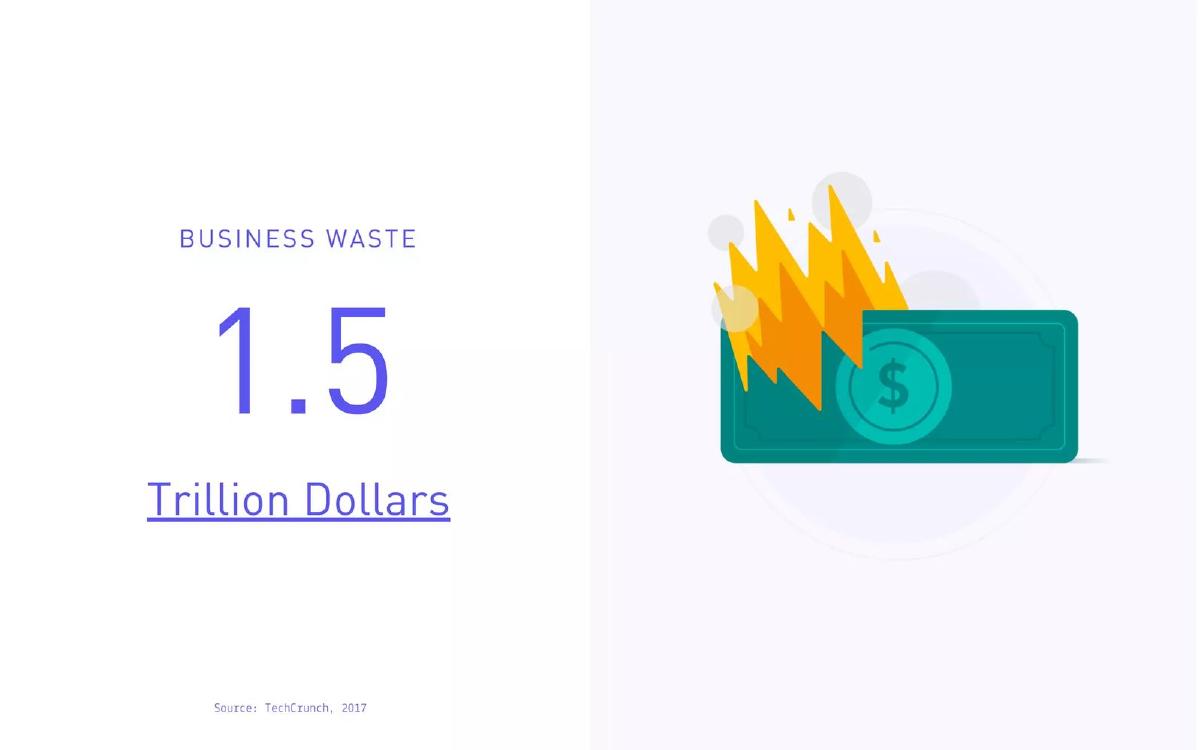
- The deck identifies a massive $1.5 trillion business waste problem caused by inefficient customer service (Slide 3).
- Yalochat leverages the fact that 84% of mobile time is spent on messaging apps like WhatsApp and Messenger (Slide 4).
- The platform claims to reduce costs by 70% per interaction while doubling sales compared to other channels (Slides 9-10).
- Traction is a core pillar, showing a 6X increase in contract value over a six-month period (Slide 11).
- The company reached $2M ARR with 42% month-over-month growth by September 2018 (Slide 12).
- Yalochat boasts a blue-chip client list including Walmart, Pepsi, Nike, and Volkswagen (Slide 12).
- The team slide highlights significant pedigree, including a former API lead from Xoom and a founder with a $1B+ IPO (Slide 18).
- The product is positioned as 'Enterprise Ready' with a 'Fast Start' compared to competitors like Salesforce or IBM Watson (Slide 19).
The Conversational CRM Playbook
Yalochat’s 2018 pitch deck arrived at a time when the initial 'chatbot' hype was cooling, and investors were looking for real enterprise utility. This deck succeeded by shifting the narrative from 'cool AI' to 'measurable ROI.' By focusing on emerging markets where WhatsApp is the dominant communication tool, Yalochat identified a gap that Western-centric CRM giants like Salesforce were slow to fill. The following teardown examines how they used aggressive traction metrics and a 'fast-start' promise to secure $8 million in Series A funding.
Slides 1-5: The Problem and Market Context
Slide 1 introduces the company with a simple tagline: "AI that improves relationships with your customers over chat." It’s a clean start that immediately identifies the product category. Slide 2 uses a high-friction emotional hook—a photo of a frustrated man on a phone—with the quote "Let me put you on hold." This sets the stage for the inefficiency of traditional customer service.
Slide 3 quantifies this frustration, citing a TechCrunch 2017 source that claims $1.5 trillion in "Business Waste." This is a classic 'Big Problem' slide designed to make the solution feel necessary rather than just 'nice to have.' Slide 4 provides the 'Why Now' context: 84% of people's time is spent on messaging apps like WhatsApp and Facebook Messenger. The implication is clear: businesses are wasting money on phone and email while customers have moved to chat.
Slide 5 identifies the specific bottleneck. While large enterprises want to meet customers on these apps, they "Don't have the tech to do so." This slide uses a graphic of a broken robot to symbolize the failure of existing internal or legacy solutions.
Slides 6-10: The Solution and Value Proposition
Slide 6 presents the Yalochat bridge, showing the AI connecting the customer (mobile device) to the enterprise (office building). The simplicity of this diagram is intentional; it positions Yalochat as the essential middleware. Slide 7 makes a bold claim: it takes "ONLY 3 weeks to get STARTED." For enterprise software, which often has 6-12 month implementation cycles, this is a significant competitive advantage.
Slide 8 expands the scope of the product, stating they "Handle their entire Customer Relationship." This moves Yalochat from a simple support bot to a full CRM replacement or extension. Slides 9 and 10 are the 'Money Slides.' They promise a 70% reduction in costs per interaction and a 2X increase in sales compared to other channels. By hitting both the bottom line (cost savings) and the top line (revenue growth), the deck makes a dual-threat case for the software.
Slides 11-14: Traction and Market Opportunity
Slide 11 shows a 6X increase in contract value over six months, starting at $5,000 in Month 1 and reaching $30,000 by Month 6. This demonstrates that once Yalochat is in the door, they are highly effective at upselling and expanding within an organization. Slide 12 is perhaps the strongest in the deck. It shows a revenue graph climbing from $31k in January 2018 to $156k in September 2018, representing 42% month-over-month growth. Below the graph is a 'Logo Wall' featuring heavyweights like Walmart, Pepsi, Nike, Aeromexico, and Volkswagen. This provides massive social proof.
Slide 13 keeps the momentum going by stating there is "USD 36M in pipeline." This suggests that the current growth is just the beginning. Slide 14 defines the geographic strategy. It highlights that 'Developing Markets' represent 4 billion people, whereas 'Developed Markets' represent only 644 million. By coloring the map to show their focus on LatAm, Africa, and Asia, they signal to investors that they are going after the largest possible volume of users.
Slides 15-18: The Team and Summary
Slide 15 provides a three-point summary of the pitch: $2M ARR, "Bigger than Slack" (a bold, albeit context-free claim), and the end of waiting on hold. Slide 16 repeats the revenue growth chart but adds detail on revenue sources: one-time fees ($8k to $50k) and tiered subscription pricing ($84k to $1MM ACV). This confirms they are playing in the high-ticket enterprise space.
Slides 17 and 18 introduce the team. The pedigree is impressive: Javier (CEO) has three previous companies; Fred (CTO) was the former API lead at Xoom (acquired by PayPal); Ivan (Head of AI) has 10+ years in Machine Learning; and Tony (Head of Partnerships) was a founder at Kio Networks with a $1B+ IPO. Slide 18 reinforces this with logos of former employers like Apple, Facebook, and WhatsApp, which is particularly relevant given their product's reliance on the WhatsApp ecosystem.
Slides 19-23: Product Deep Dive and Competition
Slide 19 is the competitive landscape. Yalochat places itself in the top-right quadrant: "Enterprise ready" and "Fast start." They contrast themselves against "Slow start" enterprise giants (Salesforce, Avaya) and "Consumer" bots (ManyChat, Chatfuel). Slides 20, 21, and 22 show the product in action. Slide 20 highlights re-targeting with a 12X effectiveness over email. Slide 21 shows the "Bots + Humans" hybrid model, claiming 92% automation and 5X faster resolution. Slide 22 demonstrates the notification system, claiming a 90% call reduction.
Finally, Slide 23 shows their global footprint with offices in San Francisco, Mexico City, Bogota, São Paulo, and Mumbai. This confirms their commitment to the emerging markets strategy mentioned earlier in the deck.
What Works in This Deck
Aggressive Traction Metrics: The deck doesn't just say they are growing; it shows a 42% MoM growth rate and a clear path to $2M ARR. This level of detail is exactly what Series A investors look for. · Clear ROI: By quantifying cost savings (70%) and sales increases (2X), Yalochat makes the purchasing decision seem like a mathematical certainty for a CFO. · Strategic Focus: The emphasis on emerging markets (4 billion people) differentiates them from the dozens of other AI startups fighting for the US market. · Team Pedigree: The team has direct experience at the platforms they are building on (WhatsApp, Facebook), which reduces execution risk in the eyes of investors.
What is Missing
The Ask: There is no slide indicating how much money they are raising or how they will spend it. While this is sometimes omitted from public versions of decks, it is a critical component of a fundraising presentation. · Unit Economics: While they show revenue growth, they don't show the cost to acquire these customers (CAC) or the lifetime value (LTV). For a SaaS business, these are vital for proving scalability. · Technical Moat: The deck explains 'What' they do and 'How' it helps, but it doesn't explain the 'Secret Sauce' of their AI. In a crowded market, explaining why their NLP (Natural Language Processing) is superior to a generic API is important.
What a Founder Should Copy
The 'Fast Start' Angle: If your product can be implemented significantly faster than the industry standard, make that a central pillar of your value prop, as seen on Slide 7. · The Hybrid Model: Acknowledging that AI isn't perfect and showing how it works with humans (Slide 21) builds trust. It shows the product is ready for real-world messy interactions, not just a controlled demo. · Logo Placement: If you have big-name clients, don't just list them; put them right next to your growth charts to show that your revenue is coming from high-quality, sustainable sources.
Frequently asked questions
- What is Yalochat's core value proposition for enterprises?
- Yalochat positions itself as an AI-driven CRM that allows large enterprises to manage the entire customer relationship through messaging apps. The deck emphasizes three main benefits: a 70% reduction in interaction costs, a 2x increase in sales compared to traditional channels, and a fast implementation time of only three weeks. It essentially acts as a bridge between legacy enterprise systems and the messaging platforms where customers actually spend their time.
- How does Yalochat differentiate itself from major competitors like Salesforce or AWS?
- On Slide 19, Yalochat uses a 2x2 matrix to position itself in the 'Enterprise Ready' and 'Fast Start' quadrant. They argue that legacy players like Salesforce and Avaya are 'Slow Start,' while consumer-focused bots like ManyChat lack enterprise capabilities. Yalochat claims to offer 'out of the box' customizable solutions that integrate easily into legacy systems, providing the speed of a startup with the security of an enterprise tool.
- What specific metrics did Yalochat use to prove their traction?
- The deck is heavy on financial proof. It highlights reaching $2 million in Annual Recurring Revenue (ARR) by late 2018, supported by a 42% month-over-month growth rate. Additionally, they show a 6X increase in contract value over six months (Slide 11) and a $36 million sales pipeline (Slide 13). These figures, combined with a logo wall of global brands like Nike and Pepsi, provide strong evidence of product-market fit.
- Why is the focus on 'Emerging Markets' significant in this deck?
- Slide 14 highlights that developing markets contain 4 billion people, compared to 644 million in developed markets. In these regions, messaging apps (specifically WhatsApp) often serve as the primary gateway to the internet. By focusing on LatAm, India, and APAC, Yalochat targets regions where traditional email-based CRM is less effective, allowing them to dominate a massive, underserved demographic where messaging is the 'operating system' of daily life.
- What is missing from the Yalochat pitch deck?
- The deck lacks a formal 'Ask' slide detailing how much capital they are raising and how they intend to allocate the funds. It also omits detailed unit economics (like CAC or LTV) and a clear long-term product roadmap. While it shows 'How We Do It' through screenshots, it doesn't provide a deep dive into the underlying AI architecture or data privacy measures, which are usually critical for enterprise SaaS deals.